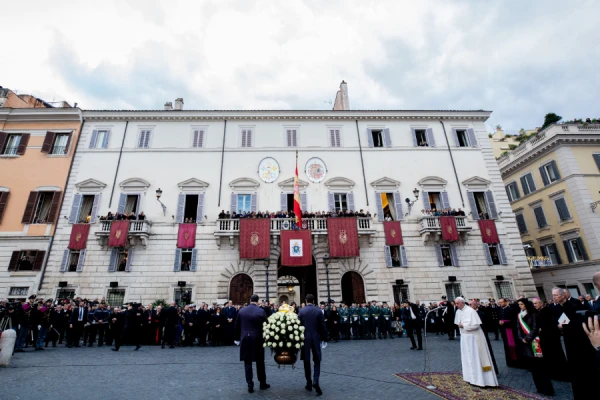
Vatican City, Nov 30, 2020 / 12:00 pm (CNA).- The Vatican has announced that Pope Francis will not visit Rome’s Piazza di Spagna this year for the traditional veneration of Mary on the Solemnity of the Immaculate Conception due to the pandemic.
Instead, Francis will mark the feast day with “an act of private devotion, entrusting the city of Rome, its inhabitants and the many sick people in every part of the world to Our Lady,” Holy See press office director Matteo Bruni said.
It will be the first time since 1953 that the pope has not offered the traditional veneration of the statue of the Immaculate Conception on the Dec. 8 feast. Bruni said that Francis would not go to the square in order to avoid people gathering and transmitting the virus.
The statue of the Immaculate Conception, next to Piazza di Spagna, sits atop a nearly 40-foot high column. It was dedicated Dec. 8, 1857, three years after Pope Pius IX promulgated a decree defining the dogma of the Immaculate Conception of Mary.
Since 1953, it has been a custom for popes to venerate the statue for the feast day, in honor of the city of Rome. Pope Pius XII was the first to do so, walking nearly two miles on foot from the Vatican.
Rome’s firefighters are usually in attendance at the prayer, in honor of their role at the 1857 inauguration of the statue. The mayor of Rome and other officials also attend.
In past years, Pope Francis left floral wreaths for the Virgin Mary, one of which was placed on the outstretched arm of the statue by firefighters. The pope also offered an original prayer for the feast day.
The Feast of the Immaculate Conception is a national holiday in Italy and crowds usually gather at the square to witness the veneration.
As is customary for Marian solemnities, Pope Francis will still lead the Angelus prayer from a window overlooking St. Peter’s Square Dec. 8.
Due to the ongoing pandemic, the Vatican’s papal Christmas liturgies will take place this year without the presence of the public.
If you value the news and views Catholic World Report provides, please consider donating to support our efforts. Your contribution will help us continue to make CWR available to all readers worldwide for free, without a subscription. Thank you for your generosity!
Click here for more information on donating to CWR. Click here to sign up for our newsletter.

Denver, Colo., Mar 26, 2018 / 04:10 pm (CNA).- As Catholics around the world are buying Easter candy and dyeing boiled eggs, two priests have offered suggestions for getting the most out of Holy Week.
“The most important, I believe, is to take advantage of the opportunities of prayer, especially attending each of the Triduum liturgies,” said Fr. Gary Benz of the Diocese of Bismarck, N.D.
“I’m not sure if a lot of Catholics have ever attended all three liturgies – Holy Thursday, Good Friday, and Holy Saturday Vigil – and experienced the whole paschal mystery in the passion, death and resurrection,” Fr. Benz told CNA.
While it may not be easy to attend all three liturgies, Benz encouraged Catholics, including families, to at least attempt attending these opportunities for prayer. He additionally noted that most churches offer an “extension of prayer” after the Triduum liturgies, which is another way to experience a fruitful Holy Week.
“On Holy Thursday, the church has set up an altar of reposition for adoration of the Blessed Sacrament, usually until midnight,” Benz remarked.
“If individuals or families could take to heart the plea of Jesus in the garden of Gethsemane, ‘Could you not spend one hour with me?’ and to just really sacrifice and spend that hour with the Lord,” he continued, particularly encouraging families to participate together in this time of adoration.
“What a powerful witness to your kids – that you’re giving one hour to Christ, which is again by way of great sacrifice, considering the busyness of family life.”
Fr. Daniel Ciucci of the Archdiocese of Denver also recommended additional prayer on Holy Saturday, specifically found in the Church’s Office of Readings.
“I would encourage people to read the Office of Readings for Holy Saturday, beginning with ‘Something Strange is Happening,’” Fr. Ciucci told CNA.
‘Something Strange is Happening’ is an ancient homily traditionally read on Holy Saturday.
On Good Friday, Benz also noted a tradition on Good Friday, in which some Churches set up a chapel with an image of the crucified body of Christ. He prompted both individuals and families to “spend some time before it, gazing upon the body of Christ and his wounds.”
If that would not be possible, Benz suggested that individuals and families set up a display of the crucifix in their own homes to venerate and “maybe pray the sorrowful mysteries of the rosary.”
Benz also highlighted “an old European tradition” for the Triduum. According to this custom, from the time of the end of the Good Friday liturgy until the Easter Vigil, homes “try to produce an aura of mourning, because Christ is in the tomb,” Benz said.
“It would be great if homes could silence the radios, televisions, technology, phones, iPads – to the best they can. Even limited talked and conversation, just to meditate that Christ is in the tomb,” he continued.
“It’s really powerful to just maintain that prayerful silence and anticipation in waiting for the resurrection.”
Pope Francis presides at the Vatican’s chrism Mass on Holy Thursday, March 28, 2024. / Credit: Daniel Ibanez/CNA
Vatican City, Mar 28, 2024 / 09:30 am (CNA).
On Holy Thursday, Pope Francis presided over a chrism Mass at which more than 1,880 priests, bishops, and cardinals renewed the promises made at their ordinations.
Pope Francis encouraged the priests to turn their gaze upon the crucified Lord and to weep over their sins in repentance, saying that tears can “purify and heal the heart.”
“Once we recognize our sin, our hearts can be opened to the working of the Holy Spirit, the source of living water that wells up within us and brings tears to our eyes,” Francis said on March 28.
Pope Francis speaks at the Vatican’s chrism Mass on Holy Thursday, March 28, 2024. Credit: Daniel Ibanez/CNA
“The Lord seeks, especially in those consecrated to him, men and women who weep for the sins of the Church and the world and become intercessors on behalf of all,” he added.
Forty-two cardinals, 42 bishops, and 1,800 priests living in Rome concelebrated the Mass with the pope in St. Peter’s Basilica.
Holy Thursday marks the institution of the Eucharist and institution of the sacrament of the priesthood at the Last Supper. Pope Francis will also preside over a Mass of the Lord’s Supper on Thursday evening at a women’s prison in Rome.
The 87-year-old pope arrived in St. Peter’s Basilica on Thursday morning in a wheelchair. Before giving his more than 20-minute homily, the pope took a sip of water and put on his reading glasses.
Pope Francis reflected in his homily on Peter’s tears after denying the Lord three times as recorded in the Gospel of Luke: “Peter remembered the word of the Lord … and went out and wept bitterly.”
Cardinal Angelo De Donatis presides at the altar during the Vatican’s chrism Mass on Holy Thursday, March 28, 2024. Credit: Daniel Ibanez/CNA
“Dear brother priests, the healing of the heart of Peter, the healing of the apostle, the healing of the pastor, came about when, grief-stricken and repentant, he allowed himself to be forgiven by Jesus. That healing took place amid tears, bitter weeping, and the sorrow that leads to renewed love,” he said.
Compunction
Pope Francis said that he wanted to speak to the priests about the importance of compunction — an awareness of guilt due to sin — which the pope admitted is a “somewhat old-fashioned” term and “an aspect of the spiritual life that has been somewhat neglected, yet remains essential.”
The pope added that compunction “is not a sense of guilt that makes us discouraged or obsessed with our unworthiness, but a beneficial ‘piercing’ that purifies and heals the heart.”
“Compunction demands effort but bestows peace. It is not a source of anxiety but of healing for the soul, since it acts as a balm upon the wounds of sin, preparing us to receive the caress of the heavenly physician, who transforms the ‘broken, contrite heart,’” Pope Francis said.
Clergy assembled at the Vatican’s Chrism Mass on Holy Thursday, March 28, 2024. Credit: Daniel Ibanez/CNA
The pope said that through compunction “the natural tendency to be indulgent with ourselves and inflexible with others is overturned and, by God’s grace, we become strict with ourselves and merciful toward others.”
“Weeping for ourselves … means seriously repenting for saddening God by our sins … It means looking within and repenting of our ingratitude and inconstancy, and acknowledging with sorrow our duplicity, dishonesty, and hypocrisy — clerical hypocrisy, dear brothers, that hypocrisy which we slip into so much — beware of clerical hypocrisy,” Francis said.
“How greatly we need to be set free from harshness and recrimination, selfishness and ambition, rigidity and frustration, in order to entrust ourselves completely to God and to find in him the calm that shields us from the storms raging all around us,” he added.
“Let us pray, intercede, and shed tears for others; in this way, we will allow the Lord to work his miracles. And let us not fear, for he will surely surprise us.”
During the Vatican’s chrism Mass, the pope, as the bishop of Rome, blessed the oil of the sick, the oil of catechumens, and the chrism oil, which will be used in the diocese during the coming year. Cardinal Angelo De Donatis served as the celebrant at the altar.
The oils were processed up the main altar of St. Peter’s in large silver urns as the hymns of the Sistine Chapel Choir filled the basilica.
Urns of oil are displayed at the Vatican’s Chrism Mass on Holy Thursday, March 28, 2024. Credit: Daniel Ibanez/CNA
Pope Francis prayed over the oil of the sick: “O God, Father of all consolation, who through your Son have willed to heal the infirmities of the sick, listen favorably to this prayer of faith: Send down from heaven, we pray, your Holy Spirit, the Paraclete, upon the rich substance of this oil, which you were pleased to bring forth from vigorous green trees to restore our bodies, so that by your holy blessing this oil may be for anyone who is anointed with it a safeguard for body, mind, and spirit, to take away every pain, every infirmity, and every sickness.”
The blessed oil will be used for the anointing of the sick in Rome throughout the year.
Pope Francis thanked the priests gathered in St. Peter’s Basilica for all they do to bring “the miracle of God’s mercy” to the world today.
“Dear priests, thank you for your open and docile hearts; thank you for your labors and thank you for your tears; thank you because you bring the miracle of mercy … you bring God to the brothers and sisters of our time,” he said. “Dear priests, may the Lord console you, confirm you, and reward you.”
Leave a Reply