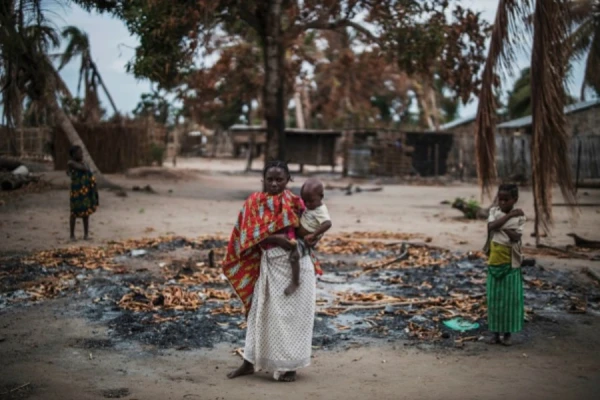
Rome Newsroom, Jul 23, 2020 / 10:30 am (CNA).- A Catholic bishop has deplored the world’s indifference to escalating extremist violence in northern Mozambique, where multiple churches have been burnt, people beheaded, young girls kidnapped, and hundreds of thousands of people displaced by the violence.
Bishop Luiz Fernando Lisboa of Mozambique’s Pemba diocese has been an outspoken advocate for the needs of the more than 200,000 people who have been displaced by the violent insurgency.
In June there were reports that insurgents had beheaded 15 people in a week. Yet the bishop said that the crisis in Mozambique has largely been met with “indifference” from the rest of the world.
“The world has no idea yet what is happening because of indifference,” Bishop Lisboa said in an interview with Portuguese media June 21.
“We do not yet have the solidarity that there should be,” he told LUSA news agency.
During Holy Week this year insurgents perpetrated attacks on seven towns and villages in Cabo Delgado province, burning down a church on Good Friday, and killing 52 young people who refused to join the terrorist group, the bishop told Aid to the Church in Need.
The bishop noted in April that extremists had already burned five or six local chapels, as well as some mosques. He said that the historic Sacred Heart of Jesus mission in Nangolo was also attacked this year.
“They attacked the church and burnt the benches and a statue of Our Lady, made of ebony. They also destroyed an image of the Sacred Heart of Jesus, to whom the parish is dedicated. Fortunately, they were unable to burn the building itself, only the benches,” Lisboa said.
The bishop said at the time that the increased attacks, frequently targeting the Church, were “an injustice that is crying out to heaven.”
Paulo Rangel, a Portuguese Member of the European Parliament who has been advocating for European support of the region, said July 23: “The international community is nowhere to be seen in regard to the problem.”
“The people were already living in extreme poverty, facing grave difficulties,” Rangel told Aid to the Church in Need. “The problem is that at the present moment these people are facing the threat of death, of losing their homes, of becoming uprooted.”
More than 1,000 people have been killed in attacks in northern Mozambique since 2017, according to the Center for Strategic and International Studies. Some of these attacks have been claimed by the Islamic State, while others have been carried out by the homegrown Ahlu Sunna Wal extremist militant group, which has been kidnapping men and women.
“At present we know that there are young girls who have been abducted and enslaved, forced into sexual slavery by some of these guerrillas, these insurgents, these terrorists,” Rangel said.
“We know that the recruitment of boys and adolescents, some of them very young, aged 14, 15, 16, is also happening. It is obvious that these young boys are under coercion. If they refuse to join the group, they could be killed,” he added.
Rangel, the parliamentary deputy and vice president of the Christian Democrat Party, had high praise for the Bishop of Pemba for his efforts to raise awareness and appeal for the needs of the Cabo Delgado region, calling Lisboa a “great apostle of this cause.”
“We try to be the voice of the voiceless by telling the world what is happening in Cabo Delgado,” Lisboa told Vatican News on July 8.
“The Church has been working with families in the villages to support the people who are suffering the attacks, especially those who have lost everything,” he said.
Pope Francis addressed the suffering in the Cabo Delgado region in his Easter Sunday Urbi et Orbi message, asking for prayer for “people who are going through serious humanitarian crises, such as in the Cabo Delgado region, in northern Mozambique.”
During his visit to Mozambique last September Pope Francis urged Church leaders in the country to seek solutions through dialogue, rather than conflict.
“The Church in Mozambique is invited to be the Church of the Visitation,” Pope Francis said in the capital, Maputo, Sept. 5.
The Church in Mozambique, he continued, “cannot be part of the problem of rivalry, disrespect and division that pits some against others, but instead a door to solutions, a space where respect, interchange and dialogue are possible.”
If you value the news and views Catholic World Report provides, please consider donating to support our efforts. Your contribution will help us continue to make CWR available to all readers worldwide for free, without a subscription. Thank you for your generosity!
Click here for more information on donating to CWR. Click here to sign up for our newsletter.

Monica Biboso and her employer, Ester Rot, while celebrating Rosh Hashanah (the Jewish New Year) in the dining room of Kibbutz Be’eri in 2022. “I don’t feel like a hero because I saved Ester” during the Oct. 7, 2023, massacre, Biboso told CNA. “I would do anything to save her. I just treated her like my mother. Every child would do the same.” / Credit: Photo courtesy of Monica Biboso
Jerusalem, Oct 7, 2024 / 05:00 am (CNA).
One year has passed since Monica Biboso, a 36-year-old Filipino woman who has worked as a caregiver in Israel for over 10 years, was suddenly awakened by the noise of bombs and gunfire in Kibbutz Be’eri, close to the Gaza border.
In a conversation with CNA, Biboso’s eyes moistened as she recalled that day. Hamas fighters surrounded the house, shattered the windows, and set the home ablaze. She still has nightmares and jumps whenever someone knocks on the door of her room at the David Dead Sea Resort by the Dead Sea, where she has been displaced for the past year.
An outing in Sderot of the caregivers who worked at Kibbutz Be’eri on Sept. 5, 2023. Biboso and her employer were transferred to a hotel on the Dead Sea, along with the surviving residents of Kibbutz Be’eri, after the attack on Oct. 7, 2023. About 10 of Biboso’s colleagues joined them, while two died in the attack and five returned to the Philippines. Credit: Monica Biboso
During the Oct. 7, 2023, massacre in Israel that took the lives of almost 1,200 people, 101 civilians were killed in Be’eri and 30 hostages were taken to Gaza, 11 of whom are still being held in captivity.
Biboso not only survived, but she also managed to protect the elderly lady she was caring for — Ester Rot, who is 81 and has dementia. They were the only two survivors from their neighborhood.
“I have never stopped praying because I have always believed that God was there,” Biboso, a Catholic, told CNA. “All the time, I prayed to God and asked him that if my time had come, he would at least protect my children. But God did not want to call me yet, and I survived.”
Biboso is married to a fellow countryman she met in Israel who had returned to the Philippines just a few days before Oct. 7. The couple has two children, ages 7 and 5, who are growing up in the Philippines under the care of Biboso’s sister.
Monica Biboso with her family in the Philippines in April 2024: her husband, Roberto; her daughter, Sofya; and her son, Clarence. In the first few hours of the Oct. 7, 2023, massacre by Hamas, she managed to stay in touch with them, then her cellphone ran out of power. “When I was able to turn my phone back on, I found video messages from my children, crying, kissing and telling me to take care of myself.” Credit: Photo courtesy of Monica Biboso
In the first few hours of being locked in the house’s safe room, Biboso stayed in touch with her family, her Filipino colleagues in the kibbutz, and Rot’s children, but then her cellphone battery died.
“When I was able to turn my phone back on, I found video messages from my children, crying, kissing, and telling me to take care of myself,” she recalled.
Biboso, who was locked in the shelter with Rot for 16 hours, has been trying to forget the experience, but from the start it was clear it would never be possible.
“All the time, I carry my bag with my documents and important things. I am afraid of losing them again. Every night before going to sleep, I need to check outside and lock the door.”
For the past year, Biboso has been undergoing psychological therapy, which is helping her cope with the memories, fear, anguish, and nightmares — and to talk about what she went through.
“When I heard the sirens, I woke Mrs. Ester up, changed her, and dressed her quickly. I gave her her medicine and something to help her sleep, and we took refuge in the safe room of the house. I understood that the situation was serious, as I could hear the gunshots getting closer and closer,” Biboso recounted to CNA.
The closed caption television cameras that Rot’s children had previously installed in the house showed Hamas militants coming and going until they managed to break into the house.
Screenshot of camera footage from Ester Rot’s home at 10:51 a.m. on Oct. 7, 2023, in Kibbutz Be’eri, where Monica Biboso lived and worked as a caregiver for the elderly woman. Two armed men can be seen in the lower left of the screen near the home. Around 11 a.m., Hamas fighters managed to break into the house by blasting a hole with explosives. Shortly afterward they set fire to the house. Credit: Courtesy of Monica Biboso
“For the entire time I was locked in the shelter, I kept praying and saying to God, ‘Help us, I know it’s impossible to save us, but I know you can save us.’”
Around 11 a.m., the Hamas fighters broke into the house by blasting a hole with explosives.
“Maybe God heard me because they couldn’t open the shelter door. I was holding the handle from the inside. He gave me incredible strength.”
The door to the shelter where Monica Biboso and her employer, Ester Rot, were barricaded for 16 hours during the Hamas attack on Kibbutz Be’eri, Oct. 7, 2023. The photo was taken by Biboso when she had the chance to return and check the situation in January 2024. “For the entire time I was locked in the shelter, I kept praying and saying to God, ‘Help us, I know it’s impossible to save us, but I know you can save us,’” Biboso told CNA. “Maybe God heard me because they couldn’t open the shelter door. I was holding the handle from the inside. He gave me incredible strength.” Credit: Photo courtesy of Monica Biboso
Then they set fire to the house.
“We could barely breathe, it was so hot. We had no water, no food, nothing. I thought we were going to die, but I kept praying.”
When asked how she was able to survive, Biboso said: “God saved me. No one was able to help us. I was weak, I couldn’t breathe, my body was shaking, and I was lying on the floor, but I kept praying. Because of him, I survived. I truly believe that. He was with me the entire time I was in the shelter. I could feel it. Without God, I wouldn’t be here.”
The living room of Ester Rot’s home in Kibbutz Be’eri, where Monica Biboso lived and worked as a caregiver for the elderly woman. The house was completely burned down during the Hamas attack on Oct. 7, 2023. The photo was taken by Biboso when she had the chance to return in January 2024. Credit: Photo courtesy of Monica Biboso
Biboso and Rot spent a day in the hospital, then they were transferred to a hotel on the Dead Sea along with the surviving residents of Kibbutz Be’eri. About 10 of Biboso’s colleagues were among them. (Two others died in the attack and five returned to the Philippines.)
“Together with my husband, we decided it was best for me to stay, at least for the time being. I could never have left Mrs. Ester or allowed her to end up in a nursing home after surviving all this. She is like a mother to me,” said Biboso, who lost her own mother at the age of 16.
“I don’t feel like a hero because I saved Mrs. Ester,” Biboso added. “I would do anything to save her. I just treated her like my mother. Every child would do the same.”
“I knew that if I wanted to have any chance of healing and overcoming this trauma, I could only do it here,” she said. “In Israel, psychologists could help me because they understand the context.”
Ultimately, economic reasons also motivated Biboso to stay. Currently, her salary is the only stable income for her family, whom she was able to reunite with for some weeks in April.
Life at the hotel follows a fairly regular routine. “When we get up, I help Mrs. Ester with breakfast, give her a bath, take her for a walk, and do exercises. After lunch, we rest. When I can’t sleep, I crochet. It helps me relax.” Sometimes the two walk along the sea, take a swim, and spend time with friends.
Four months after Oct. 7, Biboso visited Kibbutz Be’eri together with Rot’s children. “It was very hard. I couldn’t stay there for long.” The house was completely destroyed by the flames.
“All my things were burned, everything was reduced to ashes,” Biboso recounted, “But my rosary didn’t burn. I found it beside my bed. It was a little burnt, but the beads were intact, and the cross was still a cross. My husband gave it to me and I used to pray with it every day before sleeping. I know I’m safe because of it.”
Monica Biboso’s rosary, the only one of her belongings left intact after the home of Ester Rot, the elderly woman she cared for and where she also lived in Kibbutz Be’eri, was set on fire by Hamas fighters during the Oct. 7, 2023, attack. “All my things were reduced to ashes,” Biboso recounted, “but my rosary didn’t burn. My husband gave it to me and I used to pray with it every day before sleeping. I know I’m safe because of it.” Credit: Photo courtesy of Monica Biboso
To this day, every night, Bibosa prays the rosary before bedtime. “In the Philippines, when my mother was alive, every day at 6 o’clock we prayed the rosary together before having dinner. I kept doing it.”
After Oct. 7, a nun living in Tel Aviv called Biboso every day, and they prayed together. “She’s helped me a lot. If I can’t sleep, I call her, and we pray together over the phone.”
“Prayer is a big help to me in healing, lightening the burden on my heart, and freeing my mind from negative thoughts,” Biboso said.
Ester Rot, the elderly woman with whom Monica Biboso works as a caregiver, on the shore of the Dead Sea. After surviving the massacre carried out by Hamas on Oct. 7, 2023, the two were displaced to the David Dead Sea Resort along with the other surviving residents of Kibbutz Be’eri. Credit: Photo courtesy of Monica Biboso
In mid-October, Biboso and Rot are expected to move to Kibbutz Hatzerim, where new housing units have been built for the Be’eri survivors.
“First, you need to have faith in God and be thankful for everything,” Biboso said. “You just need to trust him, and he will make a way to save you. This war will also end because of him. He will find a way to bring good out of it all.”
Leave a Reply