

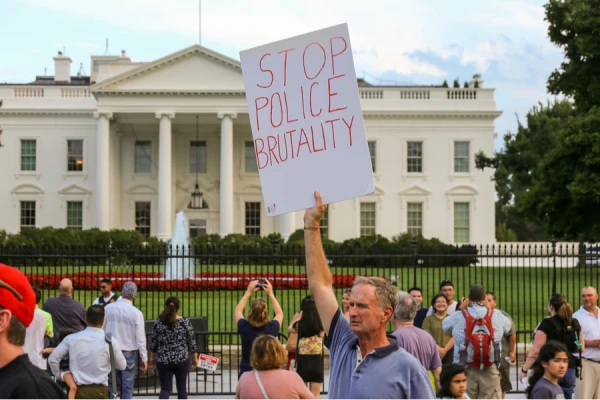
Washington D.C., Jun 8, 2020 / 10:20 am (CNA).- Priests in the Archdiocese of Washington will demonstrate outside of the White House on Monday as a “prayerful protest” against hatred and institutional discrimination of all kinds.
The June 8 protest will be led by Fr. Cornelis Ejiogu, SSJ, pastor of St. Luke Church in Washington, DC.
“Our mission: to pray for a change of heart, an end to hatred and institutional discrimination of all kinds,” said an email sent to priests of the Archdiocese of Washington by Fr. Daniel B. Carson, the vicar general and moderator of the curia for the archdiocese on June 5.
“Please join the Catholic faithful in a public witness to pray for the soul of George Floyd and the soul of America,” said Carson. Floyd was a man who died in the custody of the Minneapolis Police Department. The officers who arrested Floyd have been arrested and charged with homicide.
In the email, Carson invited priests to “join local Catholic bishops, clergy and lay faithful as we pray and move with Christian solidarity to lift our country up in prayer.”
“Let us gather to rededicate ourselves to the defense of all life and recommit ourselves to an anti-racism agenda,” Carson said.
Clergy were instructed in the email to “please wear (a) cassock, habit, or black clerical shirt,” and to bring a bottle of water, a mask, and a hat, as well as “appropriate signs/posters.”
The protest is set to start at 11 am at Lafayette Park, before moving to the White House at noon.
The email from the vicar general’s office inviting priests to attend the event included the reminder that “social distancing may be difficult, so do not forget your mask.”
Public Masses have not resumed in much of the archdiocese. Guidance on the archdiocesan website for the reopening of churches stresses that when and where public Masses resume, “social distancing will still be in place,” and “the six feet separation restriction will likely still be required.”
While some websites and social media posts have indicated that the archdiocese had ordered priests to attend the protest, the email – obtained by CNA – extended an invitation and contained no requirement to attend.
Several priests of the archdiocese told CNA they were surprised by the invitation, given the potentially volatile atmosphere that has accompanied some demonstrations outside the White House in the past week.
Two priests of the archdiocese, who spoke on condition of anonymity out of concern for ecclesiastical repercussions, told CNA that the event was “very unexpected,” and not consistent with diocesan guidelines regarding social distancing amid the coronavirus pandemic.
“We have been told for weeks that we cannot meet groups of the faithful, open our churches, serve in our parishes. Now they want us to take to the streets,” one priest told CNA.
A priest planning to attend the event expressed to CNA his concern that photos of priests in clerical garb outside the White House could be used for partisan purposes.
“I’ve been a priest here for more than a decade,” the priest told CNA. “I cannot remember ever being invited to wear a cassock to a public event organized by the chancery. It seems like they [just] want some good pictures.”
Neither the Archdiocese of Washington nor Fr. Ejiogu responded to CNA’s requests for comment on the event in time for publication.
Mass in the Archdiocese of DC has been restricted due to the ongoing COVID-19 pandemic. In Washington D.C., religious services are classed as “nonessential” in the District of Columbia and Mass is limited to a total of 10 people, including outdoor services. In an update to priests, circulated by the office of the vicar general last week, the archdiocese said it was “pursuing a potential waiver application to try and make progress towards reopening.”
Other dioceses faced with similar restrictions, including in Minnesota, Illinois, and Wisconsin, were able to reopen after religious groups threatened or filed lawsuits citing religious freedom protections.
If you value the news and views Catholic World Report provides, please consider donating to support our efforts. Your contribution will help us continue to make CWR available to all readers worldwide for free, without a subscription. Thank you for your generosity!
Click here for more information on donating to CWR. Click here to sign up for our newsletter.

This clearly tells us hatred against Trump is more important than the Mass to Archbishop Gregory.
Praying at the White House isn’t actually praying; it’s what’s called “virtue signalling,” and aiming a message at the President.
If they really wanted to pray, they’d kneel quietly before the Blessed Sacrament and ask Him for help.
““Let us gather to rededicate ourselves to the defense of all life and recommit ourselves to an anti-racism agenda,” Carson said. Clergy were instructed in the email to “please wear (a) cassock, habit, or black clerical shirt,” and to bring a bottle of water, a mask, and a hat, as well as “appropriate signs/posters.””
Oh, yes? And when is the last time he invited them to go, so clothed, to pray in front of an abortion clinic?
What Catholics want across the nation is for the right to peacefully assemble in the Catholic churches, and to have the sacraments restored to us without so many of senseless restrictions imposed by Democratic Governors and Mayors. This is the “hill” that Catholics want to die on, namely our rights to practice our faith, worship our God inside of our churches, aka religious freedom. This cause is supported by President Donald Trump who is married to a Catholic and whose son Barron is a Catholic.
Catholics do not want their priests demonstrating in front of the White House to sooth the wounded ego of Archbishop Gregory, whose nasty words he spoke when the President held up a Bible in front of a burned out Church, and then went to the JPII Shrine and signed an executive order supporting world-wide the right to freedom of worship. Archbishop Gregory was soundly rebuked by Archbishop Vigano as one of the Evil Shepherds in the Church.
The fact that the US Catholic Bishop’s Conference has only one black Archbishop is their own evidence of racism and this is something the White House cannot fix except to revoke the tax exempt status the the US Catholic Bishop Conference because they Bishops violate the Civil Rights Act. The White House cannot make the US Catholic Bishop’s Conference a non-racist institution full on non-white Bishops and Cardinals. Only the US Catholic Bishop’s Conference can reform itself, not the President.
It is not missed on anyone that Archbishop Gregory was rebuked by Cardinal Vigano as an Evil Shephard this past week. It is not missed that Archbishop Gregory worked in 2002 with then Cardinal McCarrick to exempt Bishops and Cardinals from the rules imposed on clergy for sexual abuse. It is not missed that Archbishop Gregory has not released the report on the misconduct of former Cardinal McCarrick after 2 years. It is not missed that the Department of Justice is looking into complaints under the RICO Act of a systemic cover-up of former Cardinal McCarrick’s conduct and has been doing so for several years after the Philadelphia Grand Jury report (2018). It is not lost on anyone that Richard Sipe viewed Archbishop Gregory as an admitted sexually active homosexual.
This stunt motivated by self-serving vanity will not work, but will expose further the evil within the clergy who are being asked to ignore the sacramental church and worship instead on the altar of BAAL I am sorry for the good priests who want to minister to the flocks of Christ that they are being asked to participate in this stunt. My Jesus, Mary, Joseph deliver us from Evil in the name of the Father, Son, and Holy Spirit.
This is nothing more than a cheap political gesture orchestrated by an openly leftist hack who happens to wear a bishop’s mitre. Wilton Gregory has apparently decided to go on the warpath against Donald Trump. I suspect this is only the beginning of his campaign to help deliver this country into the hands of the political heirs of Mao.
This certainly puts a new twist on the Deblasio line about “protests” being essential, while religious services are not. Gregory must be thinking that not administering the sacraments gives priests plenty of time for political agitation. What else should we have expected from a protege of Bernadin and a close friend of Ted McCarrick?