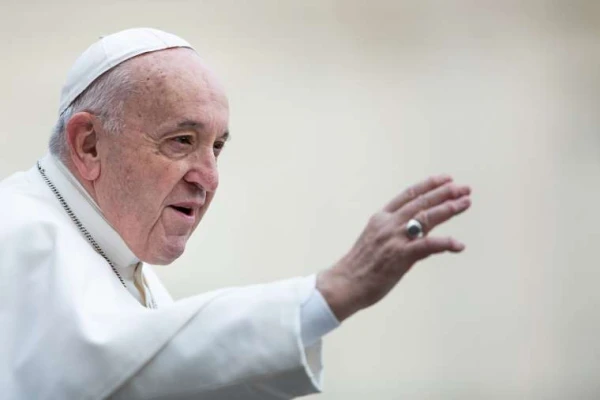
Vatican City, Jun 7, 2020 / 05:16 am (CNA).- The Holy Trinity is saving love in a world filled with corruption, evil, and the sinfulness of men and women, Pope Francis said Sunday.
In his weekly address before the Angelus prayer June 7, the pope said though God created a good and beautiful world, after the fall “the world is marked by evil and corruption.”
“We men and women are sinners, all of us,” he continued, speaking from a window overlooking St. Peter’s Square.
“God could intervene to judge the world, to destroy evil and chastise sinners. Instead, He loves the world, despite its sins; God loves each of us even when we make mistakes and turn away from him,” he said.
Pope Francis reflected on the feast of the Holy Trinity and the words of John 3:16: “For God so loved the world that He gave His one and only Son, that whoever believes in Him shall not perish but have eternal life.”
“These words indicate that the action of the three divine Persons – Father, Son and Holy Spirit – is all one single plan of love that saves humanity and the world,” he stated.
The pope pointed to the great love of God the Father, who, to save sinners, sent his Son and the Holy Spirit.
“The Trinity is therefore Love, all at the service of the world, which he wishes to save and recreate.”
“God loves me. This is the sentiment of today,” he underlined.
According to Francis, to live a Christian life means welcoming God-Love, encountering Him, searching for Him, and placing Him first in our lives.
“May the Virgin Mary, dwelling-place of the Trinity, help us to welcome with an open heart the love of God, which fills us with joy and gives meaning to our journey in this world, always guiding us towards our destination, which is Heaven,” he prayed.
After praying the traditional Marian prayer, Pope Francis addressed those gathered in St. Peter’s Square, noting that their “small presence” was a sign that “the acute phase” of the coronavirus pandemic is over in Italy.
When people broke into applause at the words, the pope warned that they should not declare “victory” too early, and everyone should continue to follow the health and safety regulations in place.
He also noted that some countries are still deeply affected by the coronavirus and continue to have many deaths.
There is one country, he said, where on Friday “one person died per minute. Terrible!”
The pope appeared to be referencing Brazil, where on June 5, an editorial on the front page of the Folha de S.Paulo newspaper said COVID-19 is “killing a Brazilian per minute,” after the country recorded 1,473 deaths in 24 hours.
According to the John Hopkins University COVID-19 dashboard, Brazil has the second-most cases of the coronavirus in the world after the United States with nearly 673,000 confirmed cases. Brazil is third in the world for deaths, with almost 36,000 recorded as of Sunday.
“I wish to express my closeness to those populations, to the sick and their families, and to all those who care for them,” Francis said.
He concluded by pointing to the Church’s dedication to the Sacred Heart of Jesus in the month of June. He asked everyone to repeat with him an old prayer he was taught by his grandmother: “Jesus, make my heart like unto thine.”
“Indeed, the human and divine Heart of Jesus is the wellspring where we can always draw upon God’s mercy, forgiveness and tenderness,” he said, encouraging everyone to focus on the love of Jesus.
“And we can do this by adoring the Eucharist, where this love is present in the Sacrament. Then our heart too, little by little, will become more patient, more generous, more merciful,” he said.
If you value the news and views Catholic World Report provides, please consider donating to support our efforts. Your contribution will help us continue to make CWR available to all readers worldwide for free, without a subscription. Thank you for your generosity!
Click here for more information on donating to CWR. Click here to sign up for our newsletter.

Rome Newsroom, Feb 15, 2021 / 08:30 am (CNA).- The president of the national bishops’ conference has welcomed Italy’s new government with a message to Prime Minister Mario Draghi, who was sworn in Saturday.
Munich, Germany, Mar 14, 2019 / 05:27 pm (CNA).- Cardinal Reinhard Marx of Munich and Freising has announced that the Catholic Church in Germany is embarking on a “binding synodal process” to tackle what he says are the three key issues arising from the clerical abuse crisis: priestly celibacy, the Church’s teaching on sexual morality, and a reduction of clerical power.
Speaking at the conclusion of the plenary session of the German bishops’ conference on Thursday, Marx told reporters that the bishops had unanimously decided these three topics would be subject to a process of “synodal progression” that could lead to a binding, but as yet undetermined, outcome.
“The Church needs synodal progress,” the president of the German bishops’ conference asserted. “Pope Francis encourages this.”
The German bishops held their plenary session in the German town of Lingen from March 11 to 14.
Addressing journalists on the final day, Marx said the Church’s teaching on sexual morality has yet to account for significant recent discoveries from theology and the humanities. Also, he said, the significance of sexuality to personhood has not yet received sufficient attention from the Church.
Bishops “feel we often are unable to speak on questions of present-day sexual behavior,” Marx said.
The cardinal also said that the German bishops appreciate priestly celibacy as an “expression of the religious bond to God” and do not simply want to give up on it. But to what extent celibacy should always be an element of priestly witness is a question “we will determine” through the “synodal process,” Marx told the press.
Furthermore, Marx said clerical abuse of power constitutes a betrayal of the trust of people in need of stability and religious orientation. Therefore, the “synodal process” would be charged with identifying what measures must be taken to achieve “the necessary reduction of [clerical] power.”
The establishment of ecclesiastical administrative courts is one such step for which the bishops will in the near future draft a proposal.
As a first step on the proposed synodal path, Marx announced that the German bishops have decided to set up three preparatory working groups. The working group on “clerical power” is headed by Bishop Karl-Heinz Wiesemann of Speyer, the working group on “sexual morality” will be headed by Bishop Franz-Josef Bode of Osnabrück. The working group on “the priest’s way of life,” which will focus on celibacy, will be moderated by Bishop Felix Genn of Münster.
Interim reports are expected from all three by Sept. 13.
Referring to the German bishops’ four year “Würzburg Synod” from 1971 to 1975, which was charged with an implementation of the decisions of the Second Vatican Council, Marx affirmed that the Church in Germany is “not starting at zero” in a synodal process, given the Würzburg experience, and various consultation processes undertaken by the German bishops in recent years.
The “synodal process” will involve consultations with the “Central Committee of German Catholics,” a lay organization that closely cooperates with the bishops’ conference, and will draw on outside experts.
Pope Benedict XVI announced his intention to resign the papacy during a meeting of cardinals Feb. 11, 2013. The surprise announcement, which he made in Latin, took place in the Hall of the Consistory in the Vatican’s apostolic palace. / Vatican Media
Washington, D.C. Newsroom, Jan 2, 2023 / 06:00 am (CNA).
On Feb. 11, 2013, before a gathering of cardinals who had come to the Vatican expecting to hear the announcement of upcoming canonizations, Pope Benedict XVI dropped a bombshell.
After a few announcements about Church business at the conclusion of the meeting, the pope took out two sheets of paper and read a prepared statement in Latin.
“I have convoked you to this Consistory, not only for the three canonizations, but also to communicate to you a decision of great importance for the life of the Church. After having repeatedly examined my conscience before God, I have come to the certainty that my strengths, due to an advanced age, are no longer suited to an adequate exercise of the Petrine ministry,” the then 85-year-old pontiff told the gathering of the Catholic Church’s highest-ranking clergymen.
Because he spoke in Latin, the language used for official Vatican proclamations, reporters present did not at first realize that the pope had just stepped down.
‘Total surprise, total shock’
The assembled cardinals, on the other hand, who knew their Latin, reacted with stunned silence.
American Cardinal James Stafford later told CNA that the pope’s statement was received with “total surprise, total shock.”
“A cardinal who was sitting next to me said, ‘Did he resign?’ I said, ‘Yes, that’s what he did. He resigned.’ And we just all stood at our places.”
Cardinals react to Pope Benedict XVI’s announcement of his intention to resign the papacy Feb. 11, 2013. The surprise announcement, which Benedict made in Latin, took place in the Hall of the Consistory in the Vatican’s apostolic palace. Vatican Media
Nigeria’s Cardinal Francis Arinze, who was present that morning, said the announcement was a “surprise, like thunder that gives no notice that it’s coming,” reported The Catholic Telegraph.
In renouncing the papacy, Benedict became only the second pope in almost 600 years to voluntarily step down. In 1294, Pietro da Morrone, an elderly hermit, was crowned Pope Celestine V, but finding the demands of the job too much for him, he resigned after only five months.
In 1415, Pope Gregory XII also resigned, but under very different circumstances — he stepped down in order to end a crisis within the Church known as the Great Western Schism.
Title, white clothes, and papal coat of arms
What happened next with Benedict XVI was no less surprising to those who expected him to live as a retired cardinal.
In his last official statement as pope, before a general audience on Feb. 27, 2013, Pope Benedict assured the tens of thousands of people gathered to hear him speak as pope for the last time that even though he was stepping back from official duties, he would remain, in essence, pope.
“The ‘always’ is also a ‘forever’ — there can no longer be a return to the private sphere. My decision to resign the active exercise of the ministry does not revoke this,” Benedict said.
“I do not return to private life, to a life of travel, meetings, receptions, conferences, and so on. I am not abandoning the cross, but remaining in a new way at the side of the crucified Lord,” he told the crowd.
A day earlier, on Feb. 26, 2013, the director of the Vatican Press Office, Father Federico Lombardi, had silenced speculation over what Benedict would be called and what he would wear. He would, Lombardi said, retain the trappings of the papacy — most significantly, his title and dress.
“He will still be called His Holiness Benedict XVI,” Lombardi said. “But he will also be called Pope Emeritus or Roman Pontiff Emeritus.”
Lombardi said Benedict would continue to wear a white cassock but without the mozzetta, the short cape that covers the shoulders. The pope’s fisherman’s ring would be replaced by a ring from his time as cardinal. The red shoes would go as well, Lombardi said, and be replaced by a pair of brown ones.
“The city of León is known for beautiful shoes, and very comfortable shoes. And when the pope was asked what he wanted to wear he said, ‘I want the shoes from León in Mexico,’” Lombardi said at the press conference.
On May 2, the cardinal who designed Benedict’s coat of arms in 2005 told CNA that he had written the pope emeritus suggesting that his coat of arms would need to be redesigned to reflect his new status. Cardinal Andrea Cordero Lanza di Montezemolo proposed making the keys of St. Peter smaller and less prominent.
“That shows that he had a historic possession but not a current jurisdiction,” said the cardinal at the time.
Benedict, however, it seems, politely declined a new coat of arms. La Stampa reported the following year that the Vatican Publishing House’s manual of ecclesiastical heraldry in the Catholic Church contained the following note:
“Expressing deep appreciation and heartfelt gratitude to the author for the interesting study sent to him, [Benedict] made it known that he prefers not to adopt an expressive heraldic emblem of the new situation created with his renouncing of the Petrine Ministry.”
By his decision to continue to dress in white like the pope, retain the title of pope, and keep the coat of arms of his papacy, Benedict revealed that in giving up the “active exercise of the ministry,” he was not forsaking the role of pope altogether.
Pope Francis and Pope Emeritus Benedict XVI pray together at the papal residence in Castel Gandolfo March 23, 2013, their first meeting after Francis’ election. Vatican Media
An expanded Petrine ministry
In his 2013 announcement, Benedict clearly expressed his intention to step aside, even determining the date and time of his official departure. Nonetheless, his decision to keep the title of pope and maintain the ceremonial protocol that goes along with the papacy led some to speculate whether there were not actually “two popes.”
Benedict’s personal secretary and closest confidante, Archbishop Georg Gänswein, sought to clear up any confusion in 2016.
In a speech at the Pontifical Gregorian University in Rome on May 20, 2016, Gänswein said that Pope Francis and Benedict are not two popes “in competition” with one another but represent one “expanded” Petrine office with “an active member” and a “contemplative.”
Parsing Benedict’s speech, Gänswein explained that in stepping down, Benedict was not giving up his ministry.
“The key word in that statement is ‘munus petrinum,’ translated — as happens most of the time — with ‘Petrine ministry.’ And yet, ‘munus,’ in Latin, has a multiplicity of meanings: It can mean service, duty, guide, or gift, even prodigy. Before and after his resignation, Benedict understood and understands his task as participation in such a ‘Petrine ministry [munus],’” Gänswein said.
“He left the papal throne and yet, with the step he took on Feb. 11, 2013, he has not abandoned this ministry,” Gänswein explained, saying the latter scenario was something “quite impossible after his irrevocable acceptance of the office in April 2005.”
Benedict himself later made clear in an interview with his biographer Peter Seewald that he saw himself as continuing in his ministry. He said that a pope who steps down is like a father whose role changes, but always remains a father.
“Of course a father does not stop being father, but he is relieved of concrete responsibility. He remains a father in a deep, inward sense, in a particular relationship which has responsibility, but not with day-to-day tasks as such. It was also this way for bishops,” Benedict said.
“I think it is also clear that the pope is no superman and his mere existence is not sufficient to conduct his role, rather he likewise exercises a function.
“If he steps down, he remains in an inner sense within the responsibility he took on, but not in the function. In this respect one comes to understand that the office of the pope has lost none of its greatness, even if the humanity of the office is perhaps becoming more clearly evident,” Benedict said.
Benedict’s decision “not to abandon his ministry” inspired a cottage industry of conspiracy theories, with some questioning whether the pope emeritus truly stepped down because of his age and frailty.
George Weigel, author of the definitive biography of St. John Paul II, “Witness to Hope,” dismissed such speculation in an interview with CNA.
“I have no reason to think that there was anything more to Pope Benedict’s resignation than what he said was its cause: his conviction that he no longer had the strength, physical and intellectual, to give the Church what it needed from a pope,” he said.
“Everything else written about this is sheer speculation. Let’s take Benedict at his word,” Weigel said.
A life of prayer
In retiring to live in the Mater Ecclesiae Monastery in the Vatican Gardens, Benedict did not completely withdraw from the world. He attended public events in his new capacity as pope emeritus, received visitors, and pursued a life of fruitful study, writing, and prayer.
Pope Francis visits Pope Emeritus Benedict XVI at the Mater Ecclesiae monastery in Vatican City to exchange Christmas greetings Dec. 23, 2013. Vatican Media
Matthew Bunson, Catholic historian, author, and executive editor of EWTN News, told CNA that Benedict was determined not to exercise authority in his new role.
“He really embraced what it means to be pope emeritus, and refrained from making public comments, to instead live a life of prayer and reflection,” Bunson said.
“Benedict really was on retreat, and in prayer,” he said, “and that means we have his prayer for us as a Church.”
While becoming increasingly frail, Benedict continued to celebrate Mass daily with the other residents of the monastery and was known to enjoy spending time in the Vatican Gardens praying his daily rosary.
In the fall of 2021, more than eight years after Benedict stepped down, his private secretary, Gänswein, told Domradio in Cologne, Germany, that Benedict was “stable in his frailty.”
He described the pope emeritus as very weak physically but still clear in mind. Gänswein said he had not lost his “typical Bavarian humor.”
The meaning of Benedict’s renunciation for future popes
In 2013, after Benedict announced that he would step down as pope, Father Gianfranco Ghirlanda, a Jesuit theologian and canonist chosen by Pope Francis to be a cardinal, wrote an essay on what should happen when a pope steps down.
In the article, published in Civiltà Cattolica, Ghirlanda suggested the retiring Benedict take the title bishop emeritus of Rome.
“It is evident that the pope who has resigned is no longer pope; therefore he no longer has any power in the Church and cannot interfere in any government affair. One may wonder what title Benedict XVI will retain. We think that he should be given the title of bishop emeritus of Rome, like any other diocesan bishop who ceases,” he said.
In December 2021, at a congress on papal resignations, Ghirlanda took up the theme again.
“Having two people with the title of ‘pope,’ even if one added ’emeritus,’ it cannot be said that this might not generate confusion in public opinion,” he said.
To make clear that the pope who resigns is no longer pope, he said, he should perhaps be called “former Roman pontiff” or “former supreme pontiff.”
Pope Francis in July 2022 told reporters that if he were to retire from the papacy he would do things differently from his predecessor.
“The first experience went very well,” Pope Francis said, because Benedict XVI “is a holy and discreet man.”
In the future, however, “it would be better to define things or explain them better,” the pontiff added.
“I am the bishop of Rome. In that case I would be the bishop emeritus of Rome,” he said, and then suggested he would live in St. John Lateran Palace rather than at the Vatican.
Life is a precious gift. Health is wealth. May all be blessed with sound health of mind and body.