

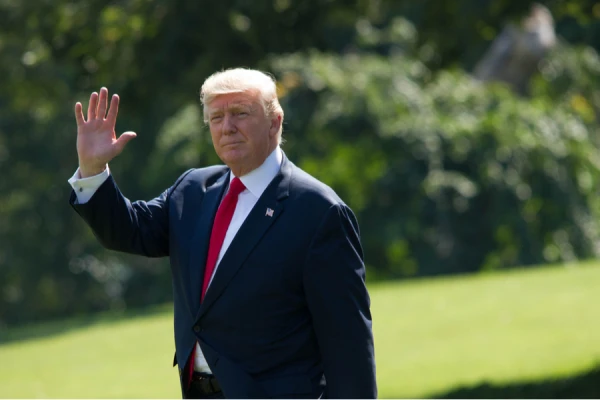
CNA Staff, Jun 5, 2020 / 10:35 am (CNA).- President Trump’s favorability rating among white Catholics has dropped almost by half since March, according to a new poll.
The Public Religion Research Institute (PRRI) reported on Thursday that President Trump’s favorability among white Catholics fell from 60% in March to 48% in April to just 37% in May.
The new poll, released June 4, was taken during a week of widespread civil unrest in several major cities, following the death of George Floyd in police custody in Minneapolis on May 25. The poll sampled 1,003 U.S. residents aged 18 or over and was conducted May 26-31.
The findings reflect other national polls showing a general growing disapproval for Trump in recent weeks, andt registering broad disapproval for his handling of the aftermath of George Floyd’s death. Though, according to PPRI’s findings, Trump still has the approval of half of overall respondents in election battleground states, with his approval in those states having increased to 50% from 38% in April.
The PPRI poll was conducted under the direction of SSRS, a polling and research firm widely used by media outlets, political pollsters, and market researchers. PPRI, however, has been the recipient of grants for research supporting LGBT initiatives.
In 2017, CNA reported that PRRI had received around $450,000 from the Arcus Foundation to create “comprehensive state maps” of public attitudes on religious exemptions and non-discrimination policies.
A list of Arcus Foundation grantees shows a 2019 grant for $150,000 for “nine months” of support for “polling research on LGBT acceptance and other social change issues in the U.S.” In 2018, the foundation also provided a grant of $150,000 for a year of such polling research.
PRRI’s poll numbers among Catholics mark a sharp change from a recent Pew Research Center poll on Trump’s handling of the new coronavirus pandemic, conducted at the beginning of May.
The May Pew report showed that, while Americans overall characterized Trump’s response to the pandemic as either “fair” or “poor” by a margin of 59%-41%, white Catholics approved of his response as “excellent” or “good” by a margin of 55%-45%. In that same poll, however, 70% of Hispanic Catholics said Trump’s response was “fair” or “poor.”
Earlier in 2020, an EWTN News/RealClearOpinion Research poll showed that almost six-in-ten white non-Hispanic Catholics approved of Trump’s presidency.
According to the poll of 1,512 Catholic registered voters conducted from Jan. 28 through Feb. 4, 58% of white non-Hispanic Catholics approved of Trump “strongly” or “somewhat,” and 53% said they were either sure to vote for him in November or there was a “strong chance” they would.
Trump’s approval rating among Catholics overall was at less than half in the EWTN poll, in part due to overwhelmingly negative reviews by Hispanic Catholics who disapproved of him 71% to 29%. A smaller subset of devout Catholics, who said they accepted all the Church’s teachings, showed strong approval of his presidency, 63% to 37%.
The Catholic vote has largely mirrored the overall popular vote in recent presidential elections.
According to initial 2016 election exit polls, Trump won the Catholic vote, but data released since then appears to contest that claim. The American National Election Studies (ANES) in 2017 reported that Clinton won the Catholic vote in 2016, 48% to 45%. And according to the February poll commissioned by EWTN News, Catholics who voted in 2016 favored Hillary Clinton by a narrow margin, 48% to Trump’s 46%.
If you value the news and views Catholic World Report provides, please consider donating to support our efforts. Your contribution will help us continue to make CWR available to all readers worldwide for free, without a subscription. Thank you for your generosity!
Click here for more information on donating to CWR. Click here to sign up for our newsletter.

yup, while the ‘white boy club’ kneels before the archbishop of wash…as trump & melania kneel before God.
the only thing the Trumps kneel to is corruption money and greed
It is difficult to believe the polls. But, I am finding most people I know who were previously liberal are now moving over to President Trump because he is defending religious liberty, even if he is highly persecuted for doing so, even by members of the Catholic hierarchy. The persecution he receives makes him authentic rather than engaging in stunts as his accusers claim. He has been a defender of Pro-Life issues, more than any President. He has handled the virus as well as he could given the fact that the scientific data was all wrong that petty liberal Democrats so fiercely cling to as a rational reason to close churches at the same time allowing taverns, liquor stores, etc. to remain open. He has wanted to reopen churches since Easter and signed an executive order to reopen churches as essential. Local Democrat Governors were allowed to keep churches closed and supported by the Supreme Court that the Governors could keep the churches closed with dictatorial directives or with excruciating restrictions not imposed on other activities within the society. He has signed an executive order to support international religious liberty as a US foreign policy which should make happy those Catholics being persecuted for their faith in other nations, China and the Middle East but one example. He has done more for the Roman Catholic faith than any President, although he wife and his son Barron are both Catholic. His wife is the first Catholic First Lady since Jackie Kennedy sixty years ago, and she seems to have had a positive influence on him.
The demonstrator who seem mostly White from affluent backgrounds have turned off the majority of Americans and threaten the property and business of Black neighborhoods, creating an unnecessary class war. This jeopardizes the decades of positive relationships established between the two races by ordinary Americans, pitting people against each other according to race They seem to be supported mostly by extremely liberal Democrat politicians and some clergy.
Beside destroying property, they have threatened and murdered the police, exhausting the resources of America. The demonstrators have failed to practice social distancing further jeopardizing their lives, the lives of their families, friends, and social circles, not to mention spreading the virus to the police and fire departments and hospitals and staff. If the virus spreads, this reckless disregard for life by all of the protestors, even those who thought they represented non-violence, but in fact became instruments of violence, we can hold them all responsible. More people who develop the virus and die from it can be attributed to the reckless disregard for human life demonstrated by these demonstrators. All the while, the Democratic Speaker of the House keeps Congress from meeting due to the pre-text of the virus…hum….
No, I think the “silent majority” will vote for Trump and GOP who want to restore law and order, religious freedom to worship, and sanity back to America. Converts are being made as we speak, and yes within the African American and Latino communities.
Glad to see this statistic. Trump is the least Christian president I’ve ever seen. He has no compassion for anyone and his priority is only himself. He wanted Marla Maples to abort Tiffany and he has been responsible
For paying for at least a dozen abortions – so far.
If Catholics think he is a so called pro life president it is only because he wants the votes as is the reason for every move he makes. He is anti-American since the only American he actually cares about is himself. He has broken every commandment and lives a life full of greed, gluttony, and selfishness.
I wish other Catholics would open their eyes and minds and try to see what an evil man he is.
Glad to see the tide may turn away from him.
“The Pharisee, standing, prayed thus to himself: God, I thank thee that I am not as the rest of men, rapacious, unjust, adulterers, or even as this tax-gatherer.”
“For paying for at least a dozen abortions – so far.” You have no evidence of that. Calumny, detraction…
I don’t understand how any Catholic can support Trump. He is a serial adulterer, he mocks the Pope’s guidance on climate change, he sows division among the faithful, and essentially does not follow any aspect of the Gospels. As a Chaplain who retired from 28 years service with the US military, I suggest that any Catholic who votes for Trump needs to examine their conscience. Also, if you encourage other Catholics to vote for Trump you are leading others down a dangerous path.
Difficult for me to believe you were a Catholic Military Chaplain. Apparently you do not believe in redemption for anyone, even though Trump has proven himself to be a defender of innocent human life in everything he has done. You must be among those who choose to believe Biden is a “faithful Catholic” in spite of all the evidence to the contrary, including everything he says, and his choice of a rabidly pro-abortion woman as his VP. The “climate change” scare is a hoax – read what an avid environmental scientist recently said about this hoax – which is an excuse for population control and the murdering of even more innocent life in the womb. There are none so blind as those who refuse to see.
Anything funded by the Arcus Foundation needs to be taken with a grain of salt.