

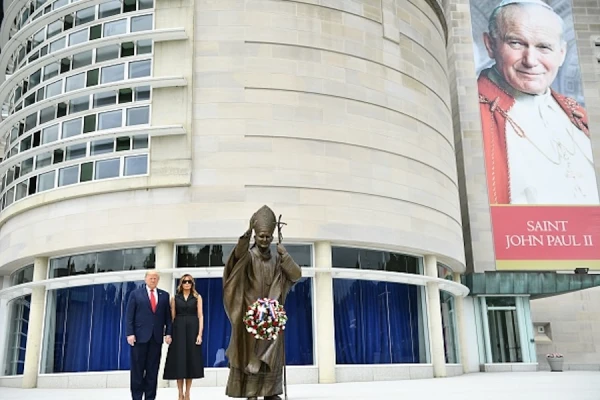
Washington D.C., Jun 2, 2020 / 10:10 am (CNA).- Amid burgeoning conflict regarding the president’s response to riots across the country, President Donald Trump visited the Saint John Paul II National Shrine in Washington, D.C. on Tuesday morning.
While a shrine spokesman said the visit was initially planned as the signing of an international religious freedom executive order and had been scheduled some time ago, Washington’s archbishop called Trump’s visit to the shrine “reprehensible.”
According to the White House daily press guidance, Trump had a scheduled visit to the Saint John Paul II National Shrine in the city’s northeast at 11:20 a.m. on Tuesday.
The president’s visit now comes shortly before he will sign an executive order “to advance international religious freedom.”
A spokesperson for the shrine said on Tuesday that the White House “originally scheduled this as an event for the president to sign an executive order on international religious freedom.”
“This was fitting given St. John Paul II was a tireless advocate of religious liberty throughout his pontificate,” the shrine stated. “International religious freedom receives widespread bipartisan support, including unanimous passage of legislation in defense of persecuted Christians and religious minorities around the world.”
He added that “the shrine welcomes all people to come and pray and learn about the legacy of St. John Paul II.”
The revamped visit, following nights of civil unrest in Washington, was met with criticism from Washginton’s archbishop.
Archbishop Wilton Gregory of Washington, D.C. said on Tuesday morning: “I find it baffling and reprehensible that any Catholic facility would allow itself to be so egregiously misused and manipulated in a fashion that violates our religious principles, which call us to defend the rights of all people even those with whom we might disagree.”
.@WashArchbishop Gregory has released a statement on the president’s visit to the Saint John Paul II National Shrine.https://t.co/46g9Ac8Wy5 pic.twitter.com/d1wERIoLVp
— DC Archdiocese (@WashArchdiocese) June 2, 2020
“Saint Pope John Paul II was an ardent defender of the rights and dignity of human beings. His legacy bears vivid witness to that truth,” Archbishop Gregory stated: “He certainly would not condone the use of tear gas and other deterrents to silence, scatter or intimidate them for a photo opportunity in front of a place of worship and peace.”
The shrine contains a first-class relic of Pope St. John Paul II’s blood, as well as an interactive exhibit on his life, accomplishments, and significant historical events. The U.S. Conference of Catholic Bishops designated the shrine as a national shrine in 2014.
A group of around 200 protesters gathered on Tuesday morning down the street from the shrine. Some of the protesters chanted “black lives matter” and “no justice, no peace,” while a small group of the protesters prayed the rosary.
According to a senior administration official, the executive order on international religious freedom Trump is scheduled to sign on Tuesday would continue his previous call for other countries “to end religious persecution.” It would integrate this call into U.S. foreign policy.
On Monday evening, Trump had visited St. John’s Episcopal Church adjacent to the White House, which every sitting U.S. president, beginning with James Madison, has attended.
Trump stood outside the church in front of cameras holding a Bible in one hand in an apparent photo-op. The church had suffered fire damage during protests on Sunday night.
At the time Trump stood outside the church, Washington, D.C. was entering a 7 p.m. curfew. Crowds had stood across from Lafayette Square behind the White House, protesting the death of George Floyd and police brutality.
According to the Washington Examiner, police dispersed crowds with tear gas and other non-lethal weapons on H Street behind the park and next to the church, but not one block over on Vermont Avenue where protests continued past curfew; the dispersal of the crowds was apparently done to make room for Trump’s visit to St. John’s rather than enforcing the city’s curfew.
If you value the news and views Catholic World Report provides, please consider donating to support our efforts. Your contribution will help us continue to make CWR available to all readers worldwide for free, without a subscription. Thank you for your generosity!
Click here for more information on donating to CWR. Click here to sign up for our newsletter.

Archbishop Gregory’s comments towards the President is uncalled for! The first lady is a devote Catholic and their appearance was to call for Peace and Unity and yet the Bishop choose to say that their visit was reprehensible! This in my opinion shows a contempt from the Church. This language is supposedly contrary to any teachings from the Church. It portrays the divide in this country!
As a catholic raised through Catholic Grade School, High School and College as an Alter Boy, Chaplains Assistant in Vietnam I now have reached a point in my life that the Archbishops action and words has now made it official that I believe that the Church has nothing more to offer than misplaced hatred for our President. This makes my leaving the church that much easier.
So now I will place my faith in direct communication to the Lord Jesus Christ and leave the church on the sidelines.
They are SCREAMING loudly for acceptance of the rioters and looters. Say they stand up for injustice YET is truly a one way street. There is NO acceptance or understanding for those trying to defend life and property. I believe the Church should see and support both sides. The Church must see both the bad and the good on both sides
Well said. The bishop is out of line. This president and his wife are the biggest supporters of rights of the unborn that our country has ever seen, bishop should be ashamed and get his rosary out and pray and quit condemning our president.
good riddance
Melania Trump may be a devote Catholic, whatever that is, be she most certainly isn’t a devout Catholic. And you certainly aren’t either, no matter all the Catholic education, service as altar boy and Chaplain. If you were such a good Catholic you would see Trump for what he is, a lying and morally corrupt adulterer, racist, hater, narcissist, cruel, stupid, draft, dodger and a non believer and coward who only used the Catholic church and the bible as a photo op.
Spiteful, much, Sonja? I am a devout Catholic, and I do not see President Trump as that laundry list of talking points you submitted. I do see you spewing vicious hatred. I’m sure you’re just fine with abortions and the attacks on freedom of religion and would far rather have them than have Mr. Trump as President.
Let me guess, TDS and a devout member of the demoncrat party.
You do know that the slaughter of the innocents is the cornerstone of your party of death? Oh well, at least your hero, Joe Biden will defend your “values”.
We are not supposed to hate anyone. If anyone had a reason to hate, it was Jesus. He spoke the truth about God’s Kingdom, which threatened the powers of his day. He was rejected by his own people, endured a merciless scourging at the hands of Roman soldiers, was cruelly mocked and then forced to carry a heavy wooden cross upon which he was ultimately nailed and hung so that his humiliation could be witnessed by all. Yet he was heard to say “Father, forgive them, they know not what they do”.
I stand with my Savior.
I strongly support Archbishop Gregory and his criticism of trump.
Hoping that the mighty intercession of St.John Paul 11 , along with all of heaven is there , to touch all wounded hearts , wounded esp. in the Father realms ,
that the Holy Father too may be grieving over words , thus more compassion and grieving / praying in The Spirit ,for all the wounded , to thus make it an occasion for blessing for all !
Wilton Gregory’s words to President Trump is reprehensible. It is no different from the words coming out from the liberal MSM.
President Trump offers me more hope than the USCCB. SAD!
The archbishop should have called the center first.
President Donald Trump signed an executive order that seeks to promote international religious freedom and stop religious persecution overseas. The President signed the EO after visiting St. John Paul II National Shrine in Washington D.C. late this morning. One of the items in the EO calls for spending millions of dollars to assist programs that advance the cause of international religious freedom.
President Donald Trump is blessed by God.
https://www.youtube.com/watch?v=XgchpzSaYJA
They did not use tear gas, or the Part Police would have had to have gas masks on! What is happening to our beloved Church. I thought the ones in the WHITE, RED AND FUCHSIA WERE TO BE THE STANDARD BEARERS TO LEAD THE FIGHT TO MAINTAIN OUR CHURCH! WHY ARE THEY NOT MORE VOCAL AND SCREAMING AT THE TOP OF THEIR VOICES AT THE CLOSING OF OUR CHURCHES, WHILE ABORTION CLINICS AND BIG BOX STORES REMAIN OPEN? ANSWER THAT ARCHBISHOP! President Trump was the first President to attend and defend the rights of the unborn. He is a breath of fresh air compared to the stale tales coming out of you and Rome!
SO MY 1ST AMENDMENT RIGHT IS DENIED BY YOU? AND I WAS JUST TELLING THE TRUTH. SUCH A SHAME THAT I CANNOT VOICE MY OPINION SINCE I A CRADLE CATHOLIC! SHAME ON YOU AND YOUR BIASED SITE. THIS IS WAS THE MSM DOES AND HAVE YOU BECOME PART OF IT?
CWR reserves the right to allow or not allow any comments on its site. No one’s “rights” were being denied. Rather, all comments are moderated. You’re welcome.
Do stop shrieking, Rosalie. You do the cause of the Faith no good, and you make supporters of the President look unhinged.
The First Amendment says “Congress shall make no law respecting an establishment of religion, or prohibiting the free exercise thereof; or abridging the freedom of speech, or of the press; or the right of the people peaceably to assemble, and to petition the Government for a redress of grievances.” The key matter is that “Congress shall make no law.” If a private website chooses not to post something you wrote, it has nothing to do with the law, Congress, or the First Amendment.
“
So the bishop is basically saying we need to love each other, except for the president. The double standards and judgemental leadership of the church is why I left the church years ago. Being spiteful yet always preaching acceptance. The church has become a complete embarrassment. This is exactly why I stopped going to mass on Sundays. Hypothetical, self absorbed idiots are in charge
God is not spiteful,God is not a complete embarrassment ,but yes God is our Judge.
We cannot blame God for anyone who has become a traitor. You see they have lost their faith and have caused confusion in the church
Remember He said I will be with you til the end days. He died for all of us. Don’t be fooled Satan loves lies and deception.
He needs you to come back and speak out to them.
John
“… This is exactly why I stopped going to mass on Sundays. Hypothetical, self absorbed idiots are in charge”
***
I’m guessing you meant to type hypocritical?
Sure, the Church is absolutely populated by fallen human beings like you & me but at the end of the day Christ is in charge of His Church & He’s who we put our trust in. He’s the one we visit in the tabernacle & receive in the Blessed Sacrament.
I think there have been hypocritical, self absorbed followers of Christ from the beginning. Or worse.
Our Lord couldn’t even depend on His own apostles who had personally witnessed His miracles. Only one had the courage to remain at His side at Calvary. The others had either betrayed Him or run away.
The miracle today is that after 2 thousand years our Church still survives her fallen members & weak clergy.
Don’t be like the apostles who ran away, be like St. John who was steadfast.
God bless you!
Archbishop Gregory remarks: “I find it baffling and reprehensible that any Catholic facility would allow itself to be so egregiously misused and manipulated in a fashion that violates our religious principles, which call us to defend the rights of all people even those with whom we might disagree.”
The Church does have something important to say, but maybe the archbishop would be less baffled if he were open to a more serendipity view of events? The CALENDAR DATE of the previously-scheduled Trump appearance (and his signing of the declaration of religious freedom!) simply became an accident of the worst timing.
Something like the meltdown into the not-irrelevant Civil War…In the Civil War, the SERENDIPITY ASYMMETRY is (a) that the North eventually escalated its case into the Emancipation Proclamation—at the cost of some 360,000 fatalities; while (b) the South thought in some large degree in terms of a less banker-dominated culture (“the system!”), one protected by states’ rights, and with some 260,000 additional dead, also white.
For the north and the Emancipation Proclamation, there were also 2,700 Black fatalities, not to be forgotten, either.
So, now, today, to the streets, with the real, richly complicated, and deeper issues too easily graffitied-over with clichés from all sides including an archbishop.
One ENCOURAGING SIGN was the more measured commentary by former President Obama (not my selection). At a similar time and case in his administration, Obama fanned the racist flames with an early snap judgment which, in that particular case, was in error. Later, he remarked that he should have “calibrated” his comments more carefully (Harvard-ese for screwing up).
To his credit, he remembered; what do we remember?
Whatever his cultural flaws, the states-rights General Robert E. Lee was also and distinctively a true gentleman and a STATESMAN. All of us should find “reprehensible,” possibly, the removal of Lee as a symbol of those qualities—missing so equally (!) in all factions today—from even our town squares and visible history.
Indeed, the archbishop who earlier promised to “always tell the truth,” perhaps he now will find “reprehensible” the New York Times “1619 Project” set to be deployed soon in public schools—and teaching that the war for Independence was not about principles of the common good, but rather about perpetuating slavery.
Another serendipity messaging, this time from the Left, POORLY TIMED AS WELL AS FALSE, and therefore sure to further inflame the hell now claiming on our streets and national memory.
Trump’s visit to the Shrine was scheduled prior to the killing of George Floyd on an unrelated issue that all people of good conscience should be able to get behind. If Gregory found the event so objectionable, he could have communicated privately with the people at the Shrine beforehand instead of publicly castigating them after the fact. He has no right to berate them for failing to go out of their way to scorn Donald Trump’s very person, especially when he was content to have the at least equally questionable persons of Cardinal Mahony and Cardinal Wuerl at his side for his installation Mass.
A further thought! The Archbishop’s outrage that President Trump should appear at the Shrine in the midst of the George Floyd protests for any cause whatsoever, even in connection with an executive order on international religious freedom, effectively relativizes the killing of George Floyd with the persecution of Christians worldwide. As He Himself has said, the death of one man is a tragedy. The death of a million men is a statistic.