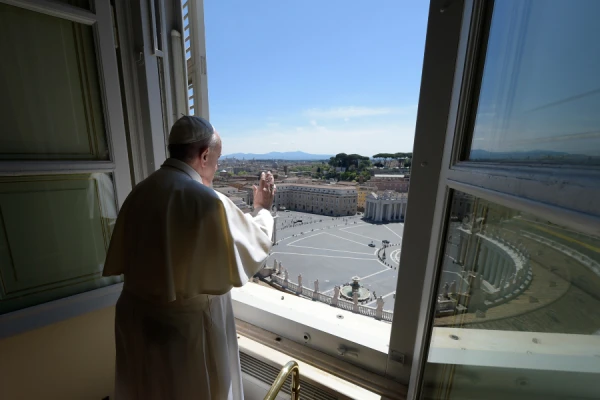
Vatican City, May 3, 2020 / 06:30 am (CNA).- Pope Francis called on all Catholics to pray for vocations to the priesthood and consecrated life on Good Shepherd Sunday, the World Day of Prayer for Vocations.
“Priesthood and consecrated life require courage and perseverance, and without prayer one does not follow this path. I invite everyone to ask the Lord for the gift of good workers for his kingdom who have their hearts and hands open to his love,” Pope Francis said on May 3.
In his Regina Caeli address, the pope said that the World Day of Prayer of Vocations is a reminder of Jesus’ words in the Gospel of Matthew: “The harvest is abundant but the laborers are few, so ask the master of the harvest to send out laborers for his harvest.”
Christ, the Good Shepherd, calls his sheep by name and the sheep listen to his voice, the pope said.
“Christian existence is always a response to the call of God, in any state of life,” he said.
Speaking from the library of the Vatican’s Apostolic Palace, Pope Francis offered advice for discerning the Lord’s voice from other voices of temptation or distraction.
He said that the voice of the evil one “seduces, assails, forces” with “tempting but passing emotions”.
“At first it flatters, makes us believe that we are omnipotent, but then it leaves us with emptiness inside and accuses us: ‘You are worth nothing,’” he said. “The voice of God, on the other hand, corrects us with much patience, but always encourages us, consoles us. It always nourishes hope.”
“The voice of God never binds: God proposes himself, he does not impose himself,” he said.
Pope Francis explained that the voice of temptation “always revolves around the self,” whereas the voice of God invites all to go “beyond ourselves to find true goodness and peace.”
“Dear brothers and sisters, in this time many thoughts and concerns lead us to turn in on ourselves. We pay attention to the voices that reach our heart. Let’s ask where they come from,” Pope Francis said.
Pope Francis said that May is “the Marian month par excellence” and encouraged people to place all of their concerns, expectations, and plans for the future “in the heart of the Holy Virgin.”
In his message for the 2020 World Day of Vocations, Pope Francis pointed to Mary’s courageous “yes” to God at the Annunciation as a model to follow:
“Cultivate the interior disposition of the Blessed Virgin Mary. Grateful that Lord gazed upon her, faithful amid fear and turmoil, she courageously embraced her vocation and made of her life an eternal song of praise to the Lord.”
“Every vocation is born of that gaze of love with which the Lord came to meet us,” he said. “We will succeed in discovering and embracing our vocation once we open our hearts in gratitude and perceive the passage of God in our lives.”
The pope stressed that vocational discernment is not simply “a decision we make as isolated individuals.”
“Vocation, more than our own choice, is a response to the Lord’s unmerited call,” he said.
Due to the coronavirus pandemic, Pope Francis led the traditional Marian Regina Caeli prayer via video livestream on May 3. The pope then appeared in the window of the Apostolic Palace above an empty St. Peter’s Square to offer a blessing for the city of Rome and the world.
“We ask for the grace to recognize and follow the voice of the Good Shepherd, who brings us out of the enclosure of selfishness and leads us to the pastures of true freedom. Our Lady, Mother of the Good Council, guide and accompany our discernment,” Pope Francis said.
If you value the news and views Catholic World Report provides, please consider donating to support our efforts. Your contribution will help us continue to make CWR available to all readers worldwide for free, without a subscription. Thank you for your generosity!
Click here for more information on donating to CWR. Click here to sign up for our newsletter.

Vatican City, Oct 26, 2017 / 12:53 pm (CNA/EWTN News).- Pope Francis conversed with astronauts orbiting earth on the International Space Station on Thursday, discussing questions as diverse as man’s place in the universe, the fragility of life and the planet, and international cooperation.
“Astronomy makes us contemplate the horizons of the universe and raises questions in us: Where did we come from? Where are we going?” the Pope said.
His first question to the astronauts: “What is your thought on man’s place in the universe?”
Italian astronaut Paolo Nespoli responded, saying that man’s place in the universe is a “complex question,” especially for him since his specialties are in the technical realm.
However, he noted that being in space has helped him to realize that the more humanity learns, the more clearly we can see how much we still do not know.
“I would love for people like you, not just engineers, not just physicists, but people like you (Holy Father) – theologians, philosophers, poets, writers… – to come here in space, and this will surely happen in the future, I would love (for them) to come here to explore what it means to have a human being in space,” he said.
Pope Francis contacted NASA’s International Space Station via a satellite call from the Vatican on Oct. 26. Aboard the space station are a total of six astronauts, including three Americans, two Russians and one Italian, who have been orbiting the earth, about 220 miles away.
Three will return to earth in December of this year, and the other three in February 2018.
Josef Aschbacher, director of the earth observation programs (ESA), told journalists after the call that for the astronauts, speaking with the Pope was an “experience of a lifetime.”
He said the Pope’s questions were all “very interesting” because they have to do with “our life, as humanity.”
For example, Francis asked the team what motivated them to become astronauts, and what they enjoy about being in space.
“Traveling in space modifies so many things that are taken for granted in everyday life, for example the idea of ??up and down,” he said, also asking if there is anything about living in the space station that has surprised them.
American Randolph Bresnik said that what gives him the greatest joy in space is being able “to look outside and see God’s creation maybe a little bit from his perspective. People cannot come up here and see the indescribable beauty of our earth and not be touched in their souls.”
There’s an incredible peace and serenity to our planet when you see it in orbit, he said, and there are “no borders, no conflict, it’s just peaceful.”
He also said that from space you can see “the thinness of the atmosphere, and it makes you realize how fragile our existence here is.”
Pope Francis responded by saying that he loved that answer, how Bresnik had pointed out the earth’s fragility, how it’s a “passing moment,” the earth turning at a rate of 10 km per second.
The astronauts also spoke with Francis about their own diversity and how it is an asset in their work on the International Space Station.
“As we work here on the space station and in our international partnership, we hope that the example of what we can achieve together is an example for all the world and humanity,” Bresnik said.
Francis said that although our society is very individualistic, cooperation is essential in life, asking about examples of collaboration in their work.
The International Space Station is a great example of international collaboration, American Joseph Acaba replied, because the crew members are from different countries and cultures, and they work together, also communicating on a daily basis with control centers in the U.S., Russia, Japan, Canada, and nine different countries in Europe.
“It’s our diversity that makes us stronger,” Acaba said. “And I think we need to embrace who we are as individuals and respect those around us. And by working together we can do things much better than we can as individuals.”
The other astronauts on the call were American Mark T. Vande Hei, and Russians Aleksandr Misurkin and Sergey Ryazanskiy.
The encounter between the astronauts on the space station and the Pope was a fascinating intersection between religion and science, said Aschbacher, noting that science can assist in the search for God through its curiosity to better understand our world.
Science asks some of the same questions as religion, such as, “where we are from and where we are going and where do we live,” he said.
Roberto Battiston, president of the Italian Space Agency (ASI), added that “there is no doubt that science is a way of searching for the truth” and though religion and science may have different ways of searching, they still have the same goal.
Pope Francis’ call marks the second time a pope has contacted astronauts in space. In 2011, Pope Benedict XVI became the first when he called the International Space Station via satellite link, speaking with 12 astronauts for about 20 minutes.
In the call, Benedict asked the astronauts questions about what it is like to view the earth from outer space and if it gave them a new perspective on the importance of promoting peace and caring for our planet’s resources.
A general view of a wreath laid by mourners outside the U.S. Embassy in Pretoria on Sept. 11, 2025, following the fatal shooting of U.S. youth activist and influencer Charlie Kirk while speaking during an event at Utah Valley University in Orem,… […]
Pope Francis prays during Christmas Mass in St. Peter’s Basilica on Dec. 24, 2023. / Vatican Media
Vatican City, Dec 24, 2023 / 18:00 pm (CNA).
Below is the full text of Pope Francis’ homily for the Solemnity of the Nativity of the Lord, delivered on Dec. 24, 2023, in St. Peter’s Basilica.
“A census of the whole earth” (cf. Lk 2:1). This was the context in which Jesus was born, and the Gospel makes a point of it. The census might have been mentioned in passing, but instead is carefully noted. And in this way, a great contrast emerges. While the emperor numbers the world’s inhabitants, God enters it almost surreptitiously. While those who exercise power seek to take their place with the great ones of history, the King of history chooses the way of littleness. None of the powerful take notice of him: only a few shepherds, relegated to the margins of social life.
The census speaks of something else. In the Scriptures, the taking of a census has negative associations. King David, tempted by large numbers and an unhealthy sense of self-sufficiency, sinned gravely by ordering a census of the people. He wanted to know how powerful he was. After some nine months, he knew how many men could wield a sword (cf. 2 Sam 24:1-9). The Lord was angered and the people suffered. On this night, however, Jesus, the “Son of David”, after nine months in Mary’s womb, is born in Bethlehem, the city of David. He does not impose punishment for the census, but humbly allows himself to be registered as one among many. Here we see, not a god of wrath and chastisement, but the God of mercy, who takes flesh and enters the world in weakness, heralded by the announcement: “on earth peace among those whom he favors” (Lk 2:14). Tonight, our hearts are in Bethlehem, where the Prince of Peace is once more rejected by the futile logic of war, by the clash of arms that even today prevents him from finding room in the world (cf. Lk 2:7).
The census of the whole earth, in a word, manifests the all-too-human thread that runs through history: the quest for worldly power and might, fame and glory, which measures everything in terms of success, results, numbers and figures, a world obsessed with achievement. Yet the census also manifests the way of Jesus, who comes to seek us through enfleshment. He is not the god of accomplishment, but the God of Incarnation. He does not eliminate injustice from above by a show of power, but from below, by a show of love. He does not burst on the scene with limitless power, but descends to the narrow confines of our lives. He does not shun our frailties, but makes them his own.
Christmas Mass in St. Peter’s Basilica on the night of Dec. 24, 2023. Vatican Media
Brothers and sisters, tonight we might ask ourselves: Which God do we believe in? In the God of incarnation or the god of achievement? Because there is always a risk that we can celebrate Christmas while thinking of God in pagan terms, as a powerful potentate in the sky; a god linked to power, worldly success, and the idolatry of consumerism. With the false image of a distant and petulant deity who treats the good well and the bad poorly; a deity made in our own image and likeness, handy for resolving our problems and removing our ills. God, on the other hand, waves no magic wand; he is no god of commerce who promises “everything all at once”. He does not save us by pushing a button, but draws near us, in order to change our world from within. Yet how deeply ingrained is the worldly notion of a distant, domineering, unbending, and powerful deity who helps his own to prevail against others! So many times this image is ingrained in us. But that is not the case: our God was born for all, during a census of the whole earth.
Let us look, then, to the “living and true God” (1 Thess 1:9). The God who is beyond all human reckoning and yet allows himself to be numbered by our accounting. The God, who revolutionizes history by becoming a part of history. The God who so respects us as to allow us to reject him; who takes away sin by taking it upon himself; who does not eliminate pain but transforms it; who does not remove problems from our lives but grants us a hope that is greater than all our problems. God so greatly desires to embrace our lives that, infinite though he is, he becomes finite for our sake. In his greatness, he chooses to become small; in his righteousness, he submits to our injustice. Brothers and sisters, this is the wonder of Christmas: not a mixture of sappy emotions and worldly contentment, but the unprecedented tenderness of a God who saves the world by becoming incarnate. Let us contemplate the Child, let us contemplate the manger, his crib, which the angels call “a sign” for us (cf. Lk 2:12). For it truly is the sign that reveals God’s face, a face of compassion and mercy, whose might is shown always and only in love. He makes himself close, tender, and compassionate. This is God’s way: closeness, compassion, tenderness.
Pope Francis brings a figure of the Christ child over to the nativity scene inside of St. Peter’s Basilica at the end of Mass. Vatican Media
Sisters and brothers, let us marvel at the fact that he “became flesh” (Jn 1:14). Flesh: the very word evokes our human frailty. The Gospel uses this word to show us that God completely assumed our human condition. Why did he go to such lengths? Because he cares for us, because he loves us to the point that he considers us more precious than all else. Dear brother, dear sister, to God, who changed history in the course of a census, you are not a number, but a face. Your name is written on his heart. But if you look to your own heart, and think of your own inadequacies and this world that is so judgmental and unforgiving, you may feel it difficult to celebrate this Christmas. You may think things are going badly, or feel dissatisfied with your limitations, your failings, your problems, and your sins. Today, though, please, let Jesus take the initiative. He says to you, “For your sake, I became flesh; for your sake, I became just like you”. So why remain caught up in your troubles? Like the shepherds, who left their flocks, leave behind the prison of your sorrows and embrace the tender love of the God who became a child. Put aside your masks and your armor; cast your cares on him and he will care for you (cf. Ps 55:22). He became flesh; he is looking not for your achievements but for your open and trusting heart. In him, you will rediscover who you truly are: a beloved son or daughter of God. Now you can believe it, for tonight the Lord was born to light up your life; his eyes are alight with love for you. We have difficulty believing in this, that God’s eyes shine with love for us.
Christmas Mass in St. Peter’s Basilica on the night of Dec. 24, 2023. Vatican Media
Christ does not look at numbers, but at faces. However, who looks at him amid the many distractions and mad rush of a bustling and indifferent world? Who is watching? In Bethlehem, as crowds of people were caught up in the excitement of the census, coming and going, filling the inns, and engaged in petty conversation, a few were close to Jesus: Mary and Joseph, the shepherds, and then the Magi.
Let us learn from them. They stood gazing upon Jesus, with their hearts set on him. They did not speak, they worshiped. Tonight, brothers and sisters, is a time of adoration, of worship.
Worship is the way to embrace the Incarnation. For it is in silence that Jesus, the Word of the Father, becomes flesh in our lives. Let us do as they did, in Bethlehem, a town whose name means “House of Bread”. Let us stand before him who is the Bread of Life. Let us rediscover worship, for to worship is not to waste time, but to make our time a dwelling place for God. It is to let the seed of the Incarnation bloom within us; it is to cooperate in the work of the Lord, who, like leaven, changes the world. To worship is to intercede, to make reparation, to allow God to realign history. As a great teller of epic tales once wrote to his son, “I put before you the one great thing to love on earth: the Blessed Sacrament… There you will find romance, glory, honor, fidelity, and the true way of all your loves on earth” (J.R.R. TOLKIEN, Letter 43, March 1941).
Brothers and sisters, tonight love changes history. Make us believe, Lord, in the power of your love, so different from the power of the world. Lord, make us, like Mary, Joseph, the shepherds, and the Magi, gather around you and worship you. As you conform us ever more to yourself, we shall bear witness before the world to the beauty of your countenance.
May the Lord of the harvest inspire and invite zealous laborers to his vineyard.