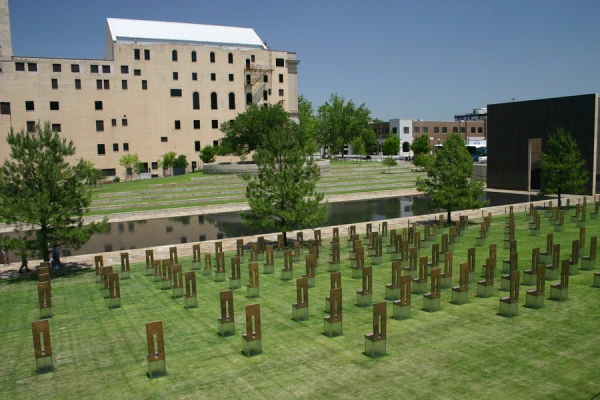
Oklahoma City, Okla., Apr 17, 2020 / 12:55 am (CNA).- Archbishop Paul Coakley of Oklahoma City will celebrate Mass April 17 across the street from a memorial commemorating the 1995 terror attack that killed nearly 170 people.
“These were our family members, our friends, co-workers and neighbors. We are grateful for their lives and we will never forget their sacrifice,” Coakley said April 16.
The anniversary of the bombings— which remain the deadliest domestic terror attack in American history— this year falls on Divine Mercy Sunday, April 19.
Coakley will celebrate Mass at the city’s downtown Saint Joseph Old Cathedral, with a livestream available.
“When we experience darkness and loss, Jesus shelters us and gives us hope,” Coakley continued.
“He accompanies us as we forge our path forward toward healing and peace. During Poland’s dark days preceding the Second World War, Jesus promised Saint Faustina that his Divine Mercy would never abandon those who trust in him. He promised this gift especially at the hour of death for those who turn to him.”
Several co-conspirators detonated a truck bomb in front of the Alfred P. Murrah Federal Building on April 19, 1995, injuring more than 800 and killing 168— including 19 children who were in a daycare in the building and three unborn children in their mother’s wombs.
“The evil that visited our city 25 years ago sought to strike fear in our hearts and destroy our way of life. But we are a resilient community, a people of faith, who overcame evil with goodness,” Coakley said.
“We refuse to be conquered by hatred. We remain grateful for the first responders and all those who rushed in to assist us that day and in the months following. We are grateful for the faith that has sustained us and the generosity of so many who have supported us…We pray that our city will continue to be a beacon of hope, healing and reconciliation for all people.”
If you value the news and views Catholic World Report provides, please consider donating to support our efforts. Your contribution will help us continue to make CWR available to all readers worldwide for free, without a subscription. Thank you for your generosity!
Click here for more information on donating to CWR. Click here to sign up for our newsletter.

Dainelys Soto, Genesis Contreras, and Daniel Soto, who arrived from Venezuela after crossing the U.S. border from Mexico, wait for dinner at a hotel provided by the Annunciation House on Sept. 22, 2022 in El Paso, Texas. / Credit: Joe Raedle/Getty Images
CNA Staff, Sep 9, 2024 / 06:00 am (CNA).
Long a champion of immigrants, particularly those fleeing war-torn countries and impoverished regions, Pope Francis last month delivered some of the clearest words in his papacy yet in support of migrants — and in rebuke of those who turn away from them.
“It must be said clearly: There are those who work systematically and with every means possible to repel migrants,” the pope said during a weekly Angelus address. “And this, when done with awareness and responsibility, is a grave sin.”
“In the time of satellites and drones, there are migrant men, women, and children that no one must see,” the pope said. “They hide them. Only God sees them and hears their cry. This is a cruelty of our civilization.”
The pope has regularly spoken out in favor of immigrants. In June he called on the faithful to “unite in prayer for all those who have had to leave their land in search of dignified living conditions.” The Holy Father has called the protection of migrants a “moral imperative.” He has argued that migrants “[must] be received” and dealt with humanely.
Migrants aboard an inflatable vessel in the Mediterranean Sea approach the guided-missile destroyer USS Carney in 2013. Carney provided food and water to the migrants aboard the vessel before coordinating with a nearby merchant vessel to take them to safety. Credit: Commander, U.S. Naval Forces Europe-Africa/U.S. 6th Fleet, Public domain, via Wikimedia Commons
The Catholic Church has long been an advocate and protector of immigrants. The U.S. Conference of Catholic Bishops (USCCB) notes on its website that “a rich body of Church teaching, including papal encyclicals, bishops’ statements, and pastoral letters, has consistently reinforced our moral obligation to treat the stranger as we would treat Christ himself.”
The Catechism of the Catholic Church teaches that prosperous nations “are obliged, to the extent they are able, to welcome the foreigner in search of the security and means of livelihood which he cannot find in his country of origin.”
Popes throughout the years, meanwhile, have expressed sentiments on immigration similar to Francis’. Pope Pius XII in 1952, for instance, described the Holy Family’s flight into Egypt as “the archetype of every refugee family.”
The Church, Pius XII said, “has been especially careful to provide all possible spiritual care for pilgrims, aliens, exiles, and migrants of every kind.”
Meanwhile, “devout associations” throughout the centuries have spearheaded “innumerable hospices and hospitals” in part for immigrants, Pius XII said.
Implications and applications of Church teaching
Chad Pecknold, an associate professor of systematic theology at The Catholic University of America, noted that the catechism “teaches that nations have the right to borders and self-definition, so there is no sense in which Catholic teaching supports the progressive goal of ‘open borders.’”
“There is a ‘duty of care’ which is owed to those fleeing from danger,” he told CNA, “but citizenship is not owed to anyone who can make it across a national border, and illegal entry or asylum cannot be taken as a debt of citizenship.”
Paul Hunker, an immigration attorney who previously served as chief counsel of U.S. Immigration and Customs Enforcement (ICE) in Dallas, agreed.
“States have to have responsibility for their own communities, they have to look out for them,” he told CNA. “So immigration can be regulated so as to not harm the common good.”
Still, Hunker noted, Catholic advocates are not wrong in responding to immigration crises — like the ongoing irregular influx through the U.S. southern border — with aid and assistance.
Paul Hunker, an immigration attorney and former chief counsel of U.S. Immigration and Customs Enforcement (ICE) in Dallas, says Catholic advocates are not wrong in responding to immigration crises — like the ongoing irregular influx through the U.S. southern border — with aid and assistance. Credit: Photo courtesy of Paul Hunker
Many Catholic organizations offer shelter, food, and legal assistance to men, women, and children who cross into the country illegally; such groups have been overwhelmed in recent years with the crush of arriving migrants at the country’s southern border.
“It’s the responsibility of the federal government to take care of the border,” he said. “When the government has created a crisis at the U.S. border, Catholic dioceses are going to want to help people.”
“I completely support what the Catholic organizations are doing in Mexico and the United States to assist people who are there,” Hunker said. “The people responding are not responsible for these crises.”
Latest crisis and legal challenge
Not everyone feels similarly. Texas Attorney General Ken Paxton has launched an investigation of multiple Catholic nonprofits that serve illegal immigrants in the state. Paxton alleges that through the services it provides to migrants, El Paso-based Annunciation House has been facilitating illegal immigration and human trafficking.
A lawyer for the group called the allegations “utter nonsense,” though attorney Jerome Wesevich acknowledged that the nonprofit “serves undocumented persons as an expression of the Catholic faith and Jesus’ command to love one another, no exceptions.”
There are considerable numbers of Church teachings that underscore the need for a charitable response to immigrants. In his 1963 encyclical Pacem in Terris, Pope John XXIII argued that man “has the right to freedom of movement and of residence within the confines of his own state,” and further that “when there are just reasons in favor of it, he must be permitted to emigrate to other countries and take up residence there.”
In the encyclical Caritas in Veritate, meanwhile, Pope Benedict XVI in 2009 acknowledged that migration poses “dramatic challenges” for nations but that migrants “cannot be considered as a commodity or a mere workforce.”
“Every migrant is a human person who, as such, possesses fundamental, inalienable rights that must be respected by everyone and in every circumstance,” the late pope wrote.
Edward Feser, a professor of philosophy at Pasadena City College in California, noted that the Church “teaches that nations should be welcoming to immigrants, that they should be sensitive to the hardships that lead them to emigrate, that they ought not to scapegoat them for domestic problems, and so on.”
Catholic teaching does not advocate an ‘open borders’ policy
Yet Catholic teaching does not advocate an “open borders” policy, Feser said. He emphasized that the catechism says countries should accept immigrants “to the extent they are able,” and further that countries “may make the exercise of the right to immigrate subject to various juridical conditions.”
There “is nothing per se in conflict with Catholic teaching when citizens and politicians call on the federal government to enforce its immigration laws,” Feser said. “On the contrary, the catechism backs them up on this.”
In addition, it is “perfectly legitimate,” Feser argued, for governments to consider both economic and cultural concerns when setting immigration policy. It is also “legitimate to deport those who enter a country illegally,” he said.
Still, he acknowledged, a country can issue exceptions to valid immigration laws when the moral situation demands it.
“Of course, there can be individual cases where a nation should forgo its right to deport those who enter it illegally, and cases where the manner in which deportations occur is associated with moral hazards, such as when doing so would break up families or return an immigrant to dangerous conditions back in his home country,” he said.
“Governments should take account of this when formulating and enforcing policy,” he said.
The tension between responding charitably to immigrants and ensuring a secure border was perhaps put most succinctly in 1986 by the late Father Theodore Hesburgh, who served as chairman of the U.S. Select Commission for Immigration and Refugee Policy that was created by the U.S. Congress in the early 1980s.
“It is not enough to sympathize with the aspirations and plight of illegal aliens. We must also consider the consequences of not controlling our borders,” said the late Father Theodore Hesburgh, who served as chairman of the U.S. Select Commission for Immigration and Refugee Policy that was created by the U.S. Congress in the early 1980s. Credit: Photo courtesy of University of Notre Dame
Writing several years after the commission, Hesburgh explained: “It is not enough to sympathize with the aspirations and plight of illegal aliens. We must also consider the consequences of not controlling our borders.”
“What about the aspirations of Americans who must compete for jobs and whose wages and work standards are depressed by the presence of large numbers of illegal aliens?” the legendary late president of the University of Notre Dame reflected. “What about aliens who are victimized by unscrupulous employers and who die in the desert at the hands of smugglers?”
“The nation needn’t wait until we are faced with a choice between immigration chaos and closing the borders,” Hesburgh stated nearly 40 years ago.
Washington D.C., Dec 5, 2018 / 03:00 pm (CNA).- The National Institutes of Health will not renew a contract with the University of California San Francisco over concerns about the project’s use of fetal tissue.
The National Institutes of Health informed UCSF it will not renew a contract to conduct research into therapies for various ailments, including AIDS and Parkinson’s disease, over concerns about the project’s use of fetal tissue.
According to the Orlando Sentinel, the decision was communicated to UCSF last week following instruction from the “highest levels.” The contract was worth approximately $2 million per year.
As recently as October, the expectation had been that the seven-year project would be extended for a further year. The contract, which expires Dec. 5, will now continue for a further 90 days, with not clear indication of its future beyond that point.
The work in the UCSF lab involves testing on what are known as “humanized mice” that have been implanted with tissues from fetal remains. This causes the mouse to develop an immune system that is similar to that of a humans.
The fetal tissues used in these experiments and research is obtained through abortions.
The decision not to renew the contract follows what the federal government called in a September statement a “comprehensive review” over the funding of research involving the use of fetal tissue. At that time, HHS said that it was seeking “adequate alternatives” to the use of fetal tissue altogether.
In the September statement, HHS wrote that they will work to “ensure that efforts to develop such alternatives are funded and accelerated.”
In November, HHS Assistant Secretary for Health Brett Giror characterized the Trump administration as being “pro-life, (and) pro-science” in a letter to Rep. Mark Meadows (R-NC). Meadows chairs the House’s Freedom Caucus and is outspoken in his pro-life views.
The non-renewal of the UCSF contract comes just over two months after the government canceled a significantly smaller contract between Food and Drug Administration and Advanced Bioscience Resources, Inc. that also involved the creation of humanized mice.
Following media scrutiny of the existing contract between the FDA and Advanced Bioscience Resources, which has admitted to the “upselling” of some fetal parts obtained through abortion, the contract was canceled and HHS announced that they would review all similar programs.
Washington D.C., Oct 10, 2017 / 04:41 pm (CNA/EWTN News).- After US President Donald Trump asked Congress to pass stricter immigration laws if they plan to grant legal status to certain undocumented immigrants, one bishop said Trump’s proposals would hurt the vulnerable.
“The Administration’s Immigration Principles and Policies do not provide the way forward for comprehensive immigration reform rooted in respect for human life and dignity, and for the security of our citizens,” Bishop Joe Vasquez of Austin, chair of the migration committee at the U.S. bishops’ conference, stated Oct. 10.
In an Oct. 8 letter to House and Senate leaders, President Trump pushed for the passage of stricter immigration laws and tougher enforcement, as part of Congress passing a version of the Dream Act.
The latest version of the Dream Act was introduced this summer by Sens. Lindsey Graham (R-S.C.) and Dick Durbin (D-Ill.). It would grant permanent legal status to young immigrants who came to the U.S. illegally as children, who do not have a criminal record, who have lived in the U.S. for at least four years, and who meet other requirements.
When Congress failed to pass such a bill several years ago, the Obama administration announced in 2012 a program, Deferred Action for Childhood Arrivals (DACA), to delay the deportation of eligible immigrants who were brought to the U.S. illegally as children, giving them time to apply for a continued stay in the U.S.
However, on Sept. 5, Trump ended the DACA program, saying it was the duty of Congress to address the matter. Any DACA-related legislation that would address the issue of Dreamers residing in the U.S., he said in Sunday’s letter, must be accompanied by stricter immigration policies in the name of national security.
In the letter to Congress, Trump cited an investigation of U.S. immigration laws which he ordered and which recently concluded. That investigation, he said, discovered weaknesses in the immigration system that needed addressing in the name of national security.
Trump called for the completion of a wall along the U.S.-Mexico border. The House in July approved a spending bill with $1.6 billion in border wall funding, but the Senate did not act on it. Currently, around 700 miles of the approximately 2,000 mile-long U.S.-Mexico border have a border fence.
Trump also supported stricter laws on the handling of unaccompanied minors who arrive at the U.S.-Mexico border. The number of unaccompanied minors coming from Central America rose sharply in recent years, peaking at over 50,000 in the 2014 fiscal year, falling in 2015 and rising once again to 47,000 in FY 2016. There have been around 38,500 unaccompanied children apprehended at the border in 2017, the administration said.
The administration in August ended a parole program for minors who were not eligible for refugee status to enter the U.S. Parents of such minors could have been eligible to apply for their child’s acceptance in the program, where they would have been vetted, if accepted, and granted legal entry into the U.S.
Also in Trump’s policy proposals to Congress were stricter standards for granting asylum, speeding up the removal of those denied asylum, hiring more immigration enforcement officials, attorneys, and judges, and requiring an E-Verify system for employers.
Bishop Vasquez said that the proposals for stricter immigration standards would hurt vulnerable populations such as refugees and unaccompanied minors.
The proposals “are not reflective of our country’s immigrant past, and they attack the most vulnerable, notably unaccompanied children and many others who flee persecution,” Bishop Vasquez said. “Most unfortunately, the principles fail to recognize that the family is the fundamental building block of our immigration system, our society, and our Church.”
Furthermore, he said, Congress should pass a version of the Dream Act immediately, regardless of whether other policy goals are fulfilled. Time is of the essence here, he said, because DACA protections will soon expire and young immigrants who benefitted from the program could lose their legal work permits in March 2018, being vulnerable to deportation and family separation.
However, Alfonso Aguilar, president of the Latino Partnership for Conservative Principles, said Trump’s proposals are more of a “wish list to be in negotiations” rather than a hard set of demands that must be met for any Dream Act to be signed into law.
“I don’t think that President Trump expects that Congress include every single of those 70 proposals in an immigration bill,” he told CNA.
Aguilar at one point during the 2016 campaign supported Trump as a candidate, but withdrew his support in September during the campaign because of Trump’s “restrictionist” immigration speech and plan to deport undocumented immigrants without criminal records.
Aguilar also noted that in his letter to Congress, Trump proposed “allowing, basically, an immigration officer at the border to remove any unaccompanied minor back to their home country.”
The passage of the Dream Act is still on the table and has its supporters in both parties, Aguilar said.
“From my conversations in Congress and with some in the White House, I think there’s a general understanding that the consensus has to be based on legislation that provides relief to Dreamers, and then resources for some interior enforcement and some border security,” he said. Trump, he said, is “committed” to the passage of “legislation that provides relief to Dreamers.”
In other immigration policies Trump called for on Sunday, the President is not taking the extreme positions that some make him out to be taking, Aguilar said.
For instance, he said Trump is not calling for an end to green cards for family members of citizens or lawful permanent residents, but just wants them limited to immediate family members and not extended family.
Calling for an E-Verify system is “a way for employers to know that the person applying for the job has legal status,” Aguilar said.
The U.S. Conference of Catholic Bishops has already been outspoken about some issues that Trump addressed in his policy proposals.
Regarding the border wall proposal, Bishop Vasquez said in January that the construction of a wall “will put immigrant lives needlessly in harm’s way,” making them “more susceptible to traffickers and smugglers.”
Bishops have also advocated for the U.S. to accept unaccompanied children coming to the U.S.-Mexico border from Central America, saying that many are fleeing violence in their home countries and that sending them back home could be akin to sending a child back into a “burning building.”
There is “abuse” within the system when it comes to asylum requests, Aguilar said, but “that doesn’t mean we have to reduce the limits of refugees.”
Rather, he said, policy should focus on accepting those who should be coming to the U.S., and securing the country against the entry of those who shouldn’t be entering.
“Making those rules more strict, making it harder, doesn’t mean that we’re not going to be a compassionate country and grant asylum to people who really deserve it,” he said of Trump’s proposal of stricter laws on the entry of unaccompanied minors.
“The idea is to ensure that those people who are getting asylum are people who really deserve it.”
Leave a Reply