

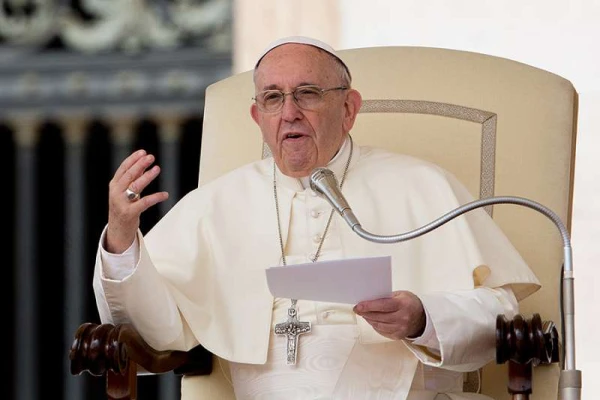
Vatican City, Mar 30, 2020 / 11:16 am (CNA).- In a private letter to an Argentine judge, Pope Francis is reported to have warned that government decisions to prioritize the economy over people could result in a “viral genocide.”
“The governments that face the crisis in this way show the priority of their decisions: the people first. … It would be sad if they opted for the opposite, which would lead to the death of very many people, something like a viral genocide,” Pope Francis wrote in a letter sent March 28, according to America Magazine, which reported it had obtained the letter.
The pope sent a handwritten note in response to a letter from Judge Roberto Andres Gallardo, the president of the Pan-American Committee of Judges for Social Rights, Argentine news agency Telam reported March 29.
“We are all concerned at the increase … of the pandemic,” Pope Francis wrote, while praising some governments for “adopting exemplary measures with priorities that are well targeted at defending the population” and serving “the common good.”
The pope also said he was “edified by the response of so many people, doctors, nurses, volunteers, religious, priests, who risk their lives to heal and defend healthy people from contagion,” Telam reported.
Pope Francis recounted in the letter that he has been in discussions with the Vatican Dicastery for Integral Human Development to “prepare ourselves for what follows” the global coronavirus outbreak.
“There are already some consequences that must be faced: hunger, especially for people without permanent work, violence, the appearance of usurers (who are the true plague of a social future, dehumanized criminals),” he wrote, according to Telam.
The pope’s letter also cited the economist Dr. Mariana Mazzucato, whose published work argues that state intervention can drive growth and innovation.
“I believe [her vision] can help to think about the future,” he wrote in the letter, which also mentioned Mazzucato’s book “The Value of Everything: Making and Taking in the Global Economy,” according to America Magazine.
To combat the spread of the coronavirus, at least 174 countries have implemented COVID-19 related travel restrictions, according to the Center for Strategic and International Studies.
Argentina was one of the first Latin American countries to implement strict coronavirus restrictions prohibiting entry to foreigners on March 17 and implemented a 12-day mandatory quarantine on March 20.
There have been 820 documented coronavirus cases in Argentina and 22 deaths from COVID-19.
“The choice is to take care of the economy or take care of lives. I chose to take care of lives,” Argentine President Alberto Fernandez said March 25, according to Bloomberg.
Global documented coronavirus cases have surpassed 745,000 confirmed cases, of which more than 100,000 cases are in Italy and 140,000 in the United States, reports the Italian Ministry of Health and Johns Hopkins University respectively.
If you value the news and views Catholic World Report provides, please consider donating to support our efforts. Your contribution will help us continue to make CWR available to all readers worldwide for free, without a subscription. Thank you for your generosity!
Click here for more information on donating to CWR. Click here to sign up for our newsletter.


Yet another bold pronouncement from a pontiff who has time and again proven himself a lonely voice crying in the wilderness.
“The choice is to take care of the economy\ or to take care of lives. I chose to take care of lives.”
Very noble, very virtuous, etc.
What does it mean?
Hmmm, Covid19 strikes and kills the elderly and sick, not exclusively the elderly and sick, but generally. I am guessing most were retired or were preparing to retire.
.
Not nearly as many young people have died, but some have.
The shut downs, from what I have seen, tend to attack young adults and young families. Younger people (especially in the West, but it is nearly universal) are already postponing marriages and child-bearing. Calling them “non-essential” and stripping them of their income is cruel as well foolish. It will simply drive down the already fragile birthrates.
.
Anti-Covid19 efforts should not be a This or That, but This and That.
Kathryn,
Yup, it’s not just one or the other. Economic conditions dictate whether people have food and shelter. The lack of those can be fatal too.
Has there been any discussion of the link between a healthy national economy and the resource availability to support the health care system?How much health care can a tanked economy support and for how long?
The closest recent one I have seen is this piece:
https://mises.org/power-market/back-work-america-has-no-choice-if-it-avoid-total-disaster
.
The author references an article on the American Spectator website (to which I do not have access as I have used up my “free articles”.)
.
You might look for articles on Venezuela’s medical system. This is one: https://www.theguardian.com/world/2019/jan/06/venezuela-health-system-crisis-nicolas-maduro
.
From what I have seen on Facebook, pointing out to people that shutting McDonalds down (because it is “non essential”) deprives people of employment does not register. They only think of the teen who lives with Mom and Dad and doesn’t really need the money. They never think of the back operations–the truck drives, and paper product producers, ketchup making factories, etc who are hit.
Oops, mistyped. The referenced article in the mises.org article is not on The American Spectator, but statnews.com
Thanks for the links. As you say, there are a lot of jobs to consider when an economy is forcibly shutdown. The shutdown really puts a strain on small businesses and their employees.
*
It had been my understanding that the health care system in Venezuela was in sorry shape even before the current virus outbreak. Reuters has an interesting article that it published on March 25, 2020. The link is:
*
https://www.reuters.com/article/us-health-coronavirus-venezuela-insight/as-coronavirus-hits-venezuela-maduro-further-quashes-dissent-idUSKBN21C1TA
‘People First’ needs to be our way of proceeding.