No Picture
News Briefs

Pope Francis in Hiroshima: ‘Never again war’
November 24, 2019 CNA Daily News 1

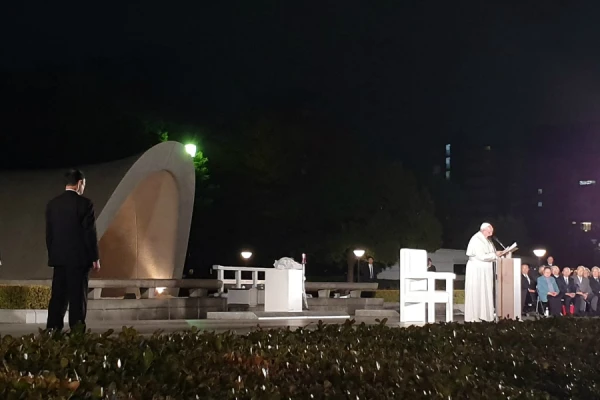
Hiroshima, Japan, Nov 24, 2019 / 05:30 am (CNA).- Pope Francis prayed for peace Sunday at the site of the atomic bomb in Hiroshima, where he called for an end to war and the threat of nuclear weapons.

“How can we propose peace if we constantly invoke the threat of nuclear war as a legitimate recourse for the resolution of conflicts?” Pope Francis said Nov. 24 in Hiroshima’s Peace Memorial Park.

“May the abyss of pain endured here remind us of boundaries that must never be crossed. A true peace can only be an unarmed peace,” the pope said.

On August 6, 1945 American armed forces dropped a uranium atomic bomb dubbed “Little Boy” on Hiroshima, Japan killing an estimated 80,000 people instantly.

More than 90% of Hiroshima’s buildings were destroyed by the blast. By the end of 1945, the death toll rose to 140,000 with people developing intestinal bleeding and leukemia from the residual radiation that followed.

“In a single plea to God and to all men and women of good will, on behalf of all the victims of atomic bombings and experiments, and of all conflicts, let us together cry out: Never again war, never again the clash of arms, never again so much suffering,” Pope Francis said after a moment of silence for the victims of Hiroshima.

“Indeed, if we really want to build a more just and secure society, we must let the weapons fall from our hands,” he said.

Pope Francis quoted Gaudium et Spes, which states that “peace is not merely the absence of war … but must be built of ceaselessly.” He added that the lessons of history show that peace is the fruit of justice, development, solidarity, care for our common home, and promotion of the common good.

“I am convinced that peace is no more than an empty word unless it is founded on truth, built up in justice, animated and perfected by charity, and attained in freedom,” he said.

Within a week of the bombings of Nagasaki and Hiroshima, the Japan announced its unconditional surrender brining World War II to a close on August 15, 1945.

Peace Memorial Park, located on the epicenter of the atomic explosion, opened ten years after the bombing. The Japanese parliament named Hiroshima a “city of peace” in 1949.

“I felt a duty to come here as a pilgrim of peace, to stand in silent prayer, to recall the innocent victims of such violence, and to bear in my heart the prayers and yearnings of the men and women of our time, especially the young, who long for peace, who work for peace and who sacrifice themselves for peace,” Pope Francis said.

“With deep conviction I wish once more to declare that the use of atomic energy for purposes of war is today, more than ever, a crime not only against the dignity of human beings but against any possible future for our common home,” he said.

The pope repeated: “The use of atomic energy for purposes of war is immoral, just as the possession of atomic weapons is immoral, as I said two years ago. We will be judged on this.”

Earlier on Sunday, Pope Francis visited the site of the atomic bombing in Nagasaki where he denounced the ‘unspeakable horror’ of nuclear weapons

“The Catholic Church is irrevocably committed to promoting peace between peoples and nations,” the pope said in Nagasaki.

“Peace and international stability,” he stated, “are incompatible with attempts to build upon the fear of mutual destruction or the threat of total annihilation.”

Twenty survivors of the Hiroshima bombing attended the ceremony. Among them was Kojí Hosokawa, who was less than one mile from the epicenter of the bombing and the only survivor in his building. He is now 91 years old.

“Although there is little time left for me, I believe that passing on the experience of Hiroshima to
the next generation is the final mission assigned to us A-bomb survivors,” she shared at the pope’s peace meeting.

Pope Francis addressed the survivors in Hiroshima: “Here I pay homage to all the victims, and I bow before the strength and dignity of those who, having survived those first moments, for years afterward bore in the flesh immense suffering, and in their spirit seeds of death that drained their vital energy.”

“We cannot allow present and future generations to lose the memory of what happened here,” Pope Francis said.

[…]

No Picture
News Briefs

In Nicaragua, armed mob raids Catholic church hosting anti-government vigil

November 23, 2019 CNA Daily News 0

Managua, Nicaragua, Nov 23, 2019 / 02:01 pm (CNA).- Parishioners holding vigil at a church to pray for detained foes of President Daniel Ortega came under attack from supporters of the government on Thursday.
 
The attackers used clubs, machetes, and metal bars in a Nov. 21 attack at a church in Masaya, about 20 miles southeast of Nicaragua’s capital of Managua.
 
“They came with pipes and machetes, they beat the altar boys and a woman and they had us surrounded in here,” said Father Harving Madina, parish priest of Masaya’s San Juan Bautista Church, the Associated Press reports.
 
Madina and parishioners at  San Juan Bautista had planned to march a few blocks to a nearby church, San Miguel, which is surrounded by pro-government groups. The march was intended to show support for its priest and parishioners on hunger strike seeking the release of relatives they say are political prisoners.
 
Their relatives were detained during protests against Nicaragua’s President Daniel Ortega.
 
A hostile group surrounded San Juan Bautista church as Mass was being celebrated, Father Madina said. The group tried to break through the doors as priests and parishioners used pews to barricade the entrance.
 
One 50-year-old parishioner who tried to stop the assailants was beaten by several people who then handed him over to onlooking police, who did not intervene during the disturbance.
 
Anti-government protests in Nicaragua began in April 2018. The crackdown from security forces and pro-government militias resulted in more than 320 deaths last year, with 2,000 injured and tens of thousands fleeing the country as refugees.
 
Modest pension reforms triggered the unrest but protests quickly turned to objections to what critics said was Ortega’s authoritarian bent.
 
Ortega, who previously led the country for over a decade after the Sandinistas’ 1979 ouster of the Somoza dictatorship, has been president of Nicaragua since 2007, and oversaw the abolition of presidential term limits in 2014.
 
The Catholic Church had suggested that the elections scheduled for 2021 be held this year, but Ortega has ruled this out.
 
Ortega’s backers have said that a demand for the president to leave office early and to hold early elections are tantamount to a coup attempt. Some have labeled the protesters as terrorists, the Associated Press reports.
 
Ortega’s government has accused many bishops and priests of supporting the opposition.
 
Rosario Murillo, Nicaragua’s vice president and Ortega’s wife, criticized “those who claim to speak in the name of the faith,” calling them “repugnant wolves who spread hatred.”
 
The San Miguel protest vigil began Nov. 14. Authorities cut off electricity and water to the church. The National Police surrounded the building, threatening to enter by force to end the demonstration.
 
Thirteen people who tried to bring water to the demonstrators Nov. 14 were arrested. They were charged Nov. 18 with weapons transport. Police say the 13 people were carrying guns and bombs, and charged that they intended to “continue carrying out terrorist acts … against police buildings, city halls and monuments.”
 
A group of priests tried to enter San Miguel church Nov. 15, but police held them back. The health of at least three protesters there is reported to be in decline.
 
Cardinal Leopoldo José Brenes Solorzano of Managua has condemned the National Police’s “siege and intimidation” of the Masaya hunger strikers and their pastor, Fr. Edwin Román.
 
The cardinal called on the national police to respect “the free movement to demonstrate” and “the exercise of religious freedom.”
 
On Nov. 18 a different pro-government group invaded Managua’s Immaculate Conception Cathedral to pursue seven mothers of detained anti-Ortega protesters who had entered the cathedral to pray.
 
The mothers removed themselves to another part of the cathedral.
 
According to the archdiocese, a violent group “related to the government” entered and took control of the cathedral. When a priest and a nun tried to rebuke them, members of the mob beat them. The two were not seriously injured but had to leave the church to protect themselves.
 
Msgr. Carlos Avilés, vicar general of the Archdiocese of Managua, said the group was backed by the police.
 
The mothers took shelter in the cathedral overnight, and were then evacuated Nov. 19 in a Red Cross ambulance, as part of a deal negotiated by Archbishop Waldemar Sommertag, apostolic nuncio to Nicaragua. The invading group later gave up control of the cathedral.
 
The Nicaraguan bishops’ conference expressed “profound concern” Nov. 19 over the “indifference of the state for the rights of Nicaraguans who are expressing their sorrow and their needs.”
 
The bishops called on “those responsible for these sieges to change their stance.”
 
Nicaraguans have suffered too much pain,” they continued. “The besieged families suffer doubly: the lack of freedom for their incarcerated family members and, now, the state of siege that threatens their lives. We call on the government to hear their petitions which are at the same time their rights.”
 
The Managua archdiocese also asked Ortega to “take immediate action that all our Catholic churches are respected.”

[…]

No Picture
News Briefs

How Ashley Stricklin found the Catholic Church at her Baptist college

November 23, 2019 CNA Daily News 1

Washington D.C., Nov 23, 2019 / 06:50 am (CNA).- Ashley Stricklin says she had a typical Texan upbringing. She was raised a Southern Baptist in a town outside of Dallas, with a family who was active in her church. Her father was a deacon in their Baptist church, and she accepted Jesus into her heart when she was nine.

Although Stricklin lived near a Catholic church, she had never been inside it, nor did she really know any Catholics–that is, until she went off to Baylor University, one of the largest Baptist-affiliated universities in the world. There, she met faithful Catholics, and embarked on a long, and at times even secretive, journey into the Catholic Church.

The Catholics Stricklin met at Baylor were “always so joyful,” which prompted her to begin to wonder what exactly was so different between the Catholic faith and the faith she was raised in. Despite her faithful Baptist upbringing, Stricklin said that she always felt as though “something was missing,” in her life, but could not quite put her finger on it.

Her new Catholic friends invited her to Eucharistic adoration, which was the first time Stricklin had ever seen the Blessed Sacrament–and she began to see exactly what she had been missing.

After that, everything changed, and she says she “started her journey” toward Catholicism. Three years later, that journey would reach a milestone, when she was received into the Church on April 28, 2019–Divine Mercy Sunday.

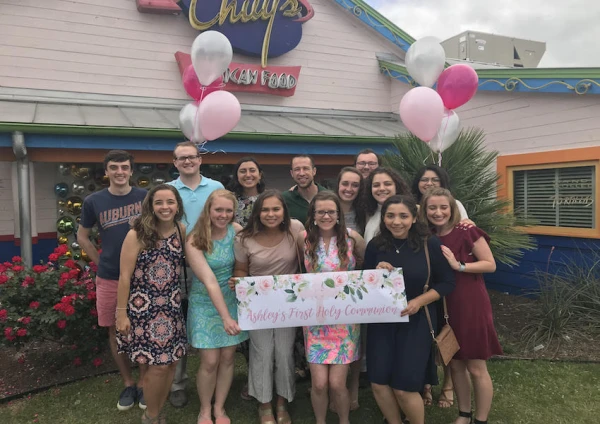
Stricklin received her first communion and confirmation at St. Peter’s Student Center, which is a campus ministry of the Diocese of Austin for students of Baylor University and nearby colleges.

Like many new Catholics, there were significant hurdles that Stricklin had to overcome before being received into the Church–both in the doctrinal sense and in the personal. For Stricklin, it was easy for her to come to accept teachings she had previously believed were wrong, such as the Immaculate Conception of Mary and Mary’s role as mediatrix of grace.

“I actually did a Marian consecration before I was confirmed,” said Stricklin. “And so it just went full circle for me.”

It was the reaction of her Baptist parents, however, that proved to be one of Stricklin’s biggest anxieties before entering the Church. Although Stricklin knew from early on in college that she wanted to become Catholic, she delayed entering the Church until her senior year, because she was afraid of how they would react.

“I definitely thought my parents were going to disown me,” Stricklin said. “That’s why I waited until I was a senior, because I didn’t think my parents would continue to pay for college.”

In the meantime, Stricklin read book after book about Catholicism, nearly exhausting the Baylor library’s section on Catholicism. She read everything from “Rome Sweet Home” to the “Summa Theologica,” eventually concentrating on conversion stories and books about the Eucharist.

Still, she kept all of her religious curiosity and plans a secret from her parents–for three years.

“I would hide my books,” she said. “I cleaned my (web) browsers, which was really not a good idea looking back now.”

Fearful still of her parents’ rejection, Stricklin waited until just two months before her First Communion and Confirmation to tell them what she was planning on doing. To her astonishment, while they were certainly taken aback, they neither abandoned her nor cut her off.

“I told my mom in February and she thought I was joking, like she just thought it was a joke,” she said, laughing. “I was like, ‘Oh no, mom, it’s not a joke.’”

Despite her fears, Stricklin’s mother attended her First Communion, and her father is supportive of her religious journey, both of which were pleasant surprises. Her grandparents, however, still do not know she has converted.

Stricklin chose St. John Paul II as her confirmation saint, something that she was hesitant to do as she thought it would reveal that she was a convert. Eventually, she realized this was silly, and went with him anyways. She said she chose St. John Paul II due to both her interest in Eastern Europe, and because she found his papacy and writings to be “truly inspiring.”

Stricklin is now a student at Creighton University School of Law, where will graduate in 2022. About seven months into her new journey as a fully-initiated Catholic, Stricklin remains intrigued and fulfilled by the Eucharist, and she continues to delve more into her faith.

After initially being intrigued by the Eucharist at her first-ever adoration, Stricklin says now that she considers the sacrament to be “such a joy” and that she eagerly looks forward to receiving it. And despite her initial troubles, fears, and everything else associated with the process of converting to Catholicism, she says things have been smooth sailing.

“It’s been an interesting journey, and each day I just continue to strive for sainthood and just keep trying to increase and my relationships with God, so, yeah, it’s been good,” she said. “It’s been a cool journey so far.”

This story is part of a CNA series profiling new converts to the Catholic faith.

[…]