No Picture
News Briefs

German bishops will light ‘Synodal Candle’ to launch controversial process  
November 25, 2019 CNA Daily News 2

Bonn, Germany, Nov 25, 2019 / 12:55 pm (CNA).- The German bishops’ conference announced Monday that a ceremonial “Synodal Candle” will be lit on the first Sunday of Advent to officially launch the nation’s “synodal process,” which is scheduled to run over two years and pass resolutions about Church life in Germany.

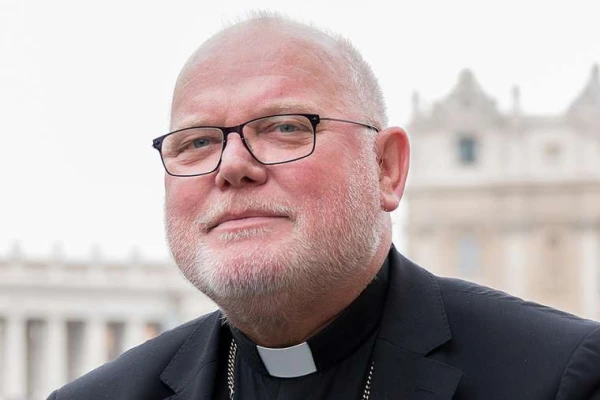
The launch ceremony will be hosted by Cardinal Reinhard Marx, who will light a candle together with lay leader Karin Kortmann in Munich’s famous Frauenkirche, or “Cathedral of Our Dear Lady.”

Draft statutes of the – no longer binding – “synodal process”  were approved Nov. 22 by a majority of the Central Committee of German Catholics (ZdK) at the lay group’s plenary assembly.

During deliberations, a motion to amend the statutes to include a focus on evangelization was rejected.

CNA Deutsch, CNA’s German language news partner, reported Nov. 25 that ZdK member Karl zu Löwenstein reminded fellow delegates of Pope Francis’ call for a new evangelization during Nov. 22 deliberations regarding the synod. Before debating and passing resolutions about the structure of the Church, one should first put Christ’s message at the center, he argued.

However, two vice presidents of the lay Catholic organization disagreed. Both Claudia Lücking-Michel and Karin Kortmann, both German politicians, argued that any amendment would delay the start of the synodal process.

The German bishops had initially planned a “binding” synodal process for German Catholics, which would pass normative resolutions on moral and ecclesiastical issues. But a Vatican intervention raised concerns that the proposed process constituted a particular council, and could not take place without permission from the Vatican. After that intervention, the initial draft statues were amended to ensure they were no longer canonically binding.

On a visit to German last week, Cardinal Robert Sarah expressed concerns about the planned synod.  Sarah has gone so far as to offer a special prayer for the Church in Germany, given developments there, warning “If a synod aims to change the doctrine of faith, then it is no longer a synod.”

In an unusual move, Pope Francis in June personally wrote a letter to all German Catholics, warning of meaningless structural maneuvering and reiterating a call to evangelization ahead of the announced process.

In addition to concerns about a lack of focus on spreading the Gospel, the actual agenda of the process – which exclusively targets the topics of sexual morality, power and ecclesial offices – and public demands of the ZdK for the blessing of homosexual couples and the ordination of women, have come in for sharp criticism from noted theologians
 

CNA Deutsch contributed to this report.

[…]

No Picture
News Briefs

AMA supports federal ban on ‘conversion therapy’

November 25, 2019 CNA Daily News 4

San Diego, Calif., Nov 25, 2019 / 12:01 pm (CNA).- The American Medical Association announced last week that it had adopted a number of new policies, including advocacy for a federal ban on “so-called reparative or conversion therapy for sexual orientation or gender identity.”

During the AMA interim meeting held in San Diego, the group’s policy-making body chose to “develop model state legislation” to ban health care providers from efforts to change sexual orientation or gender identity,” the group said in a Nov. 19 statement.

“The support for legislative bans strengthens AMA’s long-standing opposition to this unscientific practice,” the medical association said.

Dr. William Kobler, an AMA board member, said that “conversion therapy has no foundation as scientifically valid medical care and lacks credible evidence to support its efficacy or safety” and that “it is clear to the AMA that the conversion therapy needs to end in the United States given the risk of deliberate harm to LGBTQ people.”

According to the group, conversion therapy for minors has been banned by 18 states and the District of Columbia.

One of the most recent states to have adopted such as ban is Massachusetts. Its law was signed in April.

The Massachusetts Catholic Conference opposed the legislation, saying it “attempts to create a solution to a problem which does not exist,” adding that it will “deny the right of parents to engage therapists who could help their child who is experiencing gender dysphoria and is confused and uncomfortable with this experience.”

Massachusetts’ law defines the banned activities as “any practice by a health care provider that attempts or purports to impose change of an individual’s sexual orientation or gender identity, including but not limited to efforts to change behaviors or gender expressions, or to eliminate or reduce sexual or romantic attractions or feelings toward individuals of the same sex.”

Under the law, health care professionals will be permitted to “provide acceptance, support, and understanding” of a minor’s sexual orientation, gender identity, or gender expression, to “facilitate an individual’s coping, social support and identity exploration and development”, or seek “to prevent or address unlawful conduct or unsafe sexual practices”, as long as they “do not attempt or purport to impose change of an individual’s sexual orientation or gender identity.”

The Massachusetts Catholic Conference said the law is unnecessary because “licensed clinical professionals are highly trained in their field and guided by ethical principles.”

It noted that minor who has “unwanted same sex attraction or gender identity, this law would prevent a licensed professional from counseling the minor towards a resolution to those unwanted urges … these professionals, with years of education and experience dealing with mental health issues, would be removed from the process of helping a young client struggling with these highly personal issues.”

The Heritage Foundation’s Ryan Anderson told CNA the Massachusetts law “imposes an ideological ban because the state disagrees with the viewpoint of certain professionals. It’s not targeted at harmful practices, but at particular values.”

A 2009 American Psychiatric Association task force recommended that the appropriate response to those with same-sex attraction involves “therapist acceptance, support, and understanding of clients … without imposing a specific sexual orientation identity outcome,” and that efforts to change orientation “involve some risk of harm.”

The APA considered homosexuality to be a mental disease until 1973. A former president of the APA said in a 2012 video interview that within the organization, political stances “override any scientific results.”

During its interim meeting, the AMA also adopted policies promoting “fully incluvise [electronic health records] for transgender patients” and encouraging “medical education accreditation bodies to both continue to encourage and periodically reassess education on health issues related to sexual orientation and gender identity in the basic science, clinical care, and cultural competency curricula.”

[…]

No Picture
News Briefs

Pope Francis meets the Japanese Emperor, who, like the pope, came after an unexpected resignation

November 25, 2019 CNA Daily News 3

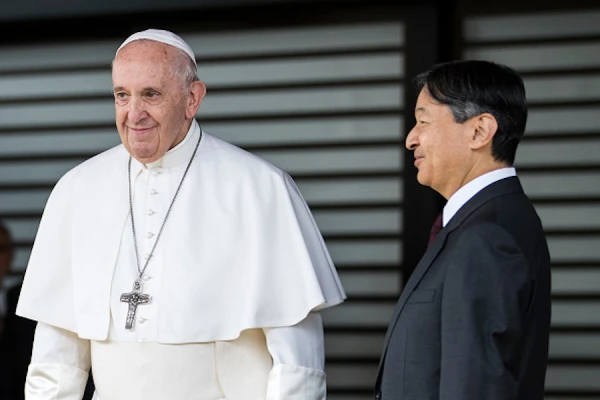
Tokyo, Japan, Nov 25, 2019 / 09:00 am (CNA).- Pope Francis met Monday with Emperor Naruhito of Japan. It was the first meeting of the two less than two weeks since Naruhito completed the rituals that made him the newest emperor in the world’s oldest continuous hereditary throne.

Pope Francis is on his first visit to Japan, a country he’s desired to experience since he was in seminary. The trip lasts from Nov. 23-26.

The relationship between the Holy See and Imperial Household has been a strange one, but the papacy has a surprising amount in common with the Japanese imperial throne. And Pope Francis and Emperor Naruhito share similar stories about their rise to positions of leadership.

On Monday, the pontiff and the emperor reportedly greeted each other in Spanish, Pope Francis’s native language.

The meeting lasted approximately 30 minutes, after which Pope Francis moved on to St. Mary’s Cathedral in Tokyo to speak to Japanese youths.

Naruhito broke with Japanese imperial protocol by personally escorting the pope to his car after their conversation. The emperor is generally expected to stay inside his palace.

That decision speaks to the personal relationship between the two rulers, who have been openly supportive of each other in the past.

Earlier in the year, Pope Francis sent a letter of congratulations to Naruhito, wishing him luck in his governance.

The pope also sent a Vatican representative to the ceremony and celebratory banquet of the Emperor’s ascension to the throne last month.

Much as Pope Francis became the pontiff after the unexpected resignation of Pope emeritus Benedict XVI, Naruhito rose to the Chrysanthemum Throne after the sudden resignation of Emperor Emeritus Akihito, his father.

Pope Francis was the first pope to follow a resignation since 1417, and Emperor Naruhito was the first to become emperor through similar means since 1817.
Emperor Emeritus Akihito’s resignation was the first since the establishment of the 1947 Japanese Constitution, and surprised the nation.

Both resignations brought some criticism from traditionalists.

Although the Emperor is the highest priest of the Shinto religion, the Imperial Family has in the past had Catholic members.

The Emperor’s own mother, Michiko, was raised in a Catholic family and attended Catholic schools in her youth. She has not openly practiced Catholicism since before she married Emperor Emeritus Akihito.

Additionally, the late Prince Asaka converted to Roman Catholicism in 1951, after the close of the Second World War, and practiced the faith until his death in 1951.


[…]

No Picture
News Briefs

Economics must prioritize human dignity, pope tells Japanese authorities

November 25, 2019 CNA Daily News 1

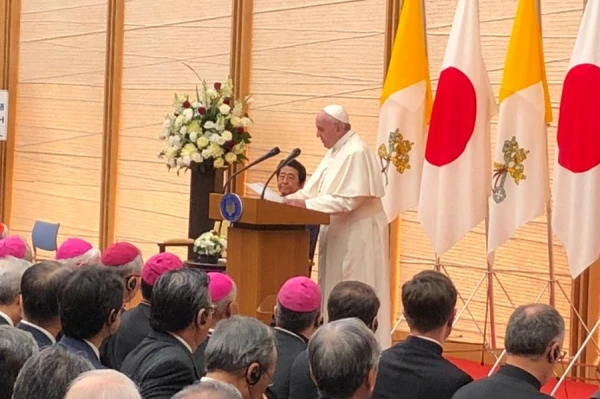
Tokyo, Japan, Nov 25, 2019 / 03:34 am (CNA).- In the measure of a country, concern for human dignity and life is more important than economic strength, Pope Francis told Japanese authorities, civil servants, and diplomats Monday in Tokyo.

“Human dignity, needs to be at the center of all social, economic and political activity,” he said Nov. 25 at the prime minister’s official residence of Kantei.

He also said intergenerational solidarity and concern for the forgotten and excluded should be fostered, pointing in particular to the young, the elderly, and the lonely.

“We know that,” he added, “in the end, the civility of every nation or people is measured not by its economic strength, but by the attention it devotes to those in need and its capacity to be fruitful and promote life.”

In a change from the usual protocol, Pope Francis met with the prime minister and authorities of Japan at almost the end of his trip, rather than the beginning.

He also met with Emperor Naruhito Nov. 25.

The pope’s first full day in Japan was instead spent visiting Nagasaki and Hiroshima, where he spoke against nuclear weapons and honored the Japanese martyrs of the 17th and 18th centuries.

His visit to Japan was the second leg of a six-day trip to Asia, which began in Thailand Nov. 20-23.

Pope Francis urged authorities in Japan to include human ecology in their efforts to protect the environment, including “confronting the growing gap between rich and poor in a global economic system that enables a select few to dwell in opulence while the majority of the world’s population lives in poverty.”

He used the delicacy of Japan’s beautiful cherry blossom to illustrate the fragility of the common home to natural disasters and “to greed, exploitation and devastation at the hands of human beings.”

As a young Jesuit in Argentina, Pope Francis was inspired by the example of the first missionaries to Japan, such as St. Francis Xavier, and wanted to go to the country as a missionary, though he was prevented for health reasons.

“In these days, I have experienced and have come to esteem once more the precious cultural heritage that Japan throughout many centuries of its history has been able to develop and preserve, and the profound religious and moral values that characterize this ancient culture,” he said.

Praising the beauty of the country, he quoted the Jesuit missionary Alessandro Valignano, who wrote in 1579: “Whoever wishes to see what our Lord has bestowed upon man need only come to Japan to see it.”

He praised Japan’s attention to the suffering of the less fortunate, the handicapped, and the disabled.

Pope Francis also said that the purpose of his trip was “to confirm Japanese Catholics in their faith, their charitable outreach to those in need and their service to the country of which they are proud citizens.”

Before the meeting with authorities, Pope Francis celebrated Mass for 50,000 people in the Tokyo Dome. Present at the Mass was ex-death row inmate Iwao Hakamada.

Hakamada, 83, was released from death row after 48 years. A boxer, he had been convicted in 1966 of a quadruple murder but was released in 2014 when new DNA evidence led to a suspension of his sentence. He is currently awaiting retrial by Japan’s supreme court.

Hakamada was baptized in prison on Christmas Eve 1984. The Catholic bishops of Japan invited Hakamada to attend the papal Mass Nov. 25.


[…]