
No Picture
News Briefs

How the blind can ‘see’ Our Lady of Guadalupe in Mexico
December 12, 2019 CNA Daily News 0

Mexico City, Mexico, Dec 12, 2019 / 07:10 pm (CNA).-

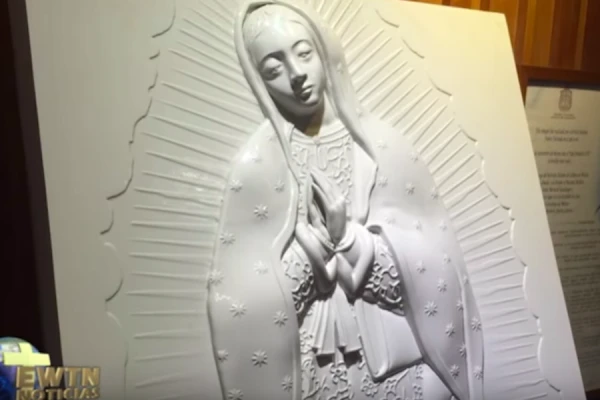
Just inside the entrance to the Basilica of Our Lady of Guadalupe in Mexico City is a small area with a bas-relief sculpture of the Virgin Mary on display, designed especially for the blind to encounter Our Lady.

Fr. Umberto Mauro Marsich, an Italian Xavarian missionary priest, explained to ACI Prensa, CNA’s Spanish language news partner, that the image is made of highly durable nylon fiber and is a gift from the Institute of Italian Culture and the Italian Embassy.

The sculpture is a “gift to the Archdiocese of Mexico so the blind can come here” and venerate Our Lady of Guadalupe, he said.

“They first read the entire description in Braille, the Nahuatl symbology of the image” on a panel to the side, “and then they come over and touch the image with their hands,” he explained.

Marsich, who holds a doctorate in moral theology and teaches at the Pontifical University of Mexico, played a key role in having the image of Our Lady of Guadalupe for the blind made and donated.

The idea came about in 2008 during an exposition of a painting of the Virgin de la Pera in Mexico which was brought to the country along with a much simpler bas-relief version.

The head of an association for the blind was in attendance at the exposition. When he touched the bas-relief image he said, “Why can’t we do something similar with Our Lady of Guadalupe?”

Fr. Marsich, who was also there at the time, said he worked with two other Italians to have a bas-relief of Our Lady of Guadalupe made.

“My friend Faranda went back to Italy and looked for people to make donations” for the work of art, Marsich said.

The sculpture was produced in the city of Faenza, Italy, in 2009. It cost about $22,000 to make.

A few days after its completion, it was brought to Saint Peter’s Basilica in the Vatican, where Pope Benedict XVI blessed it. It was then transported to Mexico and placed in the Guadalupe Basilica on Dec. 9, 2009.

More than 100 visually-impaired people gathered on the day the statue was installed in the basilica. Marsich said he was touched by their emotion, as, “finally being able to touch her, [they] discovered the beauty of the message conveyed to them by the Nahuatl symbology, which is a very luminous symbology.”

“People were so obviously moved that they were weeping,” he recalled.

However, the image is not just to be contemplated by visually impaired people, he pointed out.

The priest stressed that everyone can express “in some way our affection, our love, our tenderness for Mary, the Virgin of Guadalupe.”

Marsich hopes other bishops will be encouraged to ask for a replica of the image of the Virgin Mary for their dioceses, which he said would cost significantly less than the original.

 

[…]

The Dispatch

The New Attack on Christmas

December 12, 2019 Dale Ahlquist 7

One hundred years ago—on December 27, 1919—G.K. Chesterton wrote about “the new attack on Christmas.” We should probably discuss the old attack on Christmas before we talk about the new attack. The old attack on […]

No Picture
News Briefs

International pro-choice groups launch abortion hotline for Poles

December 12, 2019 CNA Daily News 0

Warsaw, Poland, Dec 12, 2019 / 03:42 pm (CNA).- A coalition of abortion advocacy groups has launched a hotline service to inform Polish women on how to procure abortion inside and outside of the largely pro-life country.

“Abortion without Borders” was released Dec. 11 by a collaboration of six pro-abortion organizations, including Abortion Dream Team, Kobiety w Sieci, and the Abortion Support Network.

The service will advise callers on how to purchase abortion drugs online or refer them to abortion clinics in the Netherlands, Britain, or Germany. The project will also provide financial assistance to women unable to afford the process. According to the Guardian, this may cover travel and medical costs.

The project will be offered to women seeking an abortion in Poland, which has some of the most pro-life laws in Europe. The country bans abortion except in cases of fetal abnormalities, rape, incest, or life-threatening emergencies.

According to Thomas Reuters Foundation News, official figures state that about 1,000 women receive an abortion in Poland each year, but abortion advocates believe the number to be much higher. They estimate that tens of thousands of women receive an abortion annually through abortion drugs ordered online or by traveling to other countries to get the procedure.

Last month, Poland was among 11 countries affirming the univeral right to life on the sidelines of the Nairobi Summit, saying the gathering was too focused on “reproductive rights.”

The joint statement said “there is no international right to abortion; in fact, international law clearly states that ‘[e]veryone has the right to life’ (e.g. Article 3 of the Universal Declaration of Human Rights).”

“The ICPD notes that countries should ‘take appropriate steps to help women avoid abortion, which in no case should be promoted as a method of family planning’ (ICPD 7.24) and to ‘reduce the recourse to abortion’ strongly affirming that ‘… [a]ny measures or changes related to abortion within the health system can only be determined at the national or local level according to the national legislative process’ (ICPD paragraph 8.25).”

The bishops of Poland issued a pro-life statement in 2018 after the “Halt Abortion” bill was approved by the parliamentary Committee on Justice and Human Rights. If passed, the law would prohibit the practice of eugenic abortions – those procured because of an unborn child’s congenital disorder or genetic deformity.

“Every conceived child has the right to birth and to life, regardless of innate diseases and genetic defects. The role of the state is to provide protection for every citizen, also in its first stage of life,” said Archbishop Stanislaw Gadecki of Poznan, president of the Polish bishops’ conference.

“The right to life is a fundamental human right, there is no doubt in this matter,” Archbishop Gadecki added in a recent statement.

[…]