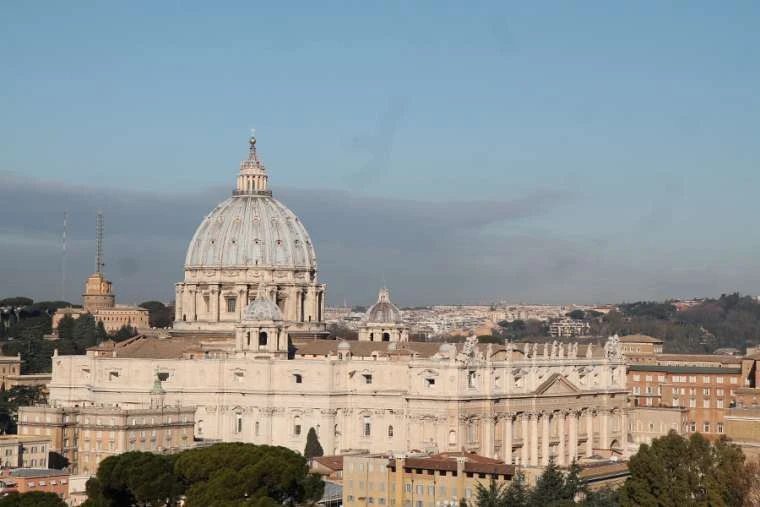
 St. Peter’s Basilica. / Bohumil Petrik/CNA
Vatican City, May 15, 2021 / 03:00 am (CNA).
In 2015, facing scandals in the healthcare sector, Pope Francis established a Pontifical Commission for the Activities of the Public Juridical Persons of the Church in the Healthcare Sector. The board of the Commission was renewed in June 2020. However, there is no trace of the Commission in the Annuario Pontificio.
The absence of the commission is striking, especially considering it has a dedicated page on the Vatican website. Even so, it is not among the organs listed in the Roman Curia page on the Vatican website.
The commission was designed as an organ of the Roman Curia, attached to the Secretariat of State and its regulations. The commission’s objective was to control and supervise how the health facilities managed by religious congregations manage money and assets.
The Ccmmission was established in 2015, following a series of scandals that affected some Catholic healthcare facilities.
The most important is known that of the crack of the IDI, the Dermopathic Institute of the Immaculate, which had found itself 800 million euros in debt due to systematic embezzlement of funds by some administrators and had had to declare bankruptcy in 2012. In 2015, the Secretariat of State acquired the hospital, pulling it out of the bankruptcy administered by the Italian state, through a for-profit partnership with the religious order that had owned and managed the hospital.
Recently, the Fatebenefratelli Hospital on Tiber Island risks being sold after another financial crash.
Not to mention the case of the Camillians, an order that manages 114 hospitals in the world, founded by St. Camillus de Lellis in the 16th century with the specific task of “giving complete service to the sick person” and “being a school of charity for those who share the mission of assistance to the sick.”
In 2013, Fr. Renato Salvatore, superior of the Camillians, was arrested because he organized the kidnapping of two Camillians friars to be re-elected as general superior. Fr. Salvatore wanted to secure the re-election to keep control over the Hospital of Santa Maria della Pietà in Casoria, near Naples.
When Pope Francis established the commission in 2015, he stressed that its aim was that of “contributing to the more effective management of activities and the conservation of assets while maintaining and promoting the charism of the founders.”
The board of the commission was appointed in 2015 and renewed in June 2020. The president is still the same: Monsignor Luigi Mistò, president of the Holy See’s Health Assistance Fund, is president.
Msgr. Segundo Tejado Muñoz, the undersecretary of the Dicastery for Promoting Integral Human Development, joined the commission to replace Msgr. Jean-Marie Mupendawatu, who was secretary of the Pontifical Council for Healthcare Workers until its suppression and absorption into the integral human development dicastery.
Out Mariella Enoc, president of the Bambino Gesù Pediatric Hospital board, owned by the Holy See. Still, Giovanni Barbara, professor of commercial law, a consultant to Mariella Enoc, joined the Commission.
Other members: Renato Balduzzi, full professor of Constitutional Law at the Catholic University of the Sacred Heart in Milan and former Minister of Health in the Monti government; Fabrizio Celani, national president of the Catholic Association of Healthcare Workers; Maurizio Gallo, entrepreneur in the consulting and institutional relations sector and also involved in the Centesimus Annus Pro Pontifice Foundation; and Saverio Capolupo, tax magistrate.
On Feb. 16, 2019, Pope Francis appointed Capolupo as a consultant for the Vatican City State, particularly for the structures provided for by the state’s legal system in economic, tax, and fiscal matters. Capolupo, among other things, was called to chair the Luigi Maria Monti Foundation, which manages the IDI, after the foundation had been led for a concise period by a son of the Congregation of the Immaculate Conception who had founded the hospital, Father Giuseppe Pusceddu.
Sister Annunziata Remossi, an official of the Congregation of Institutes of Consecrated Life and Societies of Apostolic Life, was confirmed as secretary of the commission. At the same time, Fr Marco Belladelli, ecclesiastical assistant of the Catholic Union of Italian Pharmacists, was appointed director of the Commission Office, “With the right to participate, with voice and vote, in the activities of the same.”
All names that stood to testify how the commission’s work should continue and continue with experts.
There are various hypotheses for why the commission is not included in the Pontifical Yearbook, all speculations.
The first is that being an active commission until the pope decides otherwise is not considered an organ of the Curia in all respects, even though the statutes say the opposite.
The second is that the Vatican does not want to publicize the commission’s work too much, considering that it must intervene in challenging and complex situations.
The third is that the commission is not considered active because the meetings have almost not taken place – according to a source familiar with the commission, the board met twice and virtually after the new membership was announced.
However, it remains a mystery why such an organ is not present in the 2020 pontifical yearbook.

[…]



Oops. Yes it does. What a terrible place to be in that you are suffering so greatly that the best option seems to be to end your own life and the best a priest can come up with is to hold your hand. Seems the Archbishop would rather be a social worker or maybe he is actually a secular catholic and doesn’t believe anymore. Love does not mean approving anything a person does. You can’t cut them off either so I guess you just have to do the hard thing of presenting the truth to them with Love. Much easier to just go along of course and Archbishop Paglia recommends. Somehow I just don’t recall and Bible stories of Jesus holding someone’s hand while they commit suicide and ii have yet to come across any of the Saints that this was their charism. Lord send us Holy Priests.
The wheels are totally off the buggy!
Jesus did not hold Judas’s hand.
First reaction was? But than as I read the Archbishop reasoning it made sense what Jesus would do. He never abandons us and if that dying person wants to repent can’t he do so as any dying person who asks too? The priest acts in Jesus name to do this. The Archbishop does not encourage or condone suicide assisted or not. He makes that clear but will not abandon anyone in leaving this life. Don’t recall any suicides in bible except Jesus betrayer but again he did not seek forgiveness and made his choice.
Jan, the chronology of events would make a huge difference in this question. If someone had previously taken a lethal dose of medication & was
*irreversibly* in the throes of death & wanted to make a confession, etc, that would be one thing.
If a priest is passively holding the hand of someone whilst in the process of suicide/euthanasia & not attempting to stop or reverse it, he’s complicit in that sin.
“Assisted suicide” prescriptions can come with anti-nausea medications which arrest the body’s natural reflex to vomit some drug overdoses. Overdoses can be treated if caught in time.
A priest should not sit by, passively holding the hand of one slitting his wrists or committing suicide through overdose or any other method.
The curia of Francis.