No Picture
News Briefs

Prison ministry includes helping people after incarceration, Pope Francis says

November 8, 2019 CNA Daily News 0

Vatican City, Nov 8, 2019 / 11:01 am (CNA).- In addition to looking after the physical and spiritual needs of those in prison, Catholics have an obligation to recognize the humanity of those who have left the prison system and to help them get back on their feet, Pope Francis said Friday.

“As Christian communities, we must ask ourselves a question” about those who have been released from prison, the pope said Nov. 8, addressing Catholics involved in prison ministry around the world.

“If these brothers and sisters have already paid the penalty for the wrongdoing, why is a new social punishment placed on their shoulders with rejection and indifference? On many occasions, this social aversion is one more reason they run the risk of repeating their own faults,” he said.

Often when a person leaves prison, he or she finds themselves in a world which is foreign to them and which, at the same time, does not trust them, the pope continued. This can make it very difficult for them to find work and to make a decent living.

“By preventing people from regaining the full exercise of their dignity, they are once again exposed to the dangers that accompany the lack of development opportunity, in the middle of violence and insecurity,” Francis stated.

“True social reintegration,” he argued, begins with access to decent work, education, self-development opportunities, and health care.

But it is often easier and more comfortable to ignore or deny the injustices present in society than to try to create equal opportunities for all citizens, he said, calling it “a way of discarding.”

He said this is the same reason many places choose incarceration as a solution over trying to fix the root societal problems which lead people to crime.

Especially today, he said, societies are called to overcome the stigmatization of people who have served time in prison for their mistakes.

“Because instead of offering the right help and resources to live a dignified life, we have become accustomed to rejecting,” he underlined, and people do this instead of looking for and noticing what effort a person might be making to respond to the love of God in his or her life.

Pope Francis spoke about ministering to the imprisoned during an audience with participants in a two-day conference on Catholic prison ministry, organized by the Dicastery for Promoting Integral Human Development.

The pope said he entrusted to the dicastery the task of making evident the Church’s concern for those in situations of suffering, including the imprisoned, but added that “it is not a task indicated only for the dicastery, but it is for the whole Church in fidelity to the mission received from Christ.”

The Church “is called to act permanently the mercy of God in favor of the most vulnerable and helpless in whom Jesus himself is present,” he said. “We will be judged on this.”

The conference took place at the Vatican Nov. 7-8 and was held to learn more about diocesan and local prison ministry in countries around the world, so that they can strengthen and improve through sharing ideas and experiences.

Pope Francis argued that prisons themselves also fail to properly reintegrate people into society, because they lack the resources to address the social, psychological, and relational problems imprisoned people often face.

Prison verpopulation is also a problem, he noted.

Pope Francis thanked those who serve the incarcerated, noting Christ’s words that “what they did to one of the least of my brothers, they did to me.”

“With the inspiration of God, each Church community is taking its own path to present the Father’s mercy to all these brothers, and to make resonate a permanent call, so that every man and society seeks to act firmly and decisively in favor of peace and justice,” he said.


[…]

No Picture
News Briefs

Don’t use ’tragic case’ to legalize assisted suicide, UK group says

November 7, 2019 CNA Daily News 1

London, England, Nov 8, 2019 / 12:09 am (CNA).- An anti-euthanasia group in the UK is calling for the continuation of laws against assisted suicide, as the family of an elderly woman acquitted of murdering her husband wants the laws relaxed.

“It is sad to see this case being used to try and justify a campaign to rip up long held universal protections, by treating those who are terminally ill, disabled, or have chronic conditions differently in law,” said Dr. Gordon Macdonald, chief executive of Care Not Killing.

“We know from the handful of places that have made such a change vulnerable people often feel pressured into ending lives prematurely.”

A jury cleared Mavis Eccleston, 80, of the murder and manslaughter of her husband Dennis, 81, in September, the BBC reports.

Mavis was accused of giving her husband a lethal dose of prescription medicine without his knowledge in a February “mercy killing.”

The Suicide Act 1961 makes it illegal to encourage or assist a death in England and Wales, the BBC reports. In 2015 the U.K. parliament rejected a bill that would have legalized assisted suicide for patients with a terminal diagnosis.

Mavis told jurors that she and her husband had both intended to take their lives with the medication, and that they had decided to do so after Dennis’ diagnosis of terminal cancer.

The couple was found in their apartment by family members on Feb. 19, 2018, after they had taken the drugs. The couple was rushed to the hospital and given an antidote to the medication. Mavis survived; Dennis did not.

The couple’s daughter Joy Munns said her mother “should never have been charged with murder,” and is calling for a change in the UK’s so-called assisted dying laws.

“My dad wanted to die at home with his family around him. He wanted to go and not suffer the pain that he did,” Munns told the BBC.

Other countries such as Belgium, the Netherlands and Canada have legalized assisted suicide, and Macdonald notes that negative effects of these legal decisions are already being demonstrated there.

In Canada, he said, which only changed the law in 2016, improvements to palliative medicine have not materialised, courts have extended assisted suicide to those with chronic conditions that are not terminal, and some patients are denied medical care and instead offered lethal drugs.

He also highlighted the case of a Belgian woman, Godelieva De Troyer, who was physically healthy but suffered from depression for a majority of her life and the Belgian state euthanised her in 2012 “without consulting either her son, or the psychiatrist who had cared for her for more than 20 years.”

A Belgian report on euthanasia in 2016-17 suggests that an estimated six people are euthanized daily in the country, where the practice has been legal since 2002.

“In the Netherlands, there was a case of a 74-year-old who was suffering from Dementia who was killed in 2016. The doctor allegedly failed to verify that the woman wanted to end her life, sedated the woman and asked her family to hold her down as she administered the lethal drug,” Macdonald said.

“These cases and many others show how assisted dying laws are operating way beyond their original remit and how patients who are not mentally competent are being killed on a regular basis.”

According to the U.K.’s National Health Service, euthanasia could be prosecuted as murder or manslaughter and carries a maximum sentence of life imprisonment, while physician-assisted suicide carries with it a maximum punishment of 14 years imprisonment.

The Catechism of the Catholic Church states that suicide and cooperation in suicide are morally unacceptable, though it notes that: “We should not despair of the eternal salvation of persons who have taken their own lives. By ways known to him alone, God can provide the opportunity for salutary repentance. The Church prays for persons who have taken their own lives.”

“Those whose lives are diminished or weakened deserve special respect. Sick or handicapped persons should be helped to lead lives as normal as possible. Whatever its motives and means, direct euthanasia consists in putting an end to the lives of handicapped, sick, or dying persons. It is morally unacceptable,” the Catechism states.

“Thus an act or omission which, of itself or by intention, causes death in order to eliminate suffering constitutes a murder gravely contrary to the dignity of the human person and to the respect due to the living God, his Creator. The error of judgment into which one can fall in good faith does not change the nature of this murderous act, which must always be forbidden and excluded,” it adds.

The Eccleston case is similar to a 2017 case in which an English chemist was cleared after administering lethal drugs to his 85-year-old father, who had reportedly wanted to die. A judge at the time ruled that the chemist’s actions “were acts of pure compassion and mercy.”

A terminally ill man, Noel Conway, who wanted a doctor to be able to prescribe him a lethal dose, challenged the Suicide Act 1961 in High Court in 2017, but his case was dismissed.

[…]

No Picture
News Briefs

N Ireland abortion law plans ‘devastating’, pro-life leader objects

November 7, 2019 CNA Daily News 0

Belfast, Northern Ireland, Nov 7, 2019 / 06:01 pm (CNA).- Northern Ireland’s proposed abortion law drew strong objections from pro-life advocates who said it removes almost all legal protection for unborn babies.

They added that it drops many safeguards provided in other parts of the U.K., allows non-doctors to perform abortions, and allows abortion of disabled babies as far as birth.

“Because of the pro-life laws previously enshrined in law in Northern Ireland, babies in the womb were given legal protection and progressive, compassionate care which we could be proud of,” Bernadette Smyth, director of Precious Life, said Nov. 5. “Against the democratic will of the electorate, who had persistently elected pro-life politicians, and against the principles of devolution, all meaningful legal protection for unborn babies and pregnant women has now been stripped away.”

Under the Northern Ireland (Executive Formation etc) Act 2019, passed in July by the British Parliament, the government is obliged to create legal access to abortion in the region by March 31, 2020. The legislation legalizing abortion took effect in part because the Northern Ireland Assembly, which has been suspended nearly three years due to a dispute between the two major governing parties, was not able to convene for business by Oct. 21.

The amendment to the NI EF Act obliging the government to provide for legal abortion in Northern Ireland was introduced by Stella Creasy, a Labour MP who represents a London constituency. The legislation has drawn some objections that it violates the letter or spirit of devolution agreements that grant the Northern Ireland Assembly power over important matters.

“The people of Northern Ireland have not given license nor approval to the new devastating abortion regime which will now be foisted upon them by a British Government which does not represent them,” Smyth said. “This proposed framework is a shocking and unconcealed attempt to further undermine the will of the people of Northern Ireland.”

The government proposes that abortion be available unconditionally up to 12 or 14 weeks gestation. In cases of fetal abnormality, the government is proposing that abortion without time limit be available. It also proposes that abortion without time limit be allowed where there is risk to the life of the mother or it is necessary to prevent grave permanent injury to her physical or mental health.

Previously, abortion was legally permitted in the region only if the mother’s life was at risk or if there was risk of long term or permanent, serious damage to her mental or physical health.

Smyth said the proposed framework goes “far beyond the requirements” of parliament’s legislation. In her view, it “removes virtually all meaningful legal protections for babies in the womb, and drops many of the legal safeguards provided by the 1967 Abortion Act in England and Wales.”

She warned of its effects on unborn babies with disabilities.

“The proposal would also mean the legalization of abortion for disabilities, including club foot, cleft lip, anencephaly and Down’s syndrome amongst other conditions, likely available right up to the moment of birth,” she said.

As a whole, Smyth said, “these proposals open the door wide to serious endangerment of women’s health and safety by opening abortion provision up to any healthcare professional, which could include nurses, midwives, pharmacists, healthcare assistants, art therapists and dieticians.”

“The framework further seriously jeopardizes the health and safety of women in Northern Ireland as it removes the requirement that two medical doctors sign off on an abortion,” she argued. “The proposal does not include a legal limit on the locations where abortions can take place, potentially permitting dangerous home use of both abortion pills along with abortion provision in school nurse clinics, (general practitioners’) surgeries, mobile abortion clinics and pharmacies.”

The government proposes that a medical practitioner or any other registered healthcare professional be able to provide abortions, provided they are appropriately trained and competent to provide treatment in accordance with their professional body’s requirements and guidelines.

Abortions past 22 or 24 weeks should be provided in hospitals, the government says.

While in England, Wales, and Scotland two doctors must certify that there were lawful grounds for abortion, the government is considering whether only one doctor’s certification should be required in Northern Ireland. It cited the likelihood of “a more significant number of people raising conscientious objections than in other parts of the U.K.”

The government proposal allows conscientious objection only for direct participation in abortion, but not “associated ancillary, administrative or managerial tasks.” This is the standard exception in other parts of the U.K.

The government’s proposed legislative framework is informed by a UN report based on the Convention on the Elimination of All Forms of Discrimination Against Women. The NI EF Act requires that the government implement the report’s recommendations.

The government consultation will close Dec. 16. It includes 15 questions regarding the details of how legal abortion provision should be made in Northern Ireland.

The government intends to published its response to the consultation and details of the action it will take within 12 weeks after Dec. 16.

The NI EF Act act also provides that since Oct. 22, abortion has been decriminalized in Northern Ireland, and a moratorium has been placed on abortion-related criminal prosecutions. Since Oct. 22, the abortion of a child capable of being born alive, except when the purpose is to preserve the life of the mother, remains unlawful.

Bills to legalize abortion in cases of fatal fetal abnormality, rape, or incest failed in the Northern Ireland Assembly in 2016.

In October, the High Court in Belfast had ruled that the region’s ban on the abortion of unborn children with fatal abnormalities violated the U.K.’s human rights commitments.

The women of Northern Ireland have been able to procure free National Health Service abortions in England, Scotland, and Wales since November 2017.

The Republic of Ireland legalized abortion by a vote of 66 to 33 percent in a 2018 referendum that removed the pro-life plank from its constitution.

[…]

No Picture
News Briefs

Saginaw diocese buries the forgotten dead on All Souls’ Day

November 7, 2019 CNA Daily News 0

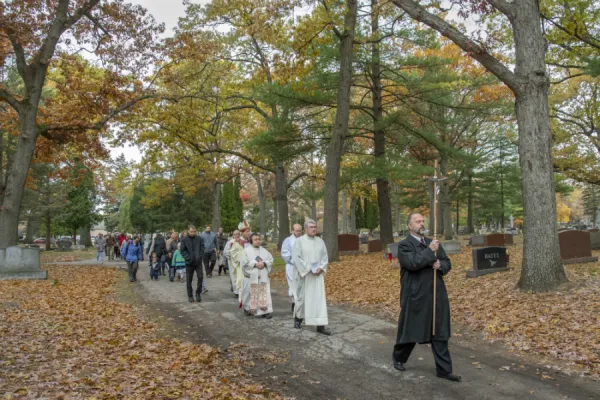
Saginaw, Mich., Nov 7, 2019 / 03:01 pm (CNA).- On Saturday Bishop Robert Gruss of Saginaw said a Mass of All Souls’ Day for 175 people whose mortal frames had been unclaimed, and which were then buried at one of the diocese’s cemeteries.

“The Church invites us to pray in a very special way, give alms and do works of penance for all the deceased, for our loved ones and friends, but also for all those who have died whom we have never known. There are many who have no one to pray for them,” Bishop Gruss preached during the Nov. 2 Mass at Calvary Cemetery in Kawkawlin, Mich., about 20 miles north of Saginaw.

“This is why we gather today in this special way for this memorial service for these unclaimed cremains. These individuals have no one to pray for them. They have not received a burial proper to their human dignity. But we will doing this today, giving these men, women and children a proper burial.”

The cremated bodies of 175 people were entombed in a crypt at the cemetery. Their remains had been in a county medical examiner’s office or funeral homes, and while some of the people had died quite recently, the oldest remains were of someone who died in 1972. Among those whose remains were entombed were 13 veterans, and military honors were presented by the Bay County Veterans Council Honor Guard.

“These individuals, these children of God, we know very little about. We know their names, but we know very little about them. But we do know that their lives have value; in the eyes of God and in our eyes, they belong to Him,” Bishop Gruss reflected.

“We are here today to show our love and care and concern for our brothers and sisters by upholding their God given dignity and providing them a final resting place where they will be remembered.”

The bishop noted that those who were being buried after the Mass “have all been part of a family. Why their cremains have been left behind is unknown to me. Though their lives remain a mystery to all of us, every aspect of their lives, every experience of their lives is known [to] God … And in the mystery of Christ’s love, they too have been offered salvation because it is God’s will that all people will be saved.”

Bishop Gruss began his homily saying, “the Church has always promoted the praying for our deceased loved ones and teaches the value of this practice. Oftentimes people make the assumption that their loved one is automatically going to heaven. We can never presume anything such as this.Yes, it is God’s will that all people are saved, but the ultimate judgment belongs to God and not to us. We can only live in hope that heaven becomes a reality for our loved onesand for us by the way we live our lives. If heaven were automatic, why would the Church need to pray for their deceased loved ones?”

He added that “we gather here today to pray for all of our loved ones who have gone before us. We gather here today to pray for these men, women and children whom we will lay rest.”

Alice Lefevre, Cemeteries Director for the Diocese of Saginaw, noted ahead of the interment that “Our Lord instructs us to bury the dead. It is a corporal work of mercy.”

The diocese reported that the students of St. Brigid of Kildare Catholic School in Midland held a “penn war” to raise money for expenses associated with the burials, raising more than $500, which was used for memorial flowers, among other things.

According to MLive, the diocese reached an agreement with Saginaw County in August that it will inter any cremated remains accumulated by the county.

The county controller, Robert Belleman, says he contacted the diocese to see if they could assist with proper burial of the cremated remains of 47 people which were held at the county medical examiner’s office.

“We really appreciate that willingness by the Diocese of Saginaw to agree to properly bury these 47 cremains,” Belleman told MLive.

[…]