No Picture
News Briefs

US bishops approve hymn translations for Liturgy of the Hours

November 12, 2019 CNA Daily News 4

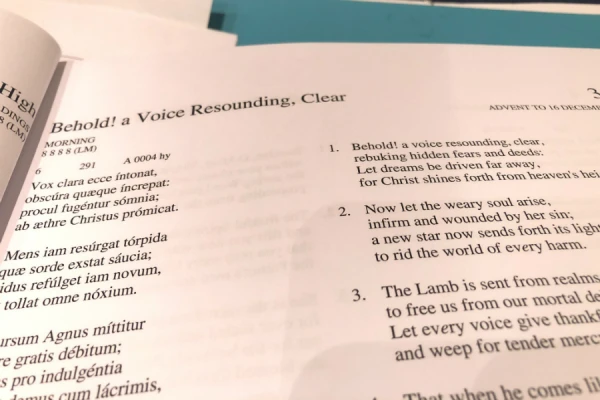
Baltimore, Md., Nov 12, 2019 / 03:01 pm (CNA).- The Latin rite bishops of the US voted overwhelmingly Tuesday morning to approve the International Commission on English in the Liturgy gray book translation of the hymns of the Liturgy of the Hours.

The Nov. 12 vote was 204 in favor, and five against.

Bishop Daniel Flores of Brownsville tweeted that “the translation of the Latin hymnody in the editio typica of the Liturgy of the Hours is a tremendous contribution to the liturgical heritage. The theological insight and aesthetic of the Latin hymns will have an English voice into the future; a work of theological transmission.”

But before the vote, the Fall General Assembly was treated to a concert performance in which the hymn translations were sung for the bishops.

The choir, which was directed by Adam Bartlett of Denver, consisted of Fellowship of Catholic University Students missionaries who live in the Baltimore area, as well as music students from the Catholic University of America. The choir sang the opening verse of the hymns, and were then joined by the bishops.

Bartlett told CNA that the choir had only just met up and rehearsed Tuesday morning before performing before the bishops. He knew some of the singers through his work with FOCUS, and he has directed the choir that performed at the organization’s national conference for the past four years.

Before ICEL did this translation, the vast majority the hymns that were printed in the English edition of the Liturgy of the Hours were translations of those found in the editio typica.

“What’s unique about this translation is that the hymns of the Latin typical edition are actually being translated, which didn’t happen the first time around,” said Bartlett.

“So we have hymns from St. Ambrose, Gregory the Great, you know, all of the great hymn writers … that are being translated and also paired with chant tunes that come from our rich tradition. In addition, of course, to modern melodies that they can be sung with,” he added. He said these translations created “great utility” as they could be sung with different tunes.

Bartlett said he found the updated hymns to be “absolutely gorgeous” and “so rich with theological imagery.” He thinks that these hymns are going to “make a really remarkable contribution to the musical life of the Church.”

“These are our hymns as Catholics,” he said. “These are the ones that come from the liturgy itself, and are put in the place where they ought to be sung, which is the Liturgy of the Hours. But I think that’s probably going to have an impact on the hymns that we sing at Mass as well.”

Valeria Lamarra, a chorister who sang on Tuesday, got involved with the ICEL hymn project through her school’s campus ministry. She had never met anyone she performed with before Tuesday morning.

“We had half an hour to practice, before getting up in front of 200 bishops,” said Lamarra. “It feels like a huge victory that the changes passed.”

[…]

No Picture
News Briefs

Bishop Barron on how to reach out to the ‘nones’

November 12, 2019 CNA Daily News 5

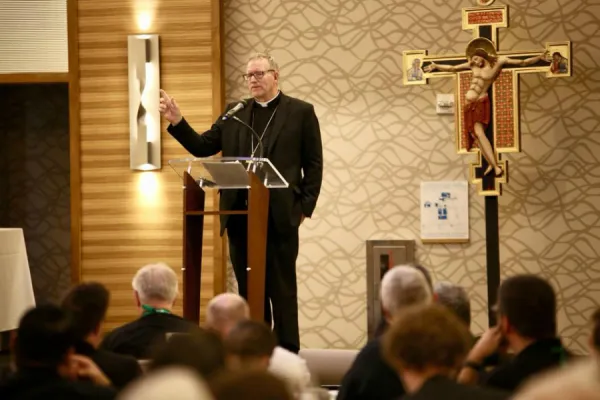
Baltimore, Md., Nov 12, 2019 / 02:38 pm (CNA).- Bishop Robert Barron, auxiliary bishop of Los Angeles and chairman of the US bishop’ committee on evangelization on Monday outlining five paths Church leaders should take to re-energize the religiously unaffiliated.

Barron’s Nov. 11 presentation was on the opening day of the USCCB’s Fall General Assembly, held in Baltimore. His presentation opened with a trailer for a new video that fully expands on how better to reach the religiously unaffiliated.

To better engage people who are not affiliated with any religion or who may be fallen-away Catholics, Barron said that the transcendentals – truth, goodness, and beauty – must be communicated to young people in order to pique their interest in religion. Barron presented five strategies and techniques that can be deployed in order to communicate these concepts to young people and the religiously unaffiliated.

These strategies highlight the Church’s teachings on justice, her beauty, her intellectualism, her missionary mission, as well as encouraging “creative use of the new media.”

Young people, said Barron, do not respond well to some of Catholicism’s teachings – particularly those on sex. What they do seem to appreciate, however, is the Church’s teachings on social justice. Barron suggested that it could be effective to lead with the Church’s teachings on social justice, referring to this as the “path of justice.”

“We have a very powerful tradition around doing the works of justice. And young people like that. They get it,” said Barron. He cited figures such as Dorothy Day, Thomas Merton, and St. Teresa of Calcutta as figures who have lived out Church teachings of social justice who should be held up as examples to the young people of today.

“We know this tradition. We should propagate it,” he said.

Barron said it was important to flex the beauty of the Church to young people, in what he called “Via Pulchritudinis,” or “The Way of Beauty.”

This beauty, said Barron, extends to more than just physical church buildings. There must also be beauty present in liturgies, as well as in things such as websites – where young people may first encounter their local parish. Barron stressed the importance of having a parish having a solid online presence, as well as engaging Catholic artists and writers and promoting their work.

“Beauty,” said Barron “is a great path to follow.”

Shifting gears to what he called the “intellectual path,” Barron was critical in how he believes the faith was currently being pitched to young people.

“We have to stop dumbing down the faith,” he said. He said there has been two generations of a “pastoral disaster” of bad formation, where key tenets of the faith were not effectively taught to young people.

This failure, said Barron, has led to people being unable to properly answer the tough questions that may be asked. When these questions go unanswered, said Barron, people may abandon faith altogether.

Despite what Barron called a “smart tradition” of Catholicism, he said it has not been properly articulated to young people through catechesis. He stressed the need for Catholic schools to better prepare their students so they are fully equipped to enter the next stage of life being able to properly defend the faith and answer those tough questions.

Next, Barron detailed his belief that it would be beneficial to “turn every parish into a missionary society,” to seek to better evangelize with young people and the religiously unaffiliated.

Barron said there must be “a dialogue with our priests and our people” regarding evangelization. He called for a change in mindset, and said that all parishes should be reaching out to the community with evangelization and mission work in mind. Parishes should “knock down the walls,” said Barron, and interact with the surrounding area.

“The young people aren’t going to come to us,” said Barron. “We have to go out to them.”

To properly execute these various techniques and strategies, Barron said priests, bishops, and parishes must embrace a “creative use of new media,” namely, social media platforms such as Reddit, Twitter, YouTube, and Facebook.

Social media is the “prime tool” to reach the young people, said Barron. He noted that young people are easily reached through social media, which are platforms that did not exist even a decade ago. The Church needs to embrace social media, which are platforms that can easily and simply reach large amounts of people, in order to reach into the world of young people, said Barron.

“It’s a tool that we can and should use to reach out to this world,” said Barron. He said that social media has a “sticky” quality about it that can draw in a user to continue to consume content. He cited an example of someone who came to embrace Catholicism after finding Barron’s videos regarding Bob Dylan and religion, which led to the person watching more and more videos on the Church.

The Church, said Barron, must invest in this, as well as hire “really good people” to work on social media.

After all, said the bishop, “young people live” online, and they must be reached where they can be found.

“Now we want to get them to parishes,” he said, “but as a first step, I think that’s one way to do it.”

[…]

No Picture
News Briefs

US bishops elect new committee leadership 

November 12, 2019 CNA Daily News 1

Baltimore, Md., Nov 12, 2019 / 09:50 am (CNA).- Members of the United States Conference of Catholic Bishops (USCCB) elected six new chairmen on Nov. 12 at their Fall General Assembly in Baltimore. The Board of Directors for Catholic Relief Services was… […]

No Picture
News Briefs

Archbishops Gomez and Vigneron elected USCCB president and vice president

November 12, 2019 CNA Daily News 1

Baltimore, Md., Nov 12, 2019 / 09:13 am (CNA).- The bishops of the US have elected a new president and vice president to lead the USCCB for the next three years. On Tuesday morning, the second day of their fall general session, the bishops elected Archbishop Jose Gomez of Los Angeles as president and Archbishop Allen Vigneron of Detroit as vice president of the conference.
 
As the votes were cast Nov. 12, Archbishop Gomez was serving as the USCCB vice president, and the bishops customarily elected the vice president to the presidency. From a slate of 10 candidates, Gomez was elected with 176 votes, more than double the number of the second-place candidate.
 
If Gomez’s election was a formality, the election of the vice president was more evenly contested. The bishops needed three rounds of voting to winnow down the nine remaining candidates.
 
Archbishop Vigneron led after the first ballot, with 77 votes but falling short of a majority. On the second round, that number rose to 106, with Archbishop Timothy Broglio of the Archdiocese for the Military Services the next placed candidate with 52 votes. The two archbishops were then put forward in a run-off third ballot, with Vigneron being elected with 151 out of 241 votes cast.
 
Gomez, 67, born in Monterrey, Mexico, and ordained a priest of Opus Dei in Spain, is the first Latino to lead the bishops’ conference. He is also the first immigrant at the conference helm.
 
Vigneron, a Michigan native, has led the Detroit archdiocese since 2009. He was ordained a priest for the archdiocese in 1975 and made an auxiliary bishop for Detroit in 1996. In 2003 he was named co-adjutor and later ordinary of the Diocese of Oakland.
 
Vigneron is widely considered to have provided steady leadership in Detroit during the recent sexual abuse crisis, even as the dioceses of the state face an ongoing Attorney General investigation. In April, he gave a speech in which he explained the importance of lay collaboration in the ministry of bishops as they govern their dioceses.
 
“In order to act well, I recognize that I am in need of what I might call ‘co-agents’–others who help me by thinking and acting along with me,” he said during a speech at the Catholic University of America.
 
“All the laity can continue to be engaged at the spiritual level, to realize that if there’s going to be change in the Church, part of it has to be that we all pray for that to happen,” he said.
“The other thing is to continue to hold the pastors accountable, to urge us to do what we need to do to advance the purification of the Church and to support us as we’re engaged in those challenges.”
Seen as a moderate conservative, earlier this year he announced that archdiocesan sporting events and leagues would no longer play on Sundays to help encourage families to observe the day of rest.
 
Vigneron had been serving as the bishops’ conference secretary, and was elected to the vice presidency from a crowded field of candidates. Despite the long list of names on the ballot, the election was marked by the absence of any notably theologically progressive candidates.
 
One of the more thorny issues facing the newly elected leadership team will be how to deal with bishops, both active and retired, who face accusations of either negligence or abuse of office.
 
In June, the conference adopted a set of protocols on how diocesan bishops could limit the ministry of their retired or removed predecessors in the event that allegations came to light. Among those provisions was the option to “disinvite” emeritus bishops from attending future USCCB meetings.
 
Shortly before the November meeting, Bishop Mark Brennan of Wheeling-Charleston wrote to the outgoing conference president Cardinal Daniel DiNardo of Galveston-Houston, asking him to disinvite former Wheeling Bishop Michael Bransfield, who faces numerous allegations of misconduct, both financial and sexual.
 
During a Nov. 11 press conference, CNA asked Cardinal DiNardo if similar requests to bar retired bishops from attending conference meetings would be made public.
 
“Bishop Bransfield was the first [such case] that we had, and I did a consultation with the administrative board,” DiNardo told CNA. “Not a vote taking, but a good consultation, but [the president] is the one who makes the decision.”
 
With investigations open in several dioceses, including into serving diocesan bishops in the dioceses of Crookston and Buffalo, Archbishop Gomez is likely to face several similarly sensitive decisions in the coming year.
 
Gomez and Vigneron also take the helm of the conference ahead of the release of the Vatican’s widely anticipated report on former cardinal Theodore McCarrick. On Monday, Cardinal Sean O’Malley of Boston updated the conference on the Vatican Secretariat of State’s progress on the investigation into McCarrick’s career rise through ecclesiastical ranks despite decades of alleged abuse.
 
O’Malley told the U.S. bishops that the Vatican process had uncovered “a much larger corpus of information than had been expected,” and that this had delayed the publication of a report.
 
A draft was now complete, O’Malley said, and was in the process of being translated and would be presented to Pope Francis in the near future. “The intention is to publish the Holy See’s response soon, if not before Christmas, soon in the New Year,” O’Malley said.
 
How that report is presented to and received by the faithful in the United States will likely be the most important part of the first year of the Gomez-Vigneron leadership.

[…]