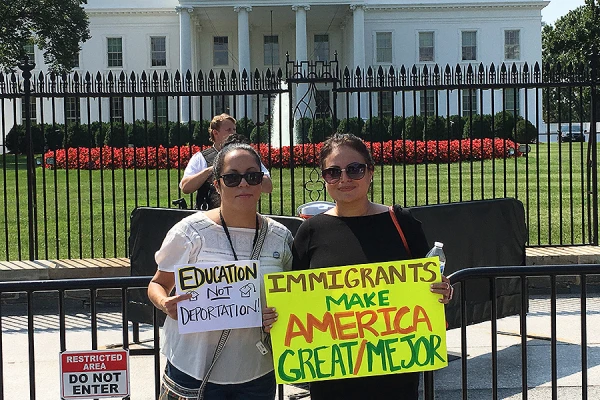
Baltimore, Md., Nov 13, 2019 / 09:44 am (CNA).- The USCCB’s migration committee chairman hopes that Congress can come to a solution regarding the situation of Deferred Action for Childhood Arrivals policy recipients, as the Supreme Court hears oral arguments in a case seeking approval to eliminate the program altogether.
Bishop Joe Vasquez of Austin told CNA Nov.12 that while he and his brother bishops have been advocating for a congressional solution to DACA, their main concern now was the situation of the approximately 700,000 DACA recipients.
“Those people need also to have someone advocate for them. So the bishops need to speak up and say very clearly that these people, we don’t want separation of families,” said Vasquez. About 256,000 children have at least one parent with DACA status.
There are fears that if DACA were to be repealed, these people would then be deported, splitting up the family. This is “a big concern for the Church,” said Vasquez.
“The Church is always going to advocate on the side of the family, because the family is very important,” he added.
DACA recipients, he said “already are…part of the fabric of this country” and contribute to the economy and to their communities.
“They’re leaders already in many of our parishes and churches,” said the bishop.
On Tuesday, the Supreme Court heard oral arguments in three cases – Department of Homeland Security v. Regents of University of California; McAleenan, Secretary of Homeland Security v. Vidal; Trump, President of U.S. v. NAACP – which concern whether the Trump administration may end DACA outright.
President Barack Obama introduced DACA via executive memorandum in June 2012. It permits people who were brought to the United States illegally as children to apply for temporary protection from deportation and work permits. The program was set to expire in 2017, but this has been delayed after Congress was given a chance to codify parts of DACA into law.
Congress failed to pass DACA into law, and the partisan-based debate over immigration and border security has continued.
The Supreme Court is expected to make a decision about whether President Donald Trump would be permitted to end DACA in the spring or early summer of 2020.
As for Vasquez, he will continue to hope that Congress can come to a solution.
“My hope and prayer is that they would be able to do something, they’d be able to reconcile and come together and take care of these people,” he said. “I think deporting them is the wrong answer. It’s not the way to address this issue.”
If you value the news and views Catholic World Report provides, please consider donating to support our efforts. Your contribution will help us continue to make CWR available to all readers worldwide for free, without a subscription. Thank you for your generosity!
Click here for more information on donating to CWR. Click here to sign up for our newsletter.

Knights of Columbus Supreme Knight Patrick Kelly speaks with EWTN News President and COO Montse Alvarado on Thursday, July 11, 2024, regarding the organization’s decision to cover mosaics by the accused abuser Father Marko Rupnik in chapels in Washington, D.C., and Connecticut. / Credit: EWTN News
Rome Newsroom, Jul 11, 2024 / 12:00 pm (CNA).
The Knights of Columbus announced Thursday they will cover mosaics by the accused abuser Father Marko Rupnik in Washington, D.C., and Connecticut, a dramatic move that represents the strongest public stand yet by a major Catholic organization regarding the former Jesuit’s embattled art.
The 2.1-million-member lay Catholic fraternal order said July 11 it would use fabric to cover the floor-to-ceiling mosaics in the two chapels of the St. John Paul II National Shrine in Washington and in the chapel at the Knights’ headquarters in New Haven, Connecticut — at least until the completion of a formal Vatican investigation into the Slovenian priest’s alleged abuse.
Patrick Kelly, Supreme Knight of the Knights of Columbus, told EWTN News Thursday the opaque material would be installed “very soon” but gave no firm timetable. The Knights said in a statement released Thursday afternoon that the artwork may later be more permanently hidden with a plaster covering after the Dicastery for the Doctrine of the Faith issues its ruling on Rupnik.
The decision by the Knights to cover the sprawling works, which envelop both spaces, was made at the end of a comprehensive, confidential review process that included consultations with sexual abuse victims and those who minister to them, art historians, pilgrims to the shrine, bishops, and moral theologians.
“The Knights of Columbus have decided to cover these mosaics because our first concern must be for victims of sexual abuse, who have already suffered immensely in the Church, and who may be further injured by the ongoing display of the mosaics at the shrine,” Kelly said in the statement.
“While opinions varied among those consulted,” he said, “there was a strong consensus to prioritize the needs of victims, especially because the allegations are current, unresolved, and horrific.”
Kelly reiterated that point in his interview with EWTN News.
“Our decision process really came down to multiple factors. But the No. 1 factor was compassion for victims,” Kelly said. “We needed to prioritize victims over anything, any material thing. So that was our primary consideration.”
The first segment of Kelly’s interview with EWTN News will air on “EWTN News Nightly” Thursday at 6 p.m. and 9 p.m. ET. Additional comments will air on “EWTN News In Depth” on Friday at 8 p.m. ET.
Knights of Columbus Supreme Knight Patrick Kelly speaks with EWTN News President and COO Montse Alvarado on Thursday, July 11, 2024, regarding the organization’s decision to cover mosaics by the accused abuser Father Marko Rupnik in chapels in Washington, D.C., and Connecticut. Credit: EWTN News
Once a renowned artist Rupnik, whose mosaics are featured in hundreds of Catholic shrines, churches, and chapels around the world, was expelled from the Jesuits in June 2023.
His expulsion followed a long review of what the society called “highly credible” accusations of serial spiritual, psychological, and sexual abuse of as many as 30 religious sisters by the priest spanning decades. Some women allege Rupnik’s abuse sometimes happened as part of the process of creating his art at the Centro Aletti, an art school he founded in Rome.
The Vatican announced in late October 2023 that Pope Francis had waived the statute of limitations in the Rupnik case, allowing the Dicastery for the Doctrine of the Faith to do a canonical investigation into the abuse allegations.
There has been no further communication from the Vatican about the inquiry, and it is unclear whether Rupnik may still be living in Rome despite having been given priestly faculties in a diocese of his home country of Slovenia last year.
Growing public outcry
What to do with Rupnik’s once widely-praised works, colorful mosaics characterized by grand, flowing figures and large eyes, has proven to be a divisive question in the wake of the numerous allegations against him, which first came to public attention in December 2022.
While some want to await Vatican judgment before dismantling and replacing Rupnik’s works, much of it made in collaboration with other artists of the Centro Aletti — a Rupnik-founded art school and theological center in Rome — the public outcry for the removal of his art has intensified.
The Knights also announced several immediate changes that would be enacted at the shrine in solidarity with abuse victims, including providing educational materials about the mosaics, making clear that their display during the consultation process “was not intended to ignore, deny, or diminish the allegations of abuse.”
Every Mass at the St. John Paul II National Shrine will now also include a prayer of the faithful for victims of sexual abuse, and saints with connections to abuse victims, such as St. Josephine Bakhita, will be specially commemorated.
The group said it became aware of the allegations against Rupnik in December 2022 — and noted that the artist, while under investigation, remains a priest in good standing in the Diocese of Koper, Slovenia.
“This decision is rooted in a foundational purpose of the Knights of Columbus, which is to protect families, especially women and children, and those who are vulnerable and voiceless,” Kelly said in the July 11 statement.
The “Redemptor Hominis” chapel of the National Shrine of St John Paul II in Washington, DC, is decorated with mosaics by Fatherr Marko Rupnik. Credit: Lawrence OP|Flickr|CC BY-NC-ND 2.0
The St. John Paul II National Shrine is a pastoral initiative of the Knights of Columbus, established in 2011, and designated a national shrine by the U.S. Catholic bishops in 2014.
Rupnik’s mosaics were installed at the shrine in 2015. The Holy Family Chapel at the Knights’ headquarters has featured Rupnik’s art since 2005.
Highlighting the John Paul II shrine’s mission of evangelization, the supreme knight said, “the art we sponsor must therefore serve as a stepping stone — not a stumbling block — to faith in Jesus Christ and his Church.”
Rupnik has not made any statements since the allegations came to light.
An eye on Lourdes
The Knights’ move to conceal the mosaics follows just a week after the bishop of Lourdes, France, said that despite his personal feelings that Rupnik’s artwork at the renowned Marian shrine there should be removed, he has decided to wait to make a final decision due to “strong opposition on the part of some.”
After forming a special commission in May 2023, Bishop Jean-Marc Micas of Tarbes announced July 2 that more time was needed “to discern what should be done” about Rupnik’s mosaics at the Marian apparition site, because his belief that they should be torn down “would not be sufficiently understood” and “would add even more division and violence” at this time.
As a “first step,” the French bishop said he had decided the mosaics will no longer be lit up at night during the shrine’s nightly candlelight rosary processions.
In his interview with EWTN News, Kelly said the Lourdes bishop’s intent to make a decision of some kind this spring galvanized the Knights to act at this time.
In his July 11 statement, Kelly thanked the Lourdes bishop for his “thoughtful decision” and said it “both informed and confirmed us in our own decision-making. Shrines are places of healing, prayer, and reconciliation. They should not cause victims further suffering.”
Emphasizing the importance of discernment based on mission and context, the supreme knight said: “Every situation is different. In the United States, Catholics continue to suffer in a unique way from the revelations of sexual abuse and, at times, from the response of the Church. It is clear to us that, as a national shrine, our decision must respect this country’s special need for healing.”
The Knights of Columbus was founded in New Haven, Connecticut, in 1882 by Blessed Michael McGivney, a parish priest. Dedicated to the advancement of the group’s key principles — charity, unity, fraternity, and patriotism — its members in 2022 provided 50 million service hours and nearly $185 million to charitable causes in their communities.
National Catholic Register Editor-in-Chief Shannon Mullen contributed to this story.
CNA Staff, Jan 3, 2025 / 14:50 pm (CNA).
Ascension’s latest podcast, “The Rosary in a Year,” topped the Apple Podcast charts after its release on Jan. 1. The latest “In a Year” podcast landed ahead of o… […]
Capitol police placed fencing in front of the U.S. Supreme Court on Dec. 1, 2021, during oral arguments in Dobbs v. Jackson Women’s Health Organization, in an attempt to separate rallies by abortion supports and pro-lifers. / Katie Yoder/CNA
Denver Newsroom, May 3, 2022 / 18:00 pm (CNA).
The Supreme Court’s previous abortion rulings were “egregiously wrong from the start” and on a “collision course with the Constitution.” These are among the colorful phrases of a 98-page preliminary draft of a U.S. Supreme Court decision that could return abortion law to the U.S. states and their voters.
The draft in Dobbs v. Jackson Women’s Health Organization was leaked on Monday evening. The Supreme Court stressed that the document “does not represent a decision by the Court or the final position of any member on the issues in the case.” But the draft shows some insight into the thought of author Justice Samuel Alito on how the court might overturn the pro-abortion decisions Roe v. Wade and Planned Parenthood v. Casey.
Here are some choice thoughts, phrases, and arguments from Alito’s draft:
Mandatory legal abortion is overruled, the debate goes back to the states.
“Abortion presents a profound moral question,” the draft concludes. “The Constitution does not prohibit the citizens of each State from regulating or prohibiting abortion. Roe and Casey arrogated that authority. We now overrule those decisions and return that authority to the people and their elected representatives.”
“We hold that Roe and Casey must be overruled,” Alito said in his introduction. “The Constitution makes no reference to abortion and no such right is explicitly protected by any constitutional provision, including the one on which the defenders of Roe and Casey now chiefly rely: the Due Process Clause of the Fourteenth Amendment.”
It’s about human life: Abortion ‘fundamentally different’ than related court decisions
“Roe’s defenders characterize the abortion right as similar to the rights recognized in past decisions involving matters such as intimate sexual relations, contraception, and marriage, but abortion is fundamentally different, as both Roe and Casey acknowledged, because it destroys what those decisions called ‘fetal life’ and what the law now before us describes as an ‘unborn human being’.” (p. 5)
“None of the other decisions cited by Roe and Casey involved the critical moral question posed by abortion.” (p. 32)
‘Egregiously wrong from the start’
“Stare decisis, the doctrine on which Casey’s controlling opinion was based, does not compel unending adherence to Roe’s abuse of judicial authority. Roe was egregiously wrong from the start. Its reasoning was exceptionally weak, and the decision has had damaging consequences. And far from bringing about a national settlement of the abortion issue, Roe and Casey have inflamed debate and deepened division.” (p. 6)
Women’s voices on abortion must be heard through the legislature and the ballot box, not the courts
“Our decision returns the issue of abortion to those legislative bodies, and it allows women on both sides of the abortion issue to seek to affect the legislative process by influencing public opinion, lobbying legislators, voting, and running for office. Women are not without electoral or political power. It is noteworthy that the percentage of women who register to vote and cast ballots is consistently higher than the percentage of men who do so.” (p. 61)
The states have ‘legitimate interests’ to regulate abortion.
“…procuring an abortion is not a fundamental constitutional right because such a right has no basis in the Constitution’s text or in our nation’s history.
“It follows that the States may regulate abortion for legitimate reasons, and when such regulations are challenged ‘under the Constitution, courts cannot ‘substitute their social and economic beliefs for the judgment of legislative bodies’.
“…These legitimate interests include respect for and preservation of prenatal life at all stages of development, the protection of maternal health and safety; the elimination of particularly gruesome or barbaric medical procedures; the preservation of the integrity of the medical profession; the mitigation of fetal pain; and the prevention of discrimination on the basis of race, sex, or disability.” (p. 65-66)
Roe v. Wade was ‘on a collision course with the Constitution’ from day one.
“…Roe’s constitutional analysis was far outside the bounds of any reasonable interpretation of the various constitutional provisions to which it vaguely pointed. Roe was on a collision course with the Constitution from the day it was decided, and Casey perpetuated its errors, and the errors do not concern some arcane corner of the law of little importance to the American people.
“Rather, wielding nothing but ‘raw judicial power,’ the Court usurped the power to address a question of profound moral and social importance that the Constitution unequivocally leaves for the people.
“Casey described itself as calling both sides of the national controversy to resolve their debate, but in doing so, Casey necessarily declared a winning side. Those on the losing side—those who sought to advance the state’s interest in fetal life—could no longer seek to persuade their elected representatives to adopt policies consistent with their views. The Court short-circuited the democratic process by closing it to the large number of Americans who dissented in any respect from Roe.” (p. 40)
Abortion precedents relied on bad history and bad reasoning
“The weaknesses in Roe’s reasoning are well-known. Without any grounding in the constitutional text, history, or precedent, it imposed on the entire country a detailed set of rules much like those that one might expect to find in a statute or regulation.” (p. 42)
“What Roe did not provide was any cogent justification for the lines it drew.” (p. 46)
“The Constitution makes no express reference to a right to obtain an abortion, and therefore those who claim that it protects such a right must show that the right is somehow implicit in the constitutional text.
“Roe, however, was remarkably loose in its treatment of the constitutional text. It held that the abortion right, which is not mentioned in the Constitution, is part of a right to privacy, which is also not mentioned.” (p. 9)
“Roe either ignored or misstated this history, and Casey declined to reconsider Roe faulty historical analysis. It is therefore important to set the record straight.” (p. 16)
“Until the latter part of the 20th century, there was no support in American law for a constitutional right to obtain an abortion. Zero. None. No state constitutional provision had recognized such a right. Until a few years before Roe was handed down, no federal or state court had recognized such a right…
“Not only was there no support for such a constitutional right until shortly before Roe, but abortion had long been a crime in every single State. At common law, abortion was criminal in at least some stages of pregnancy and was regarded as unlawful and could have very serious consequences at all stages. American law followed the common law until a wave of statutory restrictions in the 1800s expanded criminal liability for abortions.” (p. 15)
“By the end of the 1950s, according to the Roe Court’s own count, statutes in all but four states and the District of Columbia prohibited abortion ‘however and whenever performed, unless done to save or preserve the life of the mother’.
“This overwhelming consensus endured until the day Roe was decided. At that time, also by the Roe Court’s own count, a substantial majority—30 States—still prohibited abortion at all stages except to save the life of the mother…
“The inescapable conclusion is that a right to abortion is not deeply rooted in the Nation’s history and traditions. On the contrary, an unbroken tradition of prohibiting abortion on pain of criminal punishment persisted from the earliest days of the common law until 1973.” (p. 24)
The Supreme Court can’t settle the abortion debate
“This Court’s inability to end debate on the issue should not have been surprising. This Court cannot bring about the permanent resolution of a rancorous national controversy simply by dictating a settlement and telling the people to move on. Whatever influence the Court may have on public attitudes must stem from the strength of our opinions, not an attempt to exercise ‘raw judicial power’.” (p. 64)
DACA has always been an unconstitutional use of an executive order. Like it or not, Congress alone has the power to legislate (Legislative Branch). Perhaps a ruling against DACA by the Supreme Court will force Congress to act rather than just talk. Thus far, they have had “all the fun and none of the responsibility.”
No path to citizenship, period.
Surely Latin bishops have more important matters to attend to, like actual pastoring of their own sheep.
DACA has always been an unconstitutional use of an executive order. Like it or not, Congress alone has the power to legislate (Legislative Branch). Perhaps a ruling against DACA by the Supreme Court will force Congress to act rather than just talk. Thus far, they have had “all the fun and none of the responsibility.”