Denver Newsroom, Nov 11, 2020 / 05:10 pm (CNA).- Ordinarily, a news analysis attempts to bring some context or expertise to a situation, in order to assess why something has happened, what might happen next, and whether any of it will prove to be important.
A news analysis often speculates about what newsmakers will do: At CNA, analysis considers often what the pope might do, or USCCB leaders, or bishops of prominent dioceses.
But this analysis will speculate about what ordinary Catholics – people who practice the faith and love the Lord and try to follow Jesus – will do after the publication of the Vatican’s McCarrick Report.
To do that, some context in this analysis will be personal. There is a reason I offer this personal narrative. Please bear with me.
I began working for the Catholic Church in 2005, while I was in canon law school. After finishing my canon law degree, in 2007 I began working regularly on cases involving clergy misconduct.
I have sat with priests guilty of sexual assault and coercion, of grooming young men, of acting with serial disregard for the promises of their priesthood and the spiritual health of their victims. I have also sat with priests falsely accused of those things. I have seen problems ignored, and I have seen problems treated with the attention they deserve.
I have seen priests get justice, and I have sometimes seen them face terrible injustice. I have seen victims mistreated, and victims treated with compassion and respect. I have seen cases in which every rule and protocol is followed, and cases in which most of them are ignored.
Before the initial McCarrick allegations were made public in June 2018, I had already seen some things. As friends dealt with grief and shock, I told some cynically “Now you know why I’m ticked off all the time.”
I had not known about McCarrick, but I knew about clerical abuse, and about the sins of omission and commission that allow it to happen.
The 449 pages of the McCarrick Report detail a story decades long, in which institutional and personal failures allowed a man who abused his power to act with serial and serious immorality — to, put simply, hurt people.
It includes accounts of both cowardice and courage, of institutional blindspots exploited by a manipulator, of naïveté, misplaced kindness, and ill-placed trust, of dysfunction, bureaucratic ineptitude, and malice. The report demonstrates that sin begets sin – it recounts stories of abusers who were themselves abused. It depicts the exploitation of crises for personal gain.
The report documents the damage wrought by a crippling bias towards institutional self-preservation, ironic for a Church that follows a crucified Lord.
There are few heroes: A mother who tried her best to speak out. A priest who blew the whistle to protect seminarians. A cardinal who came to realize, only over time, that he needed to make clear a serious problem.
The McCarrick Report also traces a broad trend of growing awareness of the importance of addressing abuse allegations, and addressing them properly. An increased understanding that presuming on good will is not helpful in the presence of manipulators. Efforts, often faltering, and sometimes failing, to learn from previous mistakes. But even amid that trend, there are appalling personal failures at every stage of McCarrick’s career.
The report does not document, or seem even to consider seriously, how McCarrick’s ambiguous and unmonitored financial situation enabled his decades of abuse. It mentions briefly his ability as a fundraiser, but offers no forensic analysis of his discretionary accounts. U.S. dioceses maintain records of those accounts, and to date have given no indication they plan to release them.
The report addresses bishops who lied for McCarrick, and about him, to the Holy See, but it does not ask why those bishops were willing to lie. It does not give serious attention to McCarrick’s social networks and their influence on the life of the Church – mention is made of a friend leaking high-level documents to McCarrick in the Vatican, but no attention is given to what influence networks that friend has. Many analysts have said it does not address whether there remain in ministry bishops who were gravely negligent, or even who compounded or facilitated cover-ups.
It brings many things to light, but the report is not a complete account of the McCarrick affair. A complete account may never emerge. Further, the Vatican’s report does not seem to consider present-day implications of McCarrick’s life and ministry, nor to draw lessons for the Church beyond McCarrick.
Questions remain, and those questions are very likely to go unanswered. Catholics who hope to see particular individuals brought to justice are likely to go disappointed.
And new scandals will inevitably emerge.
Since the retirement of Theodore McCarrick, there have already been some institutional reforms designed to prevent a situation like McCarrick’s from happening again. Institutional audits in U.S. dioceses, review boards, the promulgation of Vos estis lux mundi. Pope Francis or the U.S. bishops may well add more layers of policy reform.
But Pope Francis has emphasized that policy reform can not substitute for personal integrity. And the McCarrick Report demonstrates how much personal integrity actually matters. The report will likely bring statements from bishops committing to that personal integrity, and it might even inspire real conversion to that effect among some bishops and Church leaders.
Inevitably, though, there will be new failures in the Church’s life, because the Church is both human and divine: The mystical Body of Christ protected in certain ways by the Holy Spirit, and a community of sinners, each of them in need of a savior, few of them yet saints.
The Church is always and everywhere holy— its members are not usually so.
That paradox is a challenge to every believer.
But the future for the Church in the U.S. seems to depend a great deal on how ordinary Catholics respond to disappointment, discouragement, and somewhat unresolved scandal.
Religious disaffiliation is on the rise in the U.S. – a growing number of Americans identify themselves with no religion, or have no religious practice. And many ordinarly practicing Catholics are out of the habit of going to Sunday Mass, because of the pandemic. It will be unsurprising if the McCarrick scandal exacerbates religious disaffiliation, especially among young Catholics, who say in surveys that they prioritize the perceived personal integrity of leaders ahead of institutional affiliation.
Within the Church, there is a small but growing pocket of Catholics who are increasingly strident toward the authority of the pope and of U.S. bishops. In crises past, pockets like those have eventually become schisms. That seems practically unlikely in the contemporary U.S., but it is not impossible or unprecedented — there are more than 25,000 members of the “Polish National Catholic Church,” a schismatic group that began in the U.S in the early 20th century.
The point is that scandals have the capacity to discourage the practice of the faith, to foster cynicism, anger, bitterness, or indifference.
Hence the personal narrative.
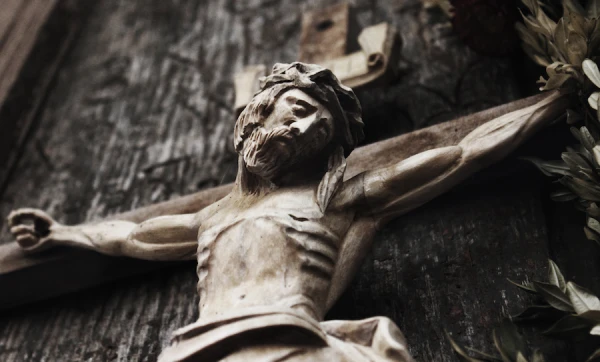
My own experience has taught me that confronting the oft-disappointing humanity of the Church is an exercise in accepting that disappointment is real, and that it can be only be relieved by embracing the cross, and the Crucified Savior.
In the spiritual life, moments of disappointment present a choice: One can nurture anger or indifference, or one can turn to Christ on the cross.
One of those choices brings life, the other does not.
That’s true for the spiritual life, and for the mission of the Church itself.
A movement of Catholics who respond to crisis with an increase of prayer, fasting, charity, and evangelization is counter-intuitive. It is also a counter-witness to the “black eye for the Church” contained in the McCarrick Report. It is confounding, and compelling.
Catholics who seek holiness in times of scandal tend often to be conduits of Christian renewal.
Making such a choice, I’ve learned by my failures, is easier said than done.
There is very little saccharine or romantic about following Jesus, especially when confronted with the sinfulness of the Church’s own leaders. There is often more setback than progress.
Humility helps – remembering our own failures tends to put the sins of others in perspective. Confession and the Eucharist help all the more.
Embracing the cross does not mean accepting or tolerating the presence of sin in the Church. Rather it means both assiduously calling for reform and repenting seriously for one’s own sins and shortcomings. Maintaining communion with the Church, even while helping to rebuild it.
The mission of the Gospel probably has very little to do with tweeking existing policy. A statement of regret from the U.S. bishops’ conference is unlikely to spark a renewal of faith in Jesus Christ.
In the wake of the McCarrick Report, renewal of the Church likely has most to do with whether ordinary Catholics will turn to Christ, and embrace his suffering on the cross. That isn’t easy. But it is the path to eternal life, and, in this life, its consequences might well be surprising.

[…]



I remember hearing about stuff like this back in the 1970’s & ’80’s. It should have died a quiet death. It’s too bad we have to resurrect it again.
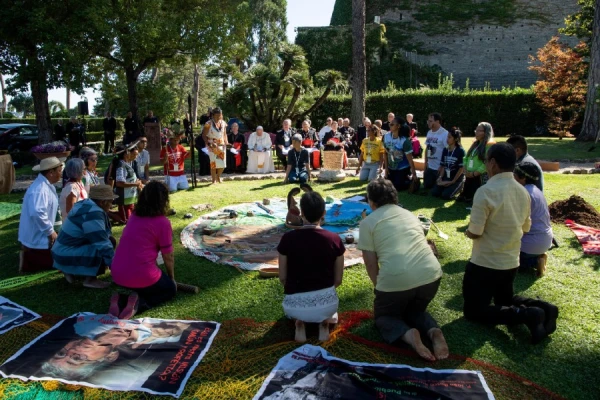
Mrscracker there are wild ceremonies – the Vatican Garden Amazonia Synod ceremony among the milder, and there are wilder [meaning unconventional Liturgy]. If you remember, seaside marriages were the thing post Vat II. Fr Malachi Brendan Martin [Irish born controversial Jesuit priest confidant to Paul VI unhappy with the dissolution of faith post Vat II permitted to leave his order accepted by the Archbishop of New York] gives one such wild account in his book Hostage to the Devil. A priest performing the ceremony unknown to all except for the suspicion of another priest friend, onlooker from a short distance – was diabolically possessed. The celebrant priest suddenly leaped at the hopeful bride dragged her into the pounding surf both grappling she for her life he attempting to drown her. His priest friend plunged into the surf with others and saved her then dragged his possessed friend away. The priest was consequently exorcised with permission of the Bishop. Fr Martin who attended several exorcisms gave the background of this priest’s possession. He was a young priest, nature lover who began finding intense, what he presumed mystical experience contemplating beautiful pastoral scenery. It got to the point that he began unconsciously substituting Eucharistic Prayer wording with aspects of nature including the consecration similar to This is my sunshine rather than Body. Bizarre yes but apparently true. His friend picked up on this and suspected something deeply wrong, his fears confirmed at the seashore wedding ceremony. Added to this I can’t withhold a sense of alarm over the Vatican Amazonia ceremony. Aside from Fr Martin’s book my experience in Africa, and with some of our Southwest Native Americans was that virtually all if not all the pagan ceremonials, rituals had an underlying evil dimension, some immoral finality.
Chaos and cosmos; cosmos and chaos? What about creation ex nihilo?
Assisi tree planting symbol of the Little Poor Man who through the years became more identified with butterflies and Nature than the Crucified Savior whose wounds he bore. Parallel to the earthly humanization of the saintly mystic is Christianity’s demythologizing less mystical more mundane guitars banjos Gregorian chant a memory. Anomaly is global minded brethren are rigidly intolerant toward brethren with discriminating mores. Stridently so. Britain passed law that certain words are forbidden everywhere anytime the home no longer sanctuary arrest possible. Portend? Semi pagan marvelous display of European man stolid in appearance with painted face semi religious the woman shaman who indeed made the sign of the Cross after she exorcised the Pontiff with secret powder magic words at the Vatican lawn ceremony. Woman shaman woman priests. A passing thought. It appeared early on we’re at a crossroads Christ’s Revelation one pathway Paradigm Shift the other. Question for us all is which pathway the Bishop of Rome will take and which will we? Faith in Christ dispels that question.
“Which pathway will the bishop of Rome take” this bishop of Rome just had shamans performe a ceremony steps away from where Peter was curcified upside down. The path he has been on from the start to change the dogmatic teachings of Christ and His church. How much more does he need to do or not do? The not do is getting rid of those who promote that which Jesus said “NO” and are trying to instigate well “yes” those aren’t really sins and there is no punishment except for the “ridgid” who actually do believe in “death, judgment, heaven and hell” along with evanelizing the world to come to Christ and His Church. Geeze this pontif has said not to evangelize and essentially all doctrines of differing beliefs are wished by God which goes directly (do not pass go) against “I am the way, the truth, the light no one comes to the Father except through Me”. Love all with the charity to get them into heaven.
Katedee this Pontiff is by far the greatest challenge in its long history to the Church’s faith in Christ. Know we’re being tested.
Guess we should accept Wicca…um no! Lord please give us a new Pope!
While the surface of the earth is some 130 Billion acres, why does it now become necessary to smear Amazonia/Wiccan graffiti on the 109 acres of Vatican grounds? Even as Amazonia bishops–some of the curiously German–continue to wallow in a working-paper swamp. Pope Pius IX, the Prisoner of the Vatican, weeps.
To his credit, the manipulated Pope Francis remained outside the circle, and even departed from “prepared remarks” (no doubt prepared by some puppet-master ghost writer) and instead appealed to Our Father who [still] art in heaven.
And Michalangelo’s overhead Sistine Ceiling still recalls the real Creation, if only in barely a quarter of an acre of surface area, but at least it’s above our eyes rather than below our feet–as if the metaphysical terms “above” and “below” still mean anything.
As with history’s disfigured “Amazons” of old, a New Paradigm that amputates the present from Tradition simply is not the way to keep abreast of significant truths.
“People carried bowls of dirt from different places around the world, each symbolizing a different issue from ecological devastation to migration. The dirt was placed around a tree from Assisi, which was planted as a ‘symbol of integral ecology.’ ”
Yes, nothing says “integral” (or a concern for Nature as “natural”) like placing samples of dirt from various diverse sources that realistically and organically do not occur around a particular tree in a particular place in time. An apt gesture which also embodies the forced sense of “natural” in same sex marriage, transgender ideology, “death with dignity” and a female priesthood, which invariably, shortly after the sobbing “newly ordained” ex-nun (who always just “knew” she had a vocation) hugs all her priestess friends becomes likewise in short order first pantheistic but then Chthonic and Christless, pretty much lesbian, “women love better” witchcraft.
Forgive me. I give little credit to Bergoglio for staying out of the circle or no comments. This may even be his “respect” for the whole thing and his silence just part of his politics.
“After what appeared to be the offering of prayers by participants, who prostrated themselves on the grass around a blanket upon which fruit, candles, and several carved items were set, an indigenous woman approached the pope and presented him with a black ring, which appeared identical to the one she was wearing.”
Ah, the commitment to the poor (and “making a mess”) in the tucum ring! No worries, folks! No need to say to Bergoglio, “You know the first year of marriage can be quite an adjustment.”
So much of this makes even Plotinus seem like Fulton Sheen. It’s not “matter” here that’s “evil”…but “matter as deity?” I do think that such a religion (this emerging religion) is indeed ultimately “evil” (and allows for infanticide, sexual abuse/poly-perversity and euthanasia as “natural”) and is ultimately non-transcendent…non-salvific…and for all the talk of being “cosmic” it is primarily tribal…and yes, it also appeals to the Germans.
With regards to St. Francis of Assisi, much of this “mess” started already with a post Vatican II counterfeit “Franciscan joy” popularized by Franciscans in the mid-80s through the 90s but still in progress? their convenient take on St. Francis’s reverence for the Eucharist and churches in almost mandatory loud, yes campy guffawing in the sanctuary and boisterous laughter and chatting after Liturgies.
The loss of reverence for the Eucharist opened the door for this “new church.”
I’ll say it again: this is just apostasy.
Apostasy, or something worse and even more interesting?
Perhaps the lawn artistry and symbolism (following the collage/chaos instrumentum laboris) is just a passing symptom of syncretic, confused and fused evangelization, devoid of clear Christian affirmation. First the Tree of Life, then the Tree of “the knowledge of good and evil,” then the Burning Bush on holy ground, BUT NOW and once again a flat-universe and a merely cosmic tree rooted in only the dampened ground of Mother Earth.
A piece of lawn art serving as a territorial marking for a new-paradigm/hybrid religion? And, as dampened ground, a natural marking of territorial dominance as if by any typical quadruped in the wild during rutting season?
The historic elevation of some pre-Christian elements into the new creation of Christian symbolism/channels for grace was one thing (e.g., fertility and the family); but the surrender today of Christian verities to pre- post- and anti-Christian paganism and hybrid lawn markings is quite another (“images of two semi-naked pregnant women”).
The Amazon anaconda kills by incremental strangulation and then swallows its prey whole, head first. One could wonder, after this desecration (yes?) of the Vatican ground whether it should be reconsecrated…
“By Courtney Grogan
Vatican City, Oct 4, 2019 / 10:30 am (CNA).- Pope Francis witnessed an indigenous performance at a tree planting ceremony in the Vatican gardens Friday, during which people held hands and bowed before carved images of pregnant women, one of which reportedly represented the Blessed Virgin Mary. ”
An additional detail from CNA presented above.
That and other aspects of this “ecological ritual” may very well require a reconsecration…to follow up on the “ecological ritual.”
Perhaps Bergoglio being outside the circle was actually a part of the ritual, to symbolize/embody that a new church was being established with the Petrine office and Faith being…”developed.”
And all of this is happening during the Month of the Rosary.
I hope and pray that Francis’s successor as Pope will imitate St Boniface and take a chainsaw to that tree.
The “Sin of Manasseh” (2 Kings 21: 7-15) leads to the exile of Judah and the destruction of the Temple in Jerusalem. Just what was the “sin”? Exactly what just occurred in the Vatican Gardens. Manasseh, the King of Judah brought an Asherah into the courtyard and then into the Temple to “worship” (bow before). Just what is an Asherah? A carved graven image of the fertility goddess and/or a tree. Does the Pope not read the Bible?
I am sure he does read the Bible, but I am less sure that he applies it to himself.