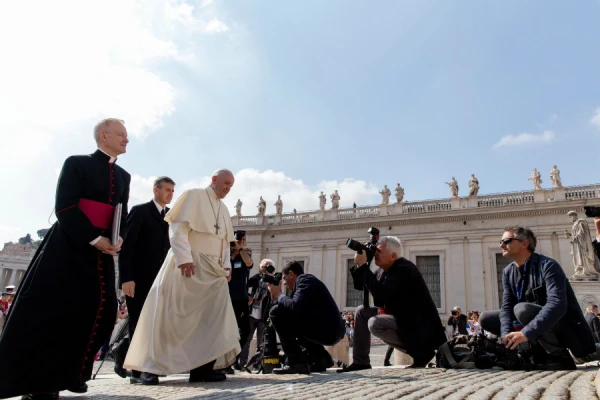
Vatican City, Jun 5, 2019 / 03:29 am (CNA).- Pope Francis Wednesday reflected upon his recent apostolic visit to Romania, where he beatified seven Greek-Catholic bishops martyred under Soviet occupation.
The pope said June 5 that the beatified bishops were “witnesses to the freedom and mercy that comes from the Gospel.”
“One of these new blesseds, Mgr. Iuliu Hossu, during his imprisonment wrote: 'God sent us into this darkness of suffering to forgive and pray for the conversion of all,'" he said.
“Thinking of the terrible tortures to which they were subjected, these words are a testimony of mercy,” Pope Francis reflected during his weekly audience in St. Peter’s Square.
Pope Francis declared the beatification of Blessed Bishops Iuliu Hossu, Valeriu Traian Frentiu, Vasile Aftenie, Ioan Suciu, Tito Livio Chinezu, Ioan Balan, and Alexandru Rusu during a Greek-Catholic Divine Liturgy in the “Field of Freedom” in Blaj, Romania June 2.
Each of the seven bishops died after being held in prisons or labor camps in Romania between 1950 and 1970 under Communist leader Nicolae Ceausescu’s regime, which harshly persecuted and imprisoned Romanian Catholics in both the Greek and Latin rites.
“The Catholic community, both Greek and Latin, is alive and active,” Pope Francis said. “We have shown that unity does not take away legitimate diversity.”
Pope Francis celebrated Mass in both rites during his three-day visit to Romania with Masses in the Latin rite for the feast of Mary’s visitation in the Bucharest Cathedral and at Transylvania’s Marian pilgrimage shrine of Șumuleu-Ciuc, in addition to the Divine Liturgy in Blaj.
The pope also met with Patriarch Daniel and the Synod of the Romanian Orthodox Church in Bucharest, a meeting which he said highlighted “the value and the need to walk together among Christians, on the level of faith and charity, and as citizens on the level of civil commitment."
“The union among all Christians, although incomplete, is based on one Baptism and is sealed by the blood and suffering suffered together in the dark times of persecution, particularly in the last century under the atheistic regime,” Pope Francis said.
“May the Holy Spirit lead us to live ever more as children of God and brothers among us,” he said.
Pope Francis thanked God for his apostolic journey to Romania May 31 – June 2 and asked for the intercession of the Blessed Virgin Mary for the visit to “bear abundant fruit for Romania and for the Church."
If you value the news and views Catholic World Report provides, please consider donating to support our efforts. Your contribution will help us continue to make CWR available to all readers worldwide for free, without a subscription. Thank you for your generosity!
Click here for more information on donating to CWR. Click here to sign up for our newsletter.

Vatican City, Aug 12, 2020 / 03:11 pm (CNA).- Pope Francis met Wednesday with an Italian missionary who was recently consecrated a bishop to lead Mongolia’s apostolic prefecture.
Bishop Giorgio Marengo, 46, served as a Consolata missionary priest in Mongolia for 17 years before Pope Francis appointed him Prefect of Ulaanbaatar April 2.
His episcopal consecration took place in Turin Aug. 8, with Cardinal Luis Tagle, prefect of the Congregation for the Evangelization of Peoples, as his principal consecrator.
“I am very grateful to the Pope for this great grace that has granted me to meet him personally and to receive a word of encouragement for this mission,” Marengo told Vatican News after his Aug. 12 meeting with the pope.
Pope Francis is “very interested in the … the Church in Mongolia and of the Mongolian people in general. We know how much the pope cares about the entire Church, even those areas where there are not large numbers, indeed precisely where the Church is more in the minority,” he said.
At the Mass of episcopal consecration, Tagle said: “May your heart, your words, your smiles whisper Jesus to the people, the poor, the suffering, the steppe, the rivers, the eternal blue skies of Mongolia.”
“A bishop can only boast of the compassionate love of Jesus,” Tagle added.
Marengo was born in northern Italy’s Piedmont region and grew up in Turin. He studied theology at the Pontifical Gregorian University in Rome and later obtained a license and doctorate from the Pontifical Urbaniana University.
While serving as a Consolata missionary in Mongolia, Marengo established a new catechesis program. He told CNA in 2014 that the program sought to form young adults into future catechists by providing lessons in theology and the Church and its mission.
Mongolia has a population of 1,300 Catholics in a country of more than 3 million people. The Prefecture Apostolic of Ulaanbaatar serves the entire country.
“I believe being a bishop in Mongolia is very similar to the episcopal ministry of the early Church,” Marengo said. “The Church is a very small reality, it is a minority but there is this group of Mongolian faithful who have chosen, with great courage and also a sense of responsibility, to follow the Lord and become part of the Catholic Church.”
The first modern mission to Mongolia was in 1922 and was entrusted to the Congregation of the Immaculate Heart of Mary. But under a communist government, religious expression was soon thereafter suppressed, until 1992.
In 2002, the Ulaanbaatar mission was elevated to the present apostolic prefecture. The mission’s superior, the late Fr. Wenceslao Padilla, a priest of the Immaculate Heart congregation, was appointed prefect, and was consecrated a bishop the following year. Padilla died in September 2018. Mongolia’s first native priest was ordained in 2016.
Marengo told Vatican News that because Mongolia’s Catholic community is so small it is especially important to pay attention to interreligious dialogue and the cultural traditions of the Mongolian people.
“It means dedicating time to know and study the language, to refine those tools that allow us to enter into a true dialogue with people, to understand their points of reference, their history, their cultural and religious roots,” he said. “And at the same time, in all this, to be faithful to the Gospel itself … to offer with great humility, with great sincerity this precious pearl we have received which is the Gospel of the Lord.”
The new bishop chose “Respicite ad eum et illuminamini” as his episcopal motto, which means “Look to him and you will be radiant.”
Marengo expects to return to Mongolia in September if coronavirus restrictions allow.
Vatican City, Jun 22, 2019 / 04:31 am (CNA).- At the conclusion of the International Youth Forum Saturday, Pope Francis announced the theme of World Youth Day 2022 to be held in Lisbon: “Mary arose and went with haste.”
Pope Francis meets with the Order of Malta’s Fra’ Marco Luzzago on June 25, 2021. / Vatican Media
Vatican City, Mar 7, 2022 / 09:35 am (CNA).
The Order of Malta’s future is in Pope Francis’ hands. After a meeting with senior members on Feb. 26, the pope will take time to ponder the proposals for renewal and eventually decide on a path of reform.
Cardinal Silvano Maria Tomasi, the papal delegate to the organization, reported on the meeting in a letter to confreres of the order.
Tomasi stressed that “we explained to the Holy Father that the reform under study keeps and better frames the order as a lay religious order and at the same time consents to the continuation of its charitable, diplomatic and humanitarian action for ‘our lords the sick’ and at the service of the Church.”
The Italian cardinal added that the pope had “decided to keep listening to us, and granted us another hearing. After the meetings, the pope will rule about the projects presented to him.”
Also present at the papal meeting were Fra’ Marco Luzzago, Lieutenant of the Grand Master, members of Tomasi’s working group for the reform, and a delegation representing the order’s members.
In a Feb. 27 press release, the 1,000-year-old institution stressed that “the focus of the meeting was the Order of Malta’s reform.”
It said that “in a letter sent to the Order of Malta’s leaders worldwide, Marwan Sehnaoui, chairman of the steering committee for the constitutional reform process, expressed his gratitude to ‘His Holiness for having dedicated two hours of his valuable time to the Order of Malta.’”
Sehnaoui said: “The Holy Father began and ended the audience by stating that he had taken himself the final decision-making of the critical issues regarding the order’s constitutional reform.”
“Pope Francis listened carefully to the presentations and interventions of both sides. After exchanging views, the Holy Father said there is no urgency in making a final decision. His Holiness also said that he wishes to gather and review more information and that he would probably convene another audience.”
These statements require a close reading. First, by explaining that the order’s diplomatic and humanitarian work will not be affected by the reform, Tomasi implicitly addressed a criticism raised after the circulation of a draft reform text, which described the Order of Malta as “subject to the Holy See.” This triggered concern that the new statutes would dilute the order’s sovereignty.
Cardinal Silvano Maria Tomasi. Martin Micallef/Maltese Association Order of Malta via Flickr.
Although it possesses no real territory, the order has the hallmarks of sovereignty, such as its own official currency, postage stamps, and vehicle registration plates. It has diplomatic relations with more than 100 states and permanent observer status at the United Nations. It also oversees a flourishing humanitarian network that is currently delivering aid to refugees fleeing Ukraine.
Speaking with the National Catholic Register on Jan, 23, Tomasi stressed that in a subsequent draft, the order was no longer described as subject to the Holy See.
“We didn’t keep that expression,” he said, “and it’s not going to be in the text of the constitution that we’re going to circulate.”
He continued: “In a letter to the order, I said that, when we would be finished with the work under the constitution, government, and working group of the special delegate, we would send the text to the ‘fras’ — the religious — to the presidents of the associations, to the sovereign council and the members of the government so that we have everybody’s input and objections — if there were aspects of the constitution or the text that weren’t acceptable or considered objectionable.”
The most important reform is, in the end, that of fras, who are known as first-class knights. Only first-class knights who descend from a family of four quarters of nobility are eligible to be elected as the Grand Master, the order’s religious superior and sovereign. This provision means that fewer than 40 people in the order are able to be considered for the role.
Pope Francis took over the reform process after a fierce debate within the order.
The working group entrusted to draft the new statutes was composed of the canon law expert Father Gianfranco Ghirlanda, Msgr. Brian Ferme, secretary of the Vatican’s Council for the Economy, Maurizio Tagliaferri, Federico Marti, and Gualtiero Ventura.
Albrecht von Boeselager. Daniel Ibáñez/CNA.
The group was later enlarged with the addition of a few senior members of the order, including the Grand Chancellor Albrecht von Boeselager. But Boeselager announced in January that he was stepping down from the expanded group. Sehnaoui, president of the order’s Lebanese association, was appointed to take Boeselager’s place, assisted by Péter Szabadhegÿ.
Tomasi refused to recognize the Sehnaoui appointment, and so he could not attend the two-day meeting to discuss the draft text.
It is particularly significant, then, that Sehnaoui was included in the group that met with the pope on Feb. 26. Sehnaoui’s presence might be considered a gesture of detente.
Tomasi sent a letter to the knights after a private meeting with the pope on Jan 29, after the two-day reform meeting, held on Jan. 25-26.
The cardinal said that “the pope has decided that he wants to meet the mixed working group with some members representing the professed, the government of the order, the procurators of the priories and the presidents of the associations, to present to him concrete reform projects.”
So, Tomasi wrote, “the Holy Father, therefore, decided to suspend all other activities until this meeting is taking place, following which he will make a final decision.”
“Therefore, the meeting of the mixed working group of Feb. 22-23 is suspended, and the meetings of the steering committee chaired by President Marwan Sehnaoui are also suspended.”
The Magistral Villa of the Sovereign Military Order of Malta in Rome. Lalupa via Wikimedia (CC BY-SA 3.0).
Tomasi stressed that “any other activity before the meeting with the pope will be considered an act of disobedience to the Holy Father.”
It was a notably harsh statement which indicated that the pope would be taking responsibility for the process.
Knights who took part in the papal meeting told CNA that “they had a positive feeling” and that the pope “listened carefully to their issues.”
Members of the order must now wait to see what the pope decides. It will eventually become clear whether he has chosen to treat the order principally as a religious order or will also consider the vast humanitarian network overseen by this sovereign entity with no territory.
Leave a Reply