No Picture
News Briefs

German Church membership will be halved by 2060, new study says
May 6, 2019 CNA Daily News 4

Berlin, Germany, May 6, 2019 / 10:43 am (CNA).- The number of Germans who pay a state-administered “Church tax” to the Catholic Church or the country’s largest Protestant group is expected to be halved by 2060, according to researchers at the University of Freiburg.

Researchers say the expected decline can be predicted a dwindling number of baptisms in Germany, the number of Germans who have departed from formal religious enrollment, and a decrease in Germany’s overall population, which is expected by 2060 to be reduced by 21 percent.

In total, the number of Germans who pay the country’s “Church tax” is expected to decrease by 49%. German law collects an income tax on the country’s Church members, which it distributes to Church organizations, among them the Catholic Church and the Evangelical Church of Germany, a federation of Protestant groups, mostly Lutheran, which constitutes the largest Protestant group in Germany.

Taxpayers have the option of opting out of tax payment by notifying state authorities that they have left the religious group in which they are enrolled. In 2017, the Church tax generated $13.5 billion for religious groups in the country. The predicted decline in membership would lead to major budget shortfalls for the Catholic Church in Germany.

Economist Bernd Raffelhüschen, who led the project, told the protestant church portal EKD.de that there is still potential for change, and the prediction should not be read as a “doomsday prophecy.

Instead, Raffelhüschen said, it presents a “generational task,” since for the next two decades Catholic and Protestant Churches will still have “resources for transformation.”

Likewise, Cardinal Reinhard Marx, president of the German bishops’ conference, has said the report represents a “call to evangelize.”

In March, Eichstätter Bishop Gregory Maria Hanke had called the German bishops to discuss the topic.

“We, the German bishops, urgently need to consider how church taxation can and should continue – I miss this discussion because the Catholic as well as the Protestant Church faces a large number of church departures each year,” Hanke said.

“At the latest in ten years, the church tax receipts will collapse.”

A better way for the future is for the Church to rely on voluntary contributions, Hanke suggested.

After the study’s report last week, Cardinal Marx encouraged German Catholics, “in view of this project, do not panic.”

“The church is always about sharing the gospel, even under changed circumstances, and for me the study is also a call for mission.”

A version of this story was originally published on CNA Deutsch, CNA’s German-language sister agency. It has been translated and adapted by CNA.
[…]

No Picture
News Briefs

Pope Francis says First Communion Mass in Bulgaria

May 6, 2019 CNA Daily News 0

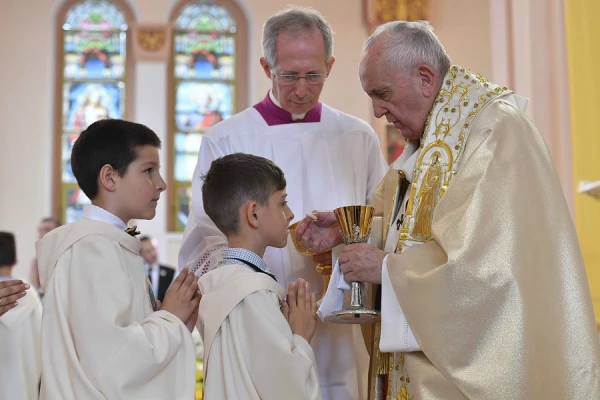
Rakovski, Bulgaria, May 6, 2019 / 05:39 am (CNA).- Pope Francis Monday gave First Communion to 245 boys and girls in Rakovski, Bulgaria, telling them the Lord wants them to share the joy of the Eucharist with others.

“Making your First Communion shows that you want to be closer to Jesus every day, to grow in friendship with him and to lead other people to share in the joy he wants us to feel,” the pope said May 6.

“The Lord needs you,” he told the first communicants, “because he wants to work the miracle of bringing his joy to many of your friends and family members.”

Pope Francis said Mass at Sacred Heart Church in Rakovski as part of his May 5-7 trip to Bulgaria and North Macedonia. Catholics in Bulgaria are a small minority — estimated to be fewer than 50,000 in a population of more than 7 million. Rakovski, a town of around 20,000 people, is mainly Catholic.

According to local authorities, at Mass there were around 700 people inside the church and another 10,000 outside.

In his homily, Francis addressed the first communicants, pointing out that Jesus’ miracle of the five loaves and two fish began with “one child who offered all he had.”

“Like that child, you too have helped a miracle to take place today. The miracle by which all of us older people have recalled our own first meeting with Jesus in the Eucharist, and are filled with gratitude for that day.”

Always pray with the same enthusiasm and joy you feel today, he urged.

He reminded the youth that this is their “first Communion,” but it is not their last, and to remember that Jesus is always present and waiting for them in the Sacrament.

“I hope that today will be the beginning of many Communions, so that your hearts may always, like today, be festive, full of joy and, above all else, gratitude,” he said.

Pope Francis said he was happy to spend this moment of celebration, friendship, joy, and fraternity with all of them, noting that it is a day of communion with themselves and with the whole Church, which “especially in the Eucharist, expresses the communion that makes all of us brothers and sisters.”

“This,” he continued, “is our identity card: God is our Father, Jesus is our brother, the Church is our family. All of us are brothers and sisters, and our law is love.”

He told the boys and girls he is sure they will always remember this day: their first encounter with Jesus in the sacrament of the Eucharist.

“One of you might ask me: How can we meet Jesus? He lived a long time ago, but then he died and was laid in the tomb!” Francis said. “It is true: Jesus carried out an immense act of love to save human beings of all times.”

But, he explained, after three days, he rose from the dead. “Now Jesus is alive and is here with us. That is why we can encounter him today in the Eucharist. We do not see him with our physical eyes, but we do see him with the eyes of faith.”

Early Monday morning, before traveling to Rakovski, Pope Francis made a visit to the Vrazhdebna Refugee Center on the outskirts of Sofia, Bulgaria, where he greeted about 50 parents and children from Syria and Iraq.

During the visit, some of the children performed a song for Pope Francis and gave him drawings they had made.

The pope thanked the group for their welcome and the children for their beautiful singing. “They bring joy to your journey,” he said. “Your journey is not always beautiful, and then there is the pain of leaving your homeland…”

But, there is always hope, he said, adding that “today, the world of migrants and refugees is a bit of a cross, a cross of humanity; it is the cross that so many people suffer…”

Before parting, Francis asked for their prayers and gave them his apostolic blessing.

[…]

No Picture
News Briefs

Pope to Bulgarian Catholics: God uses imperfect people

May 5, 2019 CNA Daily News 0

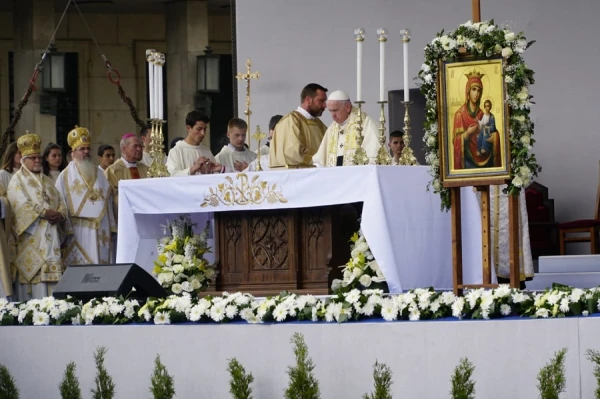
Sofia, Bulgaria, May 5, 2019 / 10:06 am (CNA).- The Lord works with imperfect situations and imperfect people, so persevere in holiness, Pope Francis encouraged Catholics in Bulgaria Sunday.

“The Lord does not wait for perfect situations or frames of mind: he creates them. He does not expect to encounter people without problems, disappointments, sins or limitations,” the pope said at Mass May 5.

Jesus “himself confronted sin and disappointment in order to encourage all men and women to persevere,” he continued. “In Jesus, God always offers us another chance. He calls us day by day to deepen our love for him and to be revived by his eternal newness. Every morning, he comes to find us where we are.”

Pope Francis celebrated Mass in Sofia, Bulgaria, on the first day of a May 5-7 trip to Bulgaria and North Macedonia. Catholics are a minority in the country; they are estimated to be fewer than 50,000 in a population of over 7 million.

According to organizers, there were an estimated 7,000 people at Mass with Pope Francis.

In his homily, the pope reflected on the day’s Gospel reading, when the resurrected Jesus appears to a group of his disciples while they are fishing in the Sea of Galilee.

Peter had returned to his old life as a fisherman, he said. “The weight of suffering, disappointment, and of betrayal had become like a stone blocking the hearts of the disciples. They were still burdened with pain and guilt, and the good news of the resurrection had not taken root in their hearts.”

In the face of failure, hurt, or even the fact that at times things do not go the way we want, there always comes a subtle and dangerous temptation to become disheartened and to give up. This is the tomb psychology that tinges everything with dejection and leads us to indulge in a soothing sense of self-pity that, like a moth, eats away at all our hope.

He emphasized that God is love, and that “love is his language,” which is why “he asks Peter, and us, to learn that language.”

Peter’s answer to the Lord’s question — “Simon, son of John, do you love me?” — reveals that Peter recognizes his own weakness. “He realizes that he cannot make progress on his own. And he takes his stand on the Lord and on the strength of his love, to the very end.”

One of the greatest difficulties today is people who know God is love, but who do not witness to this in the world, so that “for many people, this is not his name,” the pope said.

God makes our lives works of art, “if only we let ourselves be led by his love,” he said. “Many of the witnesses of Easter in this blessed land created magnificent masterpieces, inspired by simple faith and great love.”

He encouraged Bulgarian Catholics to not be afraid of holiness and to not be afraid to become the saints their country needs.

“Today we are called to lift up our eyes and acknowledge what the Lord has done in the past, and to walk with him towards the future, knowing that, whether we succeed or fail, he will always be there to keep telling us to cast our nets,” he concluded.

[…]