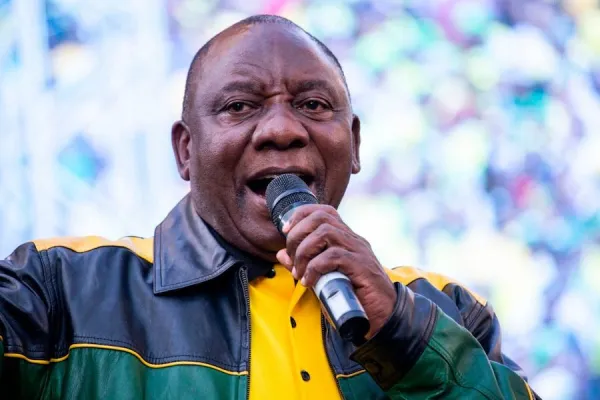
Johannesburg, South Africa, May 14, 2019 / 12:07 am (CNA).- In the wake of President Cyril Ramaphosa’s successful reelection bid last week, South Africa’s Catholic bishops are applauding the country’s efforts to hold a free and fair election, but have also issued stern expectations for the new government.
“We congratulate the Independent Electoral Commission and all political parties for creating a conducive environment for [a] free and fair election,” the bishops wrote in a May 13 statement signed by Bishop Sithembele Sipuka.
“Now that the election is over, we expect the President of our nation to dispense with the politics of expediency and show firm hand in dealing with those implicated in corruption and state capture,” the bishops wrote.
Ramaphosa, a member of the African National Congress (ANC) party which has held power in South Africa since the end of apartheid, first took office in February 2018.
His party won approximately 58% of the vote May 11 and retained parliamentary power in eight of the nine South African provinces.
According to Reuters, the ANC’s margin of victory was the smallest since the party began, which Ramaphosa attributed to voters expressing their frustration with corruption in the party. Voter turnout was about 65%.
“The dwindling in the voter turn-out as well as the incidents of protests during the election are a stern warning to all the political parties that, twenty five years into Constitutional Democracy, there is a need to renegotiate the social contract between the ruling elite and those living in the margins of the economy,” the bishops asserted.
South Africa is experiencing high unemployment, poverty and corruption under the ANC’s rule. The ANC is the party of Nelson Mandela, the first black president of the country, elected in 1994 when the country became a constitutional democracy for the first time.
“In the previous 25 years, the Constitutional Democracy and its embedded social contract have failed to create tangible dividends, especially to the poor, in terms of acceptable levels of access to quality education, quality health care, job opportunities, and decent housing,” the bishops said.
Therefore, they continued, the “mending of the social contract” over the next five years will involve “tackling the triple challenges of poverty, unemployment and inequality.”
Ramaphosa took over leadership of the ANC in 2017 after former president Jacob Zuma resigned in disgrace, following numerous corruption scandals. This week Ramaphosa vowed to tackle corruption in the party.
The bishops called for the new government to “put the country first” and address the nation’s economic issues in order to put the citizens of the country back to work.
By some estimates, 27 percent of South Africans do not have jobs, Reuters reports.
“In particular, we call on the ruling party to develop a national strategic plan, with measurable targets that can be subject to accountability, to address youth unemployment, which is a ticking time bomb and has at some level contributed the disenchantment and voter apathy among the youth,” the bishops noted.
The bishops issued concrete expectations for the new president. These include: keeping those suspected of corruption out of the cabinet and the Parliament, reducing the size of the cabinet, introducing measures to more effectively prosecute those involved in corruption and state capture, and introducing measures to address “irregular, fruitless and wasteful expenditure in the government departments and municipalities.”
If you value the news and views Catholic World Report provides, please consider donating to support our efforts. Your contribution will help us continue to make CWR available to all readers worldwide for free, without a subscription. Thank you for your generosity!
Click here for more information on donating to CWR. Click here to sign up for our newsletter.

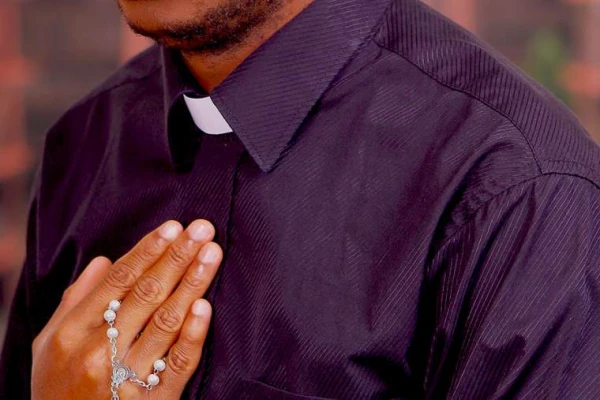
Enugu, Nigeria, Aug 2, 2019 / 06:01 pm (CNA).- Priests of southeastern Nigeria’s Diocese of Enugu protested Friday government inaction in the face of widespread violence. Fr. Paul Offu, a priest of the diocese, had been murdered the previous day.
Offu was shot to death Aug. 1 in the Awgu local government area, about 20 miles south of Enugu.
He was from Enugu state, and had been the pastor of St. James the Greater parish in Ugbawka.
The Enugu diocese wrote on Facebook that Offu was killed “by some hoodlums suspected to be the notorious and murderous Fulani herdsmen.”
Ebere Amaraizu, a public relations officers for Enugu police, said Aug. 2 that those responsible for the death were yet to be identified, according to the Daily Trust. The Nigerian outlet also indicated that Amaraizu indicated that the Fulani should not be blamed for the death before those responsible were apprehended.
Fr. Benjamin Achi, communications director for the Enugu diocese, told The Punch that “Fr. Offu was stopped by the murderous herdsmen while returning to his parish after a visit to priest friend.”
“They dragged him to the bush but one of the assailants said kill him that the church would not do anything if they kidnapped him,” Achi said, according to The Punch.
Priests of the Enugu diocese protested Offu’s death, marching Aug. 2 to the Enugu State Government House and police headquarters urging that officials do more to defend residents.
Violence against Christians has significantly increased in Nigeria in recent years, with the radical Islamist group Boko Haram threatening safety in the north, and smaller violent gangs threatening security in the south.
Fulani herders, most of whom are Muslim, have had increasing conflict with largely Christian farmers over limited natural resources in recent years.
Pope Francis interacted with an energetic crowd of 65,000 young adults and catechists at Martyrs’ Stadium in Kinshasa, Democratic Republic of Congo, on Feb. 2, 2023. / Vatican Media
Rome Newsroom, Feb 2, 2023 / 05:45 am (CNA).
To bring about peace, “prayer is the most powerful weapon there is,” Pope Francis told thousands of young adults and catechism teachers in the Democratic Republic of Congo on Thursday.
The meeting in Martyrs’ Stadium in Kinshasa, the capital city of the DRC, took place on Feb. 2, the third day of the pope’s visit to the central African country. On Feb. 3, Francis will fly to Juba, South Sudan, for the second leg of his peace pilgrimage.
Pope Francis on Thursday interacted with an enthusiastic crowd of about 65,000 young people and adults, some of whom traveled days to be present for the papal visit.
Pope Francis interacted with an energetic crowd of 65,000 young adults and catechists at Martyrs’ Stadium in Kinshasa, Democratic Republic of Congo, on Feb. 2, 2023. Vatican Media
“Yes, prayer conquers fear and enables us to take our future into our hands. Do you believe this?” the pope said. “Do you want to make prayer your secret, as refreshing water for the soul, as the one weapon you carry, as a traveling companion on each day’s journey?”
During the second half of his speech, the pope was repeatedly drowned out by the energetic audience, which broke out in cheering, singing, and dancing despite the hot weather.
Pope Francis interacted with an energetic crowd of 65,000 young adults and catechists at Martyrs’ Stadium in Kinshasa, Democratic Republic of Congo, on Feb. 2, 2023. Vatican Media
In his talk, Francis used the imagery of the hand to speak about the future of the DRC.
“God has placed the gift of life, the future of society and the future of this great country in those hands of yours,” he said.
“Dear brother, dear sister, do your hands not seem small and frail, empty and unsuited to so great a task? It’s true,” he said. “Let me tell you something: your hands all look alike, they all look alike, but none of them is exactly the same. No one has hands just like yours, and that is a sign that you are a unique treasure, an unrepeatable and incomparable treasure.”
He invited those present in the stadium to open and close their hands while meditating on whether they wanted to choose peace or violence.
Pope Francis interacted with an energetic crowd of 65,000 young adults and catechists at Martyrs’ Stadium in Kinshasa, Democratic Republic of Congo, on Feb. 2, 2023. Vatican Media
“Notice how you can squeeze your hand, closing it to make a fist. Or you can open it, to offer it to God and to others,” he said.
“You who dream of a different future: from your hands, tomorrow can be born, tomorrow can be born from your hands, from your hands peace so lacking in this country can at last come about.”
Bishop Donatien Bafuidinsoni Maloko-Mana from the Diocese of Inongo, in western DRC, was at the meeting.
He told EWTN News that people from his diocese traveled in boats on the Congo River for two to four days to arrive in Kinshasa.
Bafuidinsoni said the Congolese people were disappointed last year when the pope’s visit was canceled, but “now that the pope is here it’s a big joy for us all.”
Even those who are following the trip from home “are really happy,” he added. “It’s a message of joy, of peace, and of hope for all.”
Sister Asterie Neema, 29, is from Rutshuru in eastern DRC, where her brother was brutally killed last year. Elias Turk/CNA
Sister Asterie Neema, 29, is from Rutshuru in eastern Congo, where, she told EWTN News, they are under the control of an armed group called M23.
Neema said her older brother was killed in 2022 by unidentified rebels in front of his 12- and 7-year-old children.
In her 29 years of life, she said, her region of the DRC has never seen peace. Neema added that she has forgiven her brother’s killers, but she hopes for peace in her country.
Not everyone in the audience was Catholic. Two young Muslim men also attended the youth gathering with Pope Francis.
Yassine Mumbere, from Butembo in eastern DRC, told EWTN News that he came to the event because all young people were invited. He also studied at a Catholic school.
Muslim Yassine Mumbere, 35, from Butembo in eastern Congo, (R) with his friend (L) at the youth gathering with Pope Francis in Kinshasa, DRC on Feb. 2, 2023. Elias Turk/CNA
The 35-year-old Muslim Scout leader said he hopes the pope’s trip will help bring peace to the DRC’s eastern region.
In his speech, Pope Francis encouraged those present to be careful of the temptation to point fingers at people, or to exclude others because of “regionalism, tribalism, or anything that makes you feel secure in your own group, but at the same time is unconcerned with the life of the community.”
“You know what happens: first, you believe in prejudices about others, then you justify hatred, then violence, and in the end, you find yourself in the middle of a war,” he said.
To create a concrete sign of community, Francis invited the crowd to hold hands with those beside them and to sing a song together: “Imagine yourselves as one Church, a single people, holding hands.”
Pope Francis interacted with an energetic crowd of 65,000 young adults and catechists at Martyrs’ Stadium in Kinshasa, Democratic Republic of Congo, on Feb. 2, 2023. Vatican Media
“Yes, brother and sister, you are indispensable and you are responsible for your Church and for your country,” he said after the song. “You are part of a greater history, one that calls you to take an active role as a builder of communion, a champion of fraternity, an indomitable dreamer of a more united world.”
After Pope Francis spoke against corruption — inviting everyone to shout together, “Go away, corruption!” — the stadium broke out in loud singing and cheering.
The event’s emcee had to invite the crowd to quiet down before the pope could continue speaking.
Francis also drew attention to two Congolese martyrs and their examples of faith: Blessed Isidore Bakanja and Blessed Marie-Clémentine Anuarite.
Statues of Blessed Isidore Bakanja and Blessed Marie-Clémentine Anuarite, young Congolese martyrs beatified by Pope John Paul II, in Martyrs’ Stadium in Kinshasa, DRC, on Feb. 2, 2023. Elias Turk/CNA
Blessed Marie-Clémentine Anuarite, a member of the Sisters of the Holy Family, was killed during the civil war in 1964 at the age of 24. Anuarite was beatified by Pope John Paul II during his visit to the DRC, then known as the Republic of Zaire, in 1985.
Blessed Isidore Bakanja was a Catholic convert at the age of 18. He became a catechist and was devoted to Our Lady of Mount Carmel. He died in 1909, around the age of 21 or 22, after succumbing to an infection caused by a beating and other torture he received at the hands of a European manager for refusing to remove his brown scapular at work. Bakanja was beatified in 1994 by Pope John Paul II.
Statues of the two blesseds were present at the youth meeting, where people in the crowd shouted and held signs asking the pope to make them “santi subito!”
The pope pointed to another example of virtue from the DRC, Floribert Bwana Chui, who was killed in 2007 in Goma.
The 26-year-old man, who worked as a customs manager, was killed for refusing to cooperate with corruption; specifically, he did not allow the passage of expired food products.
A spectator at Martyrs’ Stadium in Kinshasa, DRC, on Feb. 2, 2023, holds a sign with the phrase “santi subito” in reference to two Congolese blesseds. Elias Turk/CNA
“He could easily have turned a blind eye; nobody would have found out, and he might even have gotten ahead as a result,” Francis said. “But, since he was a Christian, he prayed. He thought of others and he chose to be honest, saying no to the filth of corruption.”
“Now I want to tell you something important,” he added. “Listen closely: If someone offers you a bribe, or promises you favors and lots of money, do not fall into the trap. Do not be deceived; do not be sucked into the swamp of evil. Do not be overcome by evil!”
Cardinal Fridolin Ambongo, president of the Symposium of Episcopal Conferences of Africa and Madagascar (SECAM). / Credit: François-Régis Salefran, CC BY-SA 4.0, via Wikimedia Commons
Considering that Ramaphosa became one of the richest men in South Africa through tenderpreneurship and underhanded deals (one of which was his involvement in the suppression of the strike at the Marikana Mine, which is owned by Lonmin, a company in which he is a director) expecting him to tackle corruption is somewhat naive.
The call of my country’s Bishops to put country before personal interest is a noble and necessary one, but will sadly fall on deaf ears. cANCer is corrupt to the core.
Considering that Ramaphosa became one of the richest men in South Africa through tenderpreneurship and underhanded deals (one of which was his involvement in the suppression of the strike at the Marikana Mine, which is owned by Lonmin, a company in which he is a director) expecting him to tackle corruption is somewhat naive.
The call of my country’s Bishops to put country before personal interest is a noble and necessary one, but will sadly fall on deaf ears. cANCer is corrupt to the core.