Washington D.C., Mar 22, 2019 / 04:32 pm (CNA).- A proposal to ease regulations on mercury pollution levels in the air fails to show proper respect for human life and health, said the heads of two committees at the U.S. Conference of Catholic Bishops on Friday.
“The proposed change to the Mercury and Air Toxics Standards (MATS) rule is troubling since it is well-documented that pregnant mothers and their unborn children are the most sensitive to mercury pollution and its adverse health effects,” said Archbishop Joseph Naumann, chairman of the U.S. Bishops’ Committee on Pro-life Activities.
Archbishop Naumann was joined by Bishop Frank Dewane of Venice, Florida, who heads the bishops’ Committee on Domestic Justice and Human Development in voicing concern over the Environmental Protection Agency’s proposed changes to the Mercury and Air Toxics Standards, decade-old regulations that have led to an 85 percent decrease in mercury emissions at coal-based power plans.
The EPA believes it is no longer “appropriate and necessary” to regulate mercury and other toxic pollutants from power plants.
It says the rules are unnecessarily expensive and is suggesting a change in the way that the costs and benefits of the regulations are calculated, in response to a 2015 Supreme Court ruling in which the justices instructed the EPA to consider the costs of the regulations to determine whether they are justified.
President Donald Trump has called the Obama-era standards a “crushing attack on American industry,” saying they threaten miners, energy workers and companies.
Advocates of the regulations say they are necessary to protect the air quality from mercury contamination, which is known to cause brain damage and birth defects in children.
“The MATS rule reflects a proper respect for life of the human person and of God’s creation – a great example of the integral ecology called for in Laudato Si’,” said Bishop Dewane.
If you value the news and views Catholic World Report provides, please consider donating to support our efforts. Your contribution will help us continue to make CWR available to all readers worldwide for free, without a subscription. Thank you for your generosity!
Click here for more information on donating to CWR. Click here to sign up for our newsletter.
Bishop David Zubik of Pittsburgh speaks with anchor Tracy Sabol on “EWTN News Nightly” on July 15, 2024, about the attempted assassination of former president Donald Trump. / Credit: “EWTN News Nightly”/screenshot
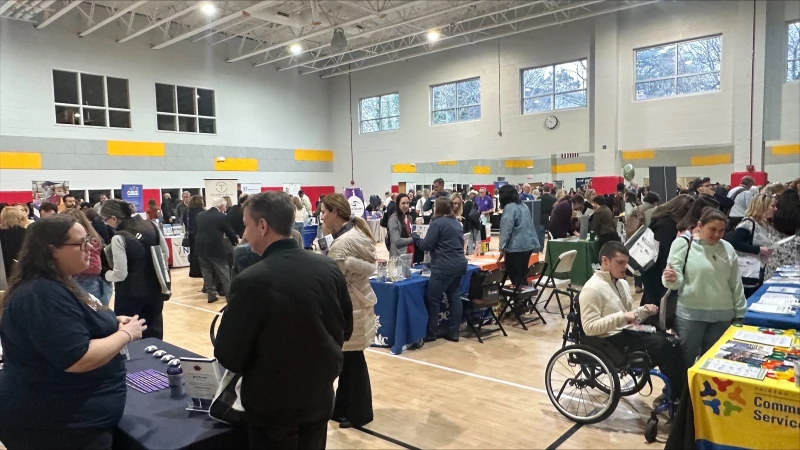
Attendees visit vendors at the Diocese of Arlington’s 2025 “From Inclusion to Belonging Conference.” / Credit: Porto Charities
Washington, D.C. Newsroom, Mar 17, 2025 / 07:00 am (CNA).
Families whose children have disabilities and Catholics with disabilities were welcomed by the Diocese of Arlington March 15 to the fourth annual “From Inclusion to Belonging Conference” which focused on plans for the future as those with disabilities prepare for adult life out of high school.
“The Lord, for us, is one who will always be there to strengthen us, to heal us, and to help us,” Bishop Michael Burbidge said in his opening remarks at the conference, held at Bishop Ireton High School in Alexandria, Virginia.
With more than 200 people in attendance, the diocesan conference featured an array of talks, in English and Spanish, about resources for children with intellectual, emotional, and physical disabilities. These included tips for life skills, faith formation, education, and employment, which were presented to parents, teachers, priests, and others.
The conference also provided talks for teenagers with disabilities, designed to help guide them on how to advocate for themselves. Those participants were brought to vendors who offered resources to connect them with opportunities.
“We are called to live the Gospel of life,” Burbidge told CNA after giving his remarks. “In fact, it is a mandate to protect, to revere, to celebrate, to cherish, and to welcome all human life. …There are no exceptions.”
Nearly 20 diocesan schools educate students with disabilities, including all four high schools. A few of the schools also have specialized programs for children who have disabilities.
Diane Elliott, an assistant superintendent for Arlington Diocese Catholic Schools, told CNA that it is important for Catholic schools to have the mindset that “we’re going to serve all God’s children.”
She said it’s “not only about the kids with disabilities,” but it’s also important for other children to learn “how to accept individual differences” and avoid stigmatizing people.
Elliott added, “the majority of what we do, it doesn’t cost any money for inclusion,” and spoke about the sensory Masses offered by the diocese. Those Masses are designed for people with sensory processing issues, and usually include dimmed lights, no organ music, and homilies that are very concise. Some people who benefit from those Masses include people with autism, downs syndrome, and Alzheimer’s disease.
For efforts that do require financial resources, Burbidge told CNA that the inclusion of those with disabilities should still always be a priority, and that when resources are limited, priorities “must be reflected in how you use those resources.”
Guadalupe Williamson, whose 14-year-old son Patrick has an intellectual disability caused by a malformation in the brain, told CNA she sends him to Saint Anthony of Padua School in Falls Church because she wanted all of her children to attend the same Catholic school.
Williamson said the inclusion efforts ensure Patrick has a “learning environment that also matches our values as a family — our Catholic values.” She said he is also an altar server, and “just absolutely loves everything that the Church has to offer.”
Roxanne Miller, a mother of 10 who lives in Huntley, sends her 18-year-old daughter Megan to St. Paul VI Catholic High School in Chantilly. She said her daughter, who has down syndrome, is “part of the fabric of the school” and referred to the inclusion efforts as “second to none.”
Miller told CNA she attended the conference while she is helping her daughter plan for her future with employment opportunities and possibly advocacy. She said Megan is in the high school’s post-graduate transitional program for those with intellectual disabilities, which is helping them connect her with future opportunities.
Faith formation for those with special needs
The Diocese of Arlington also operates a Special Religious Development (SPRED) Program, which helps those with disabilities develop a faith community and have “access to prepare for and receive the sacraments,” Burbidge told CNA.
“That’s been a great work in our diocese,” the bishop said.
Charleen Katra, who serves on the board of the National Catholic Partnership on Disability, gives talk on ensuring those with disabilities have access to the sacraments at the Diocese of Arlington’s “From Inclusion to Belonging Conference.”. Credit: Tyler Arnold/Catholic News Agency
Nancy Emanuel, the coordinator for Special Needs Ministries in the diocese, told CNA that the program provides special religious development designed for those “who don’t fit into the typical religious education programs.”
Emmanuel said about 150 adults and children participate in the program, which divides those who are enrolled by age. The program is inclusive of those with physical and mental disabilities, which includes people with autism and down syndrome.
For some Catholics with disabilities, Emmanuel said that accessing the sacraments can at times be “overwhelming” for them. She said the program uses a lot of visual and tactile learning. For a person’s First Communion or for Confirmation, she said the instructors will practice those rituals with those children or adults to “make it so that it’s a friendly experience.”
Charleen Katra, who serves on the board of the National Catholic Partnership on Disability, gave a talk on the importance of ensuring Catholics with disabilities have access to the sacraments and the ways in which dioceses can accommodate their needs.
She said that dioceses must “meet the real needs” of each person. She noted that catechesis for a person affected by serious intellectual disabilities can sometimes be as simple as ensuring the person knows that the Eucharist is the literal Body and Blood of Christ before communion and ensuring the person knows he or she is receiving the Holy Spirit prior to confirmation.
“If there’s anybody missing in the Body of Christ, we know it’s not complete,” Katra said.
Cardinal Timothy Dolan (left) and Republican presidential nominee former president Donald Trump react during the annual Alfred E. Smith Foundation Dinner at the New York Hilton Midtown on Oct. 17, 2024, in New York City. / Credit: Michael M. San… […]
4 Comments
It may be that the changes to the mercury regulations are bad.
If, however, the bishops didn’t speak out on so any subjects that are only tangentially related to morals or are reflexively left-wing, and focused more on being shepherds, perhaps when they did speak it would have more effect.
You can blame Trump for the easing of regulations. Everywhere you look the key administration secretaries of EPA, Interior and Energy were advocates of rolling back ecology improving measures by Obama. Trump, a champion of the church, calls global warning a hoax. He has to go.




It may be that the changes to the mercury regulations are bad.
If, however, the bishops didn’t speak out on so any subjects that are only tangentially related to morals or are reflexively left-wing, and focused more on being shepherds, perhaps when they did speak it would have more effect.
So many, not so any. Sorry.
You can blame Trump for the easing of regulations. Everywhere you look the key administration secretaries of EPA, Interior and Energy were advocates of rolling back ecology improving measures by Obama. Trump, a champion of the church, calls global warning a hoax. He has to go.
“Global warming” (shame on you, you’re not using the latest approved term) is a hoax.
I remember when they were terrifying us in the 1970’s with the absolutely certain scientific consensus of global *cooling*.