

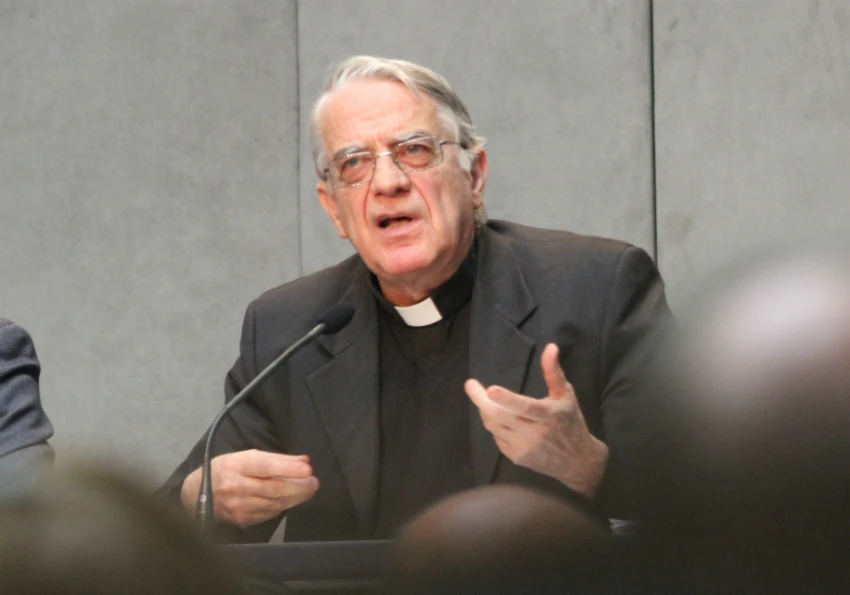
Vatican City, Jan 22, 2019 / 12:00 pm (CNA).- The moderator of the Vatican’s February summit on child sexual abuse has written an article outlining his take on the Church’s most effective models of response for addressing its sexual abuse crisis.
The article, written by Fr. Federico Lombardi, is published in the Jan. 19 issue of the Jesuit-run bi-monthly magazine La Civiltà Cattolica. Lombardi, a Jesuit and former papal spokesman, will be a central actor in the Feb. 21-24 meeting, which will convene the leaders of bishops’ conferences from around the world to discuss the clerical sexual abuse of minors.
Lombardi has long known in Italy as a key figure in the fight against sex abuse by clergy.
In 2011, Lombardi was part of a significant moment related to combating sexual abuse: A conference, “Toward Healing and Renewal,” organized by the Pontifical Gregorian University. The work of the conference become the basis for the establishment of the Gregorian’s Centre for Child Protection, which partially inspired the Pontifical Commission for the Protection of Minors.
In 2017, Lombardi was involved in the organization of the conference “Child Dignity in Digital Age,” which drafted and presented to Pope Francis the “Declaration of Rome”, which proposed new approaches needed to countering sexual abuse in the internet era.
Lombardi is also part of the steering committee of the “Child Dignity Alliance.”
The former papal spokesperson has also gained attention as an expert on sexual abuse issues because of his articles on La Civiltà Cattolica. In an essay last month, he retraced step-by-step the history of the clergy sex abuse crisis and of the Church’s response.
In his most recent article, Lombardi listed some “good practices” for an effective response. Those documents will be likely at the center of the discussions in the February meeting.
Lombardi highlighted the document “Protecting Minors from Sexual Abuse,” issued by the Canadian Bishops Conference, which addresses the effects of abuses on victims and community, explains how to respond to the crisis and outlines “guidelines” for juridical and pastoral procedures.
Lombardi said that “it is expected that every diocese will appoint dedicated people to collect abuse reports and to proceed to preliminary investigations.”
The moderator of the February meeting also praised the diocese in Bergamo, in Northern Italy, which established a specific office in the diocesan Curia, called the “diocesan service for the Protection of Minors.” While such offices are standard operating procedure in the United States, they are less common in other parts of the world.
Lombardi stressed that “the collaboration between dioceses and ecclesial institutions” is crucial, as it is important to “formulate and set up new curricula,” especially to train those on the front line of countering the abuse crisis. The Jesuit noted that “this is difficult in vast areas of the world that lack of experience, resources and competences.”
If you value the news and views Catholic World Report provides, please consider donating to support our efforts. Your contribution will help us continue to make CWR available to all readers worldwide for free, without a subscription. Thank you for your generosity!
Click here for more information on donating to CWR. Click here to sign up for our newsletter.

Nothing about homosexual exploitation of teenagers and young adults? This does not bode well.
Stop the hate speech. There is zero credible evidence that homosexuals, as a group, exploit children, teenagers, or young adults at a greater rate than do heterosexuals. In fact, heterosexual men offend at a significantly higher rate (case in point, the Church’s own sordid history of criminal sexual abuse). You are imposing your personal ignorance, intolerance, and unsubstantiated opinions on an already persecuted group of people. It is all of our responsibilities as Catholics, as Christians, to assist and protect the vulnerable. Hate directed at any group should be as unacceptable to us as it was to Jesus Christ. Check yourself.
“unsubstantiated opinions”
They are not unsubstantiated opinions. They are backed by statistics. And we are certainly free to hate the behavior that is causing such terrible damage to the victims, to the souls of the perpetrators, and to the Church.
“The John Jay study, which was commissioned by the USCCB, found that 19 percent of the more than 4,000 victims of predatory priests were female; 81 percent of cases of clergy sexual abuse involved priests and male victims. According to the John Jay study (see page 6 for the summary of demographics) the largest group (50.9 percent) of victims were between the ages of 11-14; 27 percent were between 15-17 years old; 16 percent were between 8-10 years old; and 6 percent of all victims were under 7. According to the John Jay Report, this was not a “pedophile priest” scandal, because the vast majority of cases involved post-pubescent males; it was a scandal of same-sex predation, though few wanted to acknowledge this.”
https://www.catholicworldreport.com/2018/08/22/understanding-the-demographics-of-the-predatory-priest-problem/
You’re not exactly citing a scientific source with the link to an op-ed in a Conservative Catholic publication. This is junk science and virulent homophobia. Homophobia goes against all of Jesus Christ’s teachings.
The fact is, a homosexual is no more likely to be a predator than a heterosexual is. No research suggests that homosexuals are at higher risk of being sex offenders, committing sexual crimes, or having impulse control disorders that result in sexual crimes than heterosexuals. Sexual orientation, by itself, is not a risk factor for crime.
You, like the op-ed you cite, have misinterpreted and cherry-picked the John Jay report.
“Many report that teens are not the object of their desire but what was available to them at the time. Perhaps prison sexual behavior is a good example. Often heterosexual men find themselves engaging in homosexual behavior while in prison and return to heterosexual behavior once released. Abusing priests, especially during the 1960’s and 1970’s when most of these crimes were committed, had power, control, access, and trust with boys much more so than with girls.” – Thomas G. Plante, PhD, Prof. of Psychiatry Santa Clara University and Stanford University
link:What we know about Homosexuals and the Catholic Clergy Sexual Abuse Crisis | Psychology Today https://www.psychologytoday.com/blog/do-the-right-thing/201004/what-we-know-about-homosexuals-and-the-catholic-clergy-sexual-abuse