No Picture
News Briefs

At Stations of the Cross, Pope asks for grace to be ashamed of our sins

March 30, 2018 CNA Daily News 1

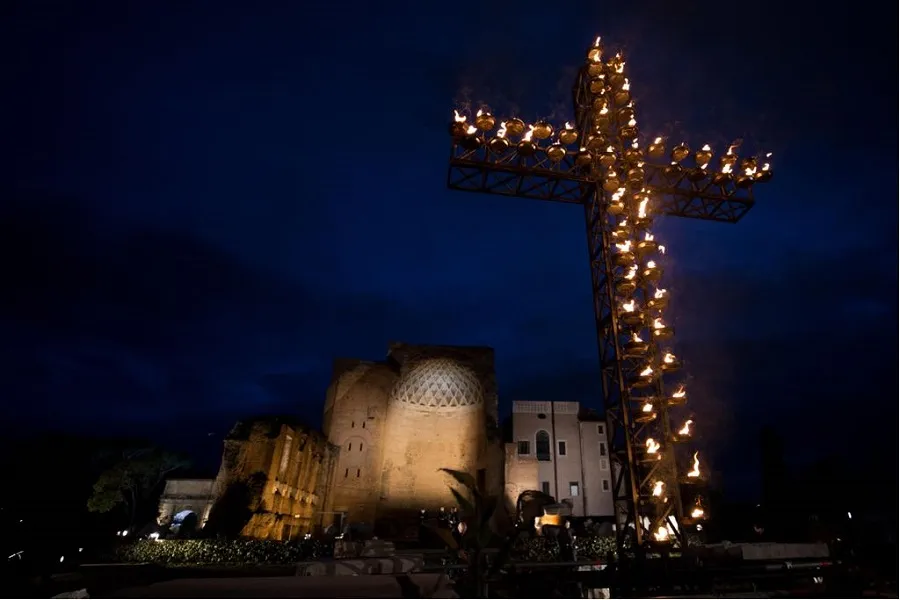
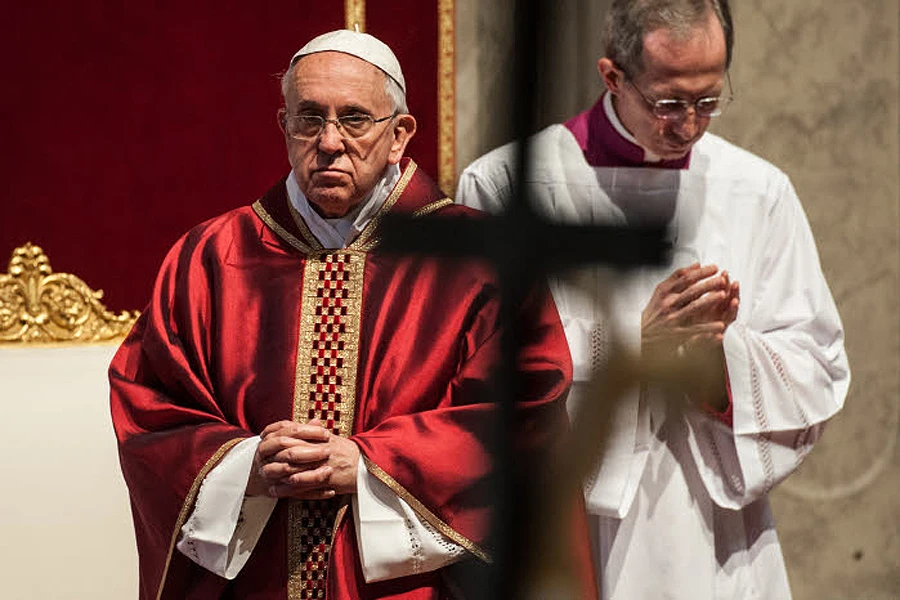
Vatican City, Mar 30, 2018 / 02:38 pm (CNA/EWTN News).- During his annual Good Friday Via Crucis at the Colosseum, Pope Francis made a heartfelt prayer asking God to give Christians the grace to be ashamed of their sins, to repent and beg for mercy, and to have hope that his love is stronger than death.

“Before your supreme love, shame pervades us for having left you alone to suffer for our sins…shame for having chosen Barabbas and not you, power and not you, appearance and not you, the god of money and not you, worldliness and not eternity,” the Pope said in his March 30 prayer.

Christians also feel shame for all the people, including some clergy, who “allowed themselves be deceived by ambition and vainglory, losing sight of their dignity and first love,” and those who have left future generations a world “fractured by divisions and wars” and “consumed by selfishness.”

Above all, Christians are ashamed “for having lost a sense of shame,” he said, and asked the Lord to “always grant us the grace of holy shame!”

Pope Francis presided over the Stations of the Cross on Good Friday at the Colosseum – an ancient practice which dates back to the pontificate of Benedict XIV, who died in 1758. After a pause, the tradition was revived by Bl. Pope Paul VI in 1964, and under St. John Paul II it became known globally through television.

Each year the pope personally chooses someone to write the meditations for the stations. This year he asked a group of Italian high school students to write the meditations, guided by religion teacher Andrea Monda.

The meditations reflected on different themes, such as compassion, Jesus’ humanity, man’s dignity, fear of suffering, modern sensitivity to anything considered offensive, the surprises God gives and the knowledge that as Christians, we are never alone.

While in the past, the pope himself used to carry the cross from station to station, it is now carried by individuals and families. This year cross-bearers included Archbishop Angelo Donatis, the Vicar of Rome, a family of five from Syria, Dominican religious sisters from Iraq and friars from the Holy Land, among others.

In his prayer at the end of the Via Crucis, Pope Francis said that as Christians contemplate Jesus’ bloody death, they look to him with a gaze full of repentance, “which before your eloquent silence, begs for your mercy.”

This repentance, he said, “springs from the certainty that only you can save us from evil, only you can heal us from our leprosy of hate, selfishness, pride, greed, revenge and idolatry.

“Only you can embrace us by restoring our dignity as your children and rejoicing for our return home, our return to life,” he said, adding that this repentance also comes from being aware of one’s smallness and vanity, and from allowing oneself to be moved by God’s “powerful invitation to convert.”

It is the repentance of David, “who from the abyss of his suffering finds in you his only strength,” and
the repentance of Peter, “who when his eyes met yours, wept bitterly for having denied you.”

“Lord Jesus, always grant us the grace of holy repentance,” he said, but noted that despite man’s sinfulness, in front of God’s majesty “the spark of hope is lit in the darkness of our despair, because we know that your only measure for loving us is to love us without measure.”

This hope, he said, is that God’s message will continue to inspire people today with the knowledge that good and forgiveness overcome evil and the desire for revenge, and that a “brotherly embrace” can dispel “hostility and fear of the other.”

It is also a hope that Christ’s sacrifice would continue to emanate the “fragrance of divine love” that touches the young people who consecrate their lives to God, and that missionaries would continue “to challenge the slumbering consciousness of humanity,” by risking their lives to serve the poor, invisible, exploited and forgotten.

Francis said this is also a hope that the Church, which is holy and yet made up of sinners, “may continue, still today, despite all attempts to discredit it, to be a light that illuminates, encourages, uplifts and bears witness to your unlimited love for humanity.”

He prayed that the Church would be “a model of selflessness, an ark of salvation, and a source of certainty and truth.”

“Lord Jesus, always grant us the grace of holy hope!” he said, and asked Jesus to help Christians “strip ourselves of the arrogance of the unrepentant thief to your left, of the short-sighted and the corrupt” and those who saw in Jesus “another chance to put one’s own fault on others, even God.”

Closing his prayer, Francis asked Jesus to help Christians identify instead “with the good thief who looks to you with eyes full of shame, repentance and hope.”

With these eyes, the good thief “saw divine victory in your apparent defeat and knelt before your mercy, honestly stealing his way into heaven.”

[…]

No Picture
News Briefs

How American seminarians in Rome celebrate Holy Week

March 30, 2018 CNA Daily News 1

Rome, Italy, Mar 30, 2018 / 12:35 pm (CNA/EWTN News).- For American seminarians at the Pontifical North American college in Rome, Holy Week liturgies take on new life and dimension, as the history of ancient traditions comes alive through the city’s remembrance of Christ’s Passion and death.

The seminarians alternate each year between having Holy Week liturgical celebrations “in house,” or having the week free to celebrate wherever they wish.

This year is an in-house year, meaning all liturgies related to Holy Week, beginning with Palm Sunday through the Easter Vigil Saturday night, are celebrated in the seminary chapel with seminarians, deacons and priests carrying out the key roles including serving, singing and chanting the Gospels.

Justin Boff, a seminarian from the Archdiocese of Baltimore in his third year of theology at the NAC, said the ambiance of the seminary during the in-house years takes on a notably calm dynamic, as the frenzied rush of coursework and exams gives way to a slower, more prayerful pace focused on the liturgy.

“We’re really blessed here to have so many resources to be able to pull from and to be able to put together really, really nice liturgies with all the smells and bells and those sorts of things,” he told CNA, adding that the NAC is “a privileged place” with few distractions from entering into the meaning of the week’s events.

As far as the run-down of the schedule for this week, after Palm Sunday Mass March 25, seminarians have largely been focused on prayer and preparing for the major liturgies.

To kick off the Triduum, seminarians on Wednesday went on the historic “church walk” started by Saint Philip Neri in the late 16th century. On Wednesday of every Holy Week, Neri would set out with his companions on foot to visit each of the four major basilicas in Rome, as well as the three minor basilicas, stopping at each for a time of prayer.

Seminarians at the NAC have kept the tradition as part of their wider observance of the ancient “Roman stational liturgy,” in which Mass is celebrated at 7 a.m. at a different Roman parish each of the 40 days during Lent, beginning Ash Wednesday and ending the Wednesday of Holy Week.

At the end of Lent, the final station Mass is typically celebrated at the papal basilica of St. Mary Major, and after this Mass seminarians and other pilgrims will set off on the seven-church walk, finishing in the evening.

For Holy Thursday at the NAC, there was the usual Mass of the Lord’s Supper, celebrated by Cardinal Edwin O’Brien. Afterward, seminarians were welcome to go out and join the hundreds of other people in Rome praying at different chapels of repose throughout the city.

After Mass is celebrated on Holy Thursday, the Eucharist is removed from the tabernacle of churches as a sign that Jesus has been taken away, and placed in a side chapel where faithful can stay to pray, sometimes all night depending on the parish.

In Rome, locals, priests, pilgrims from abroad, and members of the Curia all turn out in droves for the event, stopping to pray at different churches around the city as a way of accompanying Jesus the night before his crucifixion and death.

“It’s really an impressive sight,” Boff said, explaining that most seminarians go out for this event, and are able to take students and peers from their apostolates along with them.

“So it’s a lot of religion these weeks, but it’s a lot of fun. You really get to see the universal Church and the local Church here in Rome, which is just beautiful.”

On Good Friday, the Veneration of the Cross service at the NAC will be celebrated at 3 p.m. by the college rector, Fr. Peter Harman. The Easter vigil Saturday night this year will be celebrated by Cardinal James Harvey. Events for Holy Week and the Easter Triduum will close Sunday morning, with Mass and evening prayer later in the afternoon.

Apart from the main liturgies, there has been daily morning prayer and Mass, and lots of preparation and rehearsals for the major events. Boff, who is playing the organ during the celebrations, has had a particularly busy week practicing with the 40-member seminary choir.

“It’s really not that much playing in the end as far as the Triduum goes, because the organ is totally silent from the Gloria on Holy Thursday to the Gloria on the Easter Vigil,” he said. “So the organ goes into the tomb a bit with the Lord.”

But the music at the vigil has to be “very triumphant and joyful,” which takes a lot of preparation to make sure the music matches the magnitude of the celebration, he said.

Deacon Colin Jones, who is from the Archdiocese of St. Paul and Minneapolis and is in his fourth year of theology at the NAC, said that for him, the station churches have played a major role in how he has lived Lent.

Though attending all the station Masses, some of which are an hour-long walk to get to, is not required, Jones said this year he tried to make it to as many as possible.

“It’s nice to be reminded about how many beautiful churches there are in the city and all the different parts of the city and a different, unique walk every morning,” he said, explaining that on any given day there are usually around 20-30 seminarians at the Masses in addition to the pilgrims and locals who come.

Jones said the long walk to get to some of the churches is “demanding,” but it allows time for prayer, and “it’s nice to have the morning for prayer and to have this pilgrimage…with our Lord through Lent.”

The churches and readings are generally the same for every year, and some were selected based on historical significance, so after awhile, he said, “the readings and the church become intertwined,” and it helps give context to the scripture passage being read.

Jones will also be chanting the part of Christ in the Gospel narrative of Jesus Passion on Good Friday, which is taken from the Gospel of John.

While the Palm Sunday Gospel reading was chanted by three priests, the Good Friday Gospel narrative will be chanted by three deacons, including Jones, who said the opportunity and the hours of practice are “a pretty big blessing, very powerful and very moving.”

Though it’s been hard to get the right pitch and tempo for the lines, Jones said being able to sing the lines of Jesus has helped him to go deeper into the events of Holy Week, specifically Jesus’ crucifixion and death.

“It just hits you in a different way and strikes more deeply,” he said. “Now we’ve sung through it a dozen times or so, so the words just get deeper every time, and you let them resonate a little bit more. And the more comfortable we become with it…we’re able to make it more of a prayer and those lines really hit you.”

Jones, who will be ordained a priest May 26, in just under a month, said he hopes that when he has a parish, he is able to impart to his parishioners the excitement and depth he’s gained about Holy Week from living and celebrating the liturgies in Rome.

And while it’s nice to have time to celebrate Holy Week elsewhere or participate in papal liturgies, Jones said he prefers the in-house years, because “you can enjoy more of a restful environment and enjoy hanging out with the guys.”

There are also more opportunities for prayer, he said, adding that “even the preparations are kind of exciting, there’s a certain excitement that’s in the house, so that’s definitely fun having all of that here this week.”


[…]

No Picture
News Briefs

For Christians in Syria, Holy Week is a time for renewing faith

March 30, 2018 CNA Daily News 1

Homs, Syria, Mar 30, 2018 / 12:11 pm (ACI Prensa).- Christians in Syria have suffered greatly in recent years. Between the Syrian civil war and ISIS occupation, many have lost their homes, their jobs, and many of their material possessions.

“But they have not lost their faith, despite everything,” said Josué Villalón, a journalist working for Aid to the Church in Need in Spain, who recently visited some of the projects supported by pontifical foundation in Syria.

“Each person and each family with whom we spoke expressed to us that right now what gives them hope and sustains them is to be able to celebrate the Eucharist – because even though they have lost everything material, they still have Jesus Christ,” he told ACI Prensa, CNA’s Spanish language sister agency.

Aid to the Church in Need is working to help thousands of those displaced by the war and persecution to return to their homes. The agency’s Spanish branch contributes more than 600,000 euros annually to help in reconstruction efforts and continuing education for young people.

One of the moments that most impressed Villalón was his visit to the Syrian Catholic cathedral in the city of Homs, where hundreds of Christians were praying the Way of the Cross.

“Praying the Way of the Cross is a very strong tradition in Syria and the Middle East. It’s always been a focal point for Christians for their Lenten and Holy Week [devotions], ” he said.

On Good Friday, a procession is planned through the streets of the old city of Homs with a cross and various icons of the Virgin Mary.

“Now more than ever, the Way of the Cross is a very important prayer,” said Villalón, because the Christian population of Syria, “with everything they have suffered during these years of war, and everything they are still suffering, embodies a way of the cross. And so this prayer has even more meaning for them.”

Many of those living in the country today have beautiful testimonies, he continued.

“What is so powerful is that Christians in Syria today are embodying in their own lives the Gospel and the mystery of the Passion, Death and Resurrection of Jesus,” he said, adding that he saw in them reflections of Christ carrying his cross, and of Veronica and Simon of Cyrene offering help.

Villalón pointed out some the first Christians were from Syria.

“Centuries before Islam came, there were Christians there, and it was in Antioch that the followers of Christ were first called Christians,” he said. “The amount of historical and documentary sources is enormous there. For example, it was in Damascus that Saint Paul received Jesus’ call to conversion.”

In addition to their 2,000-year presence in the region, Christians in Syria and the Middle East continue to “contribute a number of irreplaceable values” such as “charity, freedom, forgiveness, and hope,” said Villalón.

“Christians are the only ones that speak about all these things, and so their presence is very important here.”


[…]

No Picture
News Briefs

On Good Friday, papal preacher tells youth to run toward love of Christ

March 30, 2018 CNA Daily News 1

Vatican City, Mar 30, 2018 / 10:06 am (CNA/EWTN News).- Papal preacher Fr. Raniero Cantalamessa dedicated his Good Friday homily to young people, comparing them to the apostle John and urging them to have the courage to go in the opposite direction of the selfishness of the world, running instead toward the sacrificial love of Jesus on the cross.

In his March 30 homily, Cantalamessa said modern society has come “under the dominion of Satan and sin,” and has been taken over by what St. Paul in his Letter to the Ephesians called the “spirit of the air.”

Cantalamessa said the phrase takes on a literal meaning today, because this spirit “spreads itself in infinite ways electronically through airwaves,” and plays a major role in shaping public opinion.

“To act, think or speak against this spirit is regarded as non-sensical or even as wrong and criminal,” he said, adding that the best way to ensure that one has not conformed to this world is by going in the opposite direction, walking toward suffering, and toward “the poor and those at the lowest level of society,” rather than away from them.

“Blending in with this world of suffering and marginalization is, paradoxically, the best way of ‘separating’ ourselves from the world because it means going in the direction from which the world flees as much as it can. It means separating ourselves from the very principle that rules the world, self-centeredness,” he said.

To drive his point home, Cantalamessa quoted British poet T.S. Eliot, saying “in a world of fugitives / The person taking the opposite direction / Will appear to run away.”

“Dear young Christians, if you will allow an old man like John to address you directly, I would exhort you: be those who take the opposite direction! Have the courage to go against the stream,” he said, adding that “the opposite direction for us is not a place but a person; it is Jesus, our friend and redeemer.”

Fr. Cantalamessa is the official papal preacher. He offers meditations to the pope and members of the Curia on Fridays during Advent and Lent, and he preaches the homily for the Good Friday veneration liturgy.

After the chanting of the Gospel during the liturgy for the Lord’s Passion in St. Peter’s Basilica, presided over by Pope Francis, Cantalamessa in his homily reflected on why the Church places such a strong emphasis on the cross of Christ.

He said that according to one theory, it could be because God reveals himself “sub contraria specie,” meaning in a form contrary to what he actually is: “he reveals his power in weakness, his wisdom in foolishness, his riches in poverty.”

However, this logic does not apply to the cross, he said, because on the cross God reveals himself “as he really is, in his most intimate and truest reality.” And this reality, he said, is that “God is love…oblative love, a love that consists in self-giving, and only on the cross does God’s infinite capacity for self-gift manifest the length to which it will go.”

With a Synod of Bishops dedicated to youth on the schedule for this October, Cantalamessa said the presence of St. John with Jesus on Calvary holds special significance, since it is believed that the evangelist joined Jesus when he was still a young man.

Noting how John is often referred to in scripture as “the disciple whom Jesus loved,” the papal preacher said this was a real and personal experience of “falling in love” with the Lord that can be seen from the fact that the whole of John’s Gospel focuses on the person of Jesus, rather than his works and teaching.
Cantalamessa said St. John was almost certainly one of the two disciples of John the Baptist who, when Jesus passed them on the beach, followed him and spent the day with him. He noted how when they asked Jesus where he was staying, “it was about the tenth hour.”

“That hour decided the course of John’s life, and he never forgot it,” Cantalamessa said, and stressed the importance of helping young people today understand not only what God and the Church expect of them and what they can offer to the Church and to society, but also to help youth understand what Jesus himself can offer to them.

He pointed to how John described his experience with Jesus as the “fullness of joy” and an “abundant life,” and urged members of the Church to accept Francis’ invitation in Evangelii Gaudium to “a renewed personal encounter with Jesus Christ, or at least an openness to letting him encounter them.”

“I ask all of you to do this unfailingly each day. No one should think that this invitation is not meant for him or her, since no one is excluded from the joy brought by the Lord,” he said, continuing to quote Francis.

Cantalamessa said it is possible to encounter Christ today because He is risen and alive, and that after this personal encounter takes place, “everything is possible.”

Speaking directly to youth, the papal preacher said they have a special mission “to rescue human love from the tragic drift in which it had ended up: love that is no longer a gift of self but only the possession – often violent and tyrannical – of another.”

Pointing to the self-sacrificial “agape” love shown by Jesus on the cross and the desiring, “eros” love that “welcomes, that pursues, that desires, and that finds joy in being loved in return,” Cantalamessa said these two types of love are linked, and cannot be separated from each other.

God both desires man and exercises charity toward him, he said, explaining that learning how to love like God “is not a question of renouncing the joys of love, attraction, and ‘eros,’ but of knowing how to unite ‘eros’ and ‘agape’ in the desire for another, the ability to give oneself to the other.”

Learning how to do this will not happen “in one day,” he said, and told youth to start preparing themselves now to give themselves either to another person in marriage, or to God in a consecrated vocation.

This preparation, he said, can begin now with something as simple as a smile or a gift of one’s time or service in one’s family, parish or volunteer work, which “so many of you are already quietly doing.”


[…]