No Picture
News Briefs

Chicago church leaders unite to oppose massive tax threat to religious groups
April 21, 2018 CNA Daily News 0

Chicago, Ill., Apr 21, 2018 / 06:01 am (CNA/EWTN News).- Religious leaders in Chicago are fighting to end a lawsuit filed by an atheist group that would impose upwards of $1 billion in taxes for churches around the nation.

The lawsuit, Gaylor v. Mnuchin, was filed by the Freedom From Religion Foundation. The case aims to end the parsonage allowance, a federal tax provision used by religious establishments such as churches, mosques, and synagogues, which offers a housing allowance to help religious leaders live in the communities they serve.

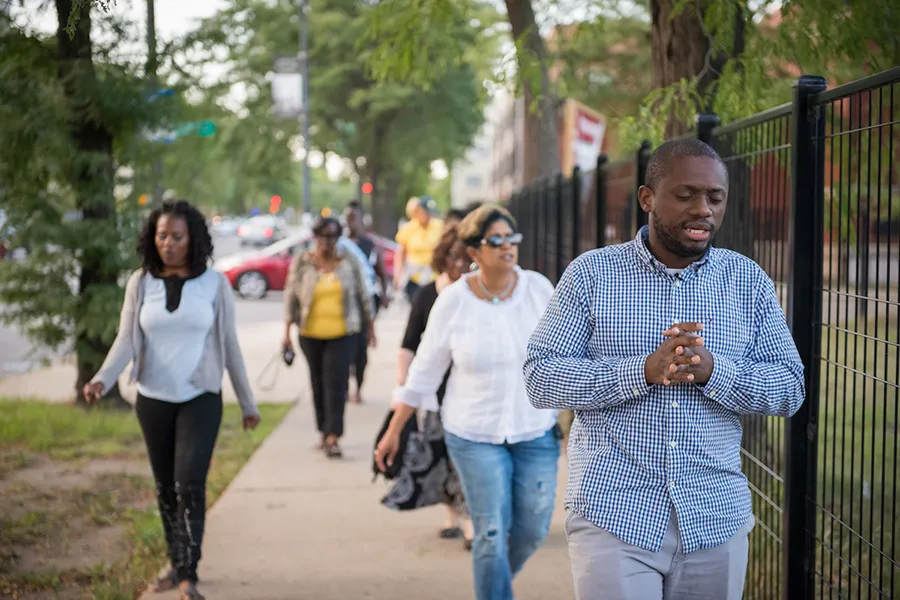
Chris Butler, pastor of the south-side Chicago Embassy Church requested April 19 that a federal appeals court throw out the lawsuit on discriminatory grounds. Butler is joined by other ecclesial communities and Churches, including leaders from the Russian Orthodox Church Outside of Russia’s Diocese of Chicago and Mid-America and Holy Cross Anglican Church.

“For the majority of churches, the pastors are like me and experience at some level the same problems that we’re trying to face in the community,” said Butler, according to a recent statement from the Becket Fund for Religious Liberty.

“If you take away even a little bit, it can become a lot of trouble quickly.”

Butler serves a predominately African-American community where he ministers to at-risk youth and the homeless in his neighborhood. He also is involved with programs to decrease local crime.

According to the Becket Fund, which has been involved in the case since January 2017, ending the parsonage allowance would “discriminate against religious groups by treating them worse than many other secular employees who receive similar tax treatment,” and would also “harm poor communities by diverting scarce resources away from essential ministries.”

Ed Peecher, bishop of the Chicago Embassy Church, said a video released by Becket that “If I am here to pastor this community, if I am here to make an impact on this community, it has to be done in the context of a relationship and it’s hard to have a relationship over distance… there is no substitute for proximity. You have to be there.”

The parsonage allowance, which was enacted by Congress 64 years ago, allows tax exemptions for religious leaders similar to exceptions in place for teachers, business leaders, and military service members, among others.

For the past century, both Congress and the IRS have recognized the convenience-of-the-employer doctrine, which upholds that employees may exclude housing benefits from their income if the benefits contribute to the convenience of the employer. This doctrine has been applied to religious and non-religious groups alike, according to Becket’s opening brief at the federal appeals court April 19.

The Becket Fund believes that if the parsonage allowance is ended, then the IRS would be discriminating particularly against religious leaders, since other secular workers receive a similar exemption.

“The same group of atheists claimed it was unconstitutional to put Mother Teresa on a postage stamp, so it’s no surprise they’re trying to sic the IRS on churches,” said Luke Goodrich, deputy general counsel at Becket.

“Treating ministers like other professionals isn’t an establishment of religion; it’s fair tax treatment.”

[…]

No Picture
News Briefs

Commentary: Religious Persecution in the Occupied Territories of Eastern Ukraine

April 20, 2018 CNA Daily News 0

Lviv, Ukraine, Apr 20, 2018 / 12:07 pm (CNA).- War continues to ravage eastern Ukraine, where conflict erupted in April 2014 following Russia’s annexation of Crimea and the violent actions of pro-Russian separatists.

Along with forcing at least 1.6 million people from their homes, the ongoing conflict has also resulted in the persecution of Protestant pastors and churches throughout the territories that are occupied by pro-Russian separatist groups. One such group is the Luhansk People’s Republic (LNR), which is located in Ukraine’s Luhansk region and declared independence in May 2014.

While the international community does not recognize the LNR as a legitimate state, this group’s totalitarian power is growing. During the last four years, the LNR has committed numerous acts of religious persecution against Protestant pastors and churches (as well as other pro-Ukrainian Churches) in the Luhansk region, including abduction, torture, and property confiscation. In fact, on March 27, 2018, the LNR raided the House of Prayer, a church in Stahanov, taking everything and leaving the church completely empty.

The following is a brief summary and analysis to create awareness about the LNR’s new religion law and appeal to the international community to create pressure on the LNR and support our brothers and sisters in Ukraine who are losing their freedom to worship and living in constant fear as they suffer for their faith.

For the last four years, Mission Eurasia has drawn the attention of the international community to the systematic religious freedom violations committed by the LNR in eastern Ukraine. And now these violations are considered a central part of the LNR’s legal framework.

According to a new law passed on Feb. 2, 2018 (#211-II “About Freedom of Conscience and Religious Organizations”), the LNR is permitted to discriminate against any and all non-Orthodox religious communities. This law violates universal human rights, severely limits religious freedom, and threatens eastern Ukraine’s existing network of religious communities and organizations.

While the law itself is a new development, the LNR has been violating religious freedom rights in Ukraine’s Luhansk region since the spring of 2014. Rather than protecting the rights of pre- existing religious communities, the LNR follows Russia’s religion laws. Therefore, in line with Russia’s strict religious freedom legislation, all religious communities and organizations in Luhansk, other than those associated with the Orthodox Church of the Moscow Patriarchate (the Russian Orthodox Church has preferential status), must now prove their loyalty and re-register with the LNR.

The following points laid out in the LNR’s new religion law are particularly concerning for churches in Luhansk:

• All religious communities and organizations must re-register with the LNR within six months of the law’s inception in order to continue operating;

• The LNR will play an increasingly significant role in regulating religious communities and organizations, and in protecting the societal role of the Russian Orthodox Church;

• All registered religious communities and organizations are required to provide detailed reports on all of their activities on a regular basis;

• Religious communities and organizations must have juridical person status to be considered legitimate;

• Religious communities and organizations must have at least 30 members to register;

• Religious communities and organizations are prohibited from leading activities in private residences, which is particularly dangerous for the many home churches in Luhansk;

• There are many grounds on which the LNR can suspend the activities of religious communities and organizations, such as suspected espionage, extremism, and terrorism;

• Religious communities and organizations are required to coordinate the distribution of all religious materials, even among their own members, with the LNR;

• There are very strict regulations placed on all religious communities and organizations that receive financial support from foreign sources.

The Baptist Union of Ukraine asserts that, even if churches in Luhansk try to re-register with the LNR, they will not be able to meet all of the requirements laid out in the new religion law.

In response, Mission Eurasia and our partner churches in Luhansk urge the global Christian community prayerfully to support our brothers and sisters who are suffering in the occupied territories of eastern Ukraine. We also implore international government leaders and human rights organizations to pressure the LNR to repeal the new law and restore religious freedom so that all religious communities in Luhansk and throughout Ukraine can worship freely.

At present, the pastors of many churches in the occupied territories of eastern Ukraine are refusing to participate in the re-registration process required by the LNR’s new religion law. These courageous leaders need our support as they stand firm in the face of escalating religious persecution.


Dr. Mykhailo Cherenkov is executive field director of Mission Eurasia and an associate professor of philosophy at the Ukrainian Catholic University in Lviv. This piece was first published at Dr. Cherenkov’s blog April 19, 2018. His opinions do not necessarily reflect the viewpoint of Catholic News Agency.

[…]

No Picture
News Briefs

Pope: Without the Eucharist, everything the Church does is vain

April 20, 2018 CNA Daily News 2

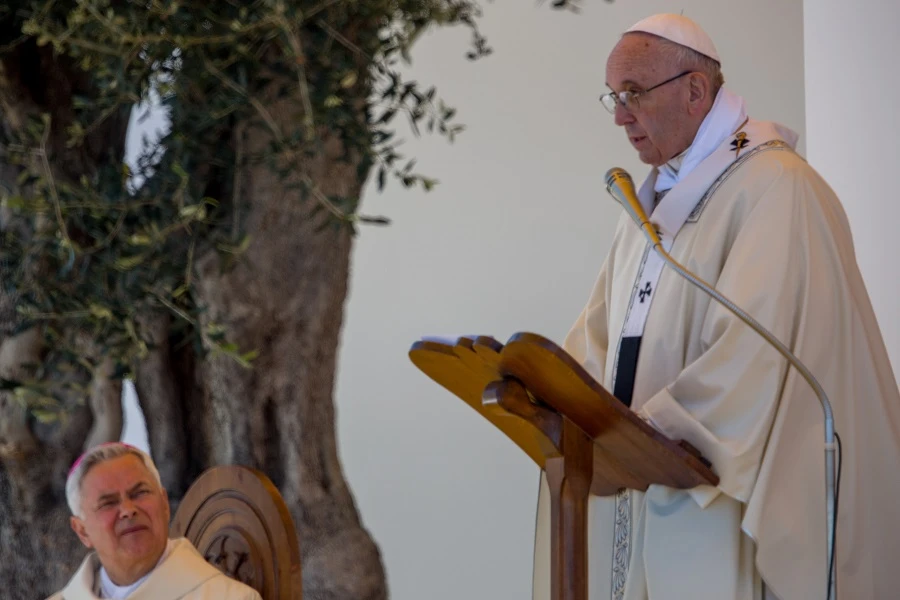
Vatican City, Apr 20, 2018 / 06:01 am (CNA/EWTN News).- During a brief day-trip to two small Italian cities, Pope Francis stressed the centrality of the Eucharist to the life and actions of the Church, saying without Christ’s love and self-sacrifice, everything would be done in vanity, since everything Jesus did was for others.

“The Eucharist is not a beautiful rite, but it is the most intimate, the most concrete, the most surprising communion that one can imagine with God: a communion of love so real that it takes on the form of eating,” the pope said April 20.

The Christian life begins again at each Mass, “where God satiates us with love. Without him, the bread of life, every effort of the Church is vain,” he said, and, quoting deceased local Bishop Tonino Bello, said “works of charity are not enough, unless those works are done with charity.”

“If love is lacking in those who do the works, if the source is lacking, if the point of departure is lacking, which is the Eucharist, then every pastoral commitment is merely a whirlwind of things,” rather than an act of service.

Pope Francis spoke during Mass in the Italian town of Molfetta. He traveled to the city after making a brief visit to Alessano as part of a half-day trip to mark the 25th anniversary of the death of Antonio Bello, known as “Don Tonino,” an Italian bishop whose cause for beatification opened in 2007.

In his homily, Francis said whoever receives the Eucharist takes on the face and mentality of the Lord, who is the bread that was broken for us. And this bread, he said, does not “rise with pride,” but is given to others.

The person who receives the Eucharist, he said, “ceases to live for themselves, for their own success, to have something or to become someone, but they live for Jesus, as Jesus, which is for others.”

Quoting Bishop Bello, Francis said the Eucharist “does not support a sedentary life,” and that without rising from the table, one remains an “unfulfilled sacrament.” He asked those present to question themselves as to how they leave every Mass, and whether or not they go out as “people of communion.”

He then emphasized the importance of the Word, which he said is a second element that can be taken from the day’s Gospel reading from John, in which the disciples asked themselves “how can this man give us his flesh to eat?” after Jesus spoke about the need to eat his flesh in order to obtain salvation.

“Many of our words are similar to this,” the pope said, noting that some people might ask: “how can the Gospel solve the problems of the world? What use is it to do good in the midst of so much evil?”

By doing this, “we fall into the error of that people, who were paralyzed by discussion about the words of Jesus, rather than ready to welcome the change of life asked by him,” Francis said, adding that these people did not understand that the words of Jesus were the path to life.

Jesus, he said, “does not respond according to our calculations and the conveniences of the moment, but with the ‘yes’ of his whole life. He does not look for our reflections, but our conversion.”

Pointing to the conversion of Saul, who later became St. Paul, Pope Francis noted how when Saul was thrown from his horse he was told to rise, go into the city and do what he would be asked.

“The first thing to avoid is staying on the ground” or staying “gripped by fear,” he said, stressing that a true apostle of Jesus “cannot simply get along on small satisfactions,” but must always get up and look forward.

And, just as Saul was told to go into the city, each Christian is also told to go, rather than staying “closed in your reassured spaces. Risk!” he said.

Christian life “must be invested in Jesus and spent for others,” he said, adding that an apostle cannot remain stationary after the resurrection, but must “go out, regardless of the problems and uncertainties.”

“We are all called, in whatever situation we find ourselves, to be bearers of paschal hope” and to be “servants of the world, but resurrected, not employed. Without ever complaining, without ever resigning ourselves.”

“It’s beautiful to be couriers of hope, simple and joyful distributors of the Easter alleluia,” Francis said, and closed his homily praying that the Word of God would free Christians and help them to rise and go forward with courage and humility.

[…]

No Picture
News Briefs

Priest murdered in Mexico amid continuing wave of violence

April 20, 2018 CNA Daily News 0

Mexico City, Mexico, Apr 20, 2018 / 03:03 am (CNA/EWTN News).- A Catholic priest in the Diocese of Cuautitlán Izcalli, México, was stabbed to death inside a church Wednesday, local reports said.

The death of Fr. Rubén Alcántara Díaz, judicial vicar of the diocese, makes 22 priests who have been murdered since 2012, the Catholic Multimedia Center reported.

According to local media, the Attorney General’s Office of Mexico State confirmed that the murder occurred the evening of April 18, inside Our Lady of Mount Carmel church in the Cumbria neighborhood.

Reports state that the 50-year-old priest was stabbed by a person who fled after the crime and who has yet to be identified.

The Diocese of Cuautitlán Izcalli expressed its sorrow over the death of the priest.

“While the pertinent inquiries are being conducted by the experts, we pray to God for his eternal rest and ask everyone to join in this intention,” the diocese said in a statement.

Bishop Alfonso Miranda, secretary general of the Mexican Bishops Conference, expressed his condolences on Twitter for the death of Fr. Alcántara Díaz and of “all the victims of the enormous amount of violence in Mexico. God help us.”

Cardinal Carlos Aguiar Retes also lamented the murder, offering prayers that “hope in the Resurrection strengthen the bishop and faithful.”

Last month Bishop Ramón Castro Castro of Cuernavaca called the murder of priests in Mexico a “painful phenomenon which has darkened the country’s horizon.”

The bishop encouraged the faithful to fight to eradicate organized crime from the country with the Gospel, always seeking justice and peace.

[…]

No Picture
News Briefs

Vietnamese pastor who was jailed for faith says it was ‘God’s gift to me’

April 19, 2018 CNA Daily News 1

Washington D.C., Apr 19, 2018 / 04:09 pm (CNA/EWTN News).- After surviving six years of imprisonment and torture, Vietnamese pastor Nguyen Cong Chinh told CNA that prayer sustained him through his physical suffering and pain.

In 2011, the evangelical pastor was charged with “undermining national solidarity” for conducting his Christian ministry with the Montagnard ethnic minority groups that live in Vietnam’s Central Highlands.

Chinh had long been an outspoken critic of the government’s ban on preaching in the region and a pro-democracy advocate.

During his imprisonment, Chinh spent nearly one month in solitary confinement and his health quickly deteriorated. He was denied treatment or access to medication, according to the U.S. Commission on International Religious Freedom (USCIRF), who advocated on his behalf.

Chinh told CNA that he experienced consolation in knowing that his suffering was in imitation of Christ.

“Even though I suffered physical suffering and pain, I felt in my soul happiness,” Chinh told CNA through an English translator at the USCIRF summit April 18.

“I viewed it as God’s gift to me,” said Chinh. “It was like what Jesus Christ went through, the same suffering that his disciples experienced, and now I’m going through the same experience. That is how the good news comes out.”

Chinh explained his hope that sharing his experience will help increase the faith of other Christians.

Prayerful communion with Christ “gave me courage to survive the prison conditions until the day that I saw freedom,” Chinh explained.

The Vietnamese pastor was released from prison July 28, 2017, about halfway through his 11 year sentence. His release came with the condition that he leave Vietnam, so Chinh currently resides in the U.S.

Several months before his release, Chinh’s wife, Tran Thi Hong, was beaten and interrogated because she met with the U.S. Ambassador-at-Large for International Religious Freedom at the time, David Saperstein, who was advocating on her husband’s behalf.

At the U.S. Commission on International Religious Freedom summit, Chinh was the only released prisoner to take part in a panel highlighting the specific cases of prisoners of conscience detained throughout the world. USCIRF is currently advocating for the release of prisoners of conscience in Saudi Arabia, Eritrea, China, Turkey, and Pakistan.

Several other prisoners of conscience were released in 2017, including Maryam Naghash Zargaran, an Iranian Christian convert from Islam who was arrested and imprisoned in 2013.

“Every time you return a prisoner of conscience to his family that truly is a victory,” former USCIRF Chair Robert George told CNA.

The USCIRF has actively advocated for Andrew Brunson, an American evangelical pastor incarcerated in Turkey since 2016. His trial in Istanbul this week was attended by Sam Brownback, the current U.S. ambassador-at-large for international religious freedom. Brunson will face another hearing in Turkey May 7.

“Since my release, the government has arrested more prisoners of conscience,” said Chinh on the prisoners of conscience panel.

Although religious freedom has improved in Vietnam since the 1970s, USCIRF still designates the country as a “country of particular concern” due to ongoing violations of religious freedom within the country.

David Adams, the Cross Catholic Outreach vice president for missions, explained the current situation in Vietnam to CNA.

“On the one hand, churches are allowed to operate with some freedom, depending on where they are located, like in the urban areas. But in other areas, like the Central Highlands where Pastor Chin was ministering to in this case a minority, the Montagnards … the government can get quite repressive and forbid any proselytizing or evangelization or even worship,” said Adams.

Cross Catholic Outreach actively supports Catholic ministries in Vietnam, with an emphasis on potable water, medical aid, and educating young people in the faith.

“Even in the most repressive societies, we have to keep hope alive. There are ways to support freedom, including religious freedom at the grassroots level,” said Adams.

[…]