

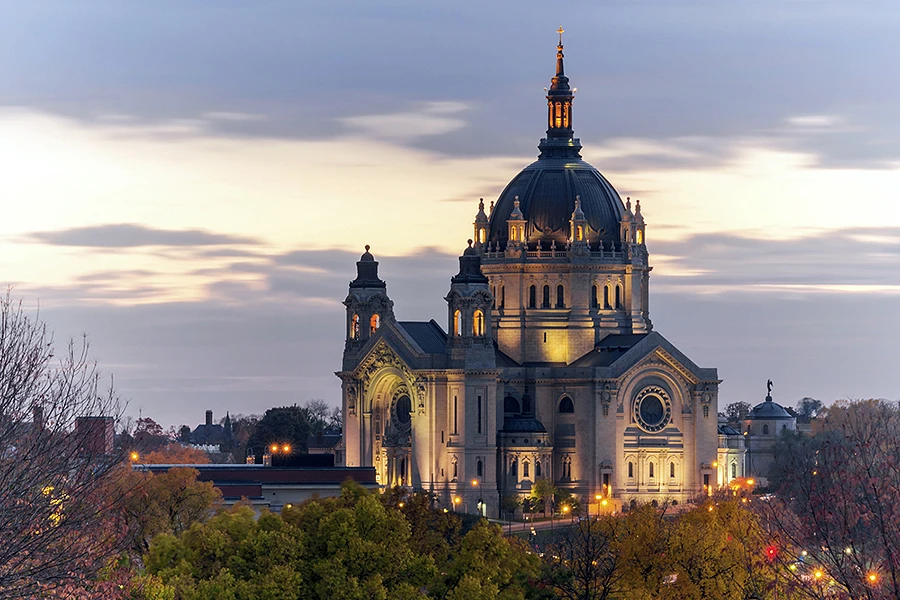
St. Paul, Minn., Dec 14, 2018 / 08:01 pm (CNA).- Archbishop Bernard Hebda of Saint Paul and Minneapolis announced Friday several changes meant “to change the culture that fostered the clergy abuse crisis.”
Among these are the creation of a new position within the Archdiocese of Saint Paul and Minneapolis to ensure that “the voice of survivors of clergy sexual abuse will be regularly heard within Archdiocesan leadership,” Hebda wrote in a Dec. 14 letter.
“To strengthen that voice, I want to say again today that any survivor who at any time entered into a settlement agreement containing a confidentiality provision is released from that provision,” he added.
“I also reiterate my pledge to meet with any survivors who would like to do so.”
Hebda wrote that he plans to make himself available to survivors of abuse all Friday afternoons in February, March, and April, as well as other times and places. Planning for spiritual outreach in 2019 is also underway, he said.
Hebda reiterated that he strongly favors a “lay-led mechanism for investigating and assessing any allegations made against me or any other bishop.”
Hebda’s predecessor, Archbishop John Nienstedt, was the subject of a misconduct allegation involving adult males in 2014. Nienstedt delegated the investigation to his senior auxiliary bishop, who submitted the investigative materials to then-Nuncio Archbishop Carlo Maria Viganò after seeking the counsel of two law firms. In addition, the allegations against Nienstedt were provided to the county attorney’s office.
However, the situation remains “unresolved for the accusers, for Archbishop Nienstedt and for the public” because Hebda said as far as he knows, the Vatican’s effort into the investigation ended when Archbishop Nienstedt resigned his office in June 2015.
Archbishop Viganò has since denied that he ordered the Vatican’s investigation of Nienstedt to be halted.
Hebda wrote of the investigation: “I share the frustration that is felt by them, and believe this situation highlights the need for a better-defined process and independent mechanism to resolve allegations made against bishops.”
An additional allegation emerged that then-bishop of New Ulm Nienstedt, at a 2005 World Youth Day event in Germany, had invited minors to his hotel room, proceeded to undress and had invited them to do the same – an account which Nienstedt denies. Hebda said he transmitted information about this allegation to the nuncio in 2016.
“I have been asked repeatedly whether there are any restrictions on Archbishop Nienstedt’s ministry,” Hebda wrote.
“My answer has always been that although I do not know of any, I am the wrong person to ask: Bishops report to the Holy Father, not to each other. I have no general juridical authority over Archbishop Nienstedt or any other bishop outside the Archdiocese.”
However, Hebda did offer clarification that Nienstedt, like any priest facing misconduct allegations, “would not be free to exercise public ministry in this Archdiocese until all open allegations are resolved.”
Hebda said he would continue to advocate for an independent review board, and would commit to transmitting the entire 2014 archdiocesan investigation to whatever national or regional review board is created.
“In order to fully address bishop accountability, the Church needs a national or regional board empowered to act, much as our well-respected Ministerial Review Board has been empowered to address allegations involving our priests and deacons,” the archbishop wrote.
“The Church cannot fulfill its mission without public trust.”
If you value the news and views Catholic World Report provides, please consider donating to support our efforts. Your contribution will help us continue to make CWR available to all readers worldwide for free, without a subscription. Thank you for your generosity!
Click here for more information on donating to CWR. Click here to sign up for our newsletter.


Being a clergy abuse survivor, I wonder if Archbishop Hebda continues to believe —as do many of the US bishops—that merely giving victims and alleged victims a “voice” (which the current attorney general of Pennsylvania also claims), along releases from confidentiality, payouts, etc. is really going to the heart of the problem. This, along with admitting “credible” allegations (whatever that may mean) as fact, thereby continuing the “guilty before proven innocent” approach. Is this not merely a desire to help the abused or those who claim to be, but also a matter of optics? As long as a diocese seems to be “doing something,” that appears to be on behalf of victims’ rights and condemning malefactors (almost all of whom are males seducing teenage boys and young men—the core, unspoken issue avoided by virtually all the bishops) then it presents itself the hero. Have a discreet process to hear victims when needed. (In other words, don’t go advertising it like a government damage-control statement.) Provide reasonable support (especially spiritually and emotionally). But so-called listening sessions, penitential prayers and services (which should be in reparation, because the real would-be penitents are mostly dead, out of ministry or in prison) and nearly-continual self recrimination relayed in the media—what does any of this really accomplish, except to add fuel to an already horrendous situation? Would the archbishop really want to establish public trust? It may take a generation: Strengthen measures to bar identified homosexual candidates from our seminaries and houses of formation. (And admit that there IS a homosexual sub-culture manipulating local and regional church institutions.) Stop allowing for pastors and confessors to make easy compromises with a secular, godless world in the guise of “accompaniment” or “discernment.” Counsel clergy who are known by their own to have these deep-seated tendencies to reform their lives if necessary and get help—or leave the ministry. And perhaps most importantly, help to truly re-establish a priesthood that identifies with Christ the victim and redeemer of His people, and lead us to the “eternal and universal kingdom … of truth, life, holiness, grace, justice, love and peace.” (Cf. Preface of Christ the King).
The worst thing that ever happened in all of this was to make sure that everyone knew they could win a million dollar verdict if they sued the church over sexual abuse. Now, many kids who actually suffered from abuse, who should get million dollar verdicts, had to compete with false claimants who make up stories of abuse because they could make a million dollars by doing so. The fact is that priests often counsel kids who are mixed up, on drugs, having terrible mental problems etc. and they may later become the subject of a fantasy, a hallucination, etc. There is literally no way to tell truth from made up falsehood in these cases. Often deserving real victims get shunted aside because the diocese has dealt with too many fake claimants and a hardness of heart setts in. In the alternative, they just assume every priest that is accused is guilty, and they believe every story they hear, and good priests who have done nothing wrong ar thrown under the bus.
Add in the homosexual angle, where homosexuals will actually set up heterosexual priests on false child abuse charges if the straight priest should ever tell on the homosexually active priest, and you have the perfect storm of destruction.
It is literally the worst possible situation. You have people who can make millions by suing, and who are driven by their circumstances to either make up or invent things, knowingly or unknowingly. These things were usually done in private, where no one else witnessed anything. Yet there are true, suffering, deserving kids who deserve whatever can be done for them. And you have fakers, drawn by the money.
Add to that this much of this took place 30 or 40 years ago, and you have the perfect witches brew of not ever being able to detect the truth. Remember an FBI agent who worked on this stuff once said that in his estimation, half of all charges are false.