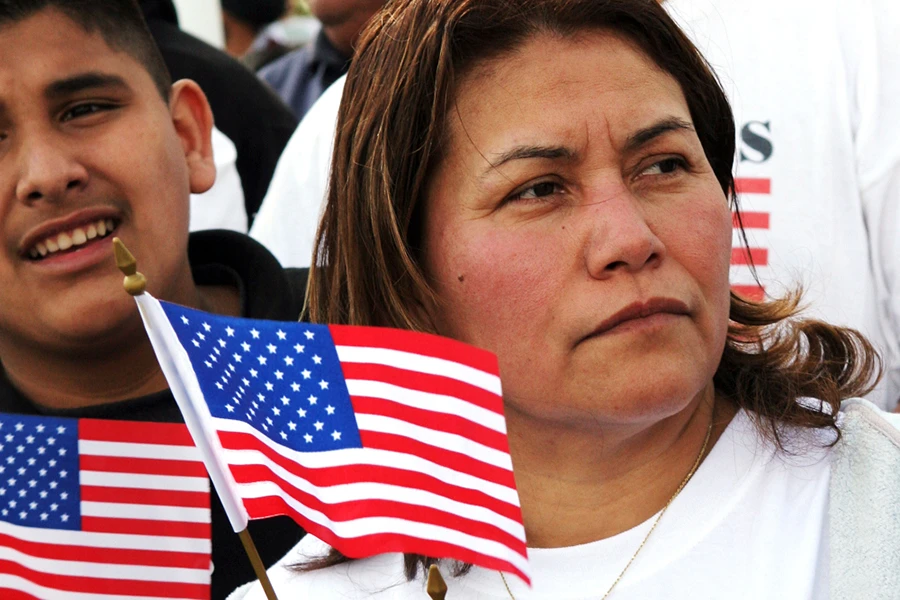
Washington D.C., Nov 1, 2018 / 04:44 pm (CNA/EWTN News).- A plan floated by President Donald Trump to end “birthright citizenship” through an executive order is likely unconstitutional, according to a law professor at The Catholic University of America.
“This idea that you can pass this kind of a fundamental change to the Constitution through the signing of a pen…does not comport with the Constitution,” CUA law professor Stacy Brustin told CNA.
In a recent interview with news site Axios, Trump said that the U.S. is “the only country in the world where a person comes in and has a baby, and the baby is essentially a citizen of the United States,” according to an Oct. 30 Axios report.
“It’s ridiculous. It’s ridiculous. And it has to end,” Trump added.
The president reportedly said that he would soon end “birthright citizenship” through an executive order.
The Fourteenth Amendment to the U.S. Constitution is generally understood to establish that citizenship is conferred upon all children born in the United States, regardless of the legal status or citizenship of their parents.
Brustin told CNA that the president is not empowered to change the Constitution through an executive order.
“There are two very clear and established ways of changing the Constitution that are actually articulated in the Constitution,” she explained.
“Either two-thirds of both houses of Congress have to pass a proposed amendment, and then send that amendment to the states for ratification by three-quarters of the states,” or else a Constitutional convention must be held. Typically, the Congressional route has been used for the passage of previous amendments.
If Trump were to pursue an amendment to change the practice of birthright citizenship, Brustin said, it would likely be “extremely difficult,” pointing to the failed attempts at passing other amendments, such as the unratified Equal Rights Amendment.
The practice of jus soli, or “birthright” citizenship is fairly common throughout North and South America, while no European country grants immediate citizenship to all those born on its soil. In most European countries, the conferral of citizenship depends upon the legal status of a child’s parents, regardless of where the child happens to be born. Some countries permit citizenship to be granted after a child has resided in the country for a set number of years, but this practice varies widely.
The Fourteenth Amendment was passed shortly after the Civil War, to ensure that former slaves could not be denied citizenship. The amendment says that “All persons born or naturalized in the United States and subject to the jurisdiction thereof, are citizens of the United States and of the State wherein they reside.”
Trump’s remarks appeared to endorsing a minority perspective on the amendment centered around the phrase “subject to the jurisdiction thereof.” While some argue that this phrase is meant to exclude people who are in the country illegally, Brustin disagreed.
“’Subject to the jurisdiction’ has been interpreted by our court as meaning ‘present in the United States,’” explained Brustin, with the sole exception being the children born to diplomats.
“But otherwise, those who are physically present are subject to the laws of the United States. That’s generally that’s what that means,” she said.
In addition to her work in the classroom, Bustin is the director of CUA’s Immigrant and Refugee Advocacy Clinic. Brustin said that the president’s words have created fear among the immigrant community she works with at the clinic.
“Whether the law is changed or not, there will be fear among those in the immigrant community that children born in the United States to immigrant parents will not be able to become citizens,” she said.
If you value the news and views Catholic World Report provides, please consider donating to support our efforts. Your contribution will help us continue to make CWR available to all readers worldwide for free, without a subscription. Thank you for your generosity!
Click here for more information on donating to CWR. Click here to sign up for our newsletter.

Massachusetts Gov. Maura Healey walks across the campus of St. John’s Prep in Danvers, Massachusetts, on April 9, 2024. / Credit: Screenshot of St. John’s Prep Facebook page last visited April 19, 2024
Boston, Mass., Apr 23, 2024 / 16:45 pm (CNA).
Pro-lifers in the Archdiocese of Boston are criticizing Cardinal Seán O’Malley over two recent appearances at Catholic education events by the pro-abortion governor of Massachusetts.
Earlier this month, Massachusetts Gov. Maura Healey, a Democrat who supports legal and publicly funded abortion and who has taken steps to make abortions easier to obtain, spoke at a fundraiser for The Catholic Schools Foundation, which raises money for Catholic schools in the archdiocese and helps poor students attend.
O’Malley, the archbishop of Boston, is the chairman of the board of trustees of the foundation, though he was in Rome at the time of the gala and did not attend it.
Healey also recently visited a Catholic school north of Boston, speaking to students and answering questions.
C.J. Doyle, executive director of the Catholic Action League of Massachusetts, called Healey’s appearances “a grave scandal.”
“Cardinal O’Malley should be ashamed of himself. Is Maura Healey an inspiring role model for Catholic students?” Doyle said.
Thomas Harvey, chairman of the Massachusetts Alliance to Stop Taxpayer Funded Abortions, called including Healey at the Catholic events “really disgraceful,” and he placed the blame on O’Malley.
“Maura Healey is a huge proponent of killing babies in the womb, in direct defiance of Catholic teaching, and yet here she is being presented to impressionable Catholic students as if she were a Catholic role model,” Harvey told the Register by text. “And the clear message being sent to Catholic students here is that killing babies in the womb is just not that big a deal.”
In June 2004, the U.S. Conference of Catholic Bishops approved a document called “Catholics in Public Life,” which states: “The Catholic community and Catholic institutions should not honor those who act in defiance of our fundamental moral principles. They should not be given awards, honors, or platforms which would suggest support for their actions.”
Terrence Donilon, a spokesman for the Archdiocese of Boston, pointed out that Healey was not an honoree at the gala or during her earlier appearance at the Catholic school.
Since Healey is the governor of the state, Donilon said, Cardinal O’Malley has worked with her “on a number of issues important to Catholics and the wider community,” including public funding for the archdiocese’s charitable work providing “basic needs assistance, job training, child care services, and immigration and refugee assistance to thousands of residents,” as well as building “badly needed affordable housing” and trying “to stem gun violence.”
“At the same time, the cardinal has been a leader in the pro-life movement for over 50 years and his commitment in being a staunch promoter of life is well known and unwavering,” Donilon said.
O’Malley, 79, a Capuchin Franciscan, has frequently attended the March for Life in Washington, D.C., and has spoken at pro-life rallies. Last week, The Boston Globe published a column by O’Malley urging state legislators to oppose a bill that would legalize physician-assisted suicide.
But critics such as Doyle claim that O’Malley during his time as archbishop has seemed to mix easily and uncritically with abortion-supporting Catholic politicians, including the late U.S. Sen. Edward Kennedy (whose funeral Mass he celebrated), the late Boston mayor Thomas Menino, former Boston mayor Marty Walsh, and the current governor, Healey, with whom he co-authored a column in The Boston Globe in September 2017 on immigration.
Donilon, O’Malley’s spokesman, addressing Healey’s participation in The Catholic Schools Foundation gala last week, said that “the governor has been a vocal supporter of Catholic education. … Our Catholic schools save cities and towns hundreds of millions of dollars in education costs. Our families benefit from an outstanding education based in an excellent faith-based environment.”
Gov. Maura Healey speaks to students at St. John’s Prep on April 9, 2024. Credit: Screenshot of St. John’s Prep Facebook page last visited on April 9, 2024.
Who is Maura Healey?
Healey, 53, was elected Massachusetts attorney general in 2014 with an endorsement from Planned Parenthood Advocacy Fund. She served two terms as attorney general before being elected governor of Massachusetts in November 2022.
As an elected official, Healey has frequently supported public policies that clash with Catholic teachings on life and sexuality.
She has verbally attacked pro-life pregnancy centers, steered state government money to private abortion funds, and, in April 2023, quietly arranged for the flagship campus of the state-run University of Massachusetts to purchase 15,000 doses of abortion pills.
Healey’s administration in June 2023 successfully proposed a curriculum framework for public schools that calls for teaching between third and fifth grades “the differences between biological sex and gender identity” and “how one’s outward behavior and appearance does not define one’s gender identity or sexual orientation.”
Healey appeared Thursday, April 11, at the annual gala of The Catholic Schools Foundation at a hotel in Boston.
“So I didn’t have the benefit of going to Catholic school,” Healey said, according to a text of her remarks provided by a spokesman. “My mom went to Catholic school, and my nephew goes to Catholic school; we have priest[s] at the dinner table every Sunday. But I do know, both having been your attorney general and now as your governor, what your work means. And I can see that experience firsthand.”
She also said she wants to find ways “to partner” with the foundation “in the important work that you [are] doing.”
“And I want you to know that, as governor, I value our vibrant mix of education, our public schools, our private schools, and our religious schools,” Healey said.
Two days earlier, on Tuesday, April 9, Healey spent about 50 minutes with a group of 120 students at St. John’s Preparatory High School, a Catholic boys’ school founded by the Xaverian Brothers in Danvers, about 18 miles northeast of Boston, according to a description of the visit published on the school’s website. The school is in the Archdiocese of Boston, though it is not run by the archdiocese.
Healey had never visited the school before, “but it was quickly clear her personal values are closely aligned with those of the Xaverian Brothers,” the school’s write-up states.
Healey emphasized leadership and empathy during her remarks. The governor also told the students that while she believes in civil discourse, “there are some basic values that have kept our society intact,” and she told students they should “call out hate when you see it.”
“We can have differences of opinion on things,” Healey said, according to the school’s write-up, “but, to me, equality has got to abide. Respect for the dignity and worth of each person is something I call on people to really adhere to.”
Robert Joyce, a lawyer and member of the board of the Pro-Life Legal Defense Fund, which provides legal representation for pro-lifers, said that St. John’s Prep last fall turned down an offer he made to provide a pro-life assembly for students featuring a canon lawyer, a physician, and a vocations director. (The head of school, Edward Hardiman, did not respond to requests for comment by deadline.)
Joyce called Healey’s recent appearances at the gala and at the school “abominations for Catholic education.”
“They send the clear message to Catholic students and parents that critical, fundamental precepts of the Catholic faith are not all that important. In simple terms, they declare that protection of innocent unborn life and the defense of traditional marriage are negotiable with these Catholic educators,” Joyce indicated.
Healey is also a featured speaker at the annual Spring Celebration of Catholic Charities Boston scheduled for Wednesday, May 29, at the Boston Harbor Hotel in Boston. O’Malley is expected to receive an award at the event for his work in welcoming immigrants.
Healey and the Catholic Church
Healey does not often talk about religion in public, but she occasionally identifies herself as a Catholic.
In October 2018, when she was state attorney general, she led off a brief column in The Boston Globe with the words: “As a member of law enforcement and as a Catholic …”
In April 2022, when Healey criticized Bishop Robert McManus of Worcester for calling for a Catholic school to take down a rainbow flag, she added, according to MassLive.com: “And I speak as a Catholic …”
In October 2022, during a debate while she was running for governor, Healey used a Catholic reference while defending herself from a claim by her Republican opponent that a bill she had supported effectively legalized infanticide, as the National Catholic Register subsequently reported. “You know, my mom goes to Mass every morning,” Healey said.
Healey is widely thought of as a potential candidate for other offices. She would be an obvious Democratic nominee for U.S. Senate in Massachusetts if either of the two incumbents (both in their 70s) leaves office.
Additionally, just hours before her appearance at The Catholic Schools Foundation gala, Healey participated in an event at Northeastern University in Boston honoring former Massachusetts governor and 1988 Democratic presidential nominee Michael Dukakis. The moderator floated Healey as a potential future candidate for president of the United States, to applause from the audience.
This story was first published by the National Catholic Register, CNA’s sister news partner, and is reprinted here on CNA with permission.
CNA Staff, Mar 5, 2025 / 12:10 pm (CNA).
The Supreme Court on Wednesday ordered the Trump administration to pay out billions in frozen foreign aid, siding with a lower court that had … […]
University of Notre Dame professor Kathleen Sprows Cummings. Credit: Ken Oliver-Méndez/CNA
Jan 10, 2026 / 10:12 am (CNA).
Assessing the impact of the Catholic Church’s first American pope was front and center at the 106th annual meeting of the American Catholic Historical Association (ACHA), which met in Pope Leo XIV’s hometown of Chicago from Jan. 8-11.
During a panel on the subject, Catholic scholars noted some of the historic caricatures of what an American papacy would be like and compared that to the first eight months of Leo’s actual papacy.
American Catholic History Association panelists (from left to right) Brian Flanagan, Colleen Dulle, Miguel Diaz and Kathleen Sprows Cummings. Credit: Ken Oliver-Méndez/CNA
At the outset of the panel, University of Notre Dame history professor Kathleen Sprows Cummings referenced the 1894 Puck magazine cartoon titled “ The American Pope,” which depicts the first apostolic delegate to the United States, Cardinal Francesco Satolli, sitting atop a church labeled the “American headquarters” and casting a shadow of then Pope Leo XIII over the entire country.
Sprows Cummings noted the cartoon illustrates “fears about papal intervention in the United States” at a time when the country was receiving waves of Catholic immigrants from countries such as Ireland and Italy.
As Catholics became more settled in American society in the subsequent decades, she said some of those prejudices began to lessen and pointed to the 1918 election of Catholic Democrat Al Smith as New York’s governor. By this point, Catholics had become “much more confident about their place in American culture.”
During the same early 20th century period, the United States also began to rise as a superpower. Sprows Cummings noted that predominant concerns about an American pope shifted to Vatican concerns over the “Americanization of the Catholic Church.”
America magazine’s Vatican correspondent, Colleen Dulle, said some of those concerns were evidently mitigated in the person of then Cardinal Robert Prevost, whose service to the Church included many years as a missionary and bishop in Peru as well as in Rome as the head of a global religious order, the Augustinians.
Sprows Cummings said the College of Cardinals clearly saw in Cardinal Prevost the “pastoral presence, administrative savvy and global vision” that the Church needed at this time and that he was “not elected in some flex of American power.”
Miguel Diaz, the John Courtney Murray, S.J. Chair in Public Service at Loyola University Chicago, noted that some of Leo’s actions have actually amounted to the opposite of flexing American power, such as his focus on the dignity of migrants, which he contrasted to the policies of the Trump administration.
Former U.S. Ambassador to the Holy See Miguel Diaz. Credit: Ken Oliver-Méndez/CNA
Diaz, who served as U.S. ambassador to the Holy See under former President Barack Obama, said Leo is “a different symbol, from America first to America cares.”
He emphasized that having an American pope is significant amid the country’s political debates because “he can say things and he will be listened to.”
The panelists also discussed what Leo’s papacy may look like moving forward, with Dulle noting that only this year are there clear signs of him charting his own programmatic course, as the events and itinerary of the 2025 Jubilee were primarily developed for Pope Francis.
Up until now, she said, he has been mostly “continuing the Francis initiatives in a different style.”
She noted Pope Leo’s management of this week’s consistory — a meeting between the pope and the College of Cardinals — where the pontiff gave them four topics to choose from, which were all in line with Francis’s priorities: synodality, evangelization, reform of the curia, and the liturgy. The cardinals chose synodality and evangelization.
Dulle said Leo is seen as “a consensus builder” who aims to build consensus around the Church’s priorities. She noted Pope Leo’s announcement this week of a regular schedule of consistories, with the next one set for this June. This approach is emerging as a “hallmark of how he governs the Church” Dulle said.
Brian Flanagan, the John Cardinal Cody Chair of Catholic Theology at Loyola University Chicago, also emphasized Leo’s strong appeal to the cardinals and bishops in efforts to reach consensus, in keeping with the Pope’s role as a preserver of unity.
Flanagan said he sees Leo exercising the papacy as not so much “at the top of the pyramid, but as at the center of conversation.” He said this is likely influenced by Leo’s past as leader of a religious order — the Order of Saint Augustine — rather than a diocese because the orders are “global, diverse, and somewhat fractious.”
“You can’t govern a global religious community without getting people on board,” he said.
There are other arguments as well. It is not a slam dunk “can’t be done.”
nationalreview.com/corner/why-trump-can-end-birthright-citizenship-by-executive-order/
Several constitutional scholars disagree with illegal alien/anchor baby advocate Stacy Brustin.
Levin and Horowitz: Yes, Trump can end birthright citizenship for children of illegal immigrants with an executive order
Stacy Brustin apparently is ignorant of the intention of the lawmakers, who intended for that part of the 14th Amendment to apply only to ex-slaves.
There are other arguments as well. It is not a slam dunk “can’t be done.”
nationalreview.com/corner/why-trump-can-end-birthright-citizenship-by-executive-order/
This is a better legal analysis than the authors:
nationalreview.com/2018/11/birthright-citizenship-14th-amendment-does-not-mandate/