Austin, Texas, Oct 11, 2018 / 03:00 pm (CNA).- All 15 Catholic dioceses in Texas plan to release names of clergy who have been credibly accused of sexually abusing a minor, according to a release from the Texas Conference of Catholic Bishops. The release will include all accusations dating back to the 1950s.
In an Oct. 10 statement released by the Texas Catholic Conference of Bishops, Archbishop Gustavo García-Siller of San Antonio said that, because of the size of the state, compiling comprehensive lists will take some time.
Texas has 8.5 million Catholics in 1,320 parishes.
All dioceses plan to publish their lists by Jan. 31, 2019 and they will be updated as new information becomes available.
“Every bishop in our state has made a statement expressing his concern for all who have been hurt and I want to express my personal sorrow at such fundamental violations of trust that have happened,” said Cardinal Daniel DiNardo, Archbishop of Galveston-Houston. “We are completely committed to eradicating the evil of sexual abuse in the church and promoting healing among the faithful and those injured by this crime.”
The Diocese of Fort Worth was the first diocese in Texas to begin publishing an updated list of clergy accused of sexual abuse. After first publicly identifying credibly accused priests in 2005, the list has been continually updated since 2007. The list currently contains the names of 15 priests, one permanent deacon, and one religious brother.
“Jesus shows how central and essential the respectful care and protection of the child and vulnerable are to the mission that He has entrusted to His Church, a mission that continues in the contemporary world,” Bishop Michael Olsen of Fort Worth wrote in a statement supporting the TCCB’s announcement.
“I maintain a zero-tolerance policy for sexual abuse of minors because ministry in the Church is a grace from God that carries with it sober responsibility, not a right to be claimed by anyone as an entitlement.
If you value the news and views Catholic World Report provides, please consider donating to support our efforts. Your contribution will help us continue to make CWR available to all readers worldwide for free, without a subscription. Thank you for your generosity!
Click here for more information on donating to CWR. Click here to sign up for our newsletter.
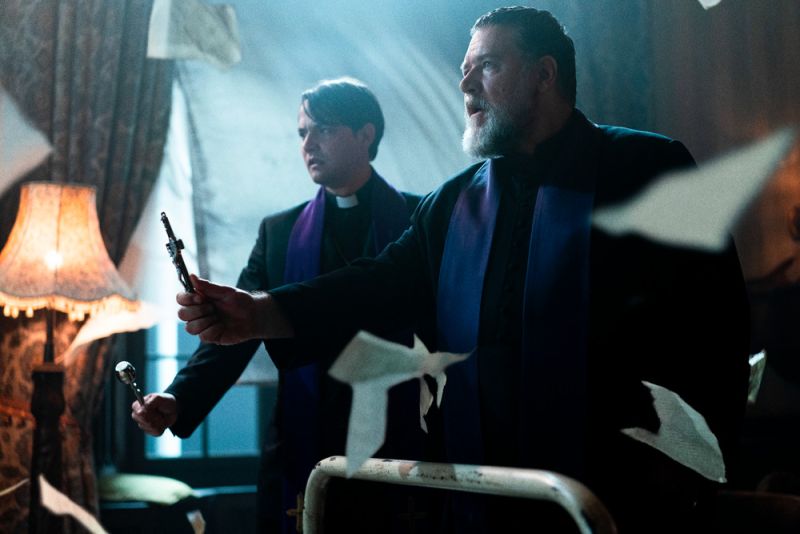
The trailer of the upcoming Russell Crowe movie “The Pope’s Exorcist” indicates that the film might not do justice to the Italian exorcist Father Gabriel Amorth or the rite of exorcism as practiced in the Catholic Church, according to an exorcist organization Amorth himself helped to found.
The International Association of Exorcists on March 7 voiced concern that the film seems to fall under the category of “splatter cinema,” which it calls a “sub-genre of horror.”
The Vatican, the statement said, is filmed with a high-contrast “chiaroscuro” effect seen in film noir.
This gives the film a “‘Da Vinci Code’ effect to instill in the public the usual doubt: Who is the real enemy? The devil or ecclesiastical ‘power’?” the exorcists’ association said.
While special effects are “inevitable” in every film about demonic possession, “everything is exaggerated, with striking physical and verbal manifestations, typical of horror films,” the group said.
“This way of narrating Don Amorth’s experience as an exorcist, in addition to being contrary to historical reality, distorts and falsifies what is truly lived and experienced during the exorcism of truly possessed people,” said the association, which claims more than 800 exorcist members and more than 120 auxiliary members worldwide.
“In addition, it is offensive with regard to the state of suffering in which those who are victims of an extraordinary action of the devil find themselves,” the group’s statement added. The statement responded to the release of the movie trailer and promised a more in-depth response to the film’s April 14 theatrical release.
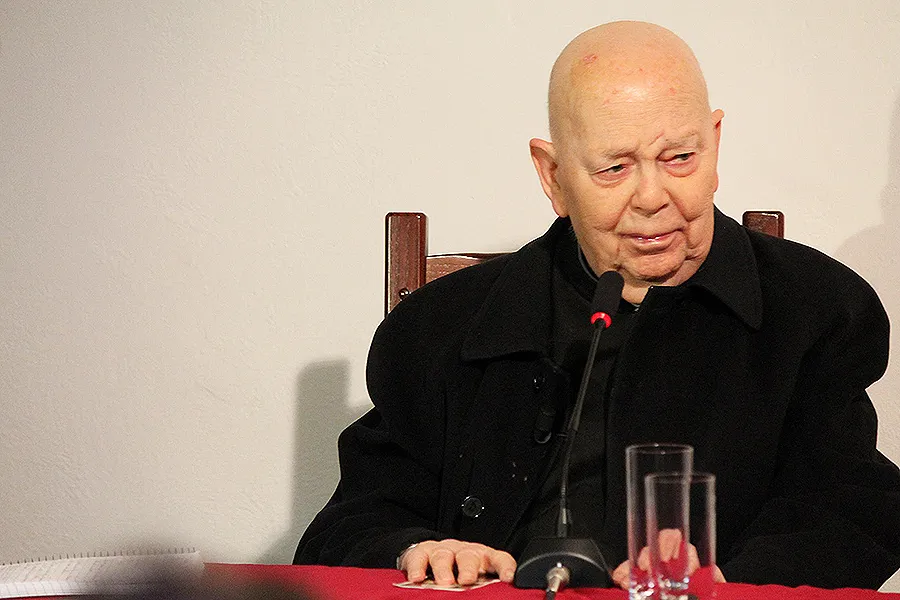
Father Gabriele Amorth, chief exorcist of Rome, speaks to CNA on May 22, 2013. Steven Driscoll/CNA
Amorth, who died at age 91 in 2016, said he performed an estimated 100,000 exorcisms during his life. He was perhaps the world’s best-known exorcist and the author of many books, including “An Exorcist Tells His Story,” reportedly an inspiration for the upcoming movie.
Several of Amorth’s books are carried by the U.S. publisher Sophia Institute Press. The publisher’s newly released book “The Pope’s Exorcist: 101 Questions About Fr. Gabriele Amorth” is an interview in which the priest addresses many topics ranging from prayer to pop music.
Michael Lichens, editor and spokesperson at Sophia Institute Press, voiced some agreement with the exorcist group.
“The International Association of Exorcists is right to be concerned and I’m thankful for their words,” Lichens told CNA. “My hope is that audiences will remember that Father Amorth is a real person with a great legacy and perhaps a few moviegoers will look up an interview or pick up his books.”
“This was a man who included St. Padre Pio and Blessed Giacomo Alberione as mentors, as well as Servant of God Candido Amantini, who was his teacher for the ministry of exorcism,” he said. “Father Amorth fought as a partisan as a young man and grew to fight greater evil as an exorcist. His life is an inspiration and I know that his work and words will still reach many.”
Amorth was born in Modena, Italy, on May 1, 1925. In wartime Italy, he was a soldier with the underground anti-fascist partisans. He was ordained a priest in 1951. He did not become an exorcist until 1986, when Cardinal Ugo Poletti, the vicar general of the Diocese of Rome, named him the diocesan exorcist.
The priest was frequently in the news for his comments on the subject of demonic forces. In an interview with The Sunday Telegraph in 2000, he said: “I speak with the devil every day. I talk to him in Latin. He answers in Italian. I have been wrestling with him, day in, day out, for 14 years.”
The movie “The Pope’s Exorcist” claims to be “inspired by the actual files of the Vatican’s chief exorcist.” The Sony Pictures movie stars the New Zealand-born actor Russell Crowe as Amorth. Crowe’s character wears a gray beard and speaks English with a noticeable accent.
“The majority of cases do not require an exorcism,” the Amorth character says in the movie’s first trailer. A cardinal explains that Crowe’s character recommends 98% of people who seek an exorcism to doctors and psychiatrists instead.
“The other 2%… I call it… evil,” Crowe adds.
The plot appears to concern Amorth’s encounter with a particular demon. Crowe’s character suggests the Church “has fought this demon before” but covered it up.
“We need to find out why,” he says.
The trailer shows short dramatic scenes of exorcism, including a confrontation between Amorth and a girl apparently suffering demonic possession.
The International Association of Exorcists said such a representation makes exorcism become “a spectacle aimed at inspiring strong and unhealthy emotions, thanks to a gloomy scenography, with sound effects such as to inspire only anxiety, restlessness, and fear in the viewer.”
“The end result is to instill the conviction that exorcism is an abnormal, monstrous, and frightening phenomenon, whose only protagonist is the devil, whose violent reactions can be faced with great difficulty,” said the exorcist group. “This is the exact opposite of what occurs in the context of exorcism celebrated in the Catholic Church in obedience to the directives imparted by it.”
CNA sought comment from Sony Pictures and “The Pope’s Exorcist” executive producer Father Edward Siebert, SJ, but did not receive a response by publication.
Amorth co-founded the International Association of Exorcists with Father René Laurentin in 1994. In 2014 the Catholic Church recognized the group as a Private Association of the Faithful.
The association trains exorcists and promotes their incorporation into local communities and normal pastoral care. It also aims to promote “correct knowledge” about exorcism ministry and collaboration with medical and psychiatric experts who have competence in spirituality.
Exorcism is considered a sacramental, not a sacrament, of the Church. It is a liturgical rite that only a priest can perform.
Hollywood made the topic a focus most famously in the 1973 movie “The Exorcist,” based on the novel by William Peter Blatty.
“Most movies about Catholicism and spiritual warfare sensationalize,” Lichens of Sophia Institute Press told CNA. “Sensationalism and terror sell tickets. As a fan of horror movies, I can understand and even appreciate that. As a Catholic who has studied Father Amorth, though, I think such sensationalism distorts the important work of exorcism.”
“On the other hand, ‘The Exorcist’ made the wider public more curious about this overlooked ministry. That is a good thing that came out, despite other reservations and concerns,” he continued. “Still, I would love it if a screenwriter and director spoke to exorcists and tried to show the often-quotidian parts of the ministry.”
An unhealthy curiosity can be a problem, Lichens said.
“When I work as a spokesperson for Amorth’s books, I am always concerned about inspiring curiosity about the demonic,” he told CNA. “As Christians, we know we have nothing to fear from the demonic but curiosity might lead some to want to seek out the supernatural or the demonic. Father Amorth has dozens of stories of people who found themselves afflicted after party game seances.”
Lichens encouraged those who are curious to read more of Amorth’s writings, some of which are excerpted on the Catholic Exchange website. Sophia Institute Press has published “Diary of an American Exorcist” by Monsignor Stephen Rosetti and “The Exorcism Files” by the American lay Catholic Adam Blai.
“First and foremost, Father Amorth was involved in a healing ministry,” Lichens said. “Like other exorcists, his work often involved doctors in physical and mental health because the goal is to bring healing and hope to the potentially afflicted.”
“Those of us who read Amorth might have been excited to read firsthand accounts of spiritual warfare, but readers quickly see a man whose heart was always full of love for those who sought his help,” he added.
The International Association of Exorcists, for its part, praised the 2016 documentary “Deliver Us,” saying this shows “what exorcism really is in the Catholic Church and “the authentic traits of a Catholic exorcist.” It shows exorcism as “a most joyful event,” in their view, because through experiencing “the presence and action of Christ the Lord and of the Communion of the Saints,” those who are “tormented by the extraordinary action of the devil gradually find liberation and peace.”
Washington D.C., Nov 30, 2020 / 01:00 pm (CNA).- The Supreme Court heard oral arguments Monday on whether the Trump administration can exclude undocumented immigrants when apportioning congressional representatives based on a state’s population.&… […]
Baltimore, Md., Nov 12, 2019 / 04:32 pm (CNA).- The U.S. Catholic bishops’ conference on Tuesday passed several action items, including an update of seminary formation and an effort to catalyze the evangelization of Hispanic Catholics in the U.S…. […]



Leave a Reply