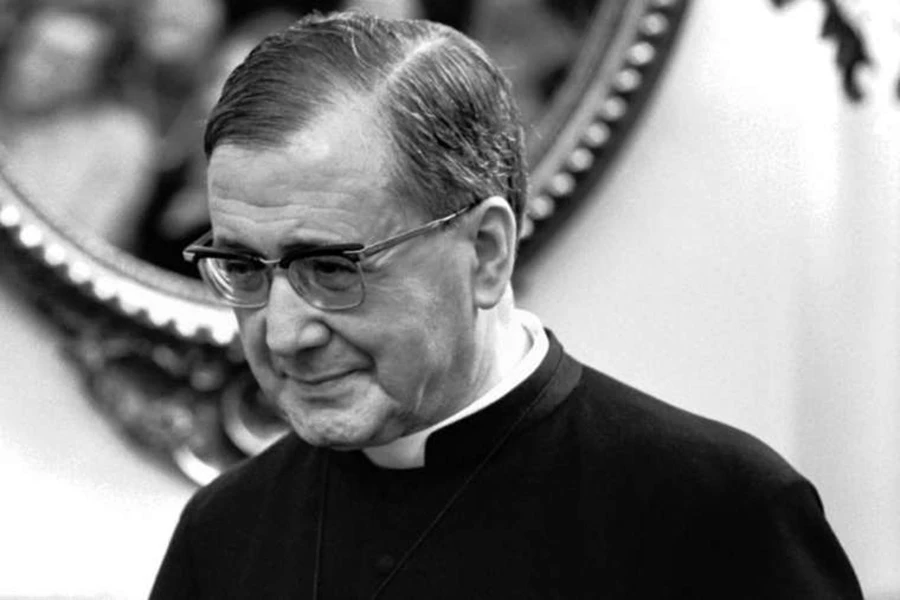
Washington D.C., Jan 8, 2019 / 05:01 pm (CNA).- Opus Dei confirmed this week that in 2005 it reached a $977,000 settlement with a Washington, D.C. woman who alleged that Opus Dei priest Fr. C. John McCloskey sexually assaulted her in the context of pastoral counseling.
The story has made headlines because of McCloskey’s connection to political and media circles in Washington, D.C. But it has also gained attention because of the place Opus Dei has occupied in popular culture, especially after the publication of the 2003 novel “The Da Vinci Code,” which offered a portrayal of Opus Dei many critics dismissed as fantastical.
But what is Opus Dei?
Founded in 1928 by Spanish priest Fr. Josemaria Escriva, the movement was borne of Escriva’s vision to help lay Catholics in Madrid understand the baptismal calling of holiness and evangelization. He called the movement Opus Dei to emphasize his belief that its foundation was a “work of God,”- or, in Latin, “Opus Dei.”
The movement began as a program of Catholic spiritual and intellectual formation for laymen, and began admitting women to its programs of formation two years after its foundation.
Technically, Opus Dei is a “personal prelature,” which is a Church structure comprised of priests and deacons joined together to “accomplish particular pastoral or missionary works,” according to canon law. The priests and deacons of the prelature are not members of a religious order, like the Jesuits or Benedictines, and therefore, they do not make public vows of poverty, chastity, and obedience, as religious priests and brothers do. Instead, they are secular clerics, as are diocesan priests, which means that like diocesan priests, they are obliged to celibacy and to obedience, but they are not bound to poverty, or to other aspects of monastic, or religious life.
Because Opus Dei is a “personal prelature,” its members are the priests and deacons incardinated into its structure. However, Opus Dei also involves lay Catholics, who associate themselves to the mission of the prelature by means of individual agreements.
Association comes at different levels: some unmarried Catholics collaborate with Opus Dei as “numeraries,” who dedicate much of their life and time to Opus Dei and its mission; “supernumeraries” are typically married, and share in Opus Dei’s work and mission in the context of their families; “cooperators” may be married or unmarried laity who collaborate with or support Opus Dei at a less committed level. There are also diocesan priests and bishops associated with Opus Dei through an organization called the Priestly Society of the Holy Cross.
Though commonly referred to as “members,” numeraries, supernumeraries, and cooperators are not formally members of Opus Dei, and remain subject to the jurisdiction of their own diocesan bishops and pastors. The prelate, or head, of Opus Dei does not exercise ecclesiastical jurisdiction for those collaborators, except in regard to specifically delineated matters related to collaboration in the prelature’s mission. The educational and spiritual work of Opus Dei, including formation, is subject to the oversight of the diocesan bishop in each place where the prelature operates.
In 2016, there were more than 2,000 priest members of the prelature, and more than 90,000 lay people were connected to the organization by means of agreements. The prelature is operative in nearly 70 countries, and headquartered in Rome.
In the United States, Opus Dei supports Catholic schools, generally segregated by sex, in several cities. The organization offers formation through spiritual direction, retreats, “evenings of recollection,” at which priests offer spiritual guidance and confession, and through “circles,” small group meetings of spiritual formation. In Washington, D.C., Opus Dei operates the Catholic Information Center, a centrally-located bookstore offering weekday Mass and frequent evening programs.
Opus Dei has been criticized by some observers, who say the organization in inconsistent in its practices in different regions, promotes secrecy about its practices and governance, and focuses its recruiting on persons of wealth or influence.
Opus Dei’s spirituality is rooted in the writings and thought of Fr. Josemaria Escriva, who was canonized by Pope St. John Paul II in 2002. Escriva’s work focused on becoming holy in ordinary life, by means of a deep prayer life, offering to God sacrifices and challenges, and the cultivation of virtue.
 […]
[…]



Pray for this sick cardinal, man. He needs it.
It’s worth the time to read the transcript of the entire CNA interview. Per Cupich, Bergoglio’s response…”exactly the kind of response that was needed.” He then goes on to trust the media who will apparently clarify the veracity of the Vigano letter using their “expertise” for the Catholic laity. He then goes on to deconstruct that letter by comparing it to “websites” and the “parallels” in language that attack the Pope…(no sense that some of that repetition is related to multiple offenses, crimes, the scope of this scandal).
I have come to the dismal conclusion that outside of assaults on children, they may not consider the rest of the reports, revelations really that bad. It’s just “stuff that happens” and I mean what starts in the seminaries.
When does the free lunch end for these people?
The Cardinal’s denials and clarifications do nothing to diminish the arrogance and condescension of his appalling remarks. On the contrary, they confirm that he was quoted correctly, and that Team Francis is as great a danger to the Faith as they appear to be.
Cupich, who uses the ‘race card’ is saying that someone is being unfair? Oh my, it doesn’t get any funnier than that! To quote bugs bunny, “what a MoreRoon”.
The “unedited” version is every bit as bad. I bet Pope Francis said ” Son, you’d better clean this mess up somehow!”
He says that the Pope’s interview was exactly what she should have said. He said it is obvious that the Pope trusts the media to come up with the correct conclusions concerning Vigano’s letter, then he claims that the media unfairly edited his interview. Does anyone else see irony in this?
NBC distorts an interview with the Cardinal to make him – ergo the Church – look bad.
I’m SHOCKED, I tell you – I’m SHOCKED.
I long for the days when I could be SHOCKED