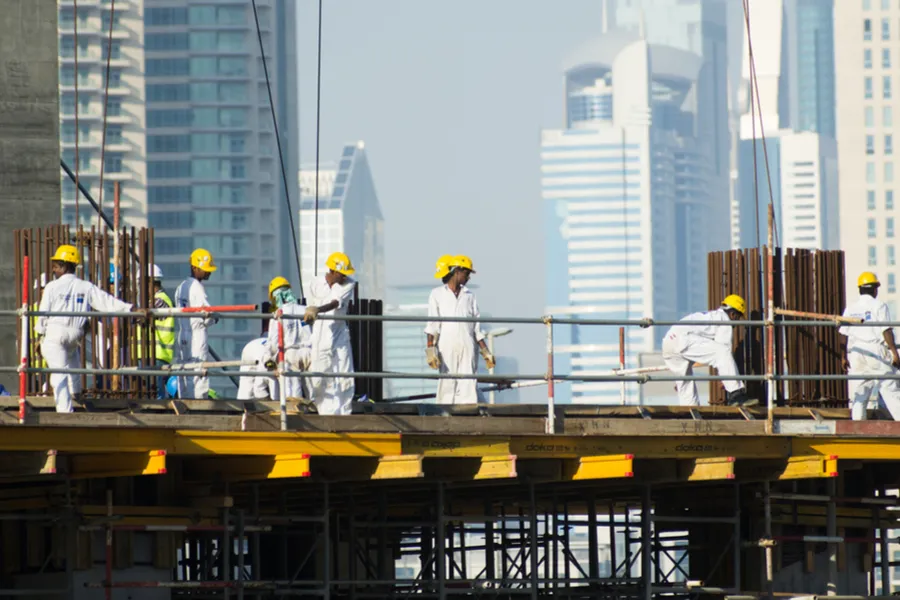
Abu Dhabi, United Arab Emirates, Jul 19, 2018 / 02:47 pm (CNA/EWTN News).- A Catholic church in Dubai is hosting a celebration to honor the United Arab Emirates’ migrant workers – many of whom are fathers separated from their homes to provide for their families.
It is a “day to honor some…fathers who are working here, separated from their families back home,” said Father Lennie Connully, OFM Cap., pastor of St Mary’s Catholic Church.
“They are here struggling for their families. We want to honor them, 500 of them,” he told CNA.
More than 500 men are expected to attend the July 20 event taking place at a labor camp for Khansaheb Investments in Dubai, more than 80 miles northeast of Abu Dhabi.
Organized by Saint Mary’s Catholic Church, the workers will enjoy games, dinner, dance, and gift baskets. The men will be given a combination of food and necessities, including items such as coffee, tea, sugar, detergents, razors, and phone cards. Father Connully said the calling cards will help connect the fathers and their families.
The fathers are “making a big sacrifice in being away from their families just to provide for them. So that is the reason why we thought of them,” he said. “It’s not on a very big scale, but it is something we can give at this moment.”
This is the third annual event that St Mary’s parish will host to provide aid and comfort to the people within the UAE. In 2017, the church celebrated the women who provide cleaning services.
This year, the event coincides with celebrations of the life of Zayed bin Sultan Al Nahyan, the founding president of the UAE.
“There can be no better way to commemorate the Year of Zayed – founding father of the UAE – than by honouring lonely fathers on the occasion of International Father’s Day. Shaikh Zayed is a true symbol of humanitarianism. To honour his vision and memory, St. Mary’s Catholic Church has decided to bring fun and entertainment into the lives of more than 500 deserving workers from selected labour accommodations in Dubai,” Fr. Connully said, according to Gulf News.
Dubai has a large migrant-to-citizen ratio, with immigrants making up more than 80 percent of the population and 90 percent of the work force.
Father Connully told CNA that the labor camps, though imperfect, offer these men a chance to be employed.
“A labor accommodation is provided by the company which employs them,” he said. “We cannot say it is ideal, but then the company, of course, is by all means looking for profit with using as little as possible.”
In 2016, numerous reports came out about these labor camp’s low wages, undocumented workers, and poor living conditions. According to Khaleej Times, there are months when workers were not paid and visas where confiscated.
However, Father Connully said the conditions are comparatively good to situations these workers face in their home countries, and the wages are still an opportunity the men may not have otherwise.
“It is comparatively good because they all have single rooms and all that…they have air conditioning and other good[s] compared to” their home countries, he said. “They are able to spare something, send something back home.”
The Asian Migrant Centre found that the largest source of migrant workers in the UAE originate from India. There are also large numbers of guest workers who are Catholic from Africa, Bangladesh, Pakistan, and the Philippines.
There are also sizable minorities of Hindus and Buddhists among the guest workers.
The Father’s Day event will serve men of “any religion,” Fr. Connully said. “We have Hindus, Muslims, Christians, all sorts of people from all over the world.”
Because God is the provider, Father Connully said fatherhood plays an important role in the faith and is an honored position.
“In the Christian faith, [fatherhood is] a very, very important role…because we look to God as our Father. He is the provider of all mankind and the Father of the family. In the Christian family, the father has a big role to play and the father has an honored position in every family, especially in the East.”
If you value the news and views Catholic World Report provides, please consider donating to support our efforts. Your contribution will help us continue to make CWR available to all readers worldwide for free, without a subscription. Thank you for your generosity!
Click here for more information on donating to CWR. Click here to sign up for our newsletter.

Nairobi, Kenya, Aug 4, 2017 / 05:04 pm (CNA/EWTN News).- With Kenya’s elections fast approaching, the country’s Catholic bishops are asking voters to choose wisely and encouraging all Kenyans to pray for peace.
“We are calling upon all Kenyans to seize this opportunity to exercise our constitutional right and give ourselves leaders of integrity,” Bishop Philip Anyolo of Homa Bay, chairman of the Kenyan bishops’ conference, said on behalf of Kenya’s bishops July 28.
“We need to create a peaceful environment, to demonstrate our patriotism for our wonderful country, and ensure that all parts of Kenya are in peace,” he added.
The bishops’ letter ahead of the Aug. 8 elections takes its title from Jeremiah 29:7, “Seek Peace and Prosperity.” They called on all Kenyans to join in prayer for their country, and a novena for peaceful elections will take place July 30-Aug. 7.
“Peace, Peace, Peace,” the bishops repeated.
Voicing appreciation for the relatively peaceful manner of the political campaigns, the bishops urged candidates to continue to conduct themselves “with decorum and sobriety” in the interests of national unity.
Kenya’s 2007 elections resulted in nationwide ethnic violence that killed 1,300 people and displaced 700,000.
The bishops appealed to young people “to restrain themselves from violence and instead be the agents of peace.”
“We exhort them to uphold to the culture of peace and engage in activities of peace-building,” they said.
The bishops pledged to work closely with election observers, state agencies, and non-state actors involved in the election.
The bishops praised the achievements of the Independent Electoral and Boundaries Commission and encouraged it to secure just, fair, credible and peaceful elections.
The run-up to the election has been marred by the apparent torture and killing of Chris Msando, a systems development manager at the elections commission, the Catholic News Agency for Africa reports. He had been scheduled to test the technology involved in voting and tallying the election results on July 31. His body was found on the outskirts of Nairobi.
The killing was denounced as “barbaric” by the bishops.
“Life is sacred and only God who gives it freely should take it away when He so desires,” they said.
The bishops also addressed the media, calling them a “very crucial actor” in the electoral process, and encouraging the media to show continued professionalism and commitment to fulfilling its duties.
Kenya’s President Uhuru Kenyatta is seeking re-election.
In his 2013 race for the presidency, he and his deputy William Ruto had been indicted by the International Criminal Court on charges of crimes against humanity. His campaign prompted warnings from the U.S. and U.K. governments if he were elected, BBC News reports.
However, the warnings did not have much consequence. He mobilized many African leaders to pressure the international court. Both cases were dropped due to a lack of evidence, with the International Criminal Court saying prosecution witnesses were intimidated and the cases could resume.
Kenyatta, the son of Kenya’s first president, has portrayed his 72-year-old opponent Raila Odinga as an agent of foreign governments who works to serve former colonial powers. He has also portrayed Odinga as an “analog generation” of politicians who must make way for the younger “digital generation.” His family owns a TV channel, a newspaper, and a number of radio stations, among many other business interests.
Odinga, a son of Kenya’s first vice-president, is making his fourth bid for the presidency. He has had different policies alliances in his career and is now running under the National Super Alliance, a coalition of Kenya’s main opposition groups. He aims to win drawing from his ethnic community, the Luo, as well as the Luhya, Kalenjin and Kamba groups.
Odinga studied to be a mechanical engineer in former East Germany, and was MP for Africa’s biggest slum, Kibera. He was imprisoned for attempting to stage a coup in 1982 against a one-party dictatorship. Though he initially denied the claim, he admitted his central role in a 2006 book. He was imprisoned from 1982-1988 and 1989-1991.
He has promised to serve only one term in office and has convinced many potential rivals to back his candidacy instead.
The sisters Madeleine and Marie-Liesse together with Louis Antona at the entrance of Greece. The three young people covered the distance from Paris to Jerusalem on foot, arriving in mid-May 2024. “I needed to walk 4,500 kilometers to understand that Jesus is not just in Jerusalem, but was by my side every step of the way,” Antona told CNA. / Credit: Photo courtesy of French pilgrims Madeleine and Marie-Liesse
Jerusalem, Jun 18, 2024 / 06:00 am (CNA).
On Sept. 17, 2023, two sisters left Paris and walked for approximately eight months to Jerusalem. Madeleine and Marie-Liesse, 19 and 22, who grew up in a Catholic family, decided to become pilgrims to grow in their faith.
“We needed to make the faith our own,” they told CNA. “This pilgrimage was to discover God, to truly search for him and deepen our faith. We learned that we can trust God; he takes care of us in everything. The Gospel is not a joke.”
Two months later, in mid-November 2023, Louis Antona, 24, also left Paris on foot, bound for Jerusalem. The three young people met providentially in Albania, walked together through Turkey, then parted ways and reunited in Jerusalem. They shared the story of their pilgrimage with CNA.
“I needed to walk 4,500 kilometers to understand that Jesus is not just in Jerusalem but was by my side every step of the way,” Antona told CNA. He walked a total of 189 days and arrived in Jerusalem on May 18.
Madeleine and Marie-Liesse — who asked that their last name not be used to protect their privacy — left from the Basilica of the Sacred Heart of Montmartre in the center of Paris with the blessing of their parents and a priest.
“It was a calling from God,” Madeleine said of the decision she and her sister made to leave. “There’s no need for reasons when God calls; you simply need to follow what he tells you.”
Madeleine and Marie-Liesse during a moment of their journey, between Slovenia and Croatia. “The faith of the people struck us: during Advent, tradition dictates that Mass be attended every morning at 6, and every time we went, the church was packed with people,” they told CNA. The two sisters left Paris on September 17, 2023, and walked for about eight months to Jerusalem. Credit: Courtesy of French pilgrims Madeleine and Marie-Liesse
The sisters created a simple blog to keep friends and family updated on their pilgrimage. The photos and brief stories reveal all the freshness of two young people on a journey while not hiding moments of doubt and difficulty.
“We chose to embark on this journey as beggars,” Marie-Liesse told CNA. “We left with just a few clothes and nothing else — no food, no money. We wanted to surrender ourselves into the hands of providence. Every evening, we knocked on people’s doors asking for shelter, a bed, and food. The Lord always provided.”
Their days were marked by walking and prayer.
“We didn’t have a strict rule because we had to adapt every day to the people who hosted us, the place, and the situation,” Marie-Liesse explained. “But we had a framework: We knew we had to pray in the morning, at midday, at night… It was important for us to be faithful to God. Every day, we also recited a rosary, praying for the intentions entrusted to us.”
The most challenging moment was making the decision to continue the journey after hearing that war had broken out in the Holy Land. “We were in Germany and full of doubts about whether to go on.”
Their journey led them to cross Switzerland, Germany, Austria, Slovenia, and Croatia. In Croatia, “the faith of the people struck us: during Advent, tradition dictates that Mass be attended every morning at 6, and every time we went, the church was packed with people,” the sisters wrote on their blog.
They stopped for a month in Medjugorje (Bosnia and Herzegovina), where their family joined them for Christmas.
“It was a difficult time. Again, we didn’t know what to do. But after a period of discernment, we realized that Christ was calling us back on the road again,” Madeleine said.
Madeleine and Marie-Liesse crossed Montenegro and arrived in Albania, where they encountered Antona.
“I had just finished my studies and wanted to offer something to God,” Antona told CNA. “I wasn’t sure what, but I thought that the best thing I had at that time was time itself. So, I decided to offer God a year of my life by embarking on a journey. It was a challenge; I wasn’t sure if I would enjoy walking and being alone.”
Louis Antona, 24, during a moment of his journey. “I had just finished my studies and wanted to offer something to God,” he told CNA. “I thought that the best thing I had at that time was time itself. So, I decided to offer God a year of my life by embarking on a journey.” Credit: Photo courtesy of Louis Antona
Antona decided to leave, despite the war. “I believe the hardest part of a pilgrimage like this is deciding to start. I knew that if I gave up because of the war, I would never do it again. Anyway, I thought that by the time I arrived, the war would already be over.”
Madeleine and Marie-Liesse are filled with wonder at the manifestation of providence in every detail of their pilgrimage, in the beautiful weather and in the rain, in every small encounter — those who hosted them after seeing them at the bus stop, those who taught them how to make bread, the gentleman who opened his door just before a downpour. “If we had arrived a minute later, we wouldn’t have met him,” they said.
The encounter with Antona wasn’t coincidental either. The two sisters had prayed to God to give them a travel companion.
“We planned to not go through Turkey because we were two women alone, but we would have liked to go that way. So we asked God to meet one pilgrim, and we met him,” the sisters explained.
The three crossed Macedonia and Greece, arriving in Turkey on Palm Sunday. In this predominantly Muslim country, they celebrated Easter, warmly welcomed by the small French-speaking community there.
The sisters Madeleine and Marie-Liesse together with Louis Antona received a blessing from a priest during a Mass in Turkey. They arrived in Turkey on Palm Sunday 2024. In this predominantly Muslim country, they celebrated Easter, warmly welcomed by the small French-speaking community there. Credit: Photo courtesy of Louis Antona
“Every day of this pilgrimage was a miracle,” Antona said. “Every day we have met people who smiled or were nice to us. I have to say that in Turkey we found the most welcoming people.”
“It is not uncommon for the Turks to spontaneously lend us a hand,” Madeleine and Marie-Liesse wrote on their blog. “In Turkey, we encountered an infinite respect for passing strangers and for Christianity, even though Christians here are forced to protect themselves from regular attacks.”
The arrival of Madeleine and Marie-Liesse in Albania. In the photo, Marie-Liesse is in front of a statue of Mother Teresa, who was originally from this country. “Every evening, we knocked on people’s doors asking for shelter, a bed, and food. The Lord always provided,” they told CNA. Credit: Photo courtesy of French pilgrims Madeleine and Marie-Liesse
Upon leaving Turkey, the paths of the three pilgrims split again. The sisters’ route went through Cyprus but they could not find a way from there to Jerusalem by sea due to suspension of transportation because of the war. Providentially, they met someone in Cyprus who offered to pay for airfare, and the sisters arrived in Tel Aviv on May 6. Three days later, on the feast of the Ascension, they were in Jerusalem.
“Many times, we thought we couldn’t reach Jerusalem,” Madeleine said. “We learned that the journey is even more important than reaching the goal. Being here is a great gift, just to be here.”
“We unpacked our bags once and for all, knelt before this Holy Land, and prayed. What peace, what a moment of grace! As we admired the sunrise and the golden light that brought color to the roofs of the old city, we could reread the wonders of God and meditate on the Gospels. His infinite love overwhelmed us,” the two sisters wrote on their blog.
The sisters Madeleine and Marie-Liesse received a blessing from a Franciscan friar at the Basilica of the Holy Sepulcher after their arrival in Jerusalem. “The greatest gift is to be here and understand what happened here, to see with our own eyes, to witness the actual places,” Madeleine said. “We were able to pause in every place, to pray and meditate in silence.” Credit: Photo courtesy of French pilgrims Madeleine and Marie-Liesse
Madeleine has no doubts: “Prayer is what carried us. When you’re weak, that’s when you’re strongest because that’s when God can act in you; you don’t take up all the space. Trusting in God can be challenging, but when you understand that God only wants you to be happy and will give you everything you need, then you realize you have everything to be happy in this moment; you can trust him.”
Ten days later, on the eve of Pentecost, Antona also arrived in Jerusalem. “Even if I had to stop somewhere else, at least I would have aimed to reach Jerusalem. This is a very important city for Christians, but the journey you take to reach it is also very important.”
French pilgrim Louis Antona arrived in Jerusalem on May 18, at the vigil of Pentecost. “Every day of this pilgrimage was a miracle,” he said. Credit: Photo courtesy of Louis Antona
The three pilgrims are still in the Holy Land. They have had the opportunity to participate in various celebrations and to visit the holy places in addition to many other sites in the area.
“The greatest gift is to be here and understand what happened here, to see with our own eyes, to witness the actual places,” Madeleine said. “We were able to pause in every place, to pray and meditate in silence.”
A journey like this isn’t for everyone, but all three of the pilgrims agree that “if God calls you, go in peace. If God helps you, everything becomes possible.”
The French pilgrims rest under the portico of the Church of the Beatitudes on a hill overlooking the Sea of Galilee. In the photo is Louis Antona. A journey like this isn’t for everyone, but, the three young people said, “if God calls you, go in peace. If God helps you, everything becomes possible.” Credit: Photo courtesy of French pilgrims Madeleine and Marie-Liesse
Leave a Reply