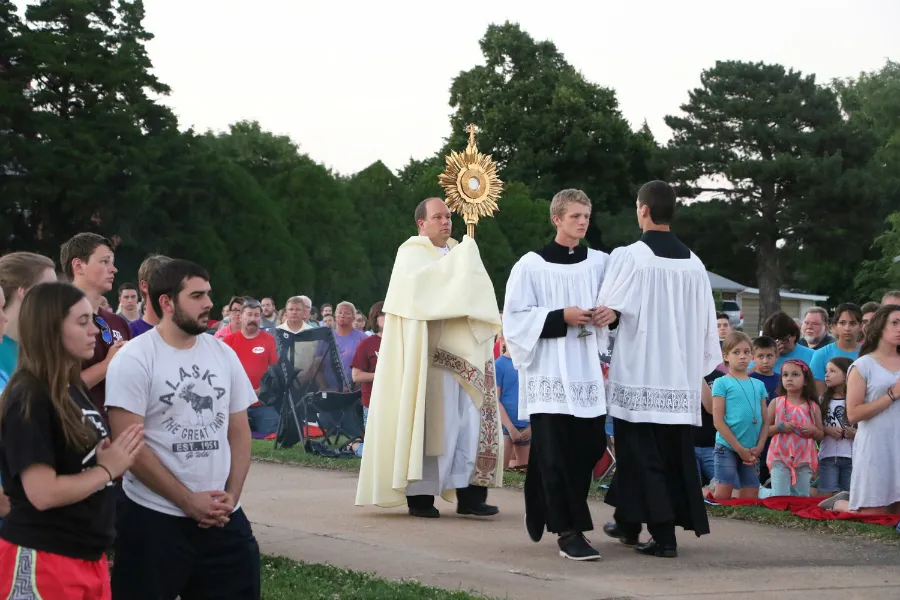
Wichita, Kan., Jul 13, 2018 / 03:04 am (CNA/EWTN News).- A Kansas-based ministry led more than a thousand people in Eucharistic adoration last week, allowing Catholics and non-Catholics to worship the Creator among the stars.
Wichita Adore Ministries hosted “Adoration Under the Stars” July 5 at the cemetery outside St. Joseph’s Catholic Church in Ost, fewer than 30 miles northwest of Wichita.
Jesse Elpers, president of WAM, said the event is a simple yet profound encounter with God.
The event ties “together the creation of God with he who created it on an altar in the middle of nowhere underneath a starlit sky,” he told CNA. “[It] has a beautiful simplicity to it.”
“If nothing else, in such a serene place like that, just to be face to face with your Lord … it’s a beautiful thing.”
An estimated 1,300 people, including 24 priests, attended the event, which also included confession and music.
Elpers said confession is one of the most important aspects of the event. More than 500 people received absolution at the event last year.
Father Dan Duling, pastor of St Joseph's, has been at the church for the past two years. The event is important, he said, because it teaches young people the value of adoration and emphasizes the glory of God in all creation.
It’s “teaching our young people about adoration and giving them an environment [in which] they can pray and adore Jesus,” he told CNA. “I think the important thing for the people is knowing God’s presence out there in his creation and everything around us.”
The event began six years ago with just over 60 attendees and was one of the first ministries of WAM. The organization is a non-profit solely run on volunteer time.
Last year, WAM handled more than 100 events, including parish adoration and diocesan conferences. The company will also lend out production equipment to parishes to put together adoration events themselves.
Elpers said the non-profit’s mission is to lead people to encounter Christ, promoting conversion and personal engagement with the loving creator.
“The ultimate goal of every effort we do, both in adoration events and in the production ministry, is to give each soul a chance at an encounter with Christ” he said, using adoration to bring people “face to face with the heart of the one who made [them], the heart of the one who longs for them.”
If you value the news and views Catholic World Report provides, please consider donating to support our efforts. Your contribution will help us continue to make CWR available to all readers worldwide for free, without a subscription. Thank you for your generosity!
Click here for more information on donating to CWR. Click here to sign up for our newsletter.
Washington D.C., Feb 19, 2017 / 03:03 am (CNA/EWTN News).- A Washington florist fined for not serving a same-sex wedding out of conscience says the state’s supreme court “violated” her freedoms by ruling against her on Thursday.
“What the court decided was that now the government has the power to separate me from my livelihood and my faith,” Barronelle Stutzman, the owner of Arlene’s Flowers in Richland, Wash., told CNA in an interview.
“They’re trying to compel me to design something that goes totally against my personal conscience, and they violated my right to free speech and expression.”
Stutzman, sued by the state of Washington and the American Civil Liberties Union for declining to provide flowers for a same-sex wedding, lost her appeal at the state’s supreme court on Thursday. She says she declined to serve a long-time customer’s wedding because of her Christian beliefs that marriage is between one man and one woman.
The court had upheld a lower court’s decision, which ruled that Stutzman violated the state’s law barring discrimination on basis of sexual orientation. The lower court ordered her to pay a fine and legal costs, which stand because of Thursday’s decision. Stutzman will appeal her case to the U.S. Supreme Court.
In the 24 hours since the Washington Supreme Court’s decision, Stutzman admitted she has received both calls of support and “hate calls.” Her faith, she said, “just increases day by day,” however.
Although the court ruled that she violated an anti-discrimination law, Stutzman said she still serves gay and lesbian customers and had a 10-year friendship with Rob, the man whose wedding she would not serve.
“It’s not about discrimination at all. Rob was one of my favorite customers,” she said. When he approached her at the shop to ask her to serve his wedding and she declined, “we talked about his mom walking him down the aisle, and we talked about his marriage, and I recommended three other florists to him and we hugged each other and Rob left,” she recalled.
“I love working with Rob, and I would be so excited if he just came back into my shop today and I could wait on him for another ten years. I really miss him.”
Stutzman said she has not had contact with Rob recently other than seeing him at court, and the last personal contact was at the deposition where they hugged and talked. She has received support from other gay and lesbian customers to act according to her beliefs, she said.
Now Stutzman’s livelihood is threatened, as she is liable for the state’s fines and the legal costs were estimated to top $2 million by the end of the case.
Kristen Waggoner, senior counsel at Alliance Defending Freedom who argued Stutzman’s case before the Washington Supreme Court, said that the American Civil Liberties Union is actively fighting other religious freedom appeals throughout the country.
“They are not about protecting freedom. They are about taking it away from those who don’t share their ideology and their radical beliefs,” she said.
“Civil liberties travel together,” she insisted, explaining that countries where freedom of religion is threatened “have less freedom in many other areas as well.”
“We know that this right that’s at issue in Barronelle’s case is essential to having a just and inclusive and a stable America. And we all need to stand for that,” Waggoner said.
President Donald Trump promised in 2015 to “preserve and protect our religious liberty” as a “first priority” in his administration, Waggoner noted, and he must sign an executive order establishing broad religious freedom protections for individuals and religious organizations.
Although a federal order would not affect Stutzman’s case at the state level, it would still be “a sign and good first step to restore balance and to show the states that this needs to be done,” she insisted.
Stutzman hopes her case “speaks in volumes” that “it’s not just my freedom, it’s everybody’s freedom, whether you’re religious or not” that is at stake.
“Rob has the freedom to act on what he believes about marriage and I’m just asking for the same,” she said.
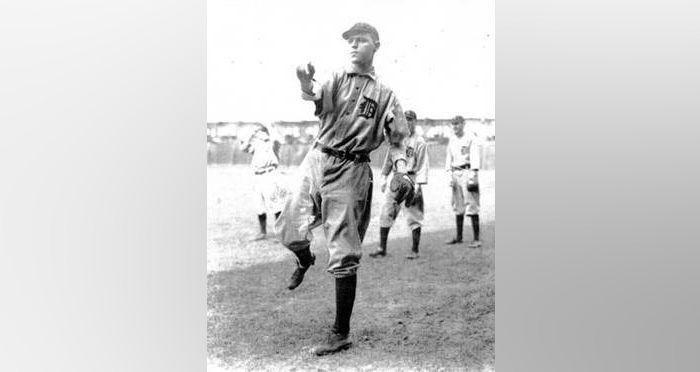
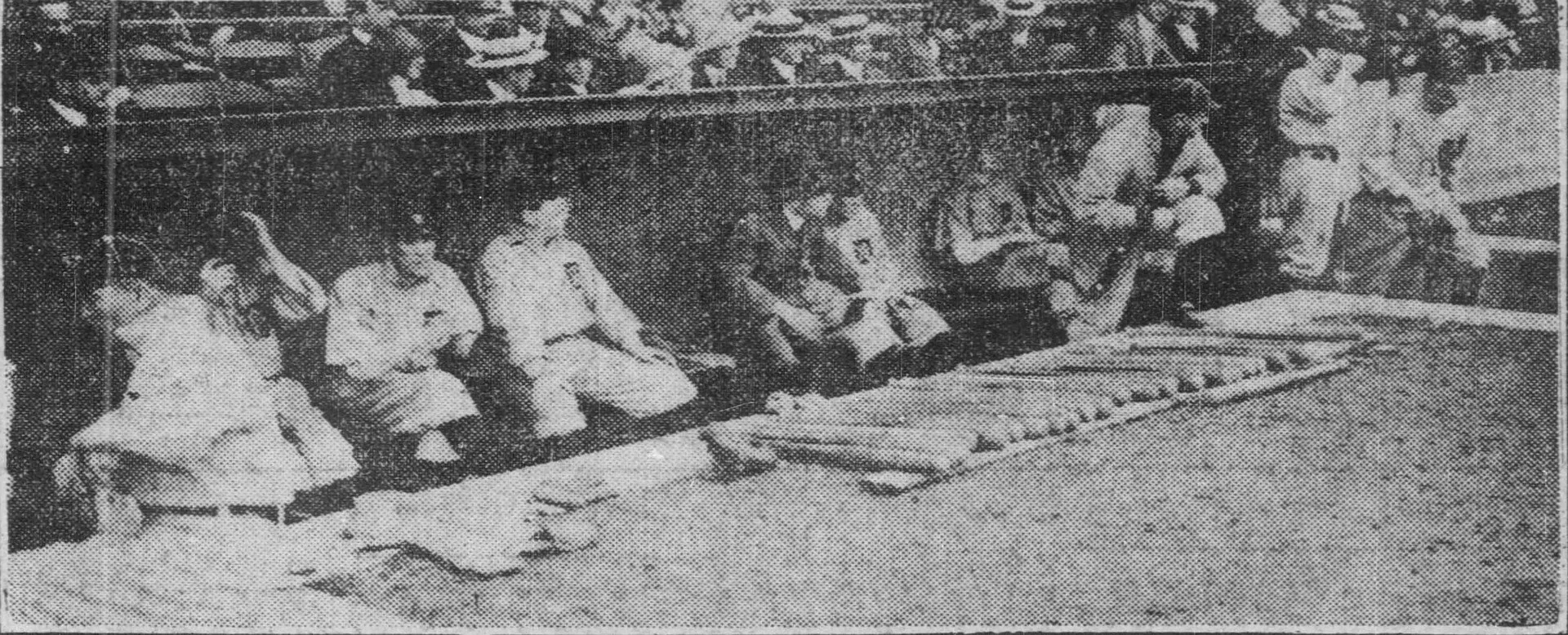
This photo of Father Allan Travers was featured in the local newspaper after his pitching “performance” for the Detroit Tigers against the Philadelphia A’s on May 18, 1912. The photo featured the caption “strikebreaker,” which worried Travers’ mother, since there was a street trolley strike in Philadelphia earlier in the month, and she didn’t want her son caught in the confusion. / Photo credit: Public domain
Detroit, Mich., Jul 23, 2023 / 08:00 am (CNA).
The worst pitcher ever to take the mound for the Detroit Tigers became a Catholic priest.
Granted, Allan Travers was already on the path to the priesthood before suiting up for Detroit on May 18, 1912. But his story — and place in baseball history — is the prime example of being in the right place at the right time (or the wrong place at the wrong time).
Travers played in only one game, but one was enough to show that God had plans for him that didn’t involve the big leagues.
The story begins, as most stories of Tigers lore do, with Ty Cobb.
The Tigers were in New York on May 15 to play the Highlanders (the precursor to the Yankees). Cobb was playing in the outfield when he was verbally abused by a New York fan who was using profanity and racial slurs to describe Cobb’s play.
Cobb — never known for keeping his cool — stormed into the stands and unleashed a volley of punches on the fan. Tigers players rushed to the scene of the chaos, yelling at Cobb to lay off the man, who was missing one hand and three fingers on his other hand after suffering an industrial accident.
Cobb didn’t care and continued the barrage.
Ban Johnson, president of the American League, happened to be at the game, checking on the family-friendly excitement of what was turning into America’s pastime.
Having one of the league’s star players beat up a disabled spectator didn’t jibe well with Johnson’s vision for baseball, so Cobb was suspended indefinitely.
The Tigers felt Cobb’s punishment was unfair, so the players voted to strike until Cobb was reinstated for the club’s next game in three days against the two-time defending World Series champion Philadelphia Athletics.
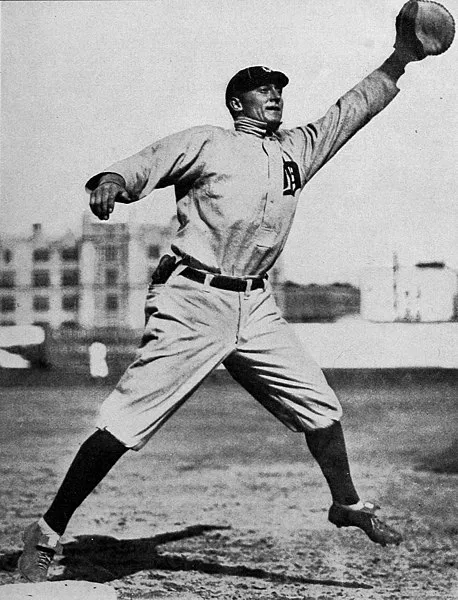
Detroit Tigers legend Ty Cobb is pictured in 1911. Not one to keep his cool, Cobb launched himself into the stands to attack a fan who insulted him in 1912, resulting in a league suspension and sparking his teammates to strike in protest. Credit: Public domain
Johnson called the Tigers’ bluff, informing then Tigers owner Frank Navin the team would face a $5,000 fine for every game Detroit forfeited.
Navin needed to field a team, and quick, so he and Tigers manager Hughie Jennings collaborated with Athletics owner/manager Connie Mack to field a team of players to take the field.
This was well before the age of expansive minor league rosters — or commercial airlines, for that matter — so it wasn’t as though the Tigers could call up the farm team in Toledo and get them to Philadelphia in time to play the A’s. Instead, scouting was done the old-fashioned way, spreading word throughout town, asking who wanted to play baseball.
And this is where Aloysius Joseph “Allan” Travers, the student manager on the St. Joseph’s College baseball team, comes into the story.
Jennings worked with a friend of his, Joe Nolan, a sportswriter for The Philadelphia Bulletin,to field a team. Nolan knew Travers, a junior at St. Joseph’s who lived in Philadelphia, from the time the A’s fielded a second-stringer team to play St. Joseph’s College.
Nolan asked Travers to find 10-12 amateur players in the area who could suit up for the Tigers in case the Tiger players followed through on their strike threats. The idea was that the amateurs would never actually take the field; rather, it was just a tactic to get Jennings’ “real” players on the field.
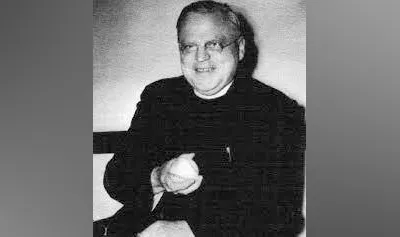
Father Allan Travers, SJ, was a priest who taught at St. Joseph’s College (now St. Joseph’s University) in Philadelphia. But in 1913, while a student at St. Joseph, he was the improbable pitcher for the Detroit Tigers, where he secured a bizarre spot in baseball history. Credit: Public domain
Travers rounded up eight players who were free that day and enticed by the $25 Navin offered to each player.
Jennings had his team of strike-breakers, as requested by Navin.
When the umpire called “play ball,” the Tiger regulars took the field, but when the umpire spotted Cobb and told him to take a seat, the rest of the team walked out and took off their uniforms.
The strike-breakers would have to play after all. They were ushered into the locker room and donned the Tigers’ gray uniforms (this was in the days before names were on the back of uniforms). Two bench coaches joined the group to offer the squad some big league experience.
The question was, who would pitch?
There were no takers at first, so Navin offered an extra $25. Travers volunteered; $50 was good money for a college kid in 1912. There was one small problem — Travers had never played organized ball.
He was the assistant manager on the college baseball team, tasked with keeping stats and writing game summaries.
But there he was, the college student with plans to join the seminary after graduation, pitching before 20,000 fans at Shibe Park against the two-time defending World Series champions. A modern David versus Goliath, a plucky underdog story.
This time Goliath won.
Travers did as well as one would expect the assistant manager of a college baseball team to do against professionals. He pitched a complete game, surrendering 24 runs on 26 hits (both American League records), walking seven and striking out one. He got an MLB strikeout — they can’t take that away from him.
But the 15.75 ERA leaves a mark. He also batted 0-for-3 at the plate.
Travers’ time in the major leagues was abrupt. After the 24-2 shellacking the A’s put on the strikebreaking Tigers, Cobb persuaded his teammates to end the strike before the team’s upcoming series against the Washington Senators.
Travers’ calling was the priesthood, not pitching.
After graduating from St. Joseph’s College in 1913, he joined the Society of Jesus, studying at St. Andrew on the Hudson in New York and Woodstock College in Maryland. He was ordained a priest in 1926, making him the only priest ever to play in a Major League game.
His ministry took him to teaching positions at St. Francis Xavier High School in Manhattan and St. Joseph’s Prep and St. Joseph’s College in Philadelphia.
Father Travers didn’t speak about his baseball exploits, but he did give an interview about his bizarre start for the Tigers.
“About noon when Nolan told me about the strike of Detroit, he told me the club would be fined and might lose its franchise if 12 players didn’t show up,” Travers told sportswriter Red Smith. “He told me to round up as many fellows as I could. We never thought we’d play a game.”
The replacement Detroit Tigers are pictured in the dugout against the Philadelphia A’s on May 18, 1912. Photo credit: Public domain
The priest said Jennings told him to avoid throwing fastballs to “avoid getting killed out there,” but the A’s didn’t hold back, even resorting to bunting when they found out the third baseman had never played baseball before.
“I fed ‘em nothing but slow stuff after Frank Baker almost hit one out of the park on me, which fortunately went foul,” Travers said. “I was doing fine until they started bunting. The guy playing third base had never played baseball before. I just didn’t get any support. I threw a beautiful slow ball and the A’s were just hitting easy flies. Trouble was, no one could catch them.”
Curious enough, the only “fame” Travers got from his start was his picture in the newspaper with the word “Strikebreaker” printed above. There was a trolley strike in Philadelphia that month, and Travers’ mother was worried for her son’s safety because people might suspect he was a scab.
Travers didn’t like talking about his baseball “career” with his students, and his story is not well known, save for a few baseball history blogs.
He did sign a ball from that fateful day that wound up in the collection of Ada, Michigan, resident Steve Nagengast, who claims to have the largest collection of Tigers autographs. Nagengast was featured in the Detroit News, and the anecdote about Travers piqued Detroit Catholic’s interest.
Travers didn’t have the greatest impact on Tigers history. But the $5,000-per-game fine the Tigers faced for each game the club forfeited would have been devastating, especially in an era when professional teams folded and changed towns all the time.
So who knows.
Father Travers’ one-game career might have just saved the Tigers.
Washington D.C., Apr 17, 2019 / 04:00 pm (CNA).- As the 2020 Presidential race begins in earnest, between the two parties sits a growing number of voters motivated by faith and morality expressing little enthusiasm for what they perceive as the Ho… […]




Leave a Reply