(Image: Benjamin Voros @vorosbenisop | Unsplash.com)
“The Church’s wealth lies in the poor, rather than in material riches.” So said Pope Francis two weeks before Christmas in 2015, echoing the words proclaimed by Deacon Lawrence when the emperor demanded of him the riches of the Church. Lawrence assembled the poor in the streets of Rome: “These are the treasures of the Church.” Our Pope Francis went on to explain that the first of the Beatitudes is to “be poor in spirit, [and that this means to be] “attached only to the riches of God.” It’s not about the rags only.
No confusion here, yet. So for the elusive New Evangelization, what does it mean—today or any day in season and out of season—to be attached only to the riches of God?
In the 1980s some proposed the sell-off of the Vatican wealth in art to feed the physically poor. And yet, working the numbers, this total wealth could be calculated at perhaps tens of billions of dollars, while many departments of the United States federal government lay claim to an annual budget measured in the hundreds of billions. And the national debt is already $22 trillion (twelve zeros) and counting, that is, each year over 1,000 times the total worth of the Sistine Ceiling plus the entire collection in the Vatican Museum—and stamp collection to boot!
The modern, globalized situation of poverty in all of its forms, as now confronting the secular world and especially the universal Church, is incomprehensible. It has ever been so.
For its part, or as only part of its part, the Church speaks up clearly for the marginalized and destitute, or even the “outcasts” and “leftovers” (Oeconomicae et pecuniariae quaestiones, January 2018). Against the regrouping Marxists, now aligned with a new set of elitist fat cats, and having learned the dangers of alliances with dynastic monarchies (Scylla and Charybdis), the perennial Church still embraces the world’s poor. With an eye to these poor and to evolving geopolitics, Pope Francis also prudently distributes more of the Church’s red hats to the far-flung periphery. Overall, and against any sudden irrelevance of the Church, the Second Vatican Council wisely grounded our renewed worldly engagement (aggiornamento) not to fashionable ideologies of the day, but to a deepened attention to the historical and singular Incarnation (ressourcement). The Council’s Church in the Modern World championed “socialization,” not socialism.
But now, with T.S. Eliot in The Hollow Men: “Between the idea and the reality, between the motion and the act—falls the Shadow.” Each new effort to reconnect to a fallen world seems exploited by the Shadow. It has ever been so.
To fill in the faltering ranks of the ordained, an ecclesiastical open-borders policy ensured an uptick in homosexual recruitment/infiltration. Then as surely as night follows day, came the Scandal of 2002. Not to mention decades of not-unrelated selective silence in seminaries on many moral issues. Instead, banners and hootenanny Masses and theological boredom inflicted on an entire generation or two.
Overrun by the wider promiscuity of the Sexual Revolution, some in high-placed shadows now question the meaning of the most intimate and creative of human encounters (and the religious and natural DNA bedrock of the entire social fabric) as prophetically defended still in Humanae Vitae.
Overrun by corrosive individualism coupled now with identity politics, some revisionist historians would redefine the actual role of the “deaconess” Phoebe in the early Church, possibly in order to eventually flatten sacramental ordination (look out, Deacon Lawrence!) by importing unisex ideology and, therefore, including women. Thereby demoting both the alter Christus of the male priesthood at the altar and the paradigmatic female presence and motherhood as exemplified uniquely in the Mother of the Incarnate Son of a self-disclosing and mysteriously Triune God.
Overrun by fifty years of neglected and integral evangelization, now as part of the New Evangelization aimed mostly at territories of the post-Christian West, some even in high-placed shadows seem to appeal to all Youth with a diluted message of syncretism. That is, while they genuinely solicit the urgent concerns of a largely abandoned generation, do they also downplay the foundational truths and demands of the human person? By hinting toward the blessing of randomized intimacies as in gay “marriage” or by (equally!) remaining speechless over “irregular” live-in arrangements of all stripes?
Overrun by the tragic disintegration of family life, some, again in high-placed shadows, seem to gnaw away at even the indissolubility of marriage, forgetful of how badly things went with the Chosen People whenever they likewise went native in the idolatrous land of Canaan. In so doing, would we unwittingly replace or at least muddle the Eucharistic Church with a merely neighborly and communitarian gathering? As with a hinted open-borders communion policy for the divorced-and-civilly remarried and for non-Catholic spouses—all of them “exceptional” cases, of course, except for any Catholic spouses who in Germany are excommunicated ipso facto for failing to check the “religion” box on their income tax returns?
The current moment is historic; much is on the table in the summer of 2018. Perhaps the recent St. Pope John Paul II is not so past-tense after all and gives us a useful hint. As for the much-vaunted concrete cases, in his The Acting Person this modern-day and non-careerist saint, yes, does agree that as a wayfarer on pilgrimage “man constitutes himself through moral judgment and corresponding action.” No dichotomy here, yet, between so-called “abstract” ideals and “concrete” cases.
St. Pope John Paul II explains that while his inquiry was “not a study in ethics,” it did not discount anything and everything of an ethical nature. By placing the ethical and universal truths of humanity “in brackets” (so to speak), as a research method, our common nature and morality is not suspended, but is actually “brought to light and given prominence.”
So, yes, to the newly asserted philosophy of “gradualism,” but man does not live by circumstances alone. Instead and as better understood in St. John Paul II’s insights into “personalism,” we have authentic personal growth with a functional compass, single-hearted pastoring and ennobling actions oriented toward a stable North Star. It is only in the reflected light of such “riches of God” (Pope Francis’ expression) that we are made “in the beginning” and remade today into the “image and likeness of God.”
Why, then, do some in high-placed shadows appeal instead to “anthropological and cultural change” and a “new paradigm”, at least seeming to displace the only really new paradigm—the gifted Incarnation and our personal conversion—as illumined by the clarity of Veritatis Splendor?
And what about the Summer of 2018? Hanging fire, we have the Humanae Vitae Commission and the Deaconess Commission, and in August the World Meeting of Families in Dublin (and the parallel and supplemental Conference of Catholic Families!), and then the October Synod on Youth, Faith and Vocations.
Where today are those cardinals, bishops, priest and deacons, and no-less also the religious and the laity—“those runners [messengers of the Gospel who] gather impetus as they run. Ages afterwards they still speak as if something had just happened”? As Chesterton further said, in The Everlasting Man: “They have not lost the speed and momentum of messengers; they have hardly lost, as it were, the wild eyes of witnesses. . . .We might sometimes fancy that the Church grows younger as the world grows old”.
Does the Church still grow young as the world grows old?
If you value the news and views Catholic World Report provides, please consider donating to support our efforts. Your contribution will help us continue to make CWR available to all readers worldwide for free, without a subscription. Thank you for your generosity!
Click here for more information on donating to CWR. Click here to sign up for our newsletter.
With the promulgation of the latest document from the DDF (Dignitas Infinita) much focus has been on the use of the word “Infinite” in the title as a qualifier for the ontological nature of human […]
Pope Emeritus Benedict XVI is greeted by Pope Francis during the Ordinary Public Consistory at St. Peter’s Basilica on Feb. 14, 2015. / Credit: Franco Origlia/Getty Images
CNA Newsroom, Dec 29, 2023 / 10:57 am (CNA).
On the eve of the first ann… […]
Pope Francis at the general audience in St. Peter’s Square, Oct. 5, 2016. / Credit: Daniel Ibanez/CNA
CNA Staff, Mar 13, 2024 / 12:00 pm (CNA).
March 13 marks the anniversary of the election of Pope Francis as the 266th successor of St. Peter. Here is a timeline of key events during his papacy:
2013
March 13 — About two weeks after Pope Benedict XVI steps down from the papacy, Cardinal Jorge Bergoglio is elected pope. He takes the papal name Francis in honor of St. Francis of Assisi and proclaims from the central balcony of St. Peter’s Basilica: “Let us begin this journey, the bishop and people, this journey of the Church of Rome, which presides in charity over all the Churches, a journey of brotherhood in love, of mutual trust. Let us always pray for one another.”
March 14 — The day after he begins his pontificate, Pope Francis returns to his hotel to personally pay his hotel bill and collect his luggage.
July 8 — Pope Francis visits Italy’s island of Lampedusa and meets with a group of 50 migrants, most of whom are young men from Somalia and Eritrea. The island, which is about 200 miles off the coast of Tunisia, is a common entry point for migrants who flee parts of Africa and the Middle East to enter Europe. This is the pope’s first pastoral visit outside of Rome and sets the stage for making reaching out to the peripheries a significant focus.
Pope Francis gives the Wednesday general audience in St. Peter’s Square on Oct. 2, 2013. Elise Harris/CNA.
July 23-28 — Pope Francis visits Rio de Janeiro, Brazil, to participate in World Youth Day 2013. More than 3 million people from around the world attend the event.
July 29 — On the return flight from Brazil, Pope Francis gives his first papal news conference and sparks controversy by saying “if a person is gay and seeks God and has goodwill, who am I to judge?” The phrase is prompted by a reporter asking the pope a question about priests who have homosexual attraction.
Nov. 24 — Pope Francis publishes his first apostolic exhortation Evangelii Gaudium (The Joy of the Gospel). The document illustrates the pope’s vision for how to approach evangelization in the modern world.
2014
Feb. 22 — Pope Francis holds his first papal consistory to appoint 19 new cardinals, including ones from countries in the developing world that have never previously been represented in the College of Cardinals, such as Haiti.
March 22 — Pope Francis creates the Pontifical Commission for the Protection of Minors. The commission works to protect the dignity of minors and vulnerable adults, such as the victims of sexual abuse.
Pope Francis greets pilgrims during his general audience on Nov. 29, 2014. Bohumil Petrik/CNA.
Oct. 5 — The Synod on the Family begins. The bishops discuss a variety of concerns, including single-parent homes, cohabitation, homosexual adoption of children, and interreligious marriages.
Dec. 6 — After facing some pushback for his efforts to reform the Roman Curia, Pope Francis discusses his opinion in an interview with La Nacion, an Argentine news outlet: “Resistance is now evident. And that is a good sign for me, getting the resistance out into the open, no stealthy mumbling when there is disagreement. It’s healthy to get things out into the open, it’s very healthy.”
2015
Jan. 18 — To conclude a trip to Asia, Pope Francis celebrates Mass in Manila, Philippines. Approximately 6 million to 7 million people attend the record-setting Mass, despite heavy rain.
March 23 — Pope Francis visits Naples, Italy, to show the Church’s commitment to helping the fight against corruption and organized crime in the city.
May 24 — To emphasize the Church’s mission to combat global warming and care for the environment, Pope Francis publishes the encyclical Laudato Si’, which urges people to take care of the environment and encourages political action to address climate problems.
Pope Francis at a Wednesday general audience in St. Peter’s Square on June 17, 2015. Bohumil Petrik.
Sept. 19-22 — Pope Francis visits Cuba and meets with Fidel Castro in the first papal visit to the country since Pope John Paul II in 1998. During his homily, Francis discusses the dignity of the human person: “Being a Christian entails promoting the dignity of our brothers and sisters, fighting for it, living for it.”
Sept. 22-27 — After departing from Cuba, Pope Francis makes his first papal visit to the United States. In Washington, D.C., he speaks to a joint session of Congress, in which he urges lawmakers to work toward promoting the common good, and canonizes the Franciscan missionary St. Junípero Serra. He also attends the World Meeting of Families in Philadelphia, which focuses on celebrating the gift of the family.
Pope Francis speaks to the U.S. Congress in Washington, D.C. on Sept. 24, 2015. . L’Osservatore Romano.
Oct. 4 — Pope Francis begins the second Synod on the Family to address issues within the modern family, such as single-parent homes, cohabitation, poverty, and abuse.
Oct. 18 — The pope canonizes St. Louis Martin and St. Marie-Azélie “Zelie” Guérin. The married couple were parents to five nuns, including St. Therese of Lisieux. They are the first married couple to be canonized together.
Dec. 8 — Pope Francis’ Jubilee Year of Mercy begins. The year focuses on God’s mercy and forgiveness and people’s redemption from sin. The pope delegates certain priests in each diocese to be Missionaries of Mercy who have the authority to forgive sins that are usually reserved for the Holy See.
2016
March 19 — Pope Francis publishes the apostolic exhortation Amoris Laetitia, which discusses a wide variety of issues facing the modern family based on discussions from the two synods on the family. The pope garners significant controversy from within the Church for comments he makes in Chapter 8 about Communion for the divorced and remarried.
April 16 — After visiting refugees on the Greek island of Lesbos, Pope Francis allows three Muslim refugee families to join him on his flight back to Rome. He says the move was not a political statement.
Pope Francis at the General Audience in St. Peter’s Square, Feb. 24, 2016. Daniel Ibanez/CNA.
July 26-31 — Pope Francis visits Krakow, Poland, as part of the World Youth Day festivities. About 3 million young Catholic pilgrims from around the world attend.
Sept. 4 — The pope canonizes St. Teresa of Calcutta, who is also known as Mother Teresa. The saint, a nun from Albania, dedicated her life to missionary and charity work, primarily in India.
Sept. 30-Oct. 2 — Pope Francis visits Georgia and Azerbaijan on his 16th trip outside of Rome since the start of his papacy. His trip focuses on Catholic relations with Orthodox Christians and Muslims.
Oct. 4 — Pope Francis makes a surprise visit to Amatrice, Italy, to pray for the victims of an earthquake in central Italy that killed nearly 300 people.
2017
May 12-13 — In another papal trip, Francis travels to Fatima, Portugal, to visit the Shrine of Our Lady of Fatima. May 13 marks the 100th anniversary of the first Marian apparition to three children in the city.
July 11 — Pope Francis adds another category of Christian life suitable for the consideration of sainthood: “offering of life.” The category is distinct from martyrdom, which only applies to someone who is killed for his or her faith. The new category applies to those who died prematurely through an offering of their life to God and neighbor.
Pope Francis greets a participant in the World Day of the Poor in Rome, Nov. 16, 2017. L’Osservatore Romano.
Nov. 19 — On the first-ever World Day of the Poor, Pope Francis eats lunch with 4,000 poor and people in need in Rome.
Nov. 27-Dec. 2 — In another trip to Asia, Pope Francis travels to Myanmar and Bangladesh. He visits landmarks and meets with government officials, Catholic clergy, and Buddhist monks. He also preaches the Gospel and promotes peace in the region.
2018
Jan. 15-21 — The pope takes another trip to Latin America, this time visiting Chile and Peru. The pontiff meets with government officials and members of the clergy while urging the faithful to remain close to the clergy and reject secularism. The Chilean visit leads to controversy over Chilean clergy sex abuse scandals.
Aug. 2 — The Vatican formally revises No. 2267 of the Catechism of the Catholic Church, which concerns the death penalty. The previous text suggested the death penalty could be permissible in certain circumstances, but the revision states that the death penalty is “inadmissible.”
Aug. 25 — Archbishop Carlo Viganò, former papal nuncio to the United States, publishes an 11-page letter calling for the resignation of Pope Francis and accusing him and other Vatican officials of covering up sexual abuse including allegations against former Cardinal Theodore McCarrick. The pope initially does not directly respond to the letter, but nine months after its publication he denies having prior knowledge about McCarrick’s conduct.
Aug. 25-26 — Pope Francis visits Dublin, Ireland, to attend the World Meeting of Families. The theme is “the Gospel of family, joy for the world.”
Pope Francis at the 2018 World Meeting of Families in Ireland. Daniel Ibanez/CNA.
Oct. 3-28 — The Synod on Young People, the Faith, and Vocational Discernment takes place. The synod focuses on best practices to teach the faith to young people and to help them discern God’s will.
2019
Jan. 22-27 — The third World Youth Day during Pope Francis’ pontificate takes place during these six days in Panama City, Panama. Young Catholics from around the world gather for the event, with approximately 3 million people in attendance.
Feb. 4 — Pope Francis signs a joint document in with Sheikh Ahmed el-Tayeb, the grand imam of Al-Azhar, in Abu Dhabi, United Arab Emirates, titled the “Document on Human Fraternity for World Peace and Living Together.” The document focuses on people of different faiths uniting together to live peacefully and advance a culture of mutual respect.
Pope Francis and Ahmed el-Tayeb, grand imam of al-Azhar, signed a joint declaration on human fraternity during an interreligious meeting in Abu Dhabi, UAE, Feb. 4, 2019. Vatican Media.
Feb. 21-24 — The Meeting on the Protection of Minors in the Church, which is labeled the Vatican Sexual Abuse Summit, takes place. The meeting focuses on sexual abuse scandals in the Church and emphasizes responsibility, accountability, and transparency.
Oct. 6-27 — The Church holds the Synod of Bishops for the Pan-Amazon region, which is also known as the Amazon Synod. The synod is meant to present ways in which the Church can better evangelize the Amazon region but leads to controversy when carved images of a pregnant Amazonian woman, referred to by the pope as Pachamama, are used in several events and displayed in a basilica near the Vatican.
Oct. 13 — St. John Henry Newman, an Anglican convert to Catholicism and a cardinal, is canonized by Pope Francis. Newman’s writings inspired Catholic student associations at nonreligious colleges and universities in the United States and other countries.
2020
March 15 — Pope Francis takes a walking pilgrimage in Rome to the chapel of the crucifix and prays for an end to the COVID-19 pandemic. The crucifix was carried through Rome during the plague of 1522.
March 27 — Pope Francis gives an extraordinary “urbi et orbi” blessing in an empty and rain-covered St. Peter’s Square, praying for the world during the coronavirus pandemic.
Pope Francis venerates the miraculous crucifix of San Marcello al Corso in St. Peter’s Square during his Urbi et Orbi blessing, March 27, 2020. Vatican Media.
2021
March 5-8 — In his first papal trip since the start of the COVID-19 pandemic, Pope Francis becomes the first pope to visit Iraq. On his trip, he signs a joint statement with Grand Ayatollah Ali al-Sistani condemning extremism and promoting peace.
July 3 — Cardinal Giovanni Angelo Becciu, who was elevated to the College of Cardinals by Pope Francis, is indicted in a Vatican court for embezzlement, money laundering, and other crimes. The pope gives approval for the indictment.
July 4 — Pope Francis undergoes colon surgery for diverticulitis, a common condition in older people. The Vatican releases a statement that assures the pope “reacted well” to the surgery. Francis is released from the hospital after 10 days.
July 16 — Pope Francis issues a motu proprio titled Traditionis Custodes. The document imposes heavy restrictions on the celebration of the Traditional Latin Mass.
Dec. 2-6 — The pope travels to Cyprus and Greece. The trip includes another visit to the Greek island of Lesbos to meet with migrants.
Pope Francis greets His Beatitude Ieronymos II in Athens, Greece on Dec. 5, 2021. Vatican Media
2022
Jan. 11 — Pope Francis makes a surprise visit to a record store in Rome called StereoSound. The pope, who has an affinity for classical music, blesses the newly renovated store.
March 19 — The pope promulgates Praedicate Evangelium, which reforms the Roman Curia. The reforms emphasize evangelization and establish more opportunities for the laity to be in leadership positions.
May 5 — Pope Francis is seen in a wheelchair for the first time in public and begins to use one more frequently. The pope has been suffering from knee problems for months.
Pope Francis greeted the crowd in a wheelchair at the end of his general audience on Aug. 3, 2022. Daniel Ibanez/CNA
July 24-30 — In his first papal visit to Canada, Pope Francis apologizes for the harsh treatment of the indigenous Canadians, saying many Christians and members of the Catholic Church were complicit.
2023
Jan. 31-Feb. 5 — Pope Francis travels to the Democratic Republic of Congo and South Sudan. During his visit, the pope condemns political violence in the countries and promotes peace. He also participates in an ecumenical prayer service with Anglican Archbishop of Canterbury Justin Welby and Moderator of the Church of Scotland Iain Greenshields.
Pope Francis greets a young boy a Mass in Juba, South Sudan on Feb. 5, 2023. Vatican Media
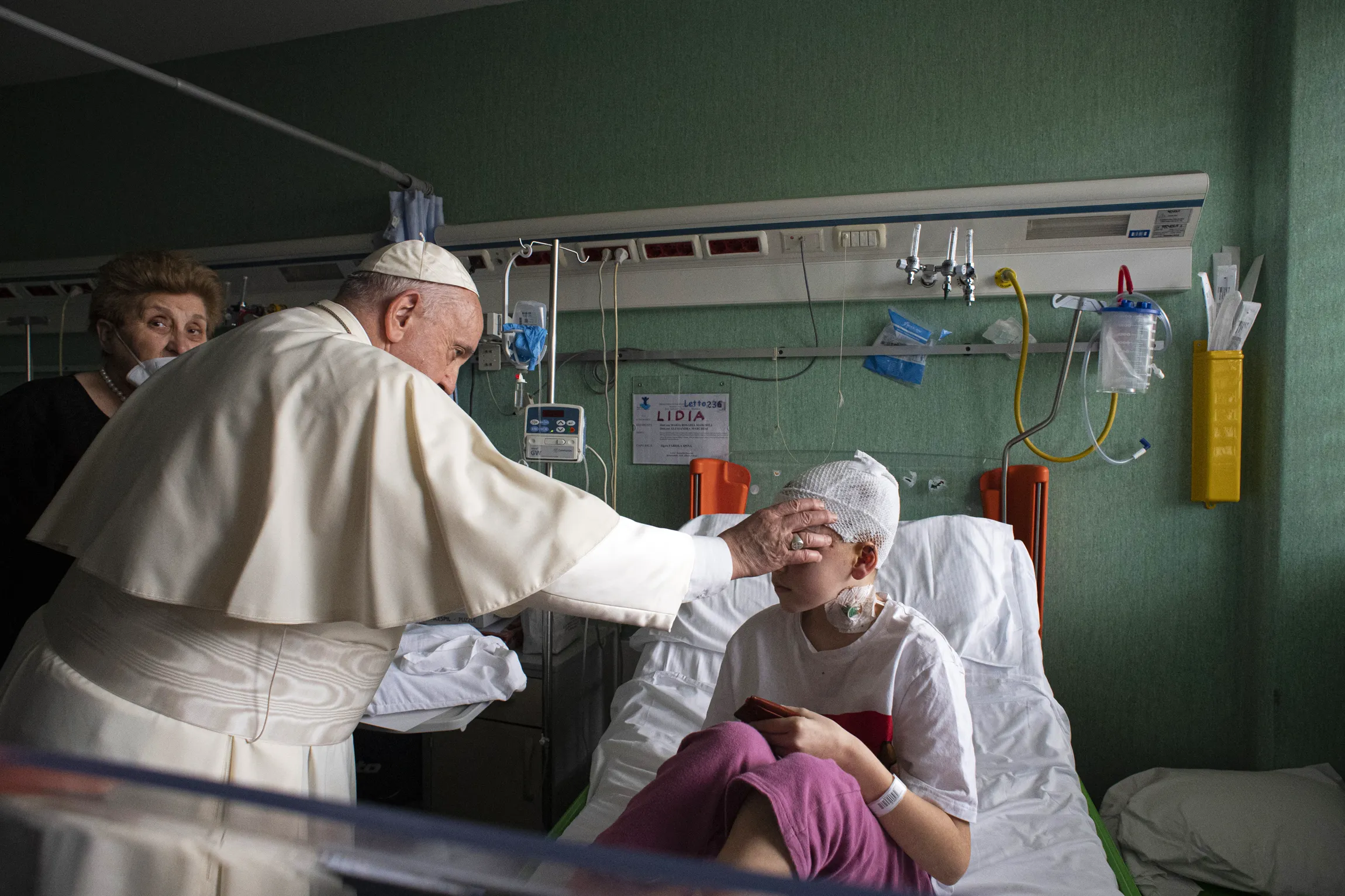
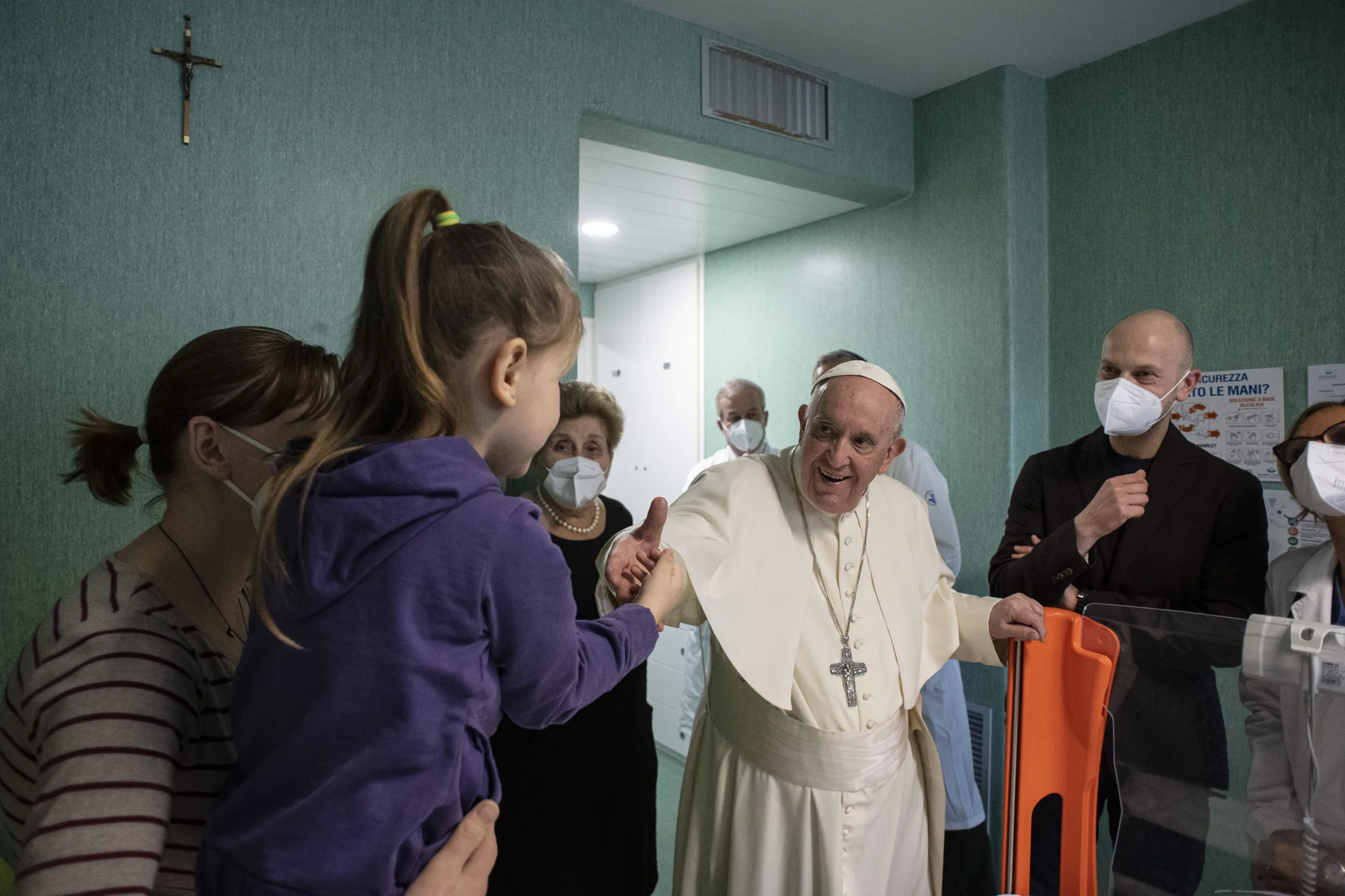
March 29-April 1 — Pope Francis is hospitalized for a respiratory infection. During his stay at Rome’s Gemelli Hospital, he visits the pediatric cancer ward and baptizes a newborn baby.
April 5 — The pope appears in the Disney documentary “The Pope: Answers,” which is in Spanish, answering six “hot-button” issues from members of Gen Z from various backgrounds. The group discusses immigration, depression, abortion, clergy sexual and psychological abuse, transgenderism, pornography, and loss of faith.
April 28-30 — Pope Francis visits Hungary to meet with government officials, civil society members, bishops, priests, seminarians, Jesuits, consecrated men and women, and pastoral workers. He celebrates Mass on the final day of the trip in Kossuth Lajos Square.
Pope Francis stands on an altar erected outside the Parliament Building in Budapest’s Kossuth Lajos’ Square during a public outdoor Mass on April 30, 2023. Vatican Media
June 7 — The Vatican announces that Pope Francis will undergo abdominal surgery that afternoon under general anesthesia due to a hernia that is causing painful, recurring, and worsening symptoms. In his general audience that morning before the surgery, Francis says he intends to publish an apostolic letter on St. Thérèse of Lisieux, “patroness of the missions,” to mark the 150th anniversary of her birth.
June 15 — After successful surgery and a week of recovery, Pope Francis is released from Gemelli Hospital.
Aug. 2-6 — Pope Francis travels to Lisbon, Portugal, for World Youth Day 2023, taking place from Aug. 1-6. He meets with Church and civil leaders ahead of presiding at the welcoming Mass and Stations of the Cross. He also hears the confessions of several pilgrims. On Aug. 5, he visits the Shrine of Our Lady of Fátima, where he prays the rosary with young people with disabilities. That evening he presides over the vigil and on Sunday, Aug. 6, he celebrates the closing Mass, where he urges the 1.5 million young people present to “be not afraid,” echoing the words of the founder of World Youth Days, St. John Paul II.
Pope Francis waves at the crowd of 1.5 million people who attended the closing Mass of World Youth Day 2023 in Lisbon, Portugal on Aug. 6, 2023. Vatican Media.
Aug. 31-Sept. 4 — Pope Francis travels to Mongolia, the world’s most sparsely populated sovereign country. The trip makes Francis the first pope to visit the Asian country that shares a 2,880-mile border with China, its most significant economic partner. Mongolia has a population of about 1,300 Catholics in a country of more than 3 million people.
Pope Francis meets with local priests and religious of Mongolia, which includes only 25 priests (19 religious and six diocesan), 33 women religious, and one bishop — Cardinal Giorgio Marengo — in Ulaanbaatar’s Cathedral of Sts. Peter and Paul on Sept. 2, 2023. Credit: Vatican Media
Sept. 22-23 — On a two-day trip to Marseille, France, Pope Francis meets with local civil and religious leaders and participates in the Mediterranean Encounter, a gathering of some 120 young people of various creeds with bishops from 30 countries.
Pope Francis asks for a moment of silence at a memorial dedicated to sailors and migrants lost at sea on the first of a two-day visit to Marseille, France, Sept. 22, 2023. A Camargue cross, which comes from the Camargue area of France, represents the three theological virtues of faith, hope, and charity. The three tridents represent faith, the anchor represents hope, and the heart represents charity. Credit: Daniel Ibañez/CNA
Oct. 4-29 — The Vatican hosts the first of two monthlong global assemblies of the Synod on Synodality, initiated by Pope Francis in 2021 to enhance the communion, participation, and mission of the Church. Pope Francis celebrates the closing Mass of the synod at St. Peter’s Basilica on Oct. 29. The second and final global assembly will take place at the Vatican in October 2024.
Pope Francis at the Synod on Synodality’s closing Mass in St. Peter’s Basilica on Oct. 29, 2023. Vatican Media
Nov. 25 — Pope Francis visits the hospital briefly for precautionary testing after coming down with the flu earlier in the day. Although he still participates in scheduled activities, other officials read his prepared remarks. The Vatican on Nov. 28 cancels the pope’s planned Dec. 1–3 trip to Dubai for the COP28 climate conference, where he was scheduled to deliver a speech, due to his illness.
Dec. 18 — The Dicastery for the Doctrine of the Faith issues the declaration Fiducia Supplicans, which authorizes nonliturgical blessings for same-sex couples and couples in “irregular situations.” Various bishops from around the world voice both support for and criticism of the document.
2024
Jan. 4 — Amid widespread backlash to Fiducia Supplicans, Cardinal Victor Manuel Fernández, prefect of the Dicastery for the Doctrine of the Faith, publishes a five-page press release that refers to Fiducia Supplicans as “perennial doctrine” and underlines that pastoral blessings of couples in irregular situations should not be “an endorsement of the life led by those who request them.”
Jan. 14 — Pope Francis for the first time responds publicly to questions about Fiducia Supplicans in an interview on an Italian television show. The pope underlines that “the Lord blesses everyone” and that a blessing is an invitation to enter into a conversation “to see what the road is that the Lord proposes to them.”
Feb. 11 — In a ceremony attended by Argentine president Javier Milei, Pope Francis canonizes María Antonia of St. Joseph — known affectionately in the pope’s home country as “Mama Antula” — in a Mass at St. Peter’s Basilica. The president and the former archbishop of Buenos Aires embrace after the ceremony. Pope Francis, who has not returned to his homeland since becoming pope in 2013, has said he wants to visit Argentina in the second half of this year.
Pope Francis meets with Argentina President Javier Milei in a private audience on Feb. 12, 2024, at the Vatican. Credit: Vatican Media
Feb. 28 — After canceling audiences the previous Saturday and having an aide read his prepared remarks at his Wednesday audience due to a “mild flu,” Pope Francis visits the hospital for diagnostic tests but returns to the Vatican afterward.
March 2 — Despite having an aide read his speech “because of bronchitis,” the pope presides over the inauguration of the 95th Judicial Year of the Vatican City State and maintains a full schedule.
March 13 — Pope Francis celebrates 11 years as Supreme Pontiff of the Roman Catholic Church.
An anonymous internet comment by a Briana & Kaitlin on The Hollow Men seems relevant to author Peter Beaulieu’s use of shadow, “Whether the death is literal or figurative, with the aid of the shadows, it creates a morally haunting statement that threatens spiritual nothingness”. “Some in high placed shadows” apparently references hollow men engaging global poverty. The Church during this Pontificate is transitioning from messaging Christ’s Revelation to addressing global poverty jettisoning the former in a futile attempt to resolve what is insoluble. Elliot’s shadow is that transition. It’s a powerful indictment if I understand the author correctly. That the poor will be always with us if true says personal charity, charitable organizations, the beatitudes are better suited to meet the reality of poverty than transforming the Church into a global corporation indistinguishable from others. The entire irreplaceable point of Christ entering our world is lost.
A sober assessment of the post-Catholic pontificate, “administered” by men who are substitutes, not successors, of the Apostles.
Indeed, 2018 in the year of shadow. It is year 5 of Pope Francis, the candidate of coverup Cardinals like Danneels and sex abusers like McCarrick, who promised that the purpose of electing “his friend” Cardinal Bergoglio was “to make the Church over in 5 years.
Thanks to McCarrick, we all know what that really means.
On the topic of shadows, Cardinal Kevin Farrell should step down from his position as head of the dicastery for Family Life, since he has just declared that priests “have no credibility” when it comes to counseling couples about marriage.
Well – Cardinal Farrell just lost all of his credibility – and he just hung himself.
But he is wrong about his brother priests – the holy priests who counsel us for the sake of Jesus have MAX credibility.
So just step down Cardinal Farrell, and go do something else that you are suited for…whatever on earth it might be.
An anonymous internet comment by a Briana & Kaitlin on The Hollow Men seems relevant to author Peter Beaulieu’s use of shadow, “Whether the death is literal or figurative, with the aid of the shadows, it creates a morally haunting statement that threatens spiritual nothingness”. “Some in high placed shadows” apparently references hollow men engaging global poverty. The Church during this Pontificate is transitioning from messaging Christ’s Revelation to addressing global poverty jettisoning the former in a futile attempt to resolve what is insoluble. Elliot’s shadow is that transition. It’s a powerful indictment if I understand the author correctly. That the poor will be always with us if true says personal charity, charitable organizations, the beatitudes are better suited to meet the reality of poverty than transforming the Church into a global corporation indistinguishable from others. The entire irreplaceable point of Christ entering our world is lost.
A sober assessment of the post-Catholic pontificate, “administered” by men who are substitutes, not successors, of the Apostles.
Indeed, 2018 in the year of shadow. It is year 5 of Pope Francis, the candidate of coverup Cardinals like Danneels and sex abusers like McCarrick, who promised that the purpose of electing “his friend” Cardinal Bergoglio was “to make the Church over in 5 years.
Thanks to McCarrick, we all know what that really means.
On the topic of shadows, Cardinal Kevin Farrell should step down from his position as head of the dicastery for Family Life, since he has just declared that priests “have no credibility” when it comes to counseling couples about marriage.
Well – Cardinal Farrell just lost all of his credibility – and he just hung himself.
But he is wrong about his brother priests – the holy priests who counsel us for the sake of Jesus have MAX credibility.
So just step down Cardinal Farrell, and go do something else that you are suited for…whatever on earth it might be.
A concise and refreshingly acerbic summary of the Church at the moment.