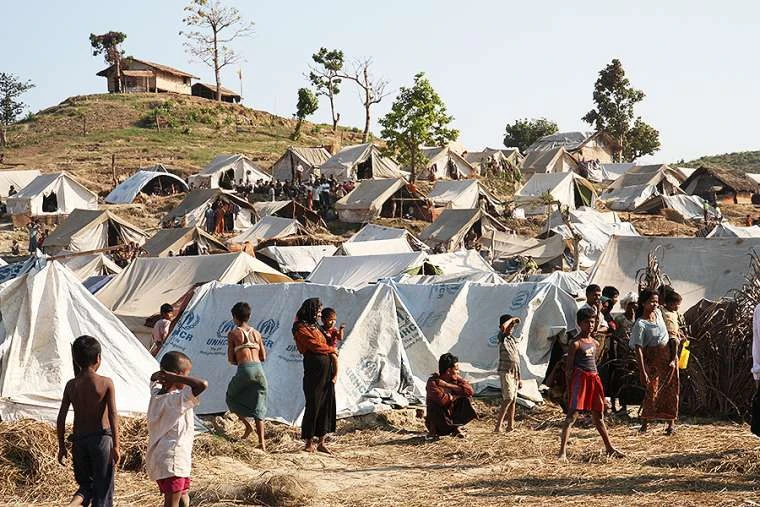
Dhaka, Bangladesh, Jun 5, 2018 / 12:10 am (CNA/EWTN News).- A United Nations-led campaign to provide contraception to Rohingya refugees in Bangladesh camps fails to show respect for the views of the already vulnerable community, said one human rights group.
“I am deeply concerned, but not surprised, that UNFPA views the deeply held values of an already victimized community as an obstacle to their goals rather than something to be respected,” said Nadja Wolfe, director of advocacy at the World Youth Alliance, a human rights group which promotes the dignity of the human person.
“Rohingya women deserve healthcare that meets their needs and respects, rather than undermines, their values,” Wolfe told CNA.
The Rohingya are a largely Muslim ethnic group who reside in Burma’s Rakhine State. Facing state-sponsored violence in their homeland, more than 660,000 have fled to neighboring Bangladesh for refuge and currently reside in camps.
On April 17, the United Nations Population Fund (UNFPA) and the Bangladesh Family Planning Directorate signed an agreement to provide Rohingya refugees both short and long-term contraception, maternal health services, and record keeping. The campaign is offering around 8,600 implants and 600 other IUDs for the refugees in camps, as well as other methods of birth control, such as pills and condoms.
However, many of the refugees hold deep-seated cultural and religious objections to birth control.
Bangladesh and UN officials promoting the contraception campaign said they are recruiting interpreters, midwives, volunteers and paramedics in an attempt to convince the Rohingya women to accept contraception.
“We plan to recruit eight interpreters who can provide counseling to convince them [about contraception],” said Kazi Mustafa Sarwar, a family planning official for Bangladesh, according to The Irrawaddy.
“It’s our main challenge, as we have yet to make them convinced,” Sarwar continued, noting that many Rohingya women “threw condoms away when our staff supplied them,” although others have accepted short-acting injectable contraceptives.
Some of the refugees have said that they wanted big families to help them survive in the camps, while other voiced religious objections to birth control. Others believe that short-term contraception is acceptable, but will refuse any long-term devices.
According to the World Health Organization, around 100,000 Rohingya children are expected to be born in Bangladesh in 2018.
If you value the news and views Catholic World Report provides, please consider donating to support our efforts. Your contribution will help us continue to make CWR available to all readers worldwide for free, without a subscription. Thank you for your generosity!
Click here for more information on donating to CWR. Click here to sign up for our newsletter.

Washington D.C., May 19, 2017 / 12:05 am (CNA/EWTN News).- The Catholic Church will speak out against injustice and avoid any attempt to normalize the “festering wound” of the Israeli-Palestinian situation, a commission from the region&rsqu… […]
Patriarch Pierbattista Pizzaballa blesses the congregation at the Church of the Holy Sepulchre in Jerusalem on April 4, 2021. / Latin Patriarchate of Jerusalem.
Jerusalem, Jun 16, 2021 / 04:00 am (CNA).
Catholic bishops will consecrate the Middl… […]
The sisters Madeleine and Marie-Liesse together with Louis Antona at the entrance of Greece. The three young people covered the distance from Paris to Jerusalem on foot, arriving in mid-May 2024. “I needed to walk 4,500 kilometers to understand that Jesus is not just in Jerusalem, but was by my side every step of the way,” Antona told CNA. / Credit: Photo courtesy of French pilgrims Madeleine and Marie-Liesse
Jerusalem, Jun 18, 2024 / 06:00 am (CNA).
On Sept. 17, 2023, two sisters left Paris and walked for approximately eight months to Jerusalem. Madeleine and Marie-Liesse, 19 and 22, who grew up in a Catholic family, decided to become pilgrims to grow in their faith.
“We needed to make the faith our own,” they told CNA. “This pilgrimage was to discover God, to truly search for him and deepen our faith. We learned that we can trust God; he takes care of us in everything. The Gospel is not a joke.”
Two months later, in mid-November 2023, Louis Antona, 24, also left Paris on foot, bound for Jerusalem. The three young people met providentially in Albania, walked together through Turkey, then parted ways and reunited in Jerusalem. They shared the story of their pilgrimage with CNA.
“I needed to walk 4,500 kilometers to understand that Jesus is not just in Jerusalem but was by my side every step of the way,” Antona told CNA. He walked a total of 189 days and arrived in Jerusalem on May 18.
Madeleine and Marie-Liesse — who asked that their last name not be used to protect their privacy — left from the Basilica of the Sacred Heart of Montmartre in the center of Paris with the blessing of their parents and a priest.
“It was a calling from God,” Madeleine said of the decision she and her sister made to leave. “There’s no need for reasons when God calls; you simply need to follow what he tells you.”
Madeleine and Marie-Liesse during a moment of their journey, between Slovenia and Croatia. “The faith of the people struck us: during Advent, tradition dictates that Mass be attended every morning at 6, and every time we went, the church was packed with people,” they told CNA. The two sisters left Paris on September 17, 2023, and walked for about eight months to Jerusalem. Credit: Courtesy of French pilgrims Madeleine and Marie-Liesse
The sisters created a simple blog to keep friends and family updated on their pilgrimage. The photos and brief stories reveal all the freshness of two young people on a journey while not hiding moments of doubt and difficulty.
“We chose to embark on this journey as beggars,” Marie-Liesse told CNA. “We left with just a few clothes and nothing else — no food, no money. We wanted to surrender ourselves into the hands of providence. Every evening, we knocked on people’s doors asking for shelter, a bed, and food. The Lord always provided.”
Their days were marked by walking and prayer.
“We didn’t have a strict rule because we had to adapt every day to the people who hosted us, the place, and the situation,” Marie-Liesse explained. “But we had a framework: We knew we had to pray in the morning, at midday, at night… It was important for us to be faithful to God. Every day, we also recited a rosary, praying for the intentions entrusted to us.”
The most challenging moment was making the decision to continue the journey after hearing that war had broken out in the Holy Land. “We were in Germany and full of doubts about whether to go on.”
Their journey led them to cross Switzerland, Germany, Austria, Slovenia, and Croatia. In Croatia, “the faith of the people struck us: during Advent, tradition dictates that Mass be attended every morning at 6, and every time we went, the church was packed with people,” the sisters wrote on their blog.
They stopped for a month in Medjugorje (Bosnia and Herzegovina), where their family joined them for Christmas.
“It was a difficult time. Again, we didn’t know what to do. But after a period of discernment, we realized that Christ was calling us back on the road again,” Madeleine said.
Madeleine and Marie-Liesse crossed Montenegro and arrived in Albania, where they encountered Antona.
“I had just finished my studies and wanted to offer something to God,” Antona told CNA. “I wasn’t sure what, but I thought that the best thing I had at that time was time itself. So, I decided to offer God a year of my life by embarking on a journey. It was a challenge; I wasn’t sure if I would enjoy walking and being alone.”
Louis Antona, 24, during a moment of his journey. “I had just finished my studies and wanted to offer something to God,” he told CNA. “I thought that the best thing I had at that time was time itself. So, I decided to offer God a year of my life by embarking on a journey.” Credit: Photo courtesy of Louis Antona
Antona decided to leave, despite the war. “I believe the hardest part of a pilgrimage like this is deciding to start. I knew that if I gave up because of the war, I would never do it again. Anyway, I thought that by the time I arrived, the war would already be over.”
Madeleine and Marie-Liesse are filled with wonder at the manifestation of providence in every detail of their pilgrimage, in the beautiful weather and in the rain, in every small encounter — those who hosted them after seeing them at the bus stop, those who taught them how to make bread, the gentleman who opened his door just before a downpour. “If we had arrived a minute later, we wouldn’t have met him,” they said.
The encounter with Antona wasn’t coincidental either. The two sisters had prayed to God to give them a travel companion.
“We planned to not go through Turkey because we were two women alone, but we would have liked to go that way. So we asked God to meet one pilgrim, and we met him,” the sisters explained.
The three crossed Macedonia and Greece, arriving in Turkey on Palm Sunday. In this predominantly Muslim country, they celebrated Easter, warmly welcomed by the small French-speaking community there.
The sisters Madeleine and Marie-Liesse together with Louis Antona received a blessing from a priest during a Mass in Turkey. They arrived in Turkey on Palm Sunday 2024. In this predominantly Muslim country, they celebrated Easter, warmly welcomed by the small French-speaking community there. Credit: Photo courtesy of Louis Antona
“Every day of this pilgrimage was a miracle,” Antona said. “Every day we have met people who smiled or were nice to us. I have to say that in Turkey we found the most welcoming people.”
“It is not uncommon for the Turks to spontaneously lend us a hand,” Madeleine and Marie-Liesse wrote on their blog. “In Turkey, we encountered an infinite respect for passing strangers and for Christianity, even though Christians here are forced to protect themselves from regular attacks.”
The arrival of Madeleine and Marie-Liesse in Albania. In the photo, Marie-Liesse is in front of a statue of Mother Teresa, who was originally from this country. “Every evening, we knocked on people’s doors asking for shelter, a bed, and food. The Lord always provided,” they told CNA. Credit: Photo courtesy of French pilgrims Madeleine and Marie-Liesse
Upon leaving Turkey, the paths of the three pilgrims split again. The sisters’ route went through Cyprus but they could not find a way from there to Jerusalem by sea due to suspension of transportation because of the war. Providentially, they met someone in Cyprus who offered to pay for airfare, and the sisters arrived in Tel Aviv on May 6. Three days later, on the feast of the Ascension, they were in Jerusalem.
“Many times, we thought we couldn’t reach Jerusalem,” Madeleine said. “We learned that the journey is even more important than reaching the goal. Being here is a great gift, just to be here.”
“We unpacked our bags once and for all, knelt before this Holy Land, and prayed. What peace, what a moment of grace! As we admired the sunrise and the golden light that brought color to the roofs of the old city, we could reread the wonders of God and meditate on the Gospels. His infinite love overwhelmed us,” the two sisters wrote on their blog.
The sisters Madeleine and Marie-Liesse received a blessing from a Franciscan friar at the Basilica of the Holy Sepulcher after their arrival in Jerusalem. “The greatest gift is to be here and understand what happened here, to see with our own eyes, to witness the actual places,” Madeleine said. “We were able to pause in every place, to pray and meditate in silence.” Credit: Photo courtesy of French pilgrims Madeleine and Marie-Liesse
Madeleine has no doubts: “Prayer is what carried us. When you’re weak, that’s when you’re strongest because that’s when God can act in you; you don’t take up all the space. Trusting in God can be challenging, but when you understand that God only wants you to be happy and will give you everything you need, then you realize you have everything to be happy in this moment; you can trust him.”
Ten days later, on the eve of Pentecost, Antona also arrived in Jerusalem. “Even if I had to stop somewhere else, at least I would have aimed to reach Jerusalem. This is a very important city for Christians, but the journey you take to reach it is also very important.”
French pilgrim Louis Antona arrived in Jerusalem on May 18, at the vigil of Pentecost. “Every day of this pilgrimage was a miracle,” he said. Credit: Photo courtesy of Louis Antona
The three pilgrims are still in the Holy Land. They have had the opportunity to participate in various celebrations and to visit the holy places in addition to many other sites in the area.
“The greatest gift is to be here and understand what happened here, to see with our own eyes, to witness the actual places,” Madeleine said. “We were able to pause in every place, to pray and meditate in silence.”
A journey like this isn’t for everyone, but all three of the pilgrims agree that “if God calls you, go in peace. If God helps you, everything becomes possible.”
The French pilgrims rest under the portico of the Church of the Beatitudes on a hill overlooking the Sea of Galilee. In the photo is Louis Antona. A journey like this isn’t for everyone, but, the three young people said, “if God calls you, go in peace. If God helps you, everything becomes possible.” Credit: Photo courtesy of French pilgrims Madeleine and Marie-Liesse
Leave a Reply