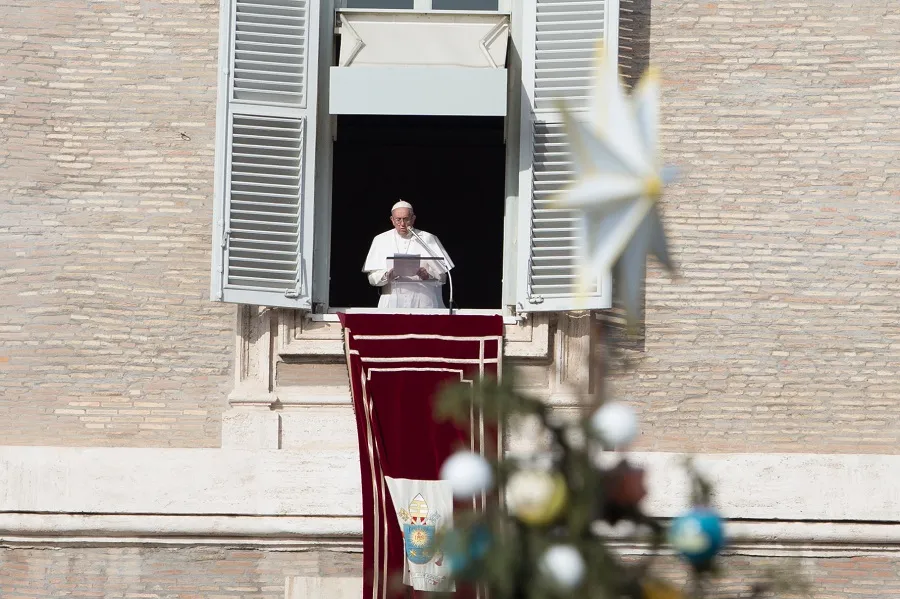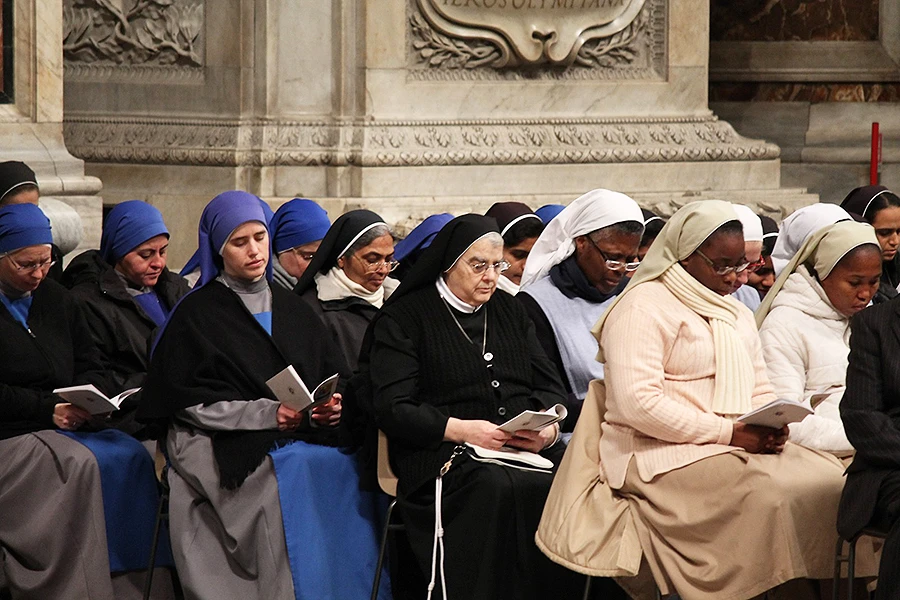
Vatican City, May 15, 2018 / 01:00 pm (CNA/EWTN News).- The Vatican published an instruction Tuesday aimed at applying norms established in Pope Francis’ 2016 apostolic constitution on women’s contemplative orders, which emphasizes the need for networks of monasteries in contemplative life. The instruction states that all monasteries of nuns must be affiliated with a federation, or organization, of religious houses.
Published May 15, the document concerns the nearly 38,000 nuns around the world in contemplative religious orders, and underscores that these religious institutes, “wholly devoted to contemplation, always occupy an eminent place in the mystical body of Christ.”
Therefore, even if there should be an urgent need for assistance in the active apostolate, as is the charism of some active religious orders, members of contemplative communities should not be called to help in pastoral ministry, the document states.
The instruction, entitled Cor orans, or “Praying heart,” was drafted by the Vatican’s Congregation for Institutes of Consecrated Life and Societies of Apostolic Life. It includes detailed regulations for the establishment and administration of monasteries for contemplative nuns, including both the legal and spiritual aspects of monastic life.
It also covers the transfer and possible suppression of monasteries, ecclesial vigilance, relations with the local diocesan bishop, means of communication, the different types of cloister, and formation.
The 34-page document “intends to make clear the provisions of the law, developing and determining the procedures in the execution” of the apostolic constitutions “Vultum dei Quaerere,” published by Francis in 2016, and “Sponsa Christi Ecclesia,” published by Pope Pius XII in 1950.
The new instruction was presented by the secretary of the congregation on religious life, Archbishop José Rodríguez Carballo, in a press conference May 15.
Pope Francis’ 2016 constitution abrogated only a few points of an earlier constitution promulgated by Pope Pius XII. Therefore, the instruction states, the two constitutions are considered “the legislation in force” and should be read “in a shared perspective.”
The most significant change the instruction puts forth is the obligation for individual monasteries, though autonomous, to belong to a federation of monasteries, connected either through a similar charism or through geographical location.
Pope Pius XII, in “Sponsa Christi Ecclesia,” encouraged the formation of these federations to prevent isolation, provide networks for mutual help, and for the preservation of the common charism, but until now membership was not obligatory.
The new norm gives monasteries one year to comply, after which time the Vatican’s office for religious life will assign monasteries to federations.
“This insistence,” Archbishop Carballo said, is due to many problems which have come about in the last couple dozen years from “the isolation of some monasteries, on the one hand, and from the importance of walking, even in monastic life, towards an ecclesiology of communion, on the other.”
Another new aspect of the norms is the requirement that individual monasteries have at least five members, three of these having made solemn professed vows, in order to remain open. This is a change from the previous requirement of at least four members in a monastery.
The suppression of individual monasteries is a solution which is “painful as much as necessary,” the document states.
Additionally, if the number of community members with solemn professed vows drops to five, the monastery loses the right to the election of its own superior, and the president of the monastery’s federation is obliged to inform the Holy See.
Unfortunately, “this is a provision that certainly concerns a substantial number of monasteries, to which we will therefore be asked to become aware of our own reality, in a dialogue with the Holy See and with the reference figures prepared by the commission,” Carballo said.
If you value the news and views Catholic World Report provides, please consider donating to support our efforts. Your contribution will help us continue to make CWR available to all readers worldwide for free, without a subscription. Thank you for your generosity!
Click here for more information on donating to CWR. Click here to sign up for our newsletter.

Pope Leo XIV greets pilgrims at the Wednesday general audience in St. Peter’s Square, Wednesday, June 25, 2025 / Credit: Daniel Ibáñez/CNA
Rome Newsroom, Aug 16, 2025 / 04:00 am (CNA).
Saturday, Aug. 16, marks Pope Leo XIV’s 100th day as pope. Since his May 8 election as the first pope born and raised in the United States, the 69-year-old Chicago native has already left his mark on a jubilee year filled with papal liturgies and a surge in pilgrim enthusiasm.
Here are some of the highlights of the first 100 days of the new Holy Father:
Papal jubilee: Pope Leo offers 16 public Masses in 14 weeks
Pope Leo XIV began his papacy in the heart of the Church’s 2025 Jubilee Year of Hope, and he made the most of this opportunity to interact with Catholic pilgrims from across the globe by offering many Masses with the public.
Pope Leo XIV celebrates Mass for the Jubilee of Sport on June 15, 2025, in St. Peter’s Basilica at the Vatican. Credit: Vatican Media
Leo XIV offered 16 large public Masses in just 14 weeks — an average of more than one per week — including seven Masses in June alone. The pace marks a significant shift from the final years of Pope Francis’ pontificate when the aging pope was unable to offer Mass himself at the altar. Francis was present at only four Masses with the public in the same time period last year.
The papal Masses have drawn large crowds and significant attention, beginning with his first inaugural Mass, which brought 200 foreign delegations — including heads of state and royalty — to the Vatican. Since then, Leo has celebrated liturgies for the jubilees of Families, Priests, and Youth as well as on major solemnities and feasts including Pentecost, Corpus Christi, the Most Sacred Heart of Jesus, the Holy Trinity, Sts. Peter and Paul, and Mary, Mother of the Church.
Leo XIV is the first pope elected during a jubilee year since 1700.
Pope Leo XIV on the solemnity of Sts. Peter and Paul in Rome, June 29, 2025. Credit: Vatican Media
A singing pope
One of Pope Leo’s most unexpected moments came during his first Regina Caeli address, when he stunned a crowd of 200,000 in St. Peter’s Square by singing the Marian hymn rather than reciting it in Latin like his recent predecessors. Since then, he has continued chanting during liturgies and leading crowds in sung versions of the Our Father in Latin.
The move inspired the Pontifical Institute of Sacred Music to launch “Let’s Sing with the Pope,” an online series aimed at making Gregorian chant more accessible.
null
First American pope on White Sox stadium jumbotron
In June, the first pope born and raised in the United States appeared on the jumbotron at a gathering of American Catholics at Chicago’s Rate Field — home of his beloved White Sox. In a video message delivered entirely in English, Pope Leo urged young people to be “beacons of hope” and invited all to see that “God is reaching out to you, calling you, inviting you to know his son, Jesus Christ.”
It was the pope’s first direct address to his hometown since his election and one of the earliest papal speeches given entirely in English.
Pope Leo XIV addresses Catholic faithful on the scoreboard at Rate Field, home to the Chicago White Sox, during a celebration and Mass to honor his election as pope on June 14, 2025, in Chicago. Credit: Scott Olson/Getty Images
The new pope’s love of sports has led to some memorable moments. He blessed 159 cyclists as they passed through Vatican City in the final leg of the Giro d’Italia.
A self-described “amateur tennis player,” Pope Leo XIV joked with tennis star Jannik Sinner, ranked the world’s No. 1, whether his white cassock would meet Wimbledon’s requirement for all white attire.
Pope Leo XIV meets with Italian tennis star Jannik Sinner on May 14, 2025, at the Vatican. Credit: Vatican Media
The pope has also been gifted White Sox and Bears jerseys and has signed baseballs for enthusiastic pilgrims.
A voice for peace in Gaza and Ukraine
Pope Leo XIV’s first words were “Peace be with you all,” recalling the first greeting of the risen Christ recorded in Scripture. As wars continued and at times intensified during Pope Leo’s first months, the pope has continued to be a voice for peace.
In June, after U.S. airstrikes on Iranian nuclear facilities, Pope Leo urged world leaders “to stop the tragedy of war before it becomes an irreparable abyss.” Following an Israeli strike that killed three people at Gaza’s only Catholic church in July, he appealed for “a ceasefire, the release of hostages, and full respect for humanitarian law.”
“Today more than ever, humanity cries out and pleads for peace,” the pope said during an Angelus from the window of the Apostolic Palace.
Leo also met with bishops and pilgrims from the Ukrainian Greek Catholic Church and welcomed Ukrainian President Volodymyr Zelenskyy to Castel Gandolfo in July, where the two discussed the urgency of “just and lasting paths of peace,” according to the Vatican.
Pope Leo XIV greets Ukraine President Volodymyr Zelenskyy at Castel Gandolfo on July 9, 2025. Credit: Vatican Media
Leo carries the Eucharist through the streets of Rome
Pope Leo personally carried the Blessed Sacrament through the streets of Rome during a Corpus Christi procession from the Archbasilica of St. John Lateran to the Basilica of St. Mary Major.
“Together, as shepherds and flock, we will feed on the Blessed Sacrament, adore him, and carry him through the streets,” he said. “In doing so, we will present him before the eyes, the consciences, and the hearts of the people.”
More than 20,000 people turned out for Leo XIV’s first Eucharistic procession as pope.
Pope Leo XIV leads a Eucharistic procession in Rome on June 22, 2025, for the feast of Corpus Christi. Credit: Daniel Ibañez/EWTN
Return to Castel Gandolfo
Pope Leo revived the papal tradition of spending summer days at the papal residence in Castel Gandolfo. During his two-week stay in July, he led public Masses in local parishes, greeted pilgrims as he led the Angelus prayer in Liberty Square, and received visiting dignitaries. His stay marks the first papal summer retreat in the lakeside town since the pontificate of Pope Benedict XVI.
The sun burst through raindrops right as Pope Leo XIV appeared in front of the apostolic palace of Castel Gandolfo to give the Angelus address on July 13, 2025. Credit: Hannah Brockhaus/CNA
Pope Leo introduces the world to great quotes by St. Augustine
A member of the Augustinian order, Pope Leo has quoted St. Augustine in nearly every one of his homilies as pope. In his first public words on May 8, he said: “I am an Augustinian, a son of St. Augustine, who once said, ‘With you I am a Christian, and for you I am a bishop.’”
Addressing 1 million young people at the Jubilee of Youth in August, he quoted Augustine’s “Confessions”: “You called, you shouted, and you broke through my deafness… I have tasted you, now I hunger and thirst for more.”
Pope Leo XIV greets crowds at the Jubilee of Youth on Aug. 3, 2025, at Tor Vergata in Rome. Credit: Vatican Media
A focus on artificial intelligence
Pope Leo has frequently spoken about artificial intelligence (AI), which is already shaping up to be a topic of interest in his pontificate with many hoping that he will address it in an encyclical.
Early on in his pontificate, Leo drew parallels between his namesake Pope Leo XIII, who responded to the industrial revolution with Rerum Novarum, and today’s digital revolution, explaining that the rise of AI poses “new challenges for the defense of human dignity, justice, and labor.”
“Humanity is at a crossroads, facing the immense potential generated by the digital revolution driven by artificial intelligence,” he warned in a message to the Geneva-based AI for Good Summit. “The impact of this revolution is far-reaching, transforming areas such as education, work, art, health care, governance, the military, and communication.”
Pope Leo XIV smiles during his Wednesday general audience on Aug. 13, 2025, in the Paul VI Audience Hall at the Vatican. Credit: Vatican Media
The Vatican website received a revamp shortly after Leo’s election, and insiders noted Leo’s relatively tech-savvy background, including a personal Twitter account prior to his papacy.
The pope also expressed concern in a speech to another AI conference about the negative effects that AI can have on the “intellectual and neurological development” of rising generations and the “loss of the sense of the human” that societies are experiencing.
Leo declares a new doctor of the Church
In one of his most significant theological gestures, Pope Leo named St. John Henry Newman, a 19th-century English convert from Anglicanism, a doctor of the Church — a rare title given to just 37 other saints. The title is granted in recognition of an already canonized saint’s significant contribution to advancing the Church’s knowledge of doctrine, theology, or spirituality.
Pope Leo XIV greets hundreds of thousands of youth and pilgrims ahead of a vigil at Tor Vergata, Rome, Saturday, Aug. 2, 2025. Credit: Mateusz Opila
Leo also approved the upcoming canonization of Blessed Carlo Acutis and Blessed Pier Giorgio Frassati in September as the first saints of his pontificate. He greenlit seven additional causes for canonization, including that of Blessed Bartolo Longo, a former satanist turned founder of the Marian shrine in Pompeii.
Carrying the cross before a million young people at the Jubilee of Youth
Pope Leo addressed the largest crowd of his papacy to date at the Jubilee of Youth, where an estimated 1 million young adults camped out in fields in Tor Vergata, southeast of Rome.
He surprised them by walking through the crowd to the stage, personally carrying the jubilee cross. During the evening vigil, he answered youth questions in English, Italian, and Spanish, offering reflections on loneliness, discernment, and friendship with Christ.
Pope Leo XIV leads young people from around the world in a procession, carrying the Jubilee Year Cross during the Jubilee of Youth this evening in Tor Vergata, on the outskirts of Rome. pic.twitter.com/XPjOnQg9p9
After Eucharistic adoration, chants of “Papa Leone!” echoed long into the night. Leo stayed past 10 p.m. — well beyond the scheduled end.
Earlier in the week, he made a surprise appearance at the opening Mass, joyfully proclaiming in English: “Jesus tells us: You are the salt of the earth. You are the light of the world!” and the crowd erupted in cheers.
Vatican City, Mar 22, 2017 / 10:57 am (CNA).- A cute moment was captured on camera Wednesday, as a 3-year-old girl “stole” Pope Francis’ zucchetto – or skull cap – at the papal general audience.
Little Estella lives in Georgia. She was in Rome with her godfather, Mountain Butorac. Waiting in St. Peter’s Square at the general audience, she was invited by a member of the papal security team to go greet the Pope as he came by.
Pope Francis offered the young girl a kiss on the cheek, and she reached up and grabbed his zucchetto. A moment later, she returned the hat to a laughing pontiff.
<blockquote class=”twitter-tweet” data-lang=”en”><p lang=”en” dir=”ltr”>Took my Goddaughter to meet the pope. She stole his hat! <a href=”https://t.co/SdSorop3uN”>pic.twitter.com/SdSorop3uN</a></p>— Mountain Butorac (@MountainButorac) <a href=”https://twitter.com/MountainButorac/status/844505243538931714″>March 22, 2017</a></blockquote>
<script async src=”//platform.twitter.com/widgets.js” charset=”utf-8″></script>
Meanwhile, Butorac captured the incident on his phone camera, and posted it to Twitter, where it quickly received more than 8,000 likes.
“It’s exciting!” Butorac told BuzzFeed News. “I’m sure every godparent would love for their godchild to meet the Holy Father. Mine just did and it was not only a special holy moment, but hilarious too!”
Bishop Thomas Zinkula, who has led the Diocese of Davenport, Iowa since 2017, was named the next archbishop of the Archdiocese of Dubuque, Iowa, on July 26, 2023. / Diocese of Davenport.
Vatican City, Jul 26, 2023 / 05:51 am (CNA).
Pope Francis… […]
6 Comments
Bishops conferences are free to make-up doctrines out of whole cloth but you evil contemplatives must be suppressed!
Women’s contemplative communities in the crosshairs of Jesuit interpretation of the charism of every monastery.
This spells the end of contemplative life in the Church. In fifty years it will be a memory. Of course, by that time, the theology of Roman Catholic priesthood will have been replaced with some sort of post-Christian clinical profile. Apostolic communities of men and women will be long forgotten.
The contemplative nuns were our last hope. They will join the charism of the monastic spa evolving among the Trappists and then — evaporate.
Perhaps only a Teresa of Jesus can take this crew of male malefactors down.
Where did the Franciscan money disappear to? The above prelate should certainly not be in charge of religious life as he mad a shambolic mess with the OFM’s
Monasteries functioning essentially in total autonomy can and do present specific dilemmas – but the solution need not be federations. No one, no construct, is better than a faithful prioress or abbess. Imposing federation upon all autonomous communities is merely a means by the current nefarious element proudly reigning to abrogate the freedom of faithful contemplative religious and undermine the authentic charism of the several orders. Congealed into a groups they are best accessed for “reformation” into the mold acceptable to the New Paradigm.
This is merely the soft dissolution of the monasteries in the program of protestantization of Roman Catholicism on its way to metamorphosis into a vacuous cultural entity occupying a place once held by a religion.
Religious life is the canary in the mine shaft of Roman Catholicism. Faith AND works. “Ora et labora.” Virtually all congregations are on the precipice of extinction. The contemplatives while diminished in numbers do at the moment hold some hope for survival. The extinction of authentic contemplative life lived emulating the model of the Desert Fathers and the great founders such as Bruno, Bernard and Teresa will announce a bitter and apocalyptic moment.
But is that not the design?
Bishops conferences are free to make-up doctrines out of whole cloth but you evil contemplatives must be suppressed!
Women’s contemplative communities in the crosshairs of Jesuit interpretation of the charism of every monastery.
This spells the end of contemplative life in the Church. In fifty years it will be a memory. Of course, by that time, the theology of Roman Catholic priesthood will have been replaced with some sort of post-Christian clinical profile. Apostolic communities of men and women will be long forgotten.
The contemplative nuns were our last hope. They will join the charism of the monastic spa evolving among the Trappists and then — evaporate.
Perhaps only a Teresa of Jesus can take this crew of male malefactors down.
Where did the Franciscan money disappear to? The above prelate should certainly not be in charge of religious life as he mad a shambolic mess with the OFM’s
Monasteries functioning essentially in total autonomy can and do present specific dilemmas – but the solution need not be federations. No one, no construct, is better than a faithful prioress or abbess. Imposing federation upon all autonomous communities is merely a means by the current nefarious element proudly reigning to abrogate the freedom of faithful contemplative religious and undermine the authentic charism of the several orders. Congealed into a groups they are best accessed for “reformation” into the mold acceptable to the New Paradigm.
This is merely the soft dissolution of the monasteries in the program of protestantization of Roman Catholicism on its way to metamorphosis into a vacuous cultural entity occupying a place once held by a religion.
Religious life is the canary in the mine shaft of Roman Catholicism. Faith AND works. “Ora et labora.” Virtually all congregations are on the precipice of extinction. The contemplatives while diminished in numbers do at the moment hold some hope for survival. The extinction of authentic contemplative life lived emulating the model of the Desert Fathers and the great founders such as Bruno, Bernard and Teresa will announce a bitter and apocalyptic moment.
But is that not the design?
Absolutely and clearly the design.
Simply more Francis-church undermining what is ancient, holy, and very Catholic.
It is all about control, dear pewsitters, nothing less.