Let’s hope the lesson regarding Mr. Scalfari has finally been learned so we don’t see further international headlines recounting this or that alleged contradiction by Pope Francis of some basic Christian tenet.
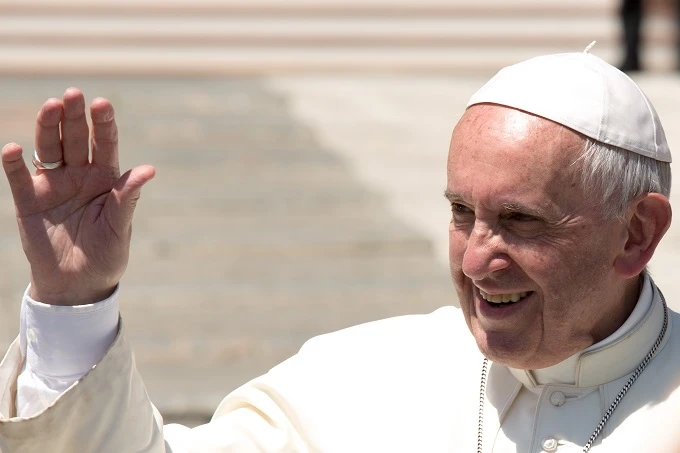
Pope Francis greets the crowd during his Easter message and blessing "urbi et orbi" (to the city and the world) delivered from the central balcony of St. Peter's Basilica at the Vatican April 1. (CNS photo/Vatican Media)
“Hell does not exist,” Pope Francis supposedly told atheist journalist Eugenio Scalfari, “what exists is the disappearance of sinful souls.”
The trouble is, there is ample evidence to indicate that Pope Francis affirms the Church’s (and, let us remember, Jesus’) teaching on hell.
Last Holy Thursday, when news of Scalfari’s controversial claim was published, all hell broke out on the Internet. The Drudge Report posted it top, front, and center. Major media outlets ran the story. Columnists began to opine. Defenders and critics of Pope Francis went at each other. Many ordinary Catholics wondered what was happening. The Vatican Communications Office responded promptly:
The Holy Father Francis recently received the founder of the newspaper La Repubblica in a private meeting on the occasion of Easter, without however giving him any interviews. What is reported by the author in today’s article is the result of his reconstruction, in which the textual words pronounced by the Pope are not quoted. No quotation of the aforementioned article must therefore be considered as a faithful transcription of the word of the Holy Father.
The “take home” point of the above is that the account of the Holy Father’s remarks is not reliable.
Some important distinctions are in order about this whole business.
1. There is the issue of whether in general Pope Francis has taught the reality of hell, understood as a permanent state of existence. He has. Repeatedly. This should have been a clue to media about the dubious nature of Scalfari’s claim, especially given his modus operandi of not taking notes and reconstructing what he alleges to have been said from memory alone. Whatever Pope Francis said or didn’t say in his private conversation with Mr. Scalfari, elsewhere he has made clear he stands by traditional Christian teaching on hell. So: repent and believe the good news.
2. There is the issue of what Pope Francis actually said to Mr. Scalfari. There is no transcript or official record of what was said. It’s possible that Pope Francis spoke in theologically nuanced ways about hell, to try to address crude ideas of his atheist conversation partner. For whatever reason, in such a scenario, Mr. Scalfari missed the nuances and simply misunderstood.
3. There is the issue of what Mr. Scalfari claims Pope Francis said. As Scalfari represents things, Pope Francis affirmed a kind of annihilationism, which is the idea that damned persons simply cease to exist. Groups such as Seventh Day Adventists and Jehovah’s Witnesses, as well as some liberal Christian theologians, have affirmed annihilationism. In a loose sense annihilation might be regarded as a sort of damnation—an eternal consequence of an evil life. But annihilationism is a doctrine substantially different from hell as the Catholic Church and most other Christian churches have traditionally understood it.
4. There is the distinction between things a pope might say to others in private conversations and official teaching acts of the pope. While we have no significant reason to suppose Pope Francis said something in private to Mr. Scalfari that contradicts what the Pope has publicly taught, it is the public teaching that represents his office, not whatever opinions he might privately share.
5. Although the Vatican’s statement implicitly warns against relying on the Scalfari account, it doesn’t state what, in fact, Pope Francis said to Scalfari. Given the circumstances of the conversation and multiple past incidents of Mr. Scalfari’s inaccurate reporting on conversations with the Holy Father, and Pope Francis’ teaching elsewhere affirming the doctrine of hell, it seems unlikely that Pope Francis said something substantially different to Mr. Scalfari from what the Church teaches. In other words, it is unlikely Pope Francis affirmed annihilationism. But the Vatican statement doesn’t pursue the matter. It should have spelled things out.
6. There is the issue of whether Mr. Scalfari should have been permitted to discuss substantial issues with Pope Francis without the clear indication that any comments in this “non-interview,” personal conversation were “off the record” and “not for publication.” It’s one thing for the Holy Father to engage in a private dialogue with someone; it’s another thing to do so when the person in question publicizes the content of the dialogue or what he takes to be its content. Given Mr. Scalfari’s track record and note-free method of recounting conversations or interviews, it’s hard to understand why the conversation occurred as it did. The decision to allow the conversation seems imprudent, at best; the resulting controversy, predictable and avoidable. If there are reasons to think otherwise, they haven’t been communicated.
7. There is the distinction between a bad thing in itself and good that can be brought from it. Misrepresenting Pope Francis’ teaching (and the Catholic Church’s teaching, which is also Jesus’ teaching) is a bad thing in itself. It should not happen. I know from personal experience that many people have been confused and even misled by Scalfari’s reporting on this important topic. At the same time, some folks have pointed to the silver lining of the Church and others now being in a position to explain the truth about hell and how media so often get it wrong when it comes to reporting on Catholic teaching. That is all true enough. But it says nothing about the prudence of the conversation in the first place, nor about the damage done to those who don’t happen to come across the rebuttal explanation. God can bring good out of bad situations, but this doesn’t mean we should set about creating bad situations in order for God to bring about good out of them.
Let’s hope the lesson regarding Mr Scalfari has finally been learned so we don’t see further international headlines recounting this or that alleged contradiction by Pope Francis of some basic Christian tenet. It’s commendable that the Holy Father talks with Scalfari. Surely, though, there is a way he can do so without the resulting misinformation we have thus far seen. After all, more souls than Mr. Scalfari’s soul are at stake.
If you value the news and views Catholic World Report provides, please consider donating to support our efforts. Your contribution will help us continue to make CWR available to all readers worldwide for free, without a subscription. Thank you for your generosity!
Click here for more information on donating to CWR. Click here to sign up for our newsletter.
Vatican City, Jun 4, 2021 / 12:00 pm (CNA).
Pope Francis said Friday that environmental degradation is “a clear outcome of economic dysfunction.”In a June 4 message marking the launch of the UN Decade on Ecosystem Restoration, the pope… […]
Pope Francis at the general audience in St. Peter’s Square, Oct. 5, 2016. / Credit: Daniel Ibanez/CNA
CNA Staff, Mar 13, 2025 / 04:00 am (CNA).
March 13 marks the 12th anniversary of the election of Pope Francis as the 265th successor of St. Peter. Here is a timeline of key events during his papacy:
2013
March 13 — About two weeks after Pope Benedict XVI steps down from the papacy, Cardinal Jorge Bergoglio is elected pope. He takes the papal name Francis in honor of St. Francis of Assisi and proclaims from the central balcony of St. Peter’s Basilica: “Let us begin this journey, the bishop and people, this journey of the Church of Rome, which presides in charity over all the Churches, a journey of brotherhood in love, of mutual trust. Let us always pray for one another.”
March 14 — The day after he begins his pontificate, Pope Francis returns to his hotel to personally pay his hotel bill and collect his luggage.
July 8 — Pope Francis visits Italy’s island of Lampedusa and meets with a group of 50 migrants, most of whom are young men from Somalia and Eritrea. The island, which is about 200 miles off the coast of Tunisia, is a common entry point for migrants who flee parts of Africa and the Middle East to enter Europe. This is the pope’s first pastoral visit outside of Rome and sets the stage for making reaching out to the peripheries a significant focus.
Pope Francis gives the Wednesday general audience in St. Peter’s Square on Oct. 2, 2013. Elise Harris/CNA.
July 23-28 — Pope Francis visits Rio de Janeiro, Brazil, to participate in World Youth Day 2013. More than 3 million people from around the world attend the event.
July 29 — On the return flight from Brazil, Pope Francis gives his first papal news conference and sparks controversy by saying “if a person is gay and seeks God and has goodwill, who am I to judge?” The phrase is prompted by a reporter asking the pope a question about priests who have homosexual attraction.
Nov. 24 — Pope Francis publishes his first apostolic exhortation Evangelii Gaudium (The Joy of the Gospel). The document illustrates the pope’s vision for how to approach evangelization in the modern world.
2014
Feb. 22 — Pope Francis holds his first papal consistory to appoint 19 new cardinals, including ones from countries in the developing world that have never previously been represented in the College of Cardinals, such as Haiti.
March 22 — Pope Francis creates the Pontifical Commission for the Protection of Minors. The commission works to protect the dignity of minors and vulnerable adults, such as the victims of sexual abuse.
Pope Francis greets pilgrims during his general audience on Nov. 29, 2014. Bohumil Petrik/CNA.
Oct. 5 — The Synod on the Family begins. The bishops discuss a variety of concerns, including single-parent homes, cohabitation, homosexual adoption of children, and interreligious marriages.
Dec. 6 — After facing some pushback for his efforts to reform the Roman Curia, Pope Francis discusses his opinion in an interview with La Nacion, an Argentine news outlet: “Resistance is now evident. And that is a good sign for me, getting the resistance out into the open, no stealthy mumbling when there is disagreement. It’s healthy to get things out into the open, it’s very healthy.”
2015
Jan. 18 — To conclude a trip to Asia, Pope Francis celebrates Mass in Manila, Philippines. Approximately 6 million to 7 million people attend the record-setting Mass, despite heavy rain.
March 23 — Pope Francis visits Naples, Italy, to show the Church’s commitment to helping the fight against corruption and organized crime in the city.
May 24 — To emphasize the Church’s mission to combat global warming and care for the environment, Pope Francis publishes the encyclical Laudato Si’, which urges people to take care of the environment and encourages political action to address climate problems.
Pope Francis at a Wednesday general audience in St. Peter’s Square on June 17, 2015. Bohumil Petrik.
Sept. 19-22 — Pope Francis visits Cuba and meets with Fidel Castro in the first papal visit to the country since Pope John Paul II in 1998. During his homily, Francis discusses the dignity of the human person: “Being a Christian entails promoting the dignity of our brothers and sisters, fighting for it, living for it.”
Sept. 22-27 — After departing from Cuba, Pope Francis makes his first papal visit to the United States. In Washington, D.C., he speaks to a joint session of Congress, in which he urges lawmakers to work toward promoting the common good, and canonizes the Franciscan missionary St. Junípero Serra. He also attends the World Meeting of Families in Philadelphia, which focuses on celebrating the gift of the family.
Pope Francis speaks to the U.S. Congress in Washington, D.C. on Sept. 24, 2015. . L’Osservatore Romano.
Oct. 4 — Pope Francis begins the second Synod on the Family to address issues within the modern family, such as single-parent homes, cohabitation, poverty, and abuse.
Oct. 18 — The pope canonizes St. Louis Martin and St. Marie-Azélie “Zelie” Guérin. The married couple were parents to five nuns, including St. Therese of Lisieux. They are the first married couple to be canonized together.
Dec. 8 — Pope Francis’ Jubilee Year of Mercy begins. The year focuses on God’s mercy and forgiveness and people’s redemption from sin. The pope delegates certain priests in each diocese to be Missionaries of Mercy who have the authority to forgive sins that are usually reserved for the Holy See.
2016
March 19 — Pope Francis publishes the apostolic exhortation Amoris Laetitia, which discusses a wide variety of issues facing the modern family based on discussions from the two synods on the family. The pope garners significant controversy from within the Church for comments he makes in Chapter 8 about Communion for the divorced and remarried.
April 16 — After visiting refugees on the Greek island of Lesbos, Pope Francis allows three Muslim refugee families to join him on his flight back to Rome. He says the move was not a political statement.
Pope Francis at the General Audience in St. Peter’s Square, Feb. 24, 2016. Daniel Ibanez/CNA.
July 26-31 — Pope Francis visits Krakow, Poland, as part of the World Youth Day festivities. About 3 million young Catholic pilgrims from around the world attend.
Sept. 4 — The pope canonizes St. Teresa of Calcutta, who is also known as Mother Teresa. The saint, a nun from Albania, dedicated her life to missionary and charity work, primarily in India.
Sept. 30-Oct. 2 — Pope Francis visits Georgia and Azerbaijan on his 16th trip outside of Rome since the start of his papacy. His trip focuses on Catholic relations with Orthodox Christians and Muslims.
Oct. 4 — Pope Francis makes a surprise visit to Amatrice, Italy, to pray for the victims of an earthquake in central Italy that killed nearly 300 people.
2017
May 12-13 — In another papal trip, Francis travels to Fatima, Portugal, to visit the Shrine of Our Lady of Fatima. May 13 marks the 100th anniversary of the first Marian apparition to three children in the city.
July 11 — Pope Francis adds another category of Christian life suitable for the consideration of sainthood: “offering of life.” The category is distinct from martyrdom, which only applies to someone who is killed for his or her faith. The new category applies to those who died prematurely through an offering of their life to God and neighbor.
Pope Francis greets a participant in the World Day of the Poor in Rome, Nov. 16, 2017. L’Osservatore Romano.
Nov. 19 — On the first-ever World Day of the Poor, Pope Francis eats lunch with 4,000 poor and people in need in Rome.
Nov. 27-Dec. 2 — In another trip to Asia, Pope Francis travels to Myanmar and Bangladesh. He visits landmarks and meets with government officials, Catholic clergy, and Buddhist monks. He also preaches the Gospel and promotes peace in the region.
2018
Jan. 15-21 — The pope takes another trip to Latin America, this time visiting Chile and Peru. The pontiff meets with government officials and members of the clergy while urging the faithful to remain close to the clergy and reject secularism. The Chilean visit leads to controversy over Chilean clergy sex abuse scandals.
Aug. 2 — The Vatican formally revises No. 2267 of the Catechism of the Catholic Church, which concerns the death penalty. The previous text suggested the death penalty could be permissible in certain circumstances, but the revision states that the death penalty is “inadmissible.”
Aug. 25 — Archbishop Carlo Viganò, former papal nuncio to the United States, publishes an 11-page letter calling for the resignation of Pope Francis and accusing him and other Vatican officials of covering up sexual abuse including allegations against former Cardinal Theodore McCarrick. The pope initially does not directly respond to the letter, but nine months after its publication he denies having prior knowledge about McCarrick’s conduct.
Aug. 25-26 — Pope Francis visits Dublin, Ireland, to attend the World Meeting of Families. The theme is “the Gospel of family, joy for the world.”
Pope Francis at the 2018 World Meeting of Families in Ireland. Daniel Ibanez/CNA.
Oct. 3-28 — The Synod on Young People, the Faith, and Vocational Discernment takes place. The synod focuses on best practices to teach the faith to young people and to help them discern God’s will.
2019
Jan. 22-27 — The third World Youth Day during Pope Francis’ pontificate takes place during these six days in Panama City, Panama. Young Catholics from around the world gather for the event, with approximately 3 million people in attendance.
Feb. 4 — Pope Francis signs a joint document in with Sheikh Ahmed el-Tayeb, the grand imam of Al-Azhar, in Abu Dhabi, United Arab Emirates, titled the “Document on Human Fraternity for World Peace and Living Together.” The document focuses on people of different faiths uniting together to live peacefully and advance a culture of mutual respect.
Pope Francis and Ahmed el-Tayeb, grand imam of al-Azhar, signed a joint declaration on human fraternity during an interreligious meeting in Abu Dhabi, UAE, Feb. 4, 2019. Vatican Media.
Feb. 21-24 — The Meeting on the Protection of Minors in the Church, which is labeled the Vatican Sexual Abuse Summit, takes place. The meeting focuses on sexual abuse scandals in the Church and emphasizes responsibility, accountability, and transparency.
Oct. 6-27 — The Church holds the Synod of Bishops for the Pan-Amazon region, which is also known as the Amazon Synod. The synod is meant to present ways in which the Church can better evangelize the Amazon region but leads to controversy when carved images of a pregnant Amazonian woman, referred to by the pope as Pachamama, are used in several events and displayed in a basilica near the Vatican.
Oct. 13 — St. John Henry Newman, an Anglican convert to Catholicism and a cardinal, is canonized by Pope Francis. Newman’s writings inspired Catholic student associations at nonreligious colleges and universities in the United States and other countries.
2020
March 15 — Pope Francis takes a walking pilgrimage in Rome to the chapel of the crucifix and prays for an end to the COVID-19 pandemic. The crucifix was carried through Rome during the plague of 1522.
March 27 — Pope Francis gives an extraordinary “urbi et orbi” blessing in an empty and rain-covered St. Peter’s Square, praying for the world during the coronavirus pandemic.
Pope Francis venerates the miraculous crucifix of San Marcello al Corso in St. Peter’s Square during his Urbi et Orbi blessing, March 27, 2020. Vatican Media.
2021
March 5-8 — In his first papal trip since the start of the COVID-19 pandemic, Pope Francis becomes the first pope to visit Iraq. On his trip, he signs a joint statement with Grand Ayatollah Ali al-Sistani condemning extremism and promoting peace.
July 3 — Cardinal Giovanni Angelo Becciu, who was elevated to the College of Cardinals by Pope Francis, is indicted in a Vatican court for embezzlement, money laundering, and other crimes. The pope gives approval for the indictment.
July 4 — Pope Francis undergoes colon surgery for diverticulitis, a common condition in older people. The Vatican releases a statement that assures the pope “reacted well” to the surgery. Francis is released from the hospital after 10 days.
July 16 — Pope Francis issues a motu proprio titled Traditionis Custodes. The document imposes heavy restrictions on the celebration of the Traditional Latin Mass.
Dec. 2-6 — The pope travels to Cyprus and Greece. The trip includes another visit to the Greek island of Lesbos to meet with migrants.
Pope Francis greets His Beatitude Ieronymos II in Athens, Greece on Dec. 5, 2021. Vatican Media
2022
Jan. 11 — Pope Francis makes a surprise visit to a record store in Rome called StereoSound. The pope, who has an affinity for classical music, blesses the newly renovated store.
March 19 — The pope promulgates Praedicate Evangelium, which reforms the Roman Curia. The reforms emphasize evangelization and establish more opportunities for the laity to be in leadership positions.
May 5 — Pope Francis is seen in a wheelchair for the first time in public and begins to use one more frequently. The pope has been suffering from knee problems for months.
Pope Francis greeted the crowd in a wheelchair at the end of his general audience on Aug. 3, 2022. Daniel Ibanez/CNA
July 24-30 — In his first papal visit to Canada, Pope Francis apologizes for the harsh treatment of the indigenous Canadians, saying many Christians and members of the Catholic Church were complicit.
2023
Jan. 31-Feb. 5 — Pope Francis travels to the Democratic Republic of Congo and South Sudan. During his visit, the pope condemns political violence in the countries and promotes peace. He also participates in an ecumenical prayer service with Anglican Archbishop of Canterbury Justin Welby and Moderator of the Church of Scotland Iain Greenshields.
Pope Francis greets a young boy a Mass in Juba, South Sudan on Feb. 5, 2023. Vatican Media
March 29-April 1 — Pope Francis is hospitalized for a respiratory infection. During his stay at Rome’s Gemelli Hospital, he visits the pediatric cancer ward and baptizes a newborn baby.
April 5 — The pope appears in the Disney documentary “The Pope: Answers,” which is in Spanish, answering six “hot-button” issues from members of Gen Z from various backgrounds. The group discusses immigration, depression, abortion, clergy sexual and psychological abuse, transgenderism, pornography, and loss of faith.
April 28-30 — Pope Francis visits Hungary to meet with government officials, civil society members, bishops, priests, seminarians, Jesuits, consecrated men and women, and pastoral workers. He celebrates Mass on the final day of the trip in Kossuth Lajos Square.
Pope Francis stands on an altar erected outside the Parliament Building in Budapest’s Kossuth Lajos’ Square during a public outdoor Mass on April 30, 2023. Vatican Media
June 7 — The Vatican announces that Pope Francis will undergo abdominal surgery that afternoon under general anesthesia due to a hernia that is causing painful, recurring, and worsening symptoms. In his general audience that morning before the surgery, Francis says he intends to publish an apostolic letter on St. Thérèse of Lisieux, “patroness of the missions,” to mark the 150th anniversary of her birth.
June 15 — After successful surgery and a week of recovery, Pope Francis is released from Gemelli Hospital.
Aug. 2-6 — Pope Francis travels to Lisbon, Portugal, for World Youth Day 2023, taking place from Aug. 1-6. He meets with Church and civil leaders ahead of presiding at the welcoming Mass and Stations of the Cross. He also hears the confessions of several pilgrims. On Aug. 5, he visits the Shrine of Our Lady of Fátima, where he prays the rosary with young people with disabilities. That evening he presides over the vigil and on Sunday, Aug. 6, he celebrates the closing Mass, where he urges the 1.5 million young people present to “be not afraid,” echoing the words of the founder of World Youth Days, St. John Paul II.
Pope Francis waves at the crowd of 1.5 million people who attended the closing Mass of World Youth Day 2023 in Lisbon, Portugal on Aug. 6, 2023. Vatican Media.
Aug. 31-Sept. 4 — Pope Francis travels to Mongolia, the world’s most sparsely populated sovereign country. The trip makes Francis the first pope to visit the Asian country that shares a 2,880-mile border with China, its most significant economic partner. Mongolia has a population of about 1,300 Catholics in a country of more than 3 million people.
Pope Francis meets with local priests and religious of Mongolia, which includes only 25 priests (19 religious and six diocesan), 33 women religious, and one bishop — Cardinal Giorgio Marengo — in Ulaanbaatar’s Cathedral of Sts. Peter and Paul on Sept. 2, 2023. Credit: Vatican Media
Sept. 22-23 — On a two-day trip to Marseille, France, Pope Francis meets with local civil and religious leaders and participates in the Mediterranean Encounter, a gathering of some 120 young people of various creeds with bishops from 30 countries.
Pope Francis asks for a moment of silence at a memorial dedicated to sailors and migrants lost at sea on the first of a two-day visit to Marseille, France, Sept. 22, 2023. A Camargue cross, which comes from the Camargue area of France, represents the three theological virtues of faith, hope, and charity. The three tridents represent faith, the anchor represents hope, and the heart represents charity. Credit: Daniel Ibañez/CNA
Oct. 4-29 — The Vatican hosts the first of two monthlong global assemblies of the Synod on Synodality, initiated by Pope Francis in 2021 to enhance the communion, participation, and mission of the Church. Pope Francis celebrates the closing Mass of the synod at St. Peter’s Basilica on Oct. 29. The second and final global assembly will take place at the Vatican in October 2024.
Pope Francis at the Synod on Synodality’s closing Mass in St. Peter’s Basilica on Oct. 29, 2023. Vatican Media
Nov. 25 — Pope Francis visits the hospital briefly for precautionary testing after coming down with the flu earlier in the day. Although he still participates in scheduled activities, other officials read his prepared remarks. The Vatican on Nov. 28 cancels the pope’s planned Dec. 1–3 trip to Dubai for the COP28 climate conference, where he was scheduled to deliver a speech, due to his illness.
Dec. 18 — The Dicastery for the Doctrine of the Faith issues the declaration Fiducia Supplicans, which authorizes nonliturgical blessings for same-sex couples and couples in “irregular situations.” Various bishops from around the world voice both support for and criticism of the document.
2024
Jan. 14 — Pope Francis for the first time responds publicly to questions about Fiducia Supplicans in an interview on an Italian television show. The pope underlines that “the Lord blesses everyone” and that a blessing is an invitation to enter into a conversation “to see what the road is that the Lord proposes to them.”
Feb. 11 — In a ceremony attended by Argentine president Javier Milei, Pope Francis canonizes María Antonia of St. Joseph — known affectionately in the pope’s home country as “Mama Antula” — in a Mass at St. Peter’s Basilica. The president and the former archbishop of Buenos Aires embrace after the ceremony. Pope Francis, who has not returned to his homeland since becoming pope in 2013, has said he wants to visit Argentina in the second half of this year.
Pope Francis meets with Argentina President Javier Milei in a private audience on Feb. 12, 2024, at the Vatican. Credit: Vatican Media
March 13 — Pope Francis celebrates 11 years as supreme pontiff of the Roman Catholic Church.
April 8 — The Dicastery for the Doctrine of the Faith releases Dignitas Infinita (“Infinite Dignity”), a document that reaffirms the Church’s perennial opposition to abortion, euthanasia, and gender ideology.
May 19 — Pope Francis appears on CBS’ “60 Minutes” in an interview with Norah O’Donnell, where he states categorically that women’s ordination to the priesthood and the diaconate is off the table.
In an interview with 60 Minutes’ Norah O’Donnell, Pope Francis took aim at his “conservative critics” in the United States. Credit: CBS News/Adam Verdugo
June 14 — Pope Francis becomes the first pope to address the G7 Summit in the southern Italian region of Puglia. In his remarks, he stresses that human dignity requires that the decisions of artificial intelligence (AI) be under the control of human beings. During the three-day event, the pope also meets with U.S. President Joe Biden.
Sept. 2-13 — Pope Francis embarks on a 12-day trip of more than 20,000 miles over seven flights through Asia and Oceania. The trip to Indonesia, Papua New Guinea, East Timor, and Singapore is his most ambitious international trip yet and the longest of his 11-year pontificate. In East Timor, 600,000 Catholics attend Mass with the Holy Father.
Pope Francis celebrates Mass at the Esplanade of Taci Tolu in Dili, Timor-Leste, Tuesday, Sept. 10, 2024. Credit: Daniel Ibáñez/CNA
Oct. 2-27 — The three-year Synod on Synodality concludes with the final session in Rome and the adoption of the final report, which in a surprise move Pope Francis signs immediately, stating he will not issue a separate postsynodal document.
Dec. 7 — Pope Francis holds a consistory at the Vatican in which he creates 21 new cardinals, including Archbishop Frank Leo of Toronto; Archbishop Dominique Joseph Mathieu of Tehran-Isfahan, Iran; and Archbishop Tarcisio Isao Kikuchi of Tokyo, reflecting the pope’s emphasis on the Church’s global mission.
Pope Francis places the red biretta on Cardinal Domenico Battaglia, archbishop of Naples, during the consistory for the creation of 21 new cardinals in St. Peter’s Basilica, Dec. 7, 2024. Credit: Daniel Ibáñez/CNA
Dec. 24 — On Christmas Eve, Pope Francis opens the Holy Door at St. Peter’s Basilica to officially launch the 2025 Jubilee Year of Hope.
Pope Francis opens the Holy Door of St. Peter’s Basilica before Mass on Christmas Eve, Dec. 24, 2024, officially launching the Jubilee Year 2025. Credit: Vatican Media
2025
Jan. 14 — “Hope,” Pope Francis’ autobiography, is released. The book marks the first time a pope has provided a first-person narration of the episodes that have marked his entire life, in this case from his childhood in Argentina in a family of Italian immigrants to becoming the successor of St. Peter.
Feb. 14 — Pope Francis is hospitalized with bronchitis and later develops double pneumonia.
March 13 — While still in Gemelli Hosptial in Rome for treatment for respiratory illnesses, Pope Francis celebrates the 12th anniversay of his election to the papacy.
Pope Francis venerates the Cross on Good Friday in St. Peter’s Basilica. / Daniel Ibáñez/CNA.
Vatican City, Mar 25, 2022 / 08:44 am (CNA).
The Vatican’s liturgy office said on Friday that it would not be issuing COVID-19 guidelines for Holy Wee… […]
74 Comments
I must state respectfully that the author of this article is willfully deluded. It is an objective fact that Pope Bergoglio has refused to deny and condemn the heretical belief on Hell attributed to him by Scalfari. What Catholic accused in public of such a monstrous lie would hesitate even an instant in doing so, much more so the Pope himself. It is also an objective fact the the Vatican has refused to deny the material accuracy of the Pope’s statement, confining itself only to denying the lack of a formal quotation of the words the Pope used. Finally, it is an objective fact that this is the second time that Scalfari has attributed this heretical position to the Pope, again without denial by the Pope in the earlier interview. Finally, it is objective fact that Pope Bergoglio has asserted this heretical position previously in written statements that the author omits from his article. There are other articles on the internet that deal with this whole debacle in detail. As a useful correction of this article, I would suggest reading the following article by Chris Ferrara: http://www.fatimaperspectives.com/fe/perspective1180.asp
Make your yes mean yes and your no mean no. Anything else is of the fallen one. Matthews 5:37. Confusion is from the devil. The pope is the Shepard which is to guide his sheep. There is right and wrong. Since the pope has been in office all we hear is confusion and he has scattered his sheep. It is the pope call to speak clearly and lead the sheep which jesus calls us all to do. Who am i to judge? Pope perhaps the question is you are NOT so much as judging a person. U r judging the morality of society that has fallen into the abyss. You pope are called to lead and u have failed to lead according to scripture. You pope are a false prophet that we were warned about. This anti pope immediately has to be removed. All catholics need to rise up and remove the pope and the corrupt cardinals and bishops that put him into power . St michael the archangel I call upon you to clean up the house of God in Christ’s name amen.
I would ask, does AL not ‘magisterially’ make this position openly, ” ‘no one is condemned [to hell] forever, because the logic of the Gospel’…is that, after the final Judgement, ‘[hell and] the souls [of hell] simply disappear’ “….? So there is a false hell belief but not the Lord’s and His People’s Gospel Hell Revelation…??
Your addition of “[to hell]” is grossly misleading, to put it nicely. Anyone with a basic knowledge of, well, Catholic theology and the English language recognizes that AL 297 is not talking about eternal judgement or condemnation. Rather, it is saying that in this life, there is no situation (“various situations of weakness or imperfection”, 296) that cannot be resolved and made right if proper steps are taken. It has nothing to do with eternal judgment. Now, having been very critical of AL, especially chapter 8, I still have issues with the passage in question. But the fact that it now taken for granted, in certain echo chambers, that this passage is about hell, is absolutely ridiculous, even laughable.
Carl, the difficulty with your interpretation of AL 297, is that is speaks specifically of condemnation. When has the Church ever taught that it “condemns” anyone “forever”? The Church does teach on mortal sin and the need to confess and amend one’s life in order the fully participate in the life of the Church. But “condemnation” and one that last “forever”? I’m no expert but I doubt if the concept of “condemnation forever” has ever been understood by the Church outside of considerations of God’s final judgement. Thus, those who interpret the language in question in AL 297 to reference Hell, can hardly be said to be “grossly misleading” as you put it, even if at some technical level they may be incorrect.
Suggest that both you and the Pontiff consult Scripture and the Catechism.
IV. Hell
1033 We cannot be united with God unless we freely choose to love him. But we cannot love God if we sin gravely against him, against our neighbor or against ourselves: “He who does not love remains in death. Anyone who hates his brother is a murderer, and you know that no murderer has eternal life abiding in him.”610 Our Lord warns us that we shall be separated from him if we fail to meet the serious needs of the poor and the little ones who are his brethren.611 To die in mortal sin without repenting and accepting God’s merciful love means remaining separated from him for ever by our own free choice. This state of definitive self-exclusion from communion with God and the blessed is called “hell.”
1034 Jesus often speaks of “Gehenna” of “the unquenchable fire” reserved for those who to the end of their lives refuse to believe and be converted, where both soul and body can be lost.612 Jesus solemnly proclaims that he “will send his angels, and they will gather . . . all evil doers, and throw them into the furnace of fire,”613 and that he will pronounce the condemnation: “Depart from me, you cursed, into the eternal fire!”614
1035 The teaching of the Church affirms the existence of hell and its eternity. Immediately after death the souls of those who die in a state of mortal sin descend into hell, where they suffer the punishments of hell, “eternal fire.”615 The chief punishment of hell is eternal separation from God, in whom alone man can possess the life and happiness for which he was created and for which he longs.
1036 The affirmations of Sacred Scripture and the teachings of the Church on the subject of hell are a call to the responsibility incumbent upon man to make use of his freedom in view of his eternal destiny. They are at the same time an urgent call to conversion:
“Enter by the narrow gate; for the gate is wide and the way is easy, that leads to destruction, and those who enter by it are many. For the gate is narrow and the way is hard, that leads to life, and those who find it are few.”616
Agreed!
“Rather, it is saying that in this life, there is no situation (“various situations of weakness or imperfection”, 296) that cannot be resolved and made right if proper steps are taken.”
This is a real stretch. The term “condemned” for Catholics has only one meaning.
Kind of agree with Chris C. I think the sentence and it’s choice of words like “forever” are a slip of the tongue or mind and are out of kilter with the practical on earth D/R et al sinner context since the clergy and Church never condemn to hell or to formal guilt but only to material guilt…even in ex communication. They can retain material mortal sin but still pass no judgement on a soul’s destination.
I think Francis was speaking about living sinners yes but simultaneously slipping half consciously into a private eschatology with a slip of the tongue that stains a Church document. His silence after these offending interviews support that.
His position on Judas supports that wherein he prefers a statue’s catechesis to all of Christ’s consistently dire words on Judas…not to mention Acts which says Judas “fell away to go to his own place”…a lonely connotation out of place with eventual heaven.
Others have made the point quite clearly, but I’ll try to boil it down to its essence: when do we ever talk about condemnation except in relation to hell? Especially when the temporal context is FOREVER?
Carl I agree with you which why you are a principled critic of the Pope and not an extremist.
People who dogmatically insist AL 297 is talking about Hell are actually doing the work of Hell because
their extremist and false attacks on the Pope gets lumped in with your principled criticisms.
Well, blessed Christmas Jim!
I guess the Beloved led me back here today in His mercy.
Your reply seems rather rash and speckled with mocking ridicule and contempt, and yet projects well some of your thoughts.
First, about content and context and understanding: Francis says with AL that the logic of the Gospel is, ‘go and continue sin, living in adultery and not as brother and sister, for the sake of the children’. Jesus’ logic of the Gospel is, ‘go and sin no more, living chastely as brother and sister for the sake of the children’. Now he says and does the same with condemnation, forgiveness and the logic of the Gospel. This is the second thing.
Hence secondly, no one thinks that unforgiveness and condemnation is forever in this life – it is absurd that you [and Francis] make Jesus, me and His Spouse say or think this! Who would rationally believe this or broad paint God’s children of doing or thinking so?? It is beyond laughable to appropriate to Jesus in the Gospel and His Gospel Teaching, that Jesus thinks wrongly that any sin or sinner is forever in this life condemned and will be unforgiven in this world or the next – except the sin against the Holy Spirit. There is no logic of the Gospel, Catholic Theology or Philosophy that proposes this though you [and Francis] do.
Third, the logic of the Gospel inherently always encompasses this life and the life to come in the logic of repentance or unrepentance, condemnation or salvation – this is not laughable or ridiculous. The is the very logic of the Gospel.
The logic of the Gospel also includes that condemnation is forever even in this life if there is no repentance – on either side of the Narrow Way Francis is wrong: either in this life and the next condemnation is forever, accordingly, and thus not contrary to God and His Logic [of the Gospel].
Further, you propose illogically that ‘forever’ is ‘specified of the non-forever place of earthly life’ – one cannot but laughably enjoin that Francis is speaking of the ‘passing earthly life’ as the ‘forever’? Really??? These things you propose are more than ridiculous, they are….??
Fourth, you isolate and limit the AL subject to just the present paragraph and this world, when it fact it is joined to the next world and the whole section in which it is found and of the whole of AL as well as to the whole Gospel. Please do not make a whole out of a part, it is not Catholic Theology nor Her Handmaid, Philosophy – this usually happens when goes beyond the Dominican , ‘make a distinction, but not a separation’ and enters the Jesuits ‘make a separation, not just a distinction’ – so the Dominicans keep the fingers and hands distinct but the Jesuits make a mess of separating them…hmm, sounds familiar.
In the Holy Family of Faith, Hope and Love, Padre!!!
Mr Jim the Scott, The Holy Trinity become man testifies to Himself and His Logic [of the Gospel], ‘the sinner who sins against the Holy Spirit is forever unforgiven and condemned, yes, in this life and in hell in the life to come’….seems pretty clear cut, don’t think the Holy Trinity got His Logic wrong…do you???
Also His Logic is the same for those who do not repent in this ‘forever earthly life’, they are and remain unforgiven and condemned, forever as well. So by God’s Logic, it is in this earthly life and hell’s life, forever, accordingly.
Well, blessed Christmas Carl!
I guess the Beloved led me back here today in His mercy.
Your reply seems rather rash and speckled with mocking ridicule and contempt, and yet projects well some of your thoughts.
First, about content and context and understanding: Francis says with AL that the logic of the Gospel is, ‘go and continue sin, living in adultery and not as brother and sister, for the sake of the children’. Jesus’ logic of the Gospel is, ‘go and sin no more, living chastely as brother and sister for the sake of the children’. Now he says and does the same with condemnation, forgiveness and the logic of the Gospel. This is the second thing.
Hence secondly, no one thinks that unforgiveness and condemnation is forever in this life – it is absurd that you [and Francis] make Jesus, me and His Spouse say or think this! Who would rationally believe this or broad paint God’s children of doing or thinking so?? It is beyond laughable to appropriate to Jesus in the Gospel and His Gospel Teaching, that Jesus thinks wrongly that any sin or sinner is forever in this life condemned and will be unforgiven in this world or the next – except the sin against the Holy Spirit. There is no logic of the Gospel, Catholic Theology or Philosophy that proposes this though you [and Francis] do.
Third, the logic of the Gospel inherently always encompasses this life and the life to come in the logic of repentance or unrepentance, condemnation or salvation – this is not laughable or ridiculous. The is the very logic of the Gospel.
The logic of the Gospel also includes that condemnation is forever even in this life if there is no repentance – on either side of the Narrow Way Francis is wrong: either in this life and the next condemnation is forever, accordingly, and thus not contrary to God and His Logic [of the Gospel].
Further, you propose illogically that ‘forever’ is ‘specified of the non-forever place of earthly life’ – one cannot but laughably enjoin that Francis is speaking of the ‘passing earthly life’ as the ‘forever’? Really??? These things you propose are more than ridiculous, they are….??
Fourth, you isolate and limit the AL subject to just the present paragraph and this world, when it fact it is joined to the next world and the whole section in which it is found and of the whole of AL as well as to the whole Gospel. Please do not make a whole out of a part, it is not Catholic Theology nor Her Handmaid, Philosophy – this usually happens when goes beyond the Dominican , ‘make a distinction, but not a separation’ and enters the Jesuits ‘make a separation, not just a distinction’ – so the Dominicans keep the fingers and hands distinct but the Jesuits make a mess of separating them…hmm, sounds familiar.
In the Holy Family of Faith, Hope and Love, Padre!!!
Mr Olson, The Holy Trinity become man testifies to Himself and His Logic [of the Gospel], ‘the sinner who sins against the Holy Spirit is forever unforgiven and condemned, yes, in this life and in hell in the life to come’….seems pretty clear cut, don’t think the Holy Trinity got His Logic wrong…do you???
Also His Logic is the same for those who do not repent in this ‘forever earthly life’, they are and remain unforgiven and condemned, forever as well. So by God’s Logic, it is in this earthly life and hell’s life, forever, accordingly.
Jesus and His Gospel mercy accompanies and teaches His right and proper steps: ‘go and sin no more’; ‘you are not married’, ‘you do not have God’s grace’, ‘it is NOT a true marriage’; it is not God’s will that you continue [in adultery] sin’; ‘you must live chastely and continent for the sake of the children [old/already]’; ‘you cannot until full Confession and Re-Communion approach the Altar for an Holy Communion’; ‘it is NOT the best you can do for now’, “My Grace is sufficient for you’; ‘convert and repent’ ….and so on.
Francis and his gospel mercy accompanies and teaches these ‘right and proper steps’, ‘go and sin more’; ‘you are married’, ‘you have God’s grace’, ‘it is a true marriage’; ‘it is God’s will that you not discontinue [in adultery] sin’; ‘you must NOT live chastely and continent for the sake of the children’; ‘you can withOUT full Confession and It’s Re-Communion approach the Altar for an Holy Communion’; ‘it is the best you can do for now’, “My Grace is INsufficient for you’, ‘DO NOT convert and repent’ ….and so on.
For the Beloved ‘these are various situations of sin’ that need full repentance, ‘going and sinning no more’ for forgiveness and restoring reconciliation, not being condemned. Without this conversion one is even in this life, but also in the next, forever condemned – this why the Father rejoiced in the younger prodigal’s sinning no more and why He was saddened that the older son rejected this mystery enjoining being lost and dead himself. This is God’s and His Gospel’s Logic of Mercy.
For the Francis ‘these are various situations only of weakness and imperfection, that must not be called sin, or culpable sin, and so there is no need for full repentance for forgiveness and restoring reconciliation, ‘go and continue in your sins’ [adultery] for they do not condemn you. The younger prodigal didn’t need to fully repent, he only needed to worm his way to understand the Father’s mercy would accompany him as he was doing his best, nothing to fear forever, you’re already in the Father’s Holy Communion Grace and Sacrifice. This is Francis’ and his gospel’s logic of mercy.
Proposing that presenting God’s Truth and Logic is laughable and ridiculous? Pretending that Francis is teaching God’s Gospel and Salvation in this is sadly what is ridiculous and calls for abundant tears.
No, this is the usual Teaching of the Holy Spirit viz-a-viz ‘condemnation.
Second, you make Jesus laughable and ridiculous and errant for Teaching John 20:23b.
Third, Francis it seems does not believe. He has purportedly just told the seminarians in spain [barcelona],”to forgive all sins even if there is no repentance because condemnation is not forever so always give absolution”. Thus demanding, diabolically that we disobey Christ Jesus and “do not retain sins”.
Benedict notes that the biblical “sheol” has two meanings–one is Death and the other is Hell. His point is that we are freed from the fear of the abysmal desolation of personal Death (which is revealed as our passage into eternity), but that Hell still remains for those who choose to condemn themselves to total self-isolation from the infinite–which is beyond themselves (Introduction to Christianity, 1968).
At the beginning of his pontificate, Pope Francis announced that he was no theologian. Indeed.
Mr. Ferrara has long appointed himself the judge of the popes, who are generally found wanting. His opinion is tainted with that spiritual jaundice that St. Francis de Sales warned against in his Introduction to the Devout Life. As such, it is less helpful than Mr. Brumley’s article, which treated everyone involved with charity and a lack of rash judgment, while at the same time calling out the actions involved as problematical and preventable. This is a balanced take. As for the other, caveat emptor; to paraphrase an old saying, We risk becoming what we consume, and that includes reading.
Being “balanced” is the most superficial of values.
Truth is what really matters.
If Ferrara has found much to criticize in a string of Popes, perhaps the problem is not jaundice in Ferrara, but flaws in those Popes, who just happen to have presided over an unprecedented dissolution of the Church.
Ferrara has never met a Pope he liked. If the head of the SSPX somehow was made Pope then I believe Ferrara would still find a way to complain or die like a Greek women because he can’t complain.
Pope Francis already explicitly denied doctrine on hell in Amoris Laetitia by writing that “nobody can be condemned forever” while Jesus said “many” go to hell.
The Scalfari interview only exhibits Bergoglios manifest persistence in the heresy written in Amoris Laetitia.
But nobody really cares anymore. I’m not even sure why publications like CWR even exist if they are going to merely spin the Popes heretical words to attempt to make it look like a mistake or merely an allegation.
Jesus became flesh, suffered, and was murdered in order to, in part, give us words that He demanded be preserved forever.
Pope Francis and many US bishops and priests are changing the meaning of Jesus’ words, yet only a few care. Those few must be the one who end up in heaven, while the many frauds end up in hell.
I have observed in my 86 years the tendency of some Catholics is to gradually become agnostic regarding spiritual questions, and I suspect this is the agenda of Popes and Priests.
Quote”It is a matter of reaching out to everyone,
of needing to help each person find his or her
proper way of participating in the ecclesial community
and thus to experience being touched by
an “unmerited, unconditional and gratuitous”
mercy. No one can be condemned for ever, because
that is not the logic of the Gospel! . Here
I am not speaking only of the divorced and remarried,
but of everyone, in whatever situation
they find themselves. Naturally, if someone
flaunts an objective sin as if it were part of the
Christian ideal, or wants to impose something
other than what the Church teaches, he or she
can in no way presume to teach or preach to
others; this is a case of something which separates
from the community (cf. Mt 18:17). “END
Yeh given the context I don’t see how you get universalism out of that? It seems to be talking about visible
membership in the earthly church and participation in the community not one of the Last Things.
People who slander the Pope give service to the Devil & do the work of Hell. If Pope Francis is destined to burn in he unmentionalble place for all his sins people who run around slandering are in danger of burning with him. Also the work of focused and fair critics of the Pope is undermined by persons who tell easily disprovable falsehoods about him. So Cardinal Burke or anybody who wants to point out why it is stupid for the Pope to continue to talk to Scalfari get lumped in with fanatics who are out to smear the Holy Father. I’m NOT having it.
“Let’s hope the lesson regarding Mr. Scalfari has finally been learned so we don’t see further international headlines recounting this or that alleged contradiction by Pope Francis of some basic Christian tenet.”
The lesson has been learned by whom? Francis is the one who keeps going back to this guy. What exactly does the author make of that?
And, for Mr. Brumley’s edification, this statement as part of Francis’ authentic magisterium from AL 297: “No one can be condemned forever, because that is not the logic of the Gospel! Here I am not speaking only of the divorced and remarried, but of everyone.”
That’s from Amoris Laetitia. Can’t blame that one on Scalfari.
What Bergoglio said to Scalfari on this particular occasion is irrelevant. What is relevant is what Scalfari has published in the past, repeatedly, and the fact that Bergoglio obviously approves of it. There will be more such interviews in the future, with more heresy reported, with more plausible deniability, but no real denial. And that’s how Bergoglio moves the ball down the field.
For a man of his age and a man in his position, this pope has spoken carelessly time and time again.
He lacks precision in thought and speech and he does not seem to care about the consequences. But this is old news.
A true leader and defender of Faith and flock would have clarified this “misunderstanding” in very short order. The faithful here nothing said in contradiction to Mr Scalfari. The pope is not moved that his flock has every right to be uncomfortable and unhappy with the mess he made.
I believe Mr Scalfari heard what the pope said, correctly. Silence is consent.
The author’s theological gymnastics are intellectually stimulating but solve nothing.
Bergoglio has a distorted view of “mercy.” He replaces the genuine mercy of Christ, which saved the very life of the woman caught in adultery, yet included the admonition “Go, and sin no more,” with a defective mercy that leaves out that admonition and instead accompanies the sinner all the way to Hell. That is okay, of course, because there really is no Hell.
Bergoglio’s disbelief of the reality of Hell helps one understand his badly deformed view of mercy.
It’s rather naive to think that the Pontiff will in the future stop putting himself in situations where he ends up with both of his feet in his mouth. Based on his track record, most of us know what to expect and I seriously doubt that we will end up being surprised. It would be uncharacteristic of him to unambiguously and unequivocally affirm the teaching of the Church. Pray for his conversion but don’t expect it.
As there was no “reply” link to your earlier comment in response to mine, I’ll have to answer that post here.
I’m not clear where you’re coming from or why you think or implied that I was unaware of the clear teachings of our faith on the existence of Hell. My point as I thought was clear, was that the term “condemnation forever” which appears in AL 297, has never been understood by the Church apart from considerations of God’s Judgement. Hence when some state that the “condemnation forever” spoken of in AL 297 refers not to Hell and eternal judgement but something else such as denial of the sacraments for those in a state of sin, they are incorrect. Hope that clarifies things.
Many of us including myself have strong convictions in respect to the Pontiff’s intent that may well be true yet not irrefutable. For example AL 297 addresses D&R in which the Pope questions whether they must remain permanently in a state of mortal sin or should the Church forgive the sin if repentant. Insofar as Scalfari there is no irrefutable evidence that the Pontiff denied Hell except for the words of an elderly atheist. Although silence may indicate guilt silence does not convict. That is why eminent canon lawyers Cardinal Burke and Fr Weinandy do not accuse the Pontiff of heresy. Otherwise Christ would have been justifiably condemned by the Sanhedrin. Perhaps the best approach to this quandary is that of canon lawyer Edward Peters who opined the Pontiff may be indictable on the preponderance of ambiguity due to wording and silence on moral issues and its effect. For a person to be convicted under the law as a heretic he must be adamant and persistent in stating a heresy. There is no evidence of that kind on any issue. There is however moral certitude [as distinct from reasonable certitude based on incontrovertible evidence] of intent due to the preponderance of misleading statements evasive responses and silence. The quandary it seems if the Pontiff who has strong support remains in Office and doesn’t make corrections may only be resolved by divine intervention. If that’s the case I hope soon.
This is the second time Bergoglio has propagated through Scalfari his disbelief of the reality of Hell, and then refused to aggressively clarify the matter.
This is an intentional tactic, not an accident of his personality. As I mentioned in a previous post, his disbelief of the reality of Hell also explains his distorted idea of Christian mercy.
It is time to look again at the legitimacy of his election — for the good of the Church.
“For example AL 297 addresses D&R in which the Pope questions whether they must remain permanently in a state of mortal sin or should the Church forgive the sin if repentant.”
AL 297 (emphasis mine): “No one can be condemned forever, because that is not the logic of the Gospel! Here I am not speaking only of the divorced and remarried, but of everyone.”
Of course Liuzza it’s misleading if you remove it from context. That last phrase in context refers to all living in an objective state of serious sin. Perhaps gays, those in a civil marriage, cohabitation. Certainly I don’t agree with him. Nonetheless it is not a definitive denial of an eternal hell.
Post-synodal apostolic exhortations are not typically used to make definitive statements of Church teaching. So Bergoglio hasn’t officially taught error. The Holy Spirit doesn’t let that happen. So if Bergoglio finally steps over the line he continually dances so close to, he will only be proving his election was not legitimate and that he is an antipope.
It may not be “definitive,” Father, but it’s fairly straightforward (and damning) nevertheless.
That someone could be “condemned forever” is precisely the logic of the Gospel, not to mention the express words of Jesus.
Then again, Jesus is only the Son of God. What does he know? Not nearly as much as Francis the Merciful.
Honestly, Father, why at this late hour of Francis’s disastrous papacy, do you and the others still strain so hard to deny the undeniable and defend the indefensible?
Actually Gerard my purpose is not to mitigate the grave damage to the Church and salvation of souls that are the effect of this Pontiff’s intentional ambiguity and misleading statements. He is apparently using the Scalfari interviews to disseminate his ‘revolutionary’ vision of the Church’s New Paradigm. My expressed purpose is twofold. It is to confirm nothing that he has said is definitive. And thus not Magisterial doctrine. God will not permit it. The Chair of Peter is preserved from error not the person who occupies it.
Excellent point.
So Christ, when He says He will announce to the goats on His left hand “Depart from me into the eternal fire prepared for the devil and his angels” didn’t know what He was talking about, and Bergoglio is now going to straighten things out for Him.
So Christ and twenty centuries of teaching the Holy Spirit has preserved in the Church is wrong and Bergoglio is right?
Cardinals now have enough evidence – on multiple issues – not just of heresy but of pertinacity (stubborn non-retraction).
This means that, tomorrow, a few cardinals can, under church law, say simply, “pertinacity is firmly manifest and Jorge Bergoglio has lost the chair by automatic metaphysical realities.”
Then they chose a new pope before the end of this month while Bergoglio lives.
Then they must not blink and hold the line while Bergoglio refuses to step down – but he will another month after because the People of God have charismatic gifts to support the true pope.
Lol….very true. The position is Pope. One would think Catholicism has about several thousand more precise, more prudent, more orthodox careful, more gravitas laden papabile to have chosen from …to fill this job title. He is some kind of punitive lesson from the permissive willing of God.
The fundamental point is that Pope Francis cannot be trusted in matters of Church doctrine. A Pope who compromises in moral issues will not hesitate to do the same in doctrinal issues.
In an article dated March 24, 2015, LifeSiteNews.com reports that: “… Scalfari has the pope denying hell. The article says: ‘What happens to that lost soul? Will it be punished? And how? The response of Francis is distinct and clear: there is no punishment, but the annihilation of that soul. All the others will participate in the beatitude of living in the presence of the Father. The souls that are annihilated will not take part in that banquet; with the death of the body their journey is finished.’”
If Scalfari misrepresented the Pope’s comments in 2015, why on earth would the Pope grant an interview in 2018 to Scalfari only to have Scalfari turn around and repeat the same allegedly erroneous narrative? What on earth is going on here?
I believe that Pope Francis said to Scalfari what Scalfari says Pope Francis said and, further, that Pope Francis intended Scalfari to publish the statement. If Pope Francis (a) in fact said nothing about hell, or (b) recited Catholic teaching about the reality of hell, he would be outraged at what Scalfari said and the Vatican statement would not be so non-committal about whether Scalfari made any material misrepresentation. So I have no doubt that Scalfari’s statement is not materially inaccurate. If Pope Francis in fact said what Scalfari says Pope Francis said, there can be no doubt that Pope Francis knew, before saying it, that Scalfari would publish it. One thing that Pope Francis isn’t is naïve.
So all I can conclude, rationally, is that Pope Francis disagrees with the Church’s teaching concerning hell and knowing that he cannot overtly deny the teaching is seeking to undermine it by sowing doubt about it through means that allow him plausible deniability.
Your take on this is rational…very rational and succinct. It helps me because I keep seeing him as spacey…and that might be a furtive way of excusing him as though he is an imbecile. You are saying he is more intentional…than a person who is chaotic of mind. Bottom line….I don’t think any of us would leave children with him for an hour for instruction on heaven and hell…and yet he’s Pope. None of us would have left daughters with Pope Alexander VI in 1494 for an hour…and yet he was Pope. We need a better theology of deficient Pope periods. I had 16 years of Catholic school. I don’t remember having one hour on the topic….and 8 of those years were Jesuit.
Imagine the chaos that would result if the SAT Reading Test had “brief passages” from “Amoris Laetitia” followed by the usual challenge to pick which statement below best expresses the meaning of the passage.
“Pope Francis has taught the reality of hell, understood as a *permanent state of existence*. He has. Repeatedly.”
As I re-read this, I can’t help but think citations would be helpful. Also, how can Hell be permanent state if we are hoping no one even goes there? Really, it all doesn’t especially add up. Given the fact the only denial is that the recollections should not be considered exact quotes. And the pope obviously does not care enough to clear up the confusion himself. Doctrinal teaching is HIS responsibility, and here we are. I for one have decided either Francis suffers from Third World cultural blindness to America, or he is willfully trying to nudge centuries of doctrine leftward. I hopeful the former, but it’s anyone’s call. This papacy cannot end soon enough.There are good popes and bad popes. From American shores, Francis seems like a bad pope.
Pope Francis is a great Pope who internalizes the Beatitudes as set forth by our Lord in his great Sermohich is the essence of our Chri
Our wonderful Pope Francis internalizes the Beatitudes as set forth by our Lord in his great Sermon, which is the essence of our Christian faith. May Pope Francis have a long papacy!
Actually Ray….Christ said to Satan in the desert that man does not live by bread alone but by
” every word that comes forth from the mouth of God”. Not some words…every word that God sent. That means the tens of thousands of words that are outside the sermon of the mount. That of course includes so many verses on punishment, several on the death penalty for us gentiles, many death penalties for the old covenant Jews only, Christ saying of hell…” where the worm dies not and the fire is not quenched”.
Read the entire Bible ,Ray, in other words and Aquinas will tell you what is void from the OT….the judicial laws and the ritual laws and the Sinai covenant blessings and punishments etc.
So if you think Christ who quoted the Bible well outside the beatitudes would agree with you and your abridged version….that it suffices….no….Christ wants you to read the whole thing in time. People read 400 page novels….many…..but the whole Bible…no.
“Let’s hope…”
How long has the author been observing this catastrophe?
Wishful thinking will not bring an end to this most devastating event in the history of the Church. A pope hell bent on the deconstruction of Roman Catholicism and replacing it with a contrived cult — The New Paradigm.
Everyone need shed the rose colored shades.
Wishful thinking is not going to provide an adequate rationale for this demonstration of “odium fidei” on the Chair of Saint Peter.
How long do we have to endure “sixties priests” before we call it for what it is? What exactly compels us to embrace the level of denial required to keep this individual in a position of power and privilege which he boldly abuses?
No more deference to deception.
If the fact that we are debating whether or not the pope believes in hell does not send chills down the spine… does not convince someone that there is something seriously wrong with the church then there’s no point in talking further.
Given Scalfari’s trwck record it is not “commendable” in the least that Pope Francis continues to agree to interview requests from this manipulative atheist reporter.
The Successor to Peter should not be the source of confusion, something Francis has in fact been since he was first elected.
Francis’ insistance on “making a mess” has resulted in repeated instances of confusion, and concern for the content of our faith is at an all time high among devout Catholics.
If Francis continues to spread confusion and to teach, or at least hint at teaching heresy and error, the College of Cardinals should consider either removing him from office or allowing him to save face by resigning.
With all due respect, Mark Brumley, you are basing your entire argument on speculation, and you lay blame on Scalfari and the media in general, when the confusion is to be blamed on (1) the pope and (2) the Vatican’s sloppy response. Your point #5, in particular, makes that perfectly clear: “…Although the Vatican’s statement implicitly warns against relying on the Scalfari account, it doesn’t state what, in fact, Pope Francis said to Scalfari.” It matters not what it “seems” to you or any of us what the pope “might” have said. He and his handlers missed the short window of opportunity to nip this in the bud by EXPLICITLY refuting Scalfari’s report with the pope’s affirmation of Church doctrine on the existence of hell. That this did not take place is telling beyond words. Instead, and as usual under this pope, the faithful laity is left to clean up the mess without support of the hierarchy. I can give you personal examples of how this plays out at the parish level. Lord have mercy.
There is little doubt in my mind after 5 years of these Pope Francis “tragedies” wherein he misleads by ambiguity, lack of clarification and his frequent use of his clerical supporters to really state what the Pope thinks. Pretty clear when his advisers are folks like Kasper, Parolin, Vigano, Sorando, etc. Isn’t it telling when he does not speak a word of correction re the German bishops outrageous and heretical statements?
With all the chaos around us regarding Pope’s supposed statement on hell, Bible, Lord’s prayer and Lucifer why not the Vatican publish an OFFICIAL STATEMENT ON THESE TOPICS? Many million souls could be at rest if authentic declaration from the holy see appears in all international media.
A.J.B. JERARD,INDIA.
“1. There is the issue of whether in general Pope Francis has taught the reality of hell, understood as a permanent state of existence. He has. Repeatedly…..”
Carl – I know I am very late to this discussion (article originally published over a year ago) but, can you point me to any specific instances of the above (i.e., where Pope Francis has unambiguously stated that hell is real and that damned souls will spend eternity there? It would be very helpful. Thank you.
Hello Mark and thank you for this article here about Pope Francis. I think the reason many priests and pastors (and maybe popes) may be revising their stance on hell is because God has written the truth on our hearts about this. The truth is that if we are invited to enter into a marriage with someone and that someone offers their love, but then says they will put us in a basement and torture us for 50 years if we don’t marry them, this is not an offer of love. There has to be a way out, or a way to voluntarily turn down the marriage proposal in order for that proposal to be a proposal which is accompanied by real love. God offering us eternal life or else being tortured for eternity is not a choice and does not allow us to see who God really is and what his love really is. It obscures our view of his kindness:
[Romans 2:4 NASB20] 4 Or do you think lightly of the riches of His kindness and restraint and patience, not knowing that the kindness of God leads you to repentance?
Would you advise your sister or niece to accept a marriage proposal which is accompanied by a threat of 50 years of torture if she did not accept the proposal? This is likely why polling such as that done by McCrindle and olive tree media in Australia has shown repeatedly for many years that the mainstream concept of hell and judgment, which involves eternal conscious torment, is reported by non-christians as one of the biggest reasons why they want nothing to do with Christianity. The traditional view of hell as eternal conscious torment is not bringing people to God. It is driving them away. I have personally spoken with many of these people who have deconstructed from and left Christianity or simply stayed away for a long time until they learned more of what the Bible really says about hell. In regard to hell, many who hold to the eternal conscious torment view will mention that punishment is “eternal” in the Bible, meaning that the torment lasts forever. This is in spite of the fact that the same Greek word aionios, eternal is used in the New Testament to describe verbal nouns over and over again which by their very nature are not themselves things which last for eternity. They are things which have endless results. A few examples are:
eternal sin
eternal salvation
eternal judgment
eternal redemption
None of these things above last for eternity. They are processes which are accomplished in a finite amount of time and then the results are endless. Considering all of the passages below, could eternal punishment also be in this category?
[Hebrews 10:26-27, 39 ESV] 26 For if we go on sinning deliberately after receiving the knowledge of the truth, there no longer remains a sacrifice for sins, 27 but a fearful expectation of judgment, and a fury of fire that will consume the adversaries. … 39 But we are not of those who shrink back and are destroyed, but of those who have faith and preserve their souls.
The author of Hebrews above is using the phrase “fire that will consume the adversaries” to intentionally contextualize his wording, “preserve their souls” in verse 39 above. Look below in Isaiah where the author of Hebrews is borrowing this fiery phrase from:
[Isaiah 26:11, 14, 19 CSB] 11 LORD, your hand is lifted up to take action, but they do not see it. Let them see your zeal for your people and be put to shame. Let fire consume your adversaries. … 14 The dead do not live; departed spirits do not rise up. Indeed, you have punished and destroyed them; you have wiped out all memory of them. … 19 Your dead will live; their bodies will rise. Awake and sing, you who dwell in the dust! For you will be covered with the morning dew, and the earth will bring out the departed spirits.
The content of Isaiah 26 above sounds a lot like Jesus in Matthew here:
[Matthew 10:28 NASB20] 28 “And do not be afraid of those who kill the body but are unable to kill the soul; but rather fear Him who is able to destroy both soul and body in hell.
And then here’s Isaiah saying almost the same thing as Jesus above in regard to those who side with antichrist during the tribulation:
[Isaiah 10:17-18 NASB20] 17 And the Light of Israel will become a fire and Israel’s Holy One a flame, And it will burn and devour his thorns and his briars in a single day. 18 And He will destroy the glory of his forest and of his fruitful garden, both soul and body, And it will be as when a sick person wastes away.
And then considering the content of the passages I’ve just shown, is it possible that these Thessalonians verses below are translated properly, expressing the same concept? The Thessalonians verses below are about the day of the Lord, just as Isaiah 26 and Isaiah 10 above are:
[1 Thessalonians 5:2-3, 23 LSB] 2 For you yourselves know full well that the day of the Lord will come just like a thief in the night. 3 While they are saying, “Peace and safety!” then destruction will come upon them suddenly like labor pains upon a woman who is pregnant, and they will never escape. … 23 Now may the God of peace Himself sanctify you entirely, and may your spirit and soul and body be preserved complete, without blame at the coming of our Lord Jesus Christ.
And then we might see James adding onto the same theme here:
[James 5:19-20 NASB20] 19 My brothers and sisters, if anyone among you strays from the truth and someone turns him back, 20 let him know that the one who has turned a sinner from the error of his way will save his soul from death and cover a multitude of sins.
James above sounds a lot like Ezekiel here from the Septuagint:
[Ezekiel 18:4, 27 Lexham English Septuagint] 4 For all lives are mine; the way is the life of the father, so also the life of the son; they are mine; the soul that sins, this is the one that will die. ……. 27 But when a lawless person turns back from his lawlessness which he committed, and he does justice and righteousness, this one has kept his soul.
Of course, what I’m hinting at here is the doctrine of annihilationism, just as you mention it in your article, that the wicked finally cease to exist after having received a just period of torment which is commensurate to the severity of their sins. To address the eternal life versus eternal punishment argument regarding hell, which has its basis in Matthew 25:46, we could understand that, part of the eternal punishment for sin is just death, and both its results and the process of it being administered both last forever. The wicked are just dead and gone forever, just as Jesus describes above in Matthew 10:28. They are endlessly being punished with an ongoing punishment of death and the results of that ongoing punishment are also endless. They are endlessly dead:
[Romans 6:23 NASB20] 23 For the wages of sin is death, but the gracious gift of God is eternal life in Christ Jesus our Lord.
[John 3:16 NASB20] 16 “For God so loved the world, that He gave His only Son, so that everyone who believes in Him will not perish, but have eternal life.
Giving consideration to the doctrine of annihilationism of course runs us right into Revelation 14:11 and revelation 20:10 which seem so definitively to have no agreement with annihilationism whatsoever. In my latest work “Hell is Made Holy”, I tackle Revelation 14:11 and Revelation 20:10 to show how the language of the smoke going up forever is a reference to the Old Testament sacrificial system, not a description of endless torment. The smoke from the sacrificial system represents complete and utter destruction under God’s wrath against sin, not endless torment. In regard to Revelation 20:10, there are eight Old Testament prophecies which foretell that satan will be killed in the future not tormented endlessly. These passages are Genesis 3:14-15; Matthew 4:5-6; Psalm 91:11-13; Romans 16:19-20; Habakkuk 3:12-13; Ezekiel 28:11-19; Isaiah 27:1; Job 26:12-13. To see a few:
[Isaiah 27:1 NASB20] 1 On that day the LORD will punish Leviathan the fleeing serpent, With His fierce and great and mighty sword, Even Leviathan the twisted serpent; And He will kill the dragon who lives in the sea.
[Ezekiel 28:13-14, 18-19 NASB20] 13 “You were in Eden, the garden of God; Every precious stone was your covering: The ruby, the topaz and the diamond; The beryl, the onyx and the jasper; The lapis lazuli, the turquoise and the emerald; And the gold, the workmanship of your settings and sockets, Was in you. On the day that you were created They were prepared. 14 “You were the anointed cherub who covers, And I placed you there. You were on the holy mountain of God; You walked in the midst of the stones of fire. … 18 “By the multitude of your wrongdoings, In the unrighteousness of your trade You profaned your sanctuaries. Therefore I have brought fire from the midst of you; It has consumed you, And I have turned you to ashes on the earth In the eyes of all who see you. 19 “All who know you among the peoples Are appalled at you; You have become terrified And you will cease to be forever.”‘”
I believe Revelation 14:11 and 20:10 are the only ones remaining that don’t elsewhere have a fully developed annihilationist interpretation. Many have proposed different solutions as to what the symbolism in these verses represents, but none have been able to make a very strong case to support their theories. If you or your readers would be interested in seeing the full evidence, you can easily find “Hell is Made Holy” for no green using just my full name, David Aaron Beaty. Thank you again for your article and God bless you, your readers, and your ministry.
I must state respectfully that the author of this article is willfully deluded. It is an objective fact that Pope Bergoglio has refused to deny and condemn the heretical belief on Hell attributed to him by Scalfari. What Catholic accused in public of such a monstrous lie would hesitate even an instant in doing so, much more so the Pope himself. It is also an objective fact the the Vatican has refused to deny the material accuracy of the Pope’s statement, confining itself only to denying the lack of a formal quotation of the words the Pope used. Finally, it is an objective fact that this is the second time that Scalfari has attributed this heretical position to the Pope, again without denial by the Pope in the earlier interview. Finally, it is objective fact that Pope Bergoglio has asserted this heretical position previously in written statements that the author omits from his article. There are other articles on the internet that deal with this whole debacle in detail. As a useful correction of this article, I would suggest reading the following article by Chris Ferrara: http://www.fatimaperspectives.com/fe/perspective1180.asp
Make your yes mean yes and your no mean no. Anything else is of the fallen one. Matthews 5:37. Confusion is from the devil. The pope is the Shepard which is to guide his sheep. There is right and wrong. Since the pope has been in office all we hear is confusion and he has scattered his sheep. It is the pope call to speak clearly and lead the sheep which jesus calls us all to do. Who am i to judge? Pope perhaps the question is you are NOT so much as judging a person. U r judging the morality of society that has fallen into the abyss. You pope are called to lead and u have failed to lead according to scripture. You pope are a false prophet that we were warned about. This anti pope immediately has to be removed. All catholics need to rise up and remove the pope and the corrupt cardinals and bishops that put him into power . St michael the archangel I call upon you to clean up the house of God in Christ’s name amen.
i agree the hole vatican 2 sect is heretic and from the devil may God destroy it
I would ask, does AL not ‘magisterially’ make this position openly, ” ‘no one is condemned [to hell] forever, because the logic of the Gospel’…is that, after the final Judgement, ‘[hell and] the souls [of hell] simply disappear’ “….? So there is a false hell belief but not the Lord’s and His People’s Gospel Hell Revelation…??
Your addition of “[to hell]” is grossly misleading, to put it nicely. Anyone with a basic knowledge of, well, Catholic theology and the English language recognizes that AL 297 is not talking about eternal judgement or condemnation. Rather, it is saying that in this life, there is no situation (“various situations of weakness or imperfection”, 296) that cannot be resolved and made right if proper steps are taken. It has nothing to do with eternal judgment. Now, having been very critical of AL, especially chapter 8, I still have issues with the passage in question. But the fact that it now taken for granted, in certain echo chambers, that this passage is about hell, is absolutely ridiculous, even laughable.
Carl, the difficulty with your interpretation of AL 297, is that is speaks specifically of condemnation. When has the Church ever taught that it “condemns” anyone “forever”? The Church does teach on mortal sin and the need to confess and amend one’s life in order the fully participate in the life of the Church. But “condemnation” and one that last “forever”? I’m no expert but I doubt if the concept of “condemnation forever” has ever been understood by the Church outside of considerations of God’s final judgement. Thus, those who interpret the language in question in AL 297 to reference Hell, can hardly be said to be “grossly misleading” as you put it, even if at some technical level they may be incorrect.
Suggest that both you and the Pontiff consult Scripture and the Catechism.
IV. Hell
1033 We cannot be united with God unless we freely choose to love him. But we cannot love God if we sin gravely against him, against our neighbor or against ourselves: “He who does not love remains in death. Anyone who hates his brother is a murderer, and you know that no murderer has eternal life abiding in him.”610 Our Lord warns us that we shall be separated from him if we fail to meet the serious needs of the poor and the little ones who are his brethren.611 To die in mortal sin without repenting and accepting God’s merciful love means remaining separated from him for ever by our own free choice. This state of definitive self-exclusion from communion with God and the blessed is called “hell.”
1034 Jesus often speaks of “Gehenna” of “the unquenchable fire” reserved for those who to the end of their lives refuse to believe and be converted, where both soul and body can be lost.612 Jesus solemnly proclaims that he “will send his angels, and they will gather . . . all evil doers, and throw them into the furnace of fire,”613 and that he will pronounce the condemnation: “Depart from me, you cursed, into the eternal fire!”614
1035 The teaching of the Church affirms the existence of hell and its eternity. Immediately after death the souls of those who die in a state of mortal sin descend into hell, where they suffer the punishments of hell, “eternal fire.”615 The chief punishment of hell is eternal separation from God, in whom alone man can possess the life and happiness for which he was created and for which he longs.
1036 The affirmations of Sacred Scripture and the teachings of the Church on the subject of hell are a call to the responsibility incumbent upon man to make use of his freedom in view of his eternal destiny. They are at the same time an urgent call to conversion:
“Enter by the narrow gate; for the gate is wide and the way is easy, that leads to destruction, and those who enter by it are many. For the gate is narrow and the way is hard, that leads to life, and those who find it are few.”616
Agreed!
“Rather, it is saying that in this life, there is no situation (“various situations of weakness or imperfection”, 296) that cannot be resolved and made right if proper steps are taken.”
This is a real stretch. The term “condemned” for Catholics has only one meaning.
Kind of agree with Chris C. I think the sentence and it’s choice of words like “forever” are a slip of the tongue or mind and are out of kilter with the practical on earth D/R et al sinner context since the clergy and Church never condemn to hell or to formal guilt but only to material guilt…even in ex communication. They can retain material mortal sin but still pass no judgement on a soul’s destination.
I think Francis was speaking about living sinners yes but simultaneously slipping half consciously into a private eschatology with a slip of the tongue that stains a Church document. His silence after these offending interviews support that.
His position on Judas supports that wherein he prefers a statue’s catechesis to all of Christ’s consistently dire words on Judas…not to mention Acts which says Judas “fell away to go to his own place”…a lonely connotation out of place with eventual heaven.
Others have made the point quite clearly, but I’ll try to boil it down to its essence: when do we ever talk about condemnation except in relation to hell? Especially when the temporal context is FOREVER?
Carl I agree with you which why you are a principled critic of the Pope and not an extremist.
People who dogmatically insist AL 297 is talking about Hell are actually doing the work of Hell because
their extremist and false attacks on the Pope gets lumped in with your principled criticisms.
Like I said I am NOT having it.
Peace.
Well, blessed Christmas Jim!
I guess the Beloved led me back here today in His mercy.
Your reply seems rather rash and speckled with mocking ridicule and contempt, and yet projects well some of your thoughts.
First, about content and context and understanding: Francis says with AL that the logic of the Gospel is, ‘go and continue sin, living in adultery and not as brother and sister, for the sake of the children’. Jesus’ logic of the Gospel is, ‘go and sin no more, living chastely as brother and sister for the sake of the children’. Now he says and does the same with condemnation, forgiveness and the logic of the Gospel. This is the second thing.
Hence secondly, no one thinks that unforgiveness and condemnation is forever in this life – it is absurd that you [and Francis] make Jesus, me and His Spouse say or think this! Who would rationally believe this or broad paint God’s children of doing or thinking so?? It is beyond laughable to appropriate to Jesus in the Gospel and His Gospel Teaching, that Jesus thinks wrongly that any sin or sinner is forever in this life condemned and will be unforgiven in this world or the next – except the sin against the Holy Spirit. There is no logic of the Gospel, Catholic Theology or Philosophy that proposes this though you [and Francis] do.
Third, the logic of the Gospel inherently always encompasses this life and the life to come in the logic of repentance or unrepentance, condemnation or salvation – this is not laughable or ridiculous. The is the very logic of the Gospel.
The logic of the Gospel also includes that condemnation is forever even in this life if there is no repentance – on either side of the Narrow Way Francis is wrong: either in this life and the next condemnation is forever, accordingly, and thus not contrary to God and His Logic [of the Gospel].
Further, you propose illogically that ‘forever’ is ‘specified of the non-forever place of earthly life’ – one cannot but laughably enjoin that Francis is speaking of the ‘passing earthly life’ as the ‘forever’? Really??? These things you propose are more than ridiculous, they are….??
Fourth, you isolate and limit the AL subject to just the present paragraph and this world, when it fact it is joined to the next world and the whole section in which it is found and of the whole of AL as well as to the whole Gospel. Please do not make a whole out of a part, it is not Catholic Theology nor Her Handmaid, Philosophy – this usually happens when goes beyond the Dominican , ‘make a distinction, but not a separation’ and enters the Jesuits ‘make a separation, not just a distinction’ – so the Dominicans keep the fingers and hands distinct but the Jesuits make a mess of separating them…hmm, sounds familiar.
In the Holy Family of Faith, Hope and Love, Padre!!!
Mr Jim the Scott, The Holy Trinity become man testifies to Himself and His Logic [of the Gospel], ‘the sinner who sins against the Holy Spirit is forever unforgiven and condemned, yes, in this life and in hell in the life to come’….seems pretty clear cut, don’t think the Holy Trinity got His Logic wrong…do you???
Also His Logic is the same for those who do not repent in this ‘forever earthly life’, they are and remain unforgiven and condemned, forever as well. So by God’s Logic, it is in this earthly life and hell’s life, forever, accordingly.
Well, blessed Christmas Carl!
I guess the Beloved led me back here today in His mercy.
Your reply seems rather rash and speckled with mocking ridicule and contempt, and yet projects well some of your thoughts.
First, about content and context and understanding: Francis says with AL that the logic of the Gospel is, ‘go and continue sin, living in adultery and not as brother and sister, for the sake of the children’. Jesus’ logic of the Gospel is, ‘go and sin no more, living chastely as brother and sister for the sake of the children’. Now he says and does the same with condemnation, forgiveness and the logic of the Gospel. This is the second thing.
Hence secondly, no one thinks that unforgiveness and condemnation is forever in this life – it is absurd that you [and Francis] make Jesus, me and His Spouse say or think this! Who would rationally believe this or broad paint God’s children of doing or thinking so?? It is beyond laughable to appropriate to Jesus in the Gospel and His Gospel Teaching, that Jesus thinks wrongly that any sin or sinner is forever in this life condemned and will be unforgiven in this world or the next – except the sin against the Holy Spirit. There is no logic of the Gospel, Catholic Theology or Philosophy that proposes this though you [and Francis] do.
Third, the logic of the Gospel inherently always encompasses this life and the life to come in the logic of repentance or unrepentance, condemnation or salvation – this is not laughable or ridiculous. The is the very logic of the Gospel.
The logic of the Gospel also includes that condemnation is forever even in this life if there is no repentance – on either side of the Narrow Way Francis is wrong: either in this life and the next condemnation is forever, accordingly, and thus not contrary to God and His Logic [of the Gospel].
Further, you propose illogically that ‘forever’ is ‘specified of the non-forever place of earthly life’ – one cannot but laughably enjoin that Francis is speaking of the ‘passing earthly life’ as the ‘forever’? Really??? These things you propose are more than ridiculous, they are….??
Fourth, you isolate and limit the AL subject to just the present paragraph and this world, when it fact it is joined to the next world and the whole section in which it is found and of the whole of AL as well as to the whole Gospel. Please do not make a whole out of a part, it is not Catholic Theology nor Her Handmaid, Philosophy – this usually happens when goes beyond the Dominican , ‘make a distinction, but not a separation’ and enters the Jesuits ‘make a separation, not just a distinction’ – so the Dominicans keep the fingers and hands distinct but the Jesuits make a mess of separating them…hmm, sounds familiar.
In the Holy Family of Faith, Hope and Love, Padre!!!
Mr Olson, The Holy Trinity become man testifies to Himself and His Logic [of the Gospel], ‘the sinner who sins against the Holy Spirit is forever unforgiven and condemned, yes, in this life and in hell in the life to come’….seems pretty clear cut, don’t think the Holy Trinity got His Logic wrong…do you???
Also His Logic is the same for those who do not repent in this ‘forever earthly life’, they are and remain unforgiven and condemned, forever as well. So by God’s Logic, it is in this earthly life and hell’s life, forever, accordingly.
Carl, perhaps:
Jesus and His Gospel mercy accompanies and teaches His right and proper steps: ‘go and sin no more’; ‘you are not married’, ‘you do not have God’s grace’, ‘it is NOT a true marriage’; it is not God’s will that you continue [in adultery] sin’; ‘you must live chastely and continent for the sake of the children [old/already]’; ‘you cannot until full Confession and Re-Communion approach the Altar for an Holy Communion’; ‘it is NOT the best you can do for now’, “My Grace is sufficient for you’; ‘convert and repent’ ….and so on.
Francis and his gospel mercy accompanies and teaches these ‘right and proper steps’, ‘go and sin more’; ‘you are married’, ‘you have God’s grace’, ‘it is a true marriage’; ‘it is God’s will that you not discontinue [in adultery] sin’; ‘you must NOT live chastely and continent for the sake of the children’; ‘you can withOUT full Confession and It’s Re-Communion approach the Altar for an Holy Communion’; ‘it is the best you can do for now’, “My Grace is INsufficient for you’, ‘DO NOT convert and repent’ ….and so on.
For the Beloved ‘these are various situations of sin’ that need full repentance, ‘going and sinning no more’ for forgiveness and restoring reconciliation, not being condemned. Without this conversion one is even in this life, but also in the next, forever condemned – this why the Father rejoiced in the younger prodigal’s sinning no more and why He was saddened that the older son rejected this mystery enjoining being lost and dead himself. This is God’s and His Gospel’s Logic of Mercy.
For the Francis ‘these are various situations only of weakness and imperfection, that must not be called sin, or culpable sin, and so there is no need for full repentance for forgiveness and restoring reconciliation, ‘go and continue in your sins’ [adultery] for they do not condemn you. The younger prodigal didn’t need to fully repent, he only needed to worm his way to understand the Father’s mercy would accompany him as he was doing his best, nothing to fear forever, you’re already in the Father’s Holy Communion Grace and Sacrifice. This is Francis’ and his gospel’s logic of mercy.
Proposing that presenting God’s Truth and Logic is laughable and ridiculous? Pretending that Francis is teaching God’s Gospel and Salvation in this is sadly what is ridiculous and calls for abundant tears.
No, this is the usual Teaching of the Holy Spirit viz-a-viz ‘condemnation.
Second, you make Jesus laughable and ridiculous and errant for Teaching John 20:23b.
Third, Francis it seems does not believe. He has purportedly just told the seminarians in spain [barcelona],”to forgive all sins even if there is no repentance because condemnation is not forever so always give absolution”. Thus demanding, diabolically that we disobey Christ Jesus and “do not retain sins”.
There is a moral obligation to revisit this.
Benedict notes that the biblical “sheol” has two meanings–one is Death and the other is Hell. His point is that we are freed from the fear of the abysmal desolation of personal Death (which is revealed as our passage into eternity), but that Hell still remains for those who choose to condemn themselves to total self-isolation from the infinite–which is beyond themselves (Introduction to Christianity, 1968).
At the beginning of his pontificate, Pope Francis announced that he was no theologian. Indeed.
Mr. Ferrara has long appointed himself the judge of the popes, who are generally found wanting. His opinion is tainted with that spiritual jaundice that St. Francis de Sales warned against in his Introduction to the Devout Life. As such, it is less helpful than Mr. Brumley’s article, which treated everyone involved with charity and a lack of rash judgment, while at the same time calling out the actions involved as problematical and preventable. This is a balanced take. As for the other, caveat emptor; to paraphrase an old saying, We risk becoming what we consume, and that includes reading.
Being “balanced” is the most superficial of values.
Truth is what really matters.
If Ferrara has found much to criticize in a string of Popes, perhaps the problem is not jaundice in Ferrara, but flaws in those Popes, who just happen to have presided over an unprecedented dissolution of the Church.
One can judge popes.
Chris Ferrara is a better representative of the gift of Faith than Bergoglio.
We all have a right to give witness.
Ferrara has never met a Pope he liked. If the head of the SSPX somehow was made Pope then I believe Ferrara would still find a way to complain or die like a Greek women because he can’t complain.
I hope that Pope Francis’ disastrous pontificate terminates soon.
Pope Francis already explicitly denied doctrine on hell in Amoris Laetitia by writing that “nobody can be condemned forever” while Jesus said “many” go to hell.
The Scalfari interview only exhibits Bergoglios manifest persistence in the heresy written in Amoris Laetitia.
But nobody really cares anymore. I’m not even sure why publications like CWR even exist if they are going to merely spin the Popes heretical words to attempt to make it look like a mistake or merely an allegation.
Jesus became flesh, suffered, and was murdered in order to, in part, give us words that He demanded be preserved forever.
Pope Francis and many US bishops and priests are changing the meaning of Jesus’ words, yet only a few care. Those few must be the one who end up in heaven, while the many frauds end up in hell.
I have observed in my 86 years the tendency of some Catholics is to gradually become agnostic regarding spiritual questions, and I suspect this is the agenda of Popes and Priests.
Nonsense! Pope Francis never said that.
Max you are worst then CNN on Trump.
Quote”It is a matter of reaching out to everyone,
of needing to help each person find his or her
proper way of participating in the ecclesial community
and thus to experience being touched by
an “unmerited, unconditional and gratuitous”
mercy. No one can be condemned for ever, because
that is not the logic of the Gospel! . Here
I am not speaking only of the divorced and remarried,
but of everyone, in whatever situation
they find themselves. Naturally, if someone
flaunts an objective sin as if it were part of the
Christian ideal, or wants to impose something
other than what the Church teaches, he or she
can in no way presume to teach or preach to
others; this is a case of something which separates
from the community (cf. Mt 18:17). “END
Yeh given the context I don’t see how you get universalism out of that? It seems to be talking about visible
membership in the earthly church and participation in the community not one of the Last Things.
People who slander the Pope give service to the Devil & do the work of Hell. If Pope Francis is destined to burn in he unmentionalble place for all his sins people who run around slandering are in danger of burning with him. Also the work of focused and fair critics of the Pope is undermined by persons who tell easily disprovable falsehoods about him. So Cardinal Burke or anybody who wants to point out why it is stupid for the Pope to continue to talk to Scalfari get lumped in with fanatics who are out to smear the Holy Father. I’m NOT having it.
“Let’s hope the lesson regarding Mr. Scalfari has finally been learned so we don’t see further international headlines recounting this or that alleged contradiction by Pope Francis of some basic Christian tenet.”
The lesson has been learned by whom? Francis is the one who keeps going back to this guy. What exactly does the author make of that?
And, for Mr. Brumley’s edification, this statement as part of Francis’ authentic magisterium from AL 297: “No one can be condemned forever, because that is not the logic of the Gospel! Here I am not speaking only of the divorced and remarried, but of everyone.”
That’s from Amoris Laetitia. Can’t blame that one on Scalfari.
If it looks like a duck…
Pope Francis isn`t talking of the afterlife. Read Carl Olson explanation above.
I wish Mr Brumley would be hired by the Vatican.
Thank you, Mr Ferrara!
What Bergoglio said to Scalfari on this particular occasion is irrelevant. What is relevant is what Scalfari has published in the past, repeatedly, and the fact that Bergoglio obviously approves of it. There will be more such interviews in the future, with more heresy reported, with more plausible deniability, but no real denial. And that’s how Bergoglio moves the ball down the field.
Indeed. Thank you
For a man of his age and a man in his position, this pope has spoken carelessly time and time again.
He lacks precision in thought and speech and he does not seem to care about the consequences. But this is old news.
A true leader and defender of Faith and flock would have clarified this “misunderstanding” in very short order. The faithful here nothing said in contradiction to Mr Scalfari. The pope is not moved that his flock has every right to be uncomfortable and unhappy with the mess he made.
I believe Mr Scalfari heard what the pope said, correctly. Silence is consent.
The author’s theological gymnastics are intellectually stimulating but solve nothing.
You are on the same level as Scalfari, sorry, since he never records his interviews. He rewrites them by memory.
Bergoglio has a distorted view of “mercy.” He replaces the genuine mercy of Christ, which saved the very life of the woman caught in adultery, yet included the admonition “Go, and sin no more,” with a defective mercy that leaves out that admonition and instead accompanies the sinner all the way to Hell. That is okay, of course, because there really is no Hell.
Bergoglio’s disbelief of the reality of Hell helps one understand his badly deformed view of mercy.
It’s rather naive to think that the Pontiff will in the future stop putting himself in situations where he ends up with both of his feet in his mouth. Based on his track record, most of us know what to expect and I seriously doubt that we will end up being surprised. It would be uncharacteristic of him to unambiguously and unequivocally affirm the teaching of the Church. Pray for his conversion but don’t expect it.
As there was no “reply” link to your earlier comment in response to mine, I’ll have to answer that post here.
I’m not clear where you’re coming from or why you think or implied that I was unaware of the clear teachings of our faith on the existence of Hell. My point as I thought was clear, was that the term “condemnation forever” which appears in AL 297, has never been understood by the Church apart from considerations of God’s Judgement. Hence when some state that the “condemnation forever” spoken of in AL 297 refers not to Hell and eternal judgement but something else such as denial of the sacraments for those in a state of sin, they are incorrect. Hope that clarifies things.
exactly
Many of us including myself have strong convictions in respect to the Pontiff’s intent that may well be true yet not irrefutable. For example AL 297 addresses D&R in which the Pope questions whether they must remain permanently in a state of mortal sin or should the Church forgive the sin if repentant. Insofar as Scalfari there is no irrefutable evidence that the Pontiff denied Hell except for the words of an elderly atheist. Although silence may indicate guilt silence does not convict. That is why eminent canon lawyers Cardinal Burke and Fr Weinandy do not accuse the Pontiff of heresy. Otherwise Christ would have been justifiably condemned by the Sanhedrin. Perhaps the best approach to this quandary is that of canon lawyer Edward Peters who opined the Pontiff may be indictable on the preponderance of ambiguity due to wording and silence on moral issues and its effect. For a person to be convicted under the law as a heretic he must be adamant and persistent in stating a heresy. There is no evidence of that kind on any issue. There is however moral certitude [as distinct from reasonable certitude based on incontrovertible evidence] of intent due to the preponderance of misleading statements evasive responses and silence. The quandary it seems if the Pontiff who has strong support remains in Office and doesn’t make corrections may only be resolved by divine intervention. If that’s the case I hope soon.
This is the second time Bergoglio has propagated through Scalfari his disbelief of the reality of Hell, and then refused to aggressively clarify the matter.
This is an intentional tactic, not an accident of his personality. As I mentioned in a previous post, his disbelief of the reality of Hell also explains his distorted idea of Christian mercy.
It is time to look again at the legitimacy of his election — for the good of the Church.
“For example AL 297 addresses D&R in which the Pope questions whether they must remain permanently in a state of mortal sin or should the Church forgive the sin if repentant.”
AL 297 (emphasis mine): “No one can be condemned forever, because that is not the logic of the Gospel! Here I am not speaking only of the divorced and remarried, but of everyone.”
Of course Liuzza it’s misleading if you remove it from context. That last phrase in context refers to all living in an objective state of serious sin. Perhaps gays, those in a civil marriage, cohabitation. Certainly I don’t agree with him. Nonetheless it is not a definitive denial of an eternal hell.
Post-synodal apostolic exhortations are not typically used to make definitive statements of Church teaching. So Bergoglio hasn’t officially taught error. The Holy Spirit doesn’t let that happen. So if Bergoglio finally steps over the line he continually dances so close to, he will only be proving his election was not legitimate and that he is an antipope.
It may not be “definitive,” Father, but it’s fairly straightforward (and damning) nevertheless.
That someone could be “condemned forever” is precisely the logic of the Gospel, not to mention the express words of Jesus.
Then again, Jesus is only the Son of God. What does he know? Not nearly as much as Francis the Merciful.
Honestly, Father, why at this late hour of Francis’s disastrous papacy, do you and the others still strain so hard to deny the undeniable and defend the indefensible?
Actually Gerard my purpose is not to mitigate the grave damage to the Church and salvation of souls that are the effect of this Pontiff’s intentional ambiguity and misleading statements. He is apparently using the Scalfari interviews to disseminate his ‘revolutionary’ vision of the Church’s New Paradigm. My expressed purpose is twofold. It is to confirm nothing that he has said is definitive. And thus not Magisterial doctrine. God will not permit it. The Chair of Peter is preserved from error not the person who occupies it.
Excellent point.
So Christ, when He says He will announce to the goats on His left hand “Depart from me into the eternal fire prepared for the devil and his angels” didn’t know what He was talking about, and Bergoglio is now going to straighten things out for Him.
So Christ and twenty centuries of teaching the Holy Spirit has preserved in the Church is wrong and Bergoglio is right?
The arrogance!
Absolutely.
Cardinals now have enough evidence – on multiple issues – not just of heresy but of pertinacity (stubborn non-retraction).
This means that, tomorrow, a few cardinals can, under church law, say simply, “pertinacity is firmly manifest and Jorge Bergoglio has lost the chair by automatic metaphysical realities.”
Then they chose a new pope before the end of this month while Bergoglio lives.
Then they must not blink and hold the line while Bergoglio refuses to step down – but he will another month after because the People of God have charismatic gifts to support the true pope.
If only Pope Francis and the Vatican would work as hard as Mr. Brumley to clear up this “misunderstanding.”
Lol….very true. The position is Pope. One would think Catholicism has about several thousand more precise, more prudent, more orthodox careful, more gravitas laden papabile to have chosen from …to fill this job title. He is some kind of punitive lesson from the permissive willing of God.
Yes. Mark summed it up well. It is imprudent at best and scandalous at worst for him to speak further with this “journalist.”
The fundamental point is that Pope Francis cannot be trusted in matters of Church doctrine. A Pope who compromises in moral issues will not hesitate to do the same in doctrinal issues.
May Jesus soon clear up the confusion in the Church.
Bergoglio and Scalfari have an agreement. Bergoglio pushes confusion, Scalfari pushes atheism. And the devil pushes them both.
In an article dated March 24, 2015, LifeSiteNews.com reports that: “… Scalfari has the pope denying hell. The article says: ‘What happens to that lost soul? Will it be punished? And how? The response of Francis is distinct and clear: there is no punishment, but the annihilation of that soul. All the others will participate in the beatitude of living in the presence of the Father. The souls that are annihilated will not take part in that banquet; with the death of the body their journey is finished.’”
If Scalfari misrepresented the Pope’s comments in 2015, why on earth would the Pope grant an interview in 2018 to Scalfari only to have Scalfari turn around and repeat the same allegedly erroneous narrative? What on earth is going on here?
I believe that Pope Francis said to Scalfari what Scalfari says Pope Francis said and, further, that Pope Francis intended Scalfari to publish the statement. If Pope Francis (a) in fact said nothing about hell, or (b) recited Catholic teaching about the reality of hell, he would be outraged at what Scalfari said and the Vatican statement would not be so non-committal about whether Scalfari made any material misrepresentation. So I have no doubt that Scalfari’s statement is not materially inaccurate. If Pope Francis in fact said what Scalfari says Pope Francis said, there can be no doubt that Pope Francis knew, before saying it, that Scalfari would publish it. One thing that Pope Francis isn’t is naïve.
So all I can conclude, rationally, is that Pope Francis disagrees with the Church’s teaching concerning hell and knowing that he cannot overtly deny the teaching is seeking to undermine it by sowing doubt about it through means that allow him plausible deniability.
Your take on this is rational…very rational and succinct. It helps me because I keep seeing him as spacey…and that might be a furtive way of excusing him as though he is an imbecile. You are saying he is more intentional…than a person who is chaotic of mind. Bottom line….I don’t think any of us would leave children with him for an hour for instruction on heaven and hell…and yet he’s Pope. None of us would have left daughters with Pope Alexander VI in 1494 for an hour…and yet he was Pope. We need a better theology of deficient Pope periods. I had 16 years of Catholic school. I don’t remember having one hour on the topic….and 8 of those years were Jesuit.
Imagine the chaos that would result if the SAT Reading Test had “brief passages” from “Amoris Laetitia” followed by the usual challenge to pick which statement below best expresses the meaning of the passage.
“Pope Francis has taught the reality of hell, understood as a *permanent state of existence*. He has. Repeatedly.”
As I re-read this, I can’t help but think citations would be helpful. Also, how can Hell be permanent state if we are hoping no one even goes there? Really, it all doesn’t especially add up. Given the fact the only denial is that the recollections should not be considered exact quotes. And the pope obviously does not care enough to clear up the confusion himself. Doctrinal teaching is HIS responsibility, and here we are. I for one have decided either Francis suffers from Third World cultural blindness to America, or he is willfully trying to nudge centuries of doctrine leftward. I hopeful the former, but it’s anyone’s call. This papacy cannot end soon enough.There are good popes and bad popes. From American shores, Francis seems like a bad pope.
Christopher Altieri links to at least four texts/stories about Pope Francis discussing hell: http://www.catholicworldreport.com/2018/03/30/pope-francis-believes-in-hell-and-he-needs-to-stop-talking-to-eugenio-scalfari/
Pope Francis is a great Pope who internalizes the Beatitudes as set forth by our Lord in his great Sermohich is the essence of our Chri
Our wonderful Pope Francis internalizes the Beatitudes as set forth by our Lord in his great Sermon, which is the essence of our Christian faith. May Pope Francis have a long papacy!
This is a head in the sand article.
Pope Francis epitomizes the Sermon on the Mount, which is the essence of Christianity. May Francis have a long Papacy!
Actually Ray….Christ said to Satan in the desert that man does not live by bread alone but by
” every word that comes forth from the mouth of God”. Not some words…every word that God sent. That means the tens of thousands of words that are outside the sermon of the mount. That of course includes so many verses on punishment, several on the death penalty for us gentiles, many death penalties for the old covenant Jews only, Christ saying of hell…” where the worm dies not and the fire is not quenched”.
Read the entire Bible ,Ray, in other words and Aquinas will tell you what is void from the OT….the judicial laws and the ritual laws and the Sinai covenant blessings and punishments etc.
So if you think Christ who quoted the Bible well outside the beatitudes would agree with you and your abridged version….that it suffices….no….Christ wants you to read the whole thing in time. People read 400 page novels….many…..but the whole Bible…no.
It seems to me you did not read the full text of the Sermon on the Mount. Might be a good idea to get fully acquainted with it.
“Let’s hope…”
How long has the author been observing this catastrophe?
Wishful thinking will not bring an end to this most devastating event in the history of the Church. A pope hell bent on the deconstruction of Roman Catholicism and replacing it with a contrived cult — The New Paradigm.
Everyone need shed the rose colored shades.
Wishful thinking is not going to provide an adequate rationale for this demonstration of “odium fidei” on the Chair of Saint Peter.
How long do we have to endure “sixties priests” before we call it for what it is? What exactly compels us to embrace the level of denial required to keep this individual in a position of power and privilege which he boldly abuses?
No more deference to deception.
If the fact that we are debating whether or not the pope believes in hell does not send chills down the spine… does not convince someone that there is something seriously wrong with the church then there’s no point in talking further.
Given Scalfari’s trwck record it is not “commendable” in the least that Pope Francis continues to agree to interview requests from this manipulative atheist reporter.
The Successor to Peter should not be the source of confusion, something Francis has in fact been since he was first elected.
Francis’ insistance on “making a mess” has resulted in repeated instances of confusion, and concern for the content of our faith is at an all time high among devout Catholics.
If Francis continues to spread confusion and to teach, or at least hint at teaching heresy and error, the College of Cardinals should consider either removing him from office or allowing him to save face by resigning.
With all due respect, Mark Brumley, you are basing your entire argument on speculation, and you lay blame on Scalfari and the media in general, when the confusion is to be blamed on (1) the pope and (2) the Vatican’s sloppy response. Your point #5, in particular, makes that perfectly clear: “…Although the Vatican’s statement implicitly warns against relying on the Scalfari account, it doesn’t state what, in fact, Pope Francis said to Scalfari.” It matters not what it “seems” to you or any of us what the pope “might” have said. He and his handlers missed the short window of opportunity to nip this in the bud by EXPLICITLY refuting Scalfari’s report with the pope’s affirmation of Church doctrine on the existence of hell. That this did not take place is telling beyond words. Instead, and as usual under this pope, the faithful laity is left to clean up the mess without support of the hierarchy. I can give you personal examples of how this plays out at the parish level. Lord have mercy.
There is little doubt in my mind after 5 years of these Pope Francis “tragedies” wherein he misleads by ambiguity, lack of clarification and his frequent use of his clerical supporters to really state what the Pope thinks. Pretty clear when his advisers are folks like Kasper, Parolin, Vigano, Sorando, etc. Isn’t it telling when he does not speak a word of correction re the German bishops outrageous and heretical statements?
With all the chaos around us regarding Pope’s supposed statement on hell, Bible, Lord’s prayer and Lucifer why not the Vatican publish an OFFICIAL STATEMENT ON THESE TOPICS? Many million souls could be at rest if authentic declaration from the holy see appears in all international media.
A.J.B. JERARD,INDIA.
“1. There is the issue of whether in general Pope Francis has taught the reality of hell, understood as a permanent state of existence. He has. Repeatedly…..”
Carl – I know I am very late to this discussion (article originally published over a year ago) but, can you point me to any specific instances of the above (i.e., where Pope Francis has unambiguously stated that hell is real and that damned souls will spend eternity there? It would be very helpful. Thank you.
Hello Mark and thank you for this article here about Pope Francis. I think the reason many priests and pastors (and maybe popes) may be revising their stance on hell is because God has written the truth on our hearts about this. The truth is that if we are invited to enter into a marriage with someone and that someone offers their love, but then says they will put us in a basement and torture us for 50 years if we don’t marry them, this is not an offer of love. There has to be a way out, or a way to voluntarily turn down the marriage proposal in order for that proposal to be a proposal which is accompanied by real love. God offering us eternal life or else being tortured for eternity is not a choice and does not allow us to see who God really is and what his love really is. It obscures our view of his kindness:
[Romans 2:4 NASB20] 4 Or do you think lightly of the riches of His kindness and restraint and patience, not knowing that the kindness of God leads you to repentance?
Would you advise your sister or niece to accept a marriage proposal which is accompanied by a threat of 50 years of torture if she did not accept the proposal? This is likely why polling such as that done by McCrindle and olive tree media in Australia has shown repeatedly for many years that the mainstream concept of hell and judgment, which involves eternal conscious torment, is reported by non-christians as one of the biggest reasons why they want nothing to do with Christianity. The traditional view of hell as eternal conscious torment is not bringing people to God. It is driving them away. I have personally spoken with many of these people who have deconstructed from and left Christianity or simply stayed away for a long time until they learned more of what the Bible really says about hell. In regard to hell, many who hold to the eternal conscious torment view will mention that punishment is “eternal” in the Bible, meaning that the torment lasts forever. This is in spite of the fact that the same Greek word aionios, eternal is used in the New Testament to describe verbal nouns over and over again which by their very nature are not themselves things which last for eternity. They are things which have endless results. A few examples are:
eternal sin
eternal salvation
eternal judgment
eternal redemption
None of these things above last for eternity. They are processes which are accomplished in a finite amount of time and then the results are endless. Considering all of the passages below, could eternal punishment also be in this category?
[Hebrews 10:26-27, 39 ESV] 26 For if we go on sinning deliberately after receiving the knowledge of the truth, there no longer remains a sacrifice for sins, 27 but a fearful expectation of judgment, and a fury of fire that will consume the adversaries. … 39 But we are not of those who shrink back and are destroyed, but of those who have faith and preserve their souls.
The author of Hebrews above is using the phrase “fire that will consume the adversaries” to intentionally contextualize his wording, “preserve their souls” in verse 39 above. Look below in Isaiah where the author of Hebrews is borrowing this fiery phrase from:
[Isaiah 26:11, 14, 19 CSB] 11 LORD, your hand is lifted up to take action, but they do not see it. Let them see your zeal for your people and be put to shame. Let fire consume your adversaries. … 14 The dead do not live; departed spirits do not rise up. Indeed, you have punished and destroyed them; you have wiped out all memory of them. … 19 Your dead will live; their bodies will rise. Awake and sing, you who dwell in the dust! For you will be covered with the morning dew, and the earth will bring out the departed spirits.
The content of Isaiah 26 above sounds a lot like Jesus in Matthew here:
[Matthew 10:28 NASB20] 28 “And do not be afraid of those who kill the body but are unable to kill the soul; but rather fear Him who is able to destroy both soul and body in hell.
And then here’s Isaiah saying almost the same thing as Jesus above in regard to those who side with antichrist during the tribulation:
[Isaiah 10:17-18 NASB20] 17 And the Light of Israel will become a fire and Israel’s Holy One a flame, And it will burn and devour his thorns and his briars in a single day. 18 And He will destroy the glory of his forest and of his fruitful garden, both soul and body, And it will be as when a sick person wastes away.
And then considering the content of the passages I’ve just shown, is it possible that these Thessalonians verses below are translated properly, expressing the same concept? The Thessalonians verses below are about the day of the Lord, just as Isaiah 26 and Isaiah 10 above are:
[1 Thessalonians 5:2-3, 23 LSB] 2 For you yourselves know full well that the day of the Lord will come just like a thief in the night. 3 While they are saying, “Peace and safety!” then destruction will come upon them suddenly like labor pains upon a woman who is pregnant, and they will never escape. … 23 Now may the God of peace Himself sanctify you entirely, and may your spirit and soul and body be preserved complete, without blame at the coming of our Lord Jesus Christ.
And then we might see James adding onto the same theme here:
[James 5:19-20 NASB20] 19 My brothers and sisters, if anyone among you strays from the truth and someone turns him back, 20 let him know that the one who has turned a sinner from the error of his way will save his soul from death and cover a multitude of sins.
James above sounds a lot like Ezekiel here from the Septuagint:
[Ezekiel 18:4, 27 Lexham English Septuagint] 4 For all lives are mine; the way is the life of the father, so also the life of the son; they are mine; the soul that sins, this is the one that will die. ……. 27 But when a lawless person turns back from his lawlessness which he committed, and he does justice and righteousness, this one has kept his soul.
Of course, what I’m hinting at here is the doctrine of annihilationism, just as you mention it in your article, that the wicked finally cease to exist after having received a just period of torment which is commensurate to the severity of their sins. To address the eternal life versus eternal punishment argument regarding hell, which has its basis in Matthew 25:46, we could understand that, part of the eternal punishment for sin is just death, and both its results and the process of it being administered both last forever. The wicked are just dead and gone forever, just as Jesus describes above in Matthew 10:28. They are endlessly being punished with an ongoing punishment of death and the results of that ongoing punishment are also endless. They are endlessly dead:
[Romans 6:23 NASB20] 23 For the wages of sin is death, but the gracious gift of God is eternal life in Christ Jesus our Lord.
[John 3:16 NASB20] 16 “For God so loved the world, that He gave His only Son, so that everyone who believes in Him will not perish, but have eternal life.
Giving consideration to the doctrine of annihilationism of course runs us right into Revelation 14:11 and revelation 20:10 which seem so definitively to have no agreement with annihilationism whatsoever. In my latest work “Hell is Made Holy”, I tackle Revelation 14:11 and Revelation 20:10 to show how the language of the smoke going up forever is a reference to the Old Testament sacrificial system, not a description of endless torment. The smoke from the sacrificial system represents complete and utter destruction under God’s wrath against sin, not endless torment. In regard to Revelation 20:10, there are eight Old Testament prophecies which foretell that satan will be killed in the future not tormented endlessly. These passages are Genesis 3:14-15; Matthew 4:5-6; Psalm 91:11-13; Romans 16:19-20; Habakkuk 3:12-13; Ezekiel 28:11-19; Isaiah 27:1; Job 26:12-13. To see a few:
[Isaiah 27:1 NASB20] 1 On that day the LORD will punish Leviathan the fleeing serpent, With His fierce and great and mighty sword, Even Leviathan the twisted serpent; And He will kill the dragon who lives in the sea.
[Ezekiel 28:13-14, 18-19 NASB20] 13 “You were in Eden, the garden of God; Every precious stone was your covering: The ruby, the topaz and the diamond; The beryl, the onyx and the jasper; The lapis lazuli, the turquoise and the emerald; And the gold, the workmanship of your settings and sockets, Was in you. On the day that you were created They were prepared. 14 “You were the anointed cherub who covers, And I placed you there. You were on the holy mountain of God; You walked in the midst of the stones of fire. … 18 “By the multitude of your wrongdoings, In the unrighteousness of your trade You profaned your sanctuaries. Therefore I have brought fire from the midst of you; It has consumed you, And I have turned you to ashes on the earth In the eyes of all who see you. 19 “All who know you among the peoples Are appalled at you; You have become terrified And you will cease to be forever.”‘”
I believe Revelation 14:11 and 20:10 are the only ones remaining that don’t elsewhere have a fully developed annihilationist interpretation. Many have proposed different solutions as to what the symbolism in these verses represents, but none have been able to make a very strong case to support their theories. If you or your readers would be interested in seeing the full evidence, you can easily find “Hell is Made Holy” for no green using just my full name, David Aaron Beaty. Thank you again for your article and God bless you, your readers, and your ministry.
“Hell Is Made Holy” mentioned above can specifically be found for no green here https://go.davidaaronbeaty.com/hellbook