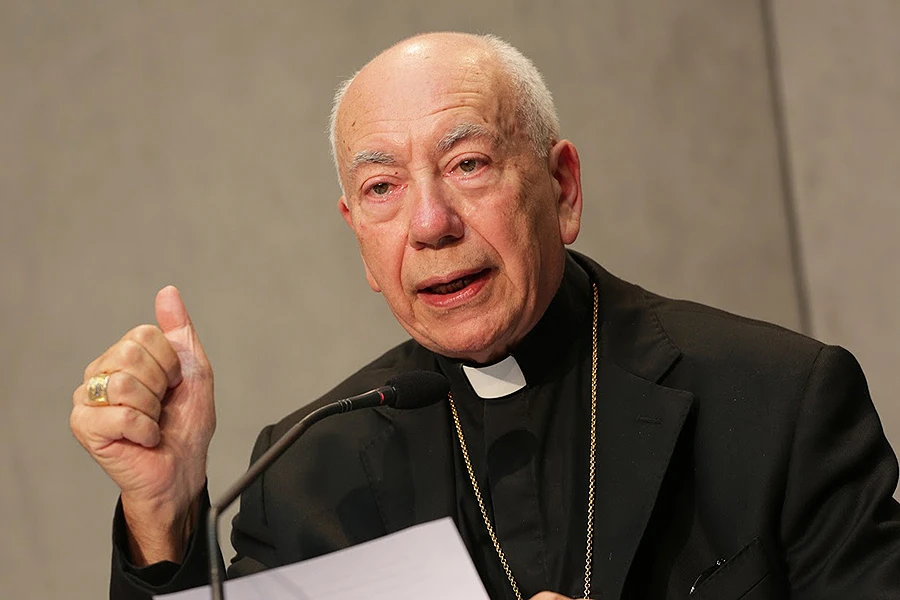
Vatican City, Mar 7, 2018 / 11:04 am (CNA/EWTN News).- The Pontifical Council for the Interpretation of Legislative Texts is awaiting the appointment of a new president, as sources have confirmed for CNA that Pope Francis has accepted the resignation of Cardinal Francesco Coccopalmerio, president of the council since 2007, who turned 80 years old March 6.
The council is tasked with preparing official interpretations of canon law, which must be approved by the pope, when questions regarding its meaning or application arise. The council also provides canonical guidance to bishops, religious orders, and offices of the Roman Curia.
Sources have told CNA that Coccopalmerio has already begun living in Milan, his native city, and that his retirement has long been expected within the congregation.
Sources connected to the council have speculated that Coccopalmerio’s successor could be Bishop Juan Ignacio Arrietta, a Spaniard, who was appointed secretary to the council in 2007, at the same time Coccopalmerio was appointed president. Arrietta, 66, was ordained a priest of Opus Dei, and was founding dean of the canon law school at the prelature’s Pontifical University of the Holy Cross in Rome.
In a 2017 booklet on the apostolic exhortation Amoris laetitia, Coccopalmerio wrote that “the Church could admit to Penance and to the Eucharist faithful who find themselves in an illegitimate union when two essential conditions occur: they want to change the situation, but they are unable to fulfill their desire.”
Coccopalmerio was connected to scandal when his secretary, Monsignor Luigi Capozzi, was arrested in 2017 amid charges of drug use and sexual misconduct in Vatican-owned buildings.
If you value the news and views Catholic World Report provides, please consider donating to support our efforts. Your contribution will help us continue to make CWR available to all readers worldwide for free, without a subscription. Thank you for your generosity!
Click here for more information on donating to CWR. Click here to sign up for our newsletter.

Altar of the Chair in St. Peter’s Basilica, where Bernini’s gorgeous bronze monument to the Chair of Peter acts as a massive
bronze reliquary for the historic wooden chair. / Credit: Vatican Media
Vatican City, Feb 22, 2025 / 11:00 am (CNA).
Every year on Feb. 22, the Catholic Church celebrates the feast of the Chair of St. Peter, a tradition that dates back more than 1,600 years.
The feast honors not just a physical chair but what it represents: the authority of St. Peter, the first pope, and the unbroken line of his successors.
References to the “Chair of Peter” date back to the early centuries of Christianity. St. Jerome, a biblical scholar of the fourth century, wrote in a letter: “I follow no leader save Christ, so I enter into communion with … the Chair of Peter, for this I know is the rock upon which the Church is built.”
The feast itself has been celebrated on Feb. 22 since at least A.D. 336, according to Monsignor Tiziano Ghirelli, a canon of St. Peter’s Basilica. By the fifth century, its importance had grown, with the imperial family participating in celebrations at the old St. Peter’s Basilica in Rome in 450 and 467.
The word “cathedra” refers to the seat of the bishop, which is why the mother church of a diocese is known as a cathedral. The bishop of Rome, as Peter’s successor, holds a unique role in guiding the Church.
The Altar of the Chair in St. Peter’s Basilica, where Bernini’s bronze monument to the Chair of Peter acts as a massive bronze reliquary for the historic wooden chair. Credit: Vatican Media
Pope Benedict XVI explained in a 2006 catechesis that the Chair of Peter “is the symbol of the bishop’s authority and in particular, of his ‘magisterium,’ that is, the evangelical teaching which, as a successor of the apostles, he is called to safeguard and to transmit to the Christian community.”
The phrase “ex cathedra” — Latin for “from the chair” — is still used to describe the pope’s most authoritative teachings.
“Celebrating the ‘chair’ of Peter means attributing a strong spiritual significance to it and recognizing it as a privileged sign of the love of God, the eternal Good Shepherd, who wanted to gather his whole Church and lead her on the path of salvation,” Benedict said.
Yes, there is actually a chair relic kept in St. Peter’s Basilica
In addition to the symbolic meaning, there is also a physical relic known as the Chair of St. Peter housed in St. Peter’s Basilica.
The wooden chair, dating back to the ninth century, was displayed for public veneration last fall amid the restoration efforts underway in the basilica.
Prior to that, the chair was last publicly exhibited in 1867, when Pope Pius IX allowed it to be seen for 12 days to mark the 1,800th anniversary of the martyrdom of Peter and Paul. Before that, the chair had not been seen since 1666 when it was first encased inside Gian Lorenzo Bernini’s monumental bronze sculpture under the stained-glass Dove of the Holy Spirit window at the basilica’s apse.
Historical records indicate that the wooden chair was likely a gift from Holy Roman Emperor Charles the Bald to Pope John VIII in 875. It features ivory panels depicting scenes from Greek mythology, including the labors of Hercules.
Pope Francis venerates the chair of St. Peter at the Synod on Synodality closing Mass on Oct. 27, 2024. Credit: Vatican Media
During the Middle Ages, the popes were solemnly enthroned on the chair. Innocent III used the wooden chair for his consecration on Feb. 22, 1198.
“Since the 11th century, the feast of Feb. 22 has been celebrated in Rome, and at the Vatican Basilica, with particular emphasis,” Ghirelli explained.
Bernini’s monument
In the 17th century, Pope Alexander VII commissioned Bernini to create an elaborate reliquary to house the chair. Bernini’s design, completed in 1666, features a gilded bronze throne elevated above the ground crowned by a stained-glass window depicting the Holy Spirit as a dove.
The structure is supported by statues of four doctors of the Church — two from the West, St. Augustine and St. Ambrose, and two from the East, St. John Chrysostom and St. Athanasius — symbolizing the unity of the Church through the ages, bringing together the teachings of both the Latin and Greek Church Fathers.
Above the throne, cherubs hold a papal tiara and keys, a reference to the authority given to Peter in the Gospel of Matthew: “You are Peter, and upon this rock, I will build my Church.”
A physical relic known as the Chair of St. Peter is housed in St. Peter’s Basilica. The wooden chair, dating back to the ninth century, was displayed for public veneration in the fall of 2024 amid the restoration efforts underway in the basilica. Credit: Matthew Bunson
Though the chair relic is once again enclosed within Bernini’s sculpture, visitors to St. Peter’s Basilica continue to pause before this symbol of the special mission of Peter and his successors to pray for the pope and his intentions.
“As we contemplate it with the wonder of faith,” Pope Francis said, “let us remember that this is the chair of love, unity, and mercy, according to Jesus’ command to the Apostle Peter not to lord it over others but to serve them in charity.”
Vatican City, Sep 29, 2017 / 11:06 am (CNA/EWTN News).- On Friday, Pope Francis said that the work of evangelization belongs to all people, and that the richness found in a variety of traditions can be a way of opening people’s hearts to the Gospel.
“The new stage of evangelization we are called upon to follow is certainly the work of the whole Church, ‘people on the way to God,’” he said Sept. 29.
Evangelization “by its very nature belongs to the People of God.”
Referencing the Second Vatican Council document Lumen gentium, he said, “From every population to which we go, a wealth emerges which the Church is called to recognize and value to bring about the unity of ‘all mankind’ of which it is the ‘sign’ and ‘the sacrament.’”
Pope Francis’ speech was part of a meeting with around 60 members of the Pontifical Council for the Promotion of the New Evangelization, at the conclusion of their plenary session Sept. 27-29.
In the audience, he told them he wanted to reflect on the “urgency” the Church feels to “renew its efforts and enthusiasm” for its mission of evangelization.
The many good traditions that people and their cultures possess give richness to the Church and life to the action of grace, which opens hearts to accept the Gospel, he said.
These traditions are “authentic gifts” expressing the infinite creativity of the Father and fostering communion, which then acts as a “seed of salvation, a prelude to universal peace and a concrete place of dialogue.”
Pope Francis also emphasized that the call to evangelize “transcends” the availability of a single person, but is actually part of a complex design of interpersonal relationships.
“Few institutions like the Church can boast of having a knowledge of the people able to enhance that cultural, moral and religious heritage that is the identity of entire generations,” he said.
This is why, he explained, it is important that in our evangelization efforts we know how to enter people’s hearts and help them to discover the sense of God and his love that gives confidence and serenity despite difficulty and challenge.
If we look deeply, he continued, we may find a “genuine desire for God that makes restless the heart of so many fallen people…”
“The joy of evangelization can reach them and give them the strength for conversion,” he said.
Pope Francis also reflected on last year’s Jubilee Year of Mercy, which he said was a time of grace lived by the whole Church “with great faith and intense spirituality,” especially the rediscovery of the Sacrament of Reconciliation.
“We cannot permit that such enthusiasm be diluted or forgotten,” he said.
The Pope said that everyone who evangelizes should be committed to announcing the message of mercy, which is made concrete and visible in the lives of believers.
Furthermore, those who have the task of proclaiming the Gospel should remember the words of the Apostle Paul, who says in 1 Timothy 1:12-16: “I am grateful to him who has strengthened me, Christ Jesus our Lord, because he considered me trustworthy in appointing me to the ministry.”
“I was once a blasphemer and a persecutor and an arrogant man, but I have been mercifully treated because I acted out of ignorance in my unbelief. Indeed, the grace of our Lord has been abundant, along with the faith and love that are in Christ Jesus,” the Pope quoted.
“This saying is trustworthy and deserves full acceptance: Christ Jesus came into the world to save sinners. Of these I am the foremost.”
The Church has a great responsibility to continue to be an instrument of mercy, Francis said.
“In this way, it can be easier to allow the reception of the Gospel to be perceived and lived as an event of salvation and it can bring a full and definitive meaning to personal and social life.”
What a surprise. Another FrancisToady.