Guayaquil, Ecuador, Mar 6, 2018 / 12:07 am (ACI Prensa).- The San Luis Gonzaga shelter in Guayaquil, Ecuador, provides free lodging and care for people with HIV, including children who lost their parents due to the illness.
An outreach of the Archdiocese of Guayaquil, the shelter has a capacity of 40 people, mostly low-income patients who are provided housing until they can receive medical care in hospitals. Food, transportation, lodging and counseling are offered free of charge.
In 2017, the shelter took in 166 patients and in January 2018 alone, they provided short-term housing and services for 115 people.
One example is Alejandro, a 61-year-old patient from Santa Elena, Ecuador, who shared with the Archdiocese of Guayaquil that he arrived at the shelter in a delicate state of health, but today feels much improved, has gained weight and knows he can continue with his treatment.
To date, the shelter has cared for people from five provinces in Ecuador, as well as foreigners from El Salvador, Colombia, Peru and Venezuela.
Since its inauguration in 2016, the shelter has received an annual donation of $25,000 from the Por Cristo Inc. Foundation of Boston, which is used for administrative and food expenses.
This article was originally published by our sister agency, ACI Prensa. It has been translated and adapted by CNA.
If you value the news and views Catholic World Report provides, please consider donating to support our efforts. Your contribution will help us continue to make CWR available to all readers worldwide for free, without a subscription. Thank you for your generosity!
Click here for more information on donating to CWR. Click here to sign up for our newsletter.
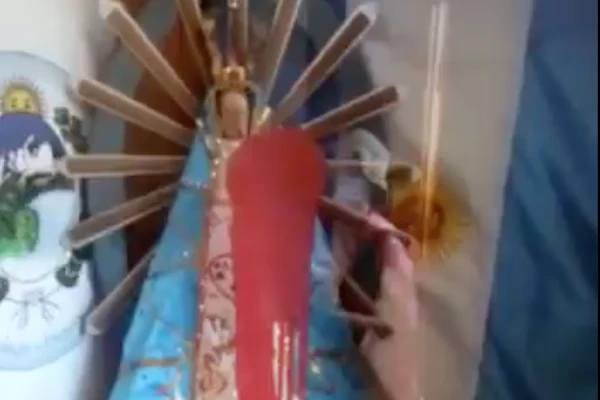
CNA Staff, Nov 9, 2020 / 08:04 pm (CNA).- A group of militants charged into a Catholic church in Argentina on Friday, beat the priest, desecrated the Eucharist, and vandalized the interior of the church. Five were eventually apprehended.
The attack took place at Our Lady of Luján Parish, located in the town of El Bolsón in Argentina’s Patagonia region near the Chilean border.
The militants were Mapuche activists. The Mapuche are an indigenous people inhabiting present day south-central Chile and southwestern Argentina, including parts of Patagonia. Militants have resorted in recent years to violence over land disputes, particularly targeting Catholic churches.
The vandals beat the parish pastor, Franciscan friar Fr. Ricardo Cittadini, briefly took another Franciscan hostage, broke sacred images, and overturned pews.
Un ciudadano envió a @aciprensa un video en el que se aprecia como quedó una parroquia en la Patagonia argentina tras el violento ataque y profanación por parte de vándalos mapuches pic.twitter.com/ASLrVHMw4O
A video sent by a local Catholic to ACI Prensa, CNA’s Spanish language news partner, shows the damage inflicted to the Church.
The video shows statues of saints and a crucifix destroyed, pews broken, and the church’s tabernacle opened, with a chalice and ciborium thrown to the ground.
According to the AICA news agency, two women entered the church after asking to use the restroom. They subsequently opened the door for several more militants, who surprised and attacked the priest and another member of the community.
Before fleeing, the militants hung an Argentine flag stained with red paint in one of the windows.
AICA reported that the attack was related to an eviction ruling that orderedMapuche group Winkul Lafken Mapu from land they had occupied in the town of Villa Mascardi, located about 20 miles southwest of Bariloche.
The land is owned by the Diocese of San Isidro. Execution of an eviction order had been postponed at request of the diocese, until security measures could be put in place for those being evicted and for police charged with carrying out the order.
The Diocese of Bariloche issued a statement lamenting desecration of the church, and expressing solidarity with “our Franciscan brothers and with the community of faithful Catholics” of the Our Lady of Luján parish.
“Violence of any kind, whether about the (land) claims or in the responses to them, is never, nor will it ever be, a solution, but rather aggravates existing conflicts. The first victim of violence is peace and harmony between people,” said Bishop Juan José Chaparro of Bariloche, in a statement after the attack.
“While understanding the respect that some members of the Mapuche people ask for, the Church, however, also demands respect and consideration for a sacred place for Catholics, such as a church, especially taking into account that the bishop has listened and dialogued on an ongoing basis with all those who have come to him.”
The diocese stressed that “the national government must assume – without delay – its proper responsibility for solving the conflicts that have arisen from the claims of the native peoples (such as the Mapuches), which have come up in many places in the national territory, not just in Patagonia.”
In doing this, “legitimate rights, differentiating them from those that may not be, must be recognized in the corresponding cases; the legal mechanisms immediately set in motion so those legitimate rights can be effectively exercised.”
“It is the longstanding reluctance of the national government to fulfill this responsibility” that is the main reason “the conflicts are growing and intensifying every day,” the statement said.
“Out of our faith we implore God our Father, to inspire in us all, sentiments of justice and peace.”
A version of this report was first published by ACI-Prensa, CNA’s Spanish-language news partner. It has been translated and adapted by CNA.
The President of the Communications Commission of the 2024 International Eucharistic Congress, Father Livingston Olivares (left), accompanies EWTN Vice President for Programming and Production Peter Gagnon (center-right), EWTN Vice President for Spanish-language Production, Marketing, and Radio Enrique Duprat (center-left), EWTN Production Director Michael Holmes (far right), and IEC Quito 2024 Communications Coordinator Marcelo Mejía (front, kneeling) at the Monument to the Equator, the exact location of the Equator (from which the country of Ecuador takes its name) on the outskirts of the country’s capital city of Quito, site of the 2024 International Eucharistic Congress. / Credit: Communications Commission of the 2024 International Eucharistic Congress
ACI Prensa Staff, May 21, 2024 / 06:40 am (CNA).
The 53rd International Eucharistic Congress (IEC) has chosen EWTN as the official channel for providing live coverage of the event, which will take place from Sept. 8–15 in Quito, Ecuador.
“The 53rd International Eucharistic Congress, which will be held in Quito Sept. 8–15, has chosen EWTN as its official channel, which will broadcast everything related” to this great event, said Father Juan Carlos Garzón, secretary-general of the IEC Quito 2024, in a statement sent from Rome to ACI Prensa, CNA’s Spanish-language news partner.
The theme for this year’s International Eucharistic Congress is “Fraternity to Heal the World.” On Monday, the Vatican also announced that Pope Francis designated Cardinal Kevin Farrell, prefect for the Dicastery for the Laity, the Family, and Life, as pontifical legate to the congress.
Garzón was in Rome last week as part of a delegation, chaired by Alfredo Espinoza Mateus, archbishop of Quito and primate of Ecuador, “to hold a series of meetings with the main papal authorities.”
Since the beginning of the preparations for IEC 2024, Garzón added: “EWTN has been present at the orientation and training for IEC 2024 communications personnel.”
Logo for the 53rd International Eucharistic Congress that will take place in Quito, Ecuador, from Sept. 8-15, 2024. Credit: Communications Commission of the 2024 International Eucharistic Congress
EWTN preparations for IEC Quito 2024
In tandem, to coordinate EWTN’s transmissions of IEC Quito 2024, a team from the network visited the Ecuadorian capital, including the Quito Metropolitan Convention Center, where the congress will be held.
The team was comprised of EWTN Vice President for Programming and Production Peter Gagnon, EWTN Director of Production Michael Holmes, and EWTN Vice President for Spanish-language Production, Marketing, and Radio Enrique Duprat.
Gagnon said EWTN transmissions of the event will be offered in Spanish, English, and German. “This will be a wonderful event for those attending and for those watching,” Gagnon said.
“For EWTN, it is an immense joy to be the channel for the Quito 2024 International Eucharistic Congress,” Duprat said. “It is essential for us to be the platform on which, no matter where our audience is, everyone can enjoy the most important Catholic events in the Church.”
As for coverage details, Duprat said: “The plan is to be able to offer this International Eucharistic Congress live and direct from Quito and in multiple languages [Spanish, English, and German] both through our television and radio signals, the internet, and through our digital app.”
The event coincides with the 150th anniversary of the 1874 consecration of Ecuador to the Sacred Heart of Jesus. In 1886, Quito was also the site of the first National Eucharistic Congress.
During their preparatory visit, the EWTN team traveled the route of a procession that will take place on Sept. 14 in the historic center of Quito, which will begin with a Mass in San Francisco Plaza and then head to the Basilica of the National Vow, where benediction will be given.
They also visited the IEC offices, where they were received by Garzón, who explained how the organization of the event is progressing, including the schedule of a theological symposium to be held Sept. 4–7, just prior to the Sept. 8–15 congress.
The EWTN delegation also visited the Middle of the World Park and Monument to the Equator, marking the equator dividing the northern and southern hemispheres and where a Liturgy of the Word is planned with emphasis on care for creation.
Registration underway
Registration for the International Eucharistic Congress, both for the theological symposium and for the congress itself, is underway and available through the event website.
The largest Catholic media organization in the world, EWTN’s 11 global TV channels and numerous regional channels are broadcast in multiple languages 24 hours a day, seven days a week to over 425 million television households in more than 160 countries and territories. EWTN platforms also include radio services transmitted through SIRIUS/XM, iHeart Radio, and more than 600 domestic and international AM and FM radio affiliates and a worldwide shortwave radio service.
Headquartered in Washington, D.C., EWTN News operates multiple global news services, including Catholic News Agency; The National Catholic Register newspaper and digital platform; ACI Prensa in Spanish; ACI Digital in Portuguese; ACI Stampa in Italian; ACI Africa in English, French, and Portuguese; ACI Mena in Arabic; CNA Deutsch in German; and ChurchPop, a digital platform that creates content in several languages. It also produces numerous television news programs including “EWTN News Nightly,” “EWTN News In Depth,” “EWTN Pro-Life Weekly,” and “The World Over with Raymond Arroyo.”
This story was first published by ACI Prensa, CNA’s Spanish-language news partner. It has been translated and adapted by CNA.
Santiago, Chile, May 31, 2018 / 03:40 pm (ACI Prensa).- The Congregation of the Sisters of the Good Samaritan in Chile on Tuesday acknowledged the complaint of sexual abuse made by a former member of the community and asked forgiveness for “not l… […]






Leave a Reply