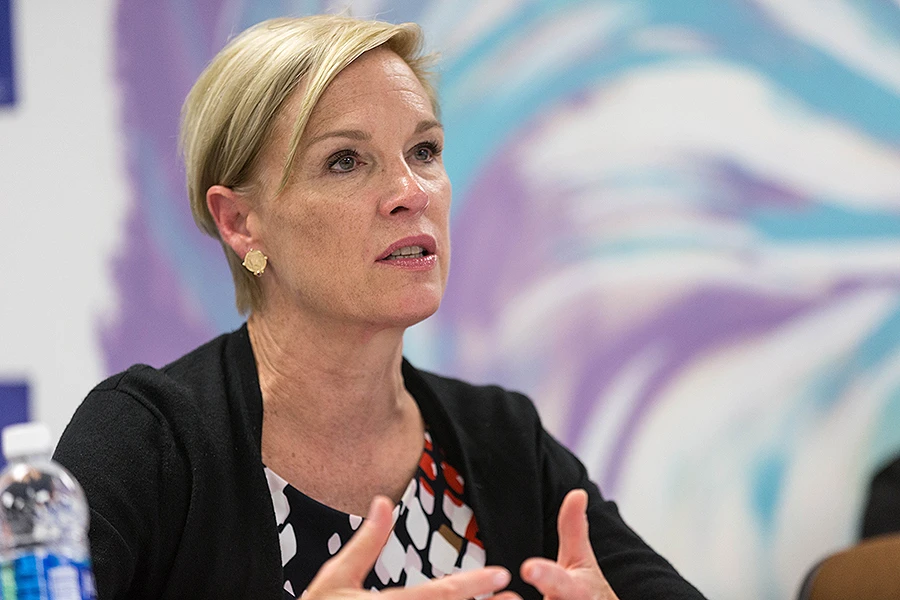
Washington D.C., Jan 24, 2018 / 01:38 pm (CNA/EWTN News).- Cecile Richards, who has served as president of Planned Parenthood since 2006, will soon step down from her position, two sources told BuzzFeed News on Wednesday.
No official timetable has been reported, but a statement provided to BuzzFeed said that Richards “plans to discuss 2018 and the next steps for Planned Parenthood’s future” at next week’s board meeting.
During Richards’ tenure as president, Planned Parenthood increased the number of abortions performed each year by more than 10 percent. In 2006, Planned Parenthood performed 289,750 abortions. In the 2016-2017 report, that number had grown to 321,384.
On average, Planned Parenthood carried out 320,000 abortions each year during Richards’ tenure.
Despite increasing the number of abortions during her time as president, the overall number of patients treated by Planned Parenthood fell. In 2006, Planned Parenthood treated 3.1 million people. In 2016, that number had dropped to 2.4 million, yet the amount of federal funding received by Planned Parenthood had increased by over $200 million.
A total of 32 clinics closed during the last year alone.
During Richards’ time as president, a series of videos produced by the Center for Medical Progress alleged that Planned Parenthood was involved in the sale of aborted fetal parts for profit.
The Department of Justice is currently investigating Planned Parenthood due to these videos. Congress earlier launched several investigations.
It is not immediately clear what Richards plans on doing next, although her memoir, titled “Make Trouble,” will be released in April.
News of Richards’ departure was well-received from former Planned Parenthood clinic worker Abby Johnson. Johnson, who now leads the pro-life group “And Then There Were None,” comprised of former abortion clinic employees, said in a statement that she would enjoy hearing from Richards now that she’s left the industry.
“As an organization that helps abortion workers leave their jobs, we would love to hear from Cecile as she exits the industry and have her hear from former workers of her organization – and how leaving was the best choice they made,” said Johnson.
“As a powerful woman, she has the capability to stand up for women and their families without relying on the lie that abortion is good for them and empowers them, when in reality it does the opposite.”
If you value the news and views Catholic World Report provides, please consider donating to support our efforts. Your contribution will help us continue to make CWR available to all readers worldwide for free, without a subscription. Thank you for your generosity!
Click here for more information on donating to CWR. Click here to sign up for our newsletter.

Members of the Sts’ailes First Nation at Holy Rosary Cathedral last year for the first Mass to integrate a First Nation language. A Cardus report presents the voices of Indigenous Canadians speaking about their faith and distinguishing it from the traditional spirituality they’re often associated with. / Photo courtesy Nicholas Elbers, 2022
Vancouver, Canada, May 17, 2023 / 14:15 pm (CNA).
A groundbreaking report published by the Ottawa-based Cardus Institute has given voice to Indigenous Canadians who are frustrated by secular society’s unawareness of — or unwillingness to accept — the fact that almost half of them are Christian.
“I find that insulting to Indigenous people’s intelligence and freedom,” Catholic priest Father Cristino Bouvette said of the prejudice he regularly encounters.
Bouvette, who has mixed Cree-Métis and Italian heritage and now serves as vicar for vocations and Young Adults in the Diocese of Calgary, was one of 12 individuals interviewed by Cardus for the report “Indigenous Voices of Faith.”
Father Deacon Andrew Bennett, left, leads a post-production discussion by Indigenous Voices of Faith participants. Photo courtesy of Cardus
Prejudice against Indigenous Christians has become so strong, even inside some Indigenous communities, “that Indigenous Christians in this country right now are living in the time of new martyrdom,” Bouvette said.
Although that martyrdom may not cost them their lives, “they are ostracized and humiliated sometimes within their own communities if they openly express their Christian or Catholic faith.”
Statistics Canada reported last year that the 2021 census found that 850,000, or 47%, of Canada’s 1.8-million Indigenous people identify as Christian and that more than a quarter of the total report they are Catholic. Only 73,000, or 4%, of Indigenous people said they adhere to traditional Indigenous spiritual beliefs.
In a new report, Cardus wants to “amplify the voices of Indigenous Canadians speaking for themselves about their religious commitments, which sometimes clash with the typical public presentation of Indigenous spirituality.” Photo courtesy of Cardus
Ukrainian Catholic Deacon Andrew Bennett, program director for Cardus Faith Communities, conducted the interviews for the think tank last fall. He published his report in March at a time when Canadian mainstream media and many political leaders continued to stir division and prejudice through misleading commentary about abandoned cemeteries at Indian Residential Schools.
The purpose of the report, he writes, “is to affirm and to shed light on the religious freedom of Indigenous peoples to hold the beliefs and engage in the practices that they choose and to contextualize their faith within their own cultures.”
Too often, however, “the public narrative implies, or boldly declares, that there’s a fundamental incompatibility between Indigenous Canadians and Christianity or other faiths,” Bennett said. “[M]any Indigenous Canadians strongly disagree with those narratives.”
Father Bouvette is clearly one of those.
“We did not have Christian faith imposed upon us because of [my Indigenous grandmother’s] time in the residential school or her father’s time in the trade school that he was sent to,” Bouvette said. “No, it was because our family freely chose to receive the saving message of Jesus Christ and lived it and had continued to pass it down.”
Bouvette said his “grandmother was not tricked into becoming something that she didn’t want to be, and then tricked into staying that way for 99 years and 11 months of her life. She was a Christian from the day of her birth, and she remained a Christian until the day of her death. And so that was not by the consequence of some imposition.”
Nevertheless, Canadians continue to labor under a prejudice holding the opposite view. “I do believe that probably the majority of Canadians at this time, out of some mistaken notion of guilt for whatever their cultural or ethnic background is, think they are somehow responsible for Indigenous people having had something thrust upon them that they didn’t want,” Bouvette said.
“We did not have Christian faith imposed upon us,” Father Cristino Bouvette says in a Cardus report on Indigenous faith. Photo courtesy of Cardus
“But I would say, give us a little more credit than that and assume that if there is an Indigenous person who continues to persevere in the Christian faith it is because they want to, because they understand why they have chosen to in the first place, and they remain committed to it. We should be respectful of that.”
The executive director of the Catholic Civil Rights League, Christian Elia, agrees and says society should grant Indigenous Catholics the respect and personal agency that is due all Canadians.
“Firstly, I am not an Indigenous person, so I cannot speak for our Indigenous brothers and sisters, but neither can non-Indigenous secularists who choose to ignore that Indigenous people in Canada continue to self-identify as Christian, the majority of these Catholic,” Elia said in an interview with The B.C. Catholic.
He said his organization has heard from many Indigenous Catholics who are “growing weary of the ongoing assumption that somehow they have been coerced into the faith, that it is inconceivable that they wish to be Catholic. This condescending attitude must stop.”
Deacon Rennie Nahanee, who serves at St. Paul’s Indian Church in North Vancouver, was another of the 12 whom Bennett interviewed. A cradle Catholic and member of the Squamish First Nation, Deacon Nahanee said there is nothing incompatible with being both an authentic Indigenous person and a Catholic.
“I’m pretty sure we had a belief in the Creator even before the missionaries came to British Columbia,” he said. “And our feelings, our thoughts about creation, the way that we lived and carried out our everyday lives, and the way that we helped to preserve the land and the animals that we used for food, our spirituality and our culture, were similar to the spirituality of the Catholic Church.”
“I believe that’s why our people accepted it. I don’t think anybody can separate themselves from God, even though they say so.”
Interviewed later by The B.C. Catholic, Nahanee said he is not bothered by the sort of prejudice outlined by Bouvette. “People are going to say or do what they want,” he said.
Voices of Indigenous Christianity
Bennett, program director of Cardus Faith Communities, interviewed 12 Indigenous Canadians, most of them Christian, about their religious commitments, “which often clash with the typical public presentation of Indigenous spirituality.” Here is a selection of some of their comments:
Tal James of the Penelakut First Nation in Nanaimo spoke about the relationship between Indigenous culture and his Christian faith:
Tal James and wife Christina. Photo courtesy of Project 620 – James Ministry
“I think … that our [Indigenous] cultures were complete, and in Jesus they’re more complete. I think that’s a big thing and a big step for a lot of us. You’re going to have a lot of non-Indigenous people look at you and question your actions based on your Aboriginal heritage. Don’t take that to heart. They’re the ignorant ones who don’t want you to flourish. Those of you who are Christians, First Nations Christians, you come to the table with the same gifting that non-Aboriginal people have. For them to say, ‘We want to make room for you at the table,’ correct them. You are already at the table, and encourage them to step back and allow your gifts to flourish. Because it’s one in the same spirit.”
Rose-Alma McDonald, a Mohawk from Akwesasne, which borders New York, Ontario, and Quebec, talked about re-embracing her Catholic faith:
Rose-Alma McDonald. Photo courtesy of Cardus
“I surprised everybody, including myself, in terms of embracing Catholicism after 20 years away. So I’ve had a few epiphanies in the sense that this is why my mother made me do so much in the church growing up. When I’m working, volunteering, and doing stuff in the church, I remember that. I keep remembering I’m Catholic and I’m still Catholic. I will stay Catholic because of the way I was raised.”
Jeff Decontie, a Mohawk from the Algonquin First Nations who lives in Ottawa, talked about being a person of faith in a secular world:
Jeff Decontie. Photo courtesy of Cardus
“Secular worldviews can sort of eat up everything around them and accept a whole wide range of beliefs at the same time. For example, you have the prevailing scientific thinking alongside New Age believers, and people in society just accept this, saying, ‘Oh, whatever it is you believe in, all religions lead to the same thing.’ No one questions it. How can these contradictions coexist? … Then we ask an [Indigenous] elder to lead prayer? Any other religion would be a no-no, but you can ask for an elder who’s going to pray a generic prayer to some generic Creator, and it’s not going to ruffle any feathers. I think that’s the danger of secular thought creeping into Canada: It goes unnoticed, it’s perceived as neutral, but at the same time it’s welcoming a whole wide range of beliefs. And it doesn’t just influence Indigenous thought. It’s influencing Christianity.”
Rosella Kinoshameg, a member of the Wikwemikong Reserve on Manitoulin Island in Ontario, spoke about being Indigenous and Catholic:
Rosella Kinoshameg. Photo courtesy of the Catholic Register
“Well, I can’t change being Indigenous. That’s something that is me. I can’t change that. But to believe in the things that I was taught, the traditional things, the way of life and the meanings of these things, and then in a church, well, those things help one another and they make me feel stronger.”
This article was originally published May 10, 2023, in The B.C. Catholic, a weekly publication serving the Catholic community in British Columbia, Canada, and is reprinted here on CNA with permission.
Cucuta, Colombia, Feb 12, 2019 / 05:23 pm (ACI Prensa).- The bishop of a Colombian diocese bordering Venezuela has said that “we can’t be still” in face of the Venezuelan people’s suffering, and noted that the Church has responded to the humanitarian crisis from its beginning.
Under the administration of Nicolas Maduro, Venezuela has been marred by violence and social upheaval, with severe shortages and hyperinflation leading millions of Venezuelans to emigrate.
Opposition leader Juan Guaidó, who declared himself interim president of Venezuela last month, has been recognized as Venezuelan president by the US, Canada, much of the European Union, and several Latin American nations.
In a statement to ACI Prensa, CNA’s Spanish language sister agency, Bishop Victor Manuel Ochoa Cadavid of Cúcuta said that when Maduro’s government began deporting Colombians in August 2015, the Church in Cúcuta “began its services to the brothers experiencing hardship.”
Since then the Diocese of Cúcuta has been daily serving thousands of people crossing the border through several initiatives, such as the Divine Providence House of Transit.
Bishop Ochoa pointed out that Cúcuta has Colombia’s highest unemployment rate: “more than 21 percent unemployment, and almost 75 percent of those employed are poorly paid, under the table.” However, “the Church is intervening with humanitarian assistance.”
“We have been helping with this crisis for the last three years. We’re doing it, we’re helping many institutions in Venezuela. Also with the aid of the U.S. government. We have a medical clinic that serves almost 800 people a day. We’re distributing food, we’re helping people who are migrating,” he said.
“The emergency has been created, but we’ve already been helping as a Church,” he told ACI Prensa.
The bishop said that since mid 2015 they have distributed “a million good quality warm servings without counting emergency servings.”
“When the food allotted for the day runs out we distribute tuna and pasta, or tuna and rice and a loaf of bread so no pregnant woman goes without eating, no child goes without eating, no elderly person goes without eating,” he said.
The bishop said that the Divine Providence House of Transit distributes 5,000 servings a day. Another 5,000 meals are delivered to eight parishes.
“It’s the charity of the Church that we try to live out here with great fidelity to the Lord: ‘I was hungry and you gave me to eat, I was thirsty and you gave me to drink, I was a stranger and you welcomed me,’” said Bishop Ochoa, expressing the desire of the faithful to be able to do more for the migrants.
The prelate highlighted the commitment of nearly 800 volunteers from parishes and ecclesial movements who are also joined by priests and nuns.
For several days aid shipments, arranged by Guaidó, have been sitting in Cúcuta, awaiting permission from Maduro to enter Venezuela.
A tanker truck and a cargo container, placed there by the Venezuelan military, are currently blocking the Tienditas bridge which connects Cúcuta to Urena, Venezuela.
Caritas Venezuela has been asking for three years that humanitarian aid be allowed into the country.
Maduro told the BBC Feb. 12 that the aid is being blocked because “it’s a show, that the United States government has set up with the compliance of the Colombian government to humiliate the Venezuelans. Venezuela is a country that has the capacity to satisfy all the necessities of our people.”
“Venezuela is a country that has dignity, and the United States has intended to create a humanitarian crisis in order to justify a military intervention – ‘humanitarian’. And this is part of that show,” Maduro said. “That’s the reason that we, with dignity, tell them that the miniscule crumbs that they intend to bring with toxic food, with leftovers that they have, we tell them no – Venezuela has dignity, Venezuela produces and works and our people do not to beg from anyone.”
It was reported Feb. 11 that Brazil has also agreed to set up a staging area for humanitian aid intended for Venezuela.
Bishop Ochoa expressed his desire that the aid enter Venezuela, saying, “Not to permit access is a political problem. We want the Venezuelan people to have all they need.”
Lester Toledo, Guaidó’s coordinator of humanitarian aid, said Feb. 11 that besides the United States “there are dozens of countries in the region, from the Lima Group and from Europe, that are willing to bring in the initial tons of aid, medical supplies, food.”
This article was originally published by our sister agency, ACI Prensa. It has been translated and adapted by CNA.
Vancouver, Canada, Feb 26, 2018 / 12:27 pm (CNA/EWTN News).- Palliative care and hospice units are known for their life-affirming service to individuals who are facing the end of their lives, accompanying patients with dignity, comfort and meaning unti… […]
Satan’s mistress.