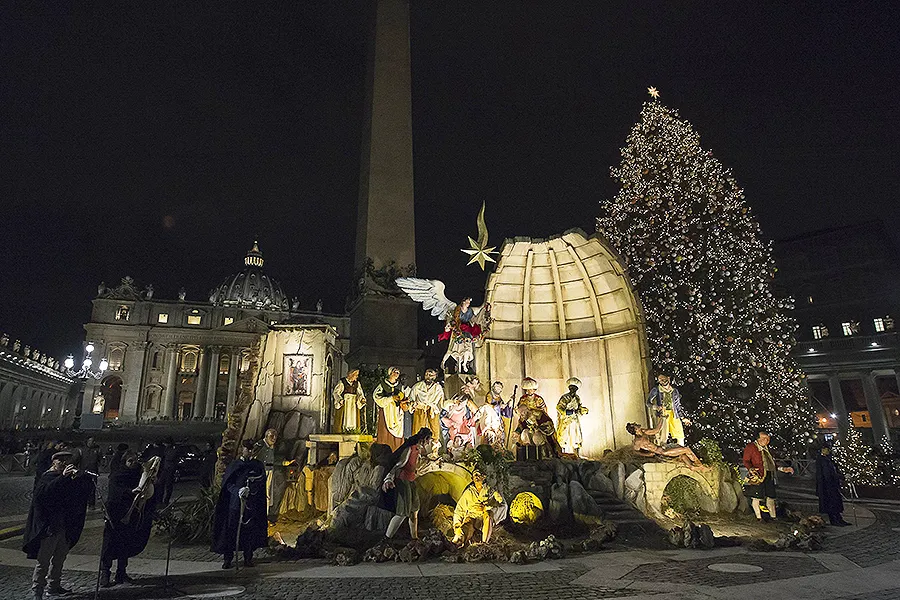
Vatican City, Dec 8, 2017 / 08:55 am (CNA/EWTN News).- In an inauguration ceremony Thursday, the Vatican officially unveiled this year’s nativity scene in St. Peter’s Square, also lighting the 69-foot Christmas tree for the first time this year.
In an audience with the tree and nativity donors Dec. 7, Pope Francis reflected on the symbolism found in the two Christmas traditions, which he said are “signs of the compassion of the heavenly Father, of his participation and closeness to humanity” even in its “very difficulties.”
The branches of the tree, “reaching upward,” remind us to reach for “the highest gifts,” he explained. And in “the simplicity of the crib we meet and contemplate the tenderness of God” as manifested in the Child Jesus.
This year’s Vatican nativity scene was created by artisans in a local workshop and donated by an ancient Benedictine Abbey, the Sanctuary of Montevergine, which lies near Naples.
A special detail of this year’s scene: in one corner hangs a replica of the icon of Our Lady of Montevergine, a nod to the abbey which donated it. The original image, which is 12 feet tall, hangs in the chapel of the Sanctuary of Montevergine.
Outside of the traditional nativity figures of Mary, Joseph, the child Jesus, the Wise Men, shepherds, an angel, and animals, the other figures are represented in the act of performing the 7 Corporal Works of Mercy, such as burying the dead, visiting the imprisoned, and clothing the naked.
The approximately 6 1/5-foot-tall figures are made of colored terracotta and dressed in traditional eighteenth-century Neapolitan costumes. The whole scene is built on a platform about 861-square-feet in size.
In a change from past years, this one includes a technological element; visitors can connect to a special Wi-Fi access point in St. Peter’s Square and scan a QR code to watch a video to learn more about the nativity.
The Christmas tree is a northern European tradition which has only recently become more common in Italy. The tradition to have a tree in St. Peter’s Square was begun by St. John Paul II in 1982.
This year’s tree, which comes from Poland, is 69-feet tall and about 60 years old. Its tip was lost when it was struck by lightning several years ago.
It was donated by the Archdiocese of Elk and cut down by a local forestry service, which transported it by truck over more than 1200 miles in 12 days to reach Rome, traveling mostly by night, when traffic is less dense.
The ornaments which decorate the spruce were created by children with cancer and their parents from several hospitals in Italy, as well as by children from Italian zones affected by earthquakes the past two years.
The ornaments were created in clay by the children and then reproduced using synthetic materials which can stand up to the weather in St. Peter’s Square.
The nativity and tree will remain in St. Peter’s Square until Jan. 7, 2018, the feast of the Baptism of the Lord.
If you value the news and views Catholic World Report provides, please consider donating to support our efforts. Your contribution will help us continue to make CWR available to all readers worldwide for free, without a subscription. Thank you for your generosity!
Click here for more information on donating to CWR. Click here to sign up for our newsletter.

When Pope Pius IX declared the doctrine of the Immaculate Conception of the Virgin Mary on December 8, 1854, he had a golden crown added to the mosaic of Mary, Virgin Immaculate, in the Chapel of the Choir in St. Peter’s Basilica. / Daniel Ibañez/CNA
Vatican City, May 29, 2023 / 10:30 am (CNA).
To honor the Blessed Virgin Mary, the Vatican offers a special Marian pilgrimage within St. Peter’s Basilica each Saturday afternoon during the month of May.
The Marian itinerary brings pilgrims from Michelangelo’s marble sculpture of the Pieta to Our Lady of Perpetual Help, a 12th-century painting brought into the basilica in 1578 in a solemn procession.
For those unable to travel to the Eternal City, CNA is providing the following “virtual tour” with photos by Daniel Ibañez of eight beautiful images of Our Lady in St. Peter’s Basilica for the feast of Mary, Mother of the Church.
In St. Peter’s Basilica’s Chapel of the Choir, a large mosaic based on painting by Italian artist Pietro Bianchi depicts Mary, Virgin Immaculate, in the glory of heaven being venerated by St. John Chrysostom (left) and other saints. Daniel Ibañez/CNA
Virgin Immaculate
In the basilica’s Chapel of the Choir, a large altarpiece reveals Mary, Virgin Immaculate, in the glory of heaven above angels and saints. The mosaic based on an 18th-century painting by Italian artist Pietro Bianchi depicts St. John Chrysostom St. Francis of Assisi, and St. Anthony of Padua venerating the Blessed Virgin Mary.
The chapel is located on the left side of the basilica behind an iron gate designed by Gian Lorenzo Bernini. St. John Chrysostom is buried beneath the altar, which also contains relics of St. Francis and St. Anthony.
When Pope Pius IX declared the doctrine of the Immaculate Conception of the Virgin Mary on December 8, 1854, he had a golden crown added to the mosaic of Mary. Pope Pius X later added a larger diamond crown to mark the 50th anniversary of the declaration in 1904.
The original painting by Bianchi can be found in Rome’s Basilica di Santa Maria degli Angeli e dei Martiri.
Mother of the Church
St. Peter’s Basilica contains an icon of the Virgin Mary titled “Mater Ecclesiae,” which means “Mother of the Church.”. Daniel Ibañez/CNA
The basilica contains an icon of the Virgin Mary titled “Mater Ecclesiae,” which means “Mother of the Church.”
The original image of the Virgin Mary and the Christ Child was painted on a column in old St. Peter’s Basilica, built by Emperor Constantine in the fourth century. It was later transferred to the 16th-century St. Peter’s Basilica. Paul VI honored the icon with the title “Mater Ecclesiae” after the Second Vatican Council.
A mosaic of the Virgin Mary overlooking St. Peter’s Square was inspired by the original Mater Ecclesiae image. The mosaic was installed after the assassination attempt against St. John Paul II in 1981.
When he blessed the mosaic, John Paul II prayed “that all those who will come to this St. Peter’s Square will lift up their gaze towards you [Mary], to direct, with feelings of filial trust, their greetings and their prayers.”
In 2018, Pope Francis added the memorial of “Mary, Mother of the Church” to the liturgical calendar for the Monday after Pentecost.
Mother of Pilgrims
A restored 16th-century painting of Our Lady holding her Son can be found in St. Peter’s Basilica above the sarcophagus of Pope Gregory XIV under the title “Mother of Pilgrims.”. Daniel Ibañez/CNA
A restored 16th-century painting of Our Lady holding her son can be found in St. Peter’s Basilica above the sarcophagus of Pope Gregory XIV.
The image is titled “Mater Peregrinorum” or Mother of Pilgrims. The original artist is not known, but Italians also refer to the painting as the “Madonna di Scossacavalli” because it came from Rome’s Church of San Giacomo Scossacavalli, which was demolished in 1937 to create the current Via della Conciliazione leading to St. Peter’s Basilica.
Our Lady of Perpetual Help
A 12th-century painting on wood titled Our Lady of Perpetual Help in the Gregorian Chapel of St. Peter’s Basilica. Daniel Ibañez/CNA
A 12th-century painting on wood titled Our Lady of Perpetual Help, also known as Our Lady of Succor, was transferred to an altar in St. Peter’s Gregorian Chapel on February 12, 1578 with a solemn procession.
The painting was the first artistic restoration completed under Pope Francis’ pontificate during the Year of Faith, according to a book published by the Knights of Columbus.
The remains of the Doctor of the Church St. Gregory of Nazianzus (d. 390) are preserved in an urn beneath the Altar of Our Lady of Succor in the Gregorian Chapel, found on the right side of the basilica.
Ark of the Covenant
A mosaic altarpiece of the Presentation of the Virgin Mary in the Temple can be found above the tomb of Pope St. Pius X near the left-front entrance of the basilica. Daniel Ibañez/CNA
A colorful mosaic altarpiece of the Presentation of the Virgin Mary in the Temple brightens the wall above the tomb of Pope St. Pius X (d. 1914) in the Presentation Chapel near the left-front entrance of the basilica.
A young Mary is depicted on the steps of the Temple with her parents, Sts. Anne and Joachim, the grandparents of Jesus.
The mosaic completed by Pietro Paolo Cristofari in 1728 is based on a painting by 17th-century artist Giovanni Francesco Romaneli, the original of which can be found in Rome’s Basilica di Santa Maria degli Angeli e dei Martiri.
Gate of Heaven
According to Father Agnello Stoia, the pastor of the parish of St. Peter’s Basilica, the 15th-century image of Mary on the oldest door of St. Peter’s Basilica is a reminder of Mary’s title, “Gate of Heaven.”. Daniel Ibañez/CNA
The central door leading to basilica was retained from the old St. Peter’s Basilica and is known as the Filarete Door. Created by a Florentine artist in 1455, the door depicts Christ, the Virgin Mary, and the apostles Sts. Peter and Paul.
According to Father Agnello Stoia, the pastor of the parish of St. Peter’s Basilica, the 15th-century image of Mary on the door is a reminder of Mary’s title, “Gate of Heaven.”
Queen Assumed into Heaven
The mosaics decorating the interior dome of St. Peter’s Basilica depict the Blessed Virgin Mary next to Christ the Redeemer and the Apostles. Daniel Ibañez/CNA
Looking up at the soaring cupola, or dome, of St. Peter’s Basilica, one sees mosaics depicting the Blessed Virgin Mary next to Christ the Redeemer, along with St. John the Baptist and the apostles.
The mosaic of the Virgin Mary on the Great Dome, completed in 1610 by Orazio Gentileschi, is based on drawings by Italian Mannerist painter Giuseppe Cesari.
Mother of the Redeemer
Michelangelo’s Pieta conveys the faith and emotion of the Blessed Virgin Mary as she cradles in her arms the dead body of her only son after witnessing him crucified. Daniel Ibañez/CNA
Michelangelo Buonarroti carved the Pieta from a single slab of Carrara marble when he was 24-years old. The sculpture was unveiled in St. Peter’s Basilica for the Jubilee of 1500.
The moving sculpture conveys the faith and emotion of the Blessed Virgin Mary as she cradles in her arms the dead body of her only son after witnessing him crucified.
The sculpture sits above a side-altar near the front entrance of St. Peter’s Basilica, where Mass was sometimes offered before recent restrictions. Visitors to the basilica can only see the Pieta behind bulletproof glass after a man attacked the sculpture with a hammer in May 1972.
The Pieta was the only work of art that Michelangelo ever signed.
Pope Leo XIV addresses the crowd following his unexpected ride around St. Peter’s Square at the Vatican following the Jubilee of Youth welcome Mass — which was celebrated by Archbishop Rino Fisichella (right) — on July 29, 2025. / Credit: Daniel… […]
Rome Newsroom, Mar 29, 2023 / 09:30 am (CNA).
Jesuit Father Hans Zollner, an internationally-renowned expert in protecting children and vulnerable adults from clerical sex abuse, has resigned from his posi… […]
6 Comments
An allegory of the coming of the Antichrist. They’re not being subtle anymore, are they?
The best way to obscure truth is often to simply emphasize the less important at the expense of the essential. Where is the Christ child? Where is the King of the Universe? Where is the Holy Family? Why is the star falling from the sky rather than guiding the Wise men? . . .and where is the outrage over the naked body builder waiting to be clothed? Why do the corporal works of mercy drown out the essential truth of our faith:namely, the Incarnation? Where have they hidden my Lord? This is a call for reparation.
I can even understand the artistic effort in taking the centrality of the adoration of the Lord Jesus in favor of human works of charity – isn’t it what the “modern” “church” is all about? Humanism took over and a Christless new religion is being born.
Time to take sides, folks. Are we going to serve God or our own bellies?
In a side note, however, I could not help but laugh at the naked in need to be clothed – six packs, a real Michelangelo figure in all its bodily glory – in nothing similar to the starving children in Africa, Haiti, or the lost homeless living in the streets of L.A.
Why are they changing the beautiful Manager Scene, christians always loved? Especially at the vatican, who are our Sheperds. I’m disappointed and sad about it.
Christmas is about JESUS’ birth first, not acts of mercy? It is a joyful, glorious time to celebrate our Precious, humble, Jesus’s birthday! JESUS is peace, love and hope.
Have mercy on us.
The two previous posts are spot on.
This manger scene is way too busy. Jesus is lost within the busyness of it all.
It is not beautiful and it is not peaceful. It is about man not the Savior.
Nevertheless,
Merry Christmas to all “men of good will” who understand the message of the birth of the Christ child.
An allegory of the coming of the Antichrist. They’re not being subtle anymore, are they?
The best way to obscure truth is often to simply emphasize the less important at the expense of the essential. Where is the Christ child? Where is the King of the Universe? Where is the Holy Family? Why is the star falling from the sky rather than guiding the Wise men? . . .and where is the outrage over the naked body builder waiting to be clothed? Why do the corporal works of mercy drown out the essential truth of our faith:namely, the Incarnation? Where have they hidden my Lord? This is a call for reparation.
The Lord be with you. The Holy Gospel according to Pope Francis.
I can even understand the artistic effort in taking the centrality of the adoration of the Lord Jesus in favor of human works of charity – isn’t it what the “modern” “church” is all about? Humanism took over and a Christless new religion is being born.
Time to take sides, folks. Are we going to serve God or our own bellies?
In a side note, however, I could not help but laugh at the naked in need to be clothed – six packs, a real Michelangelo figure in all its bodily glory – in nothing similar to the starving children in Africa, Haiti, or the lost homeless living in the streets of L.A.
Why are they changing the beautiful Manager Scene, christians always loved? Especially at the vatican, who are our Sheperds. I’m disappointed and sad about it.
Christmas is about JESUS’ birth first, not acts of mercy? It is a joyful, glorious time to celebrate our Precious, humble, Jesus’s birthday! JESUS is peace, love and hope.
Have mercy on us.
The two previous posts are spot on.
This manger scene is way too busy. Jesus is lost within the busyness of it all.
It is not beautiful and it is not peaceful. It is about man not the Savior.
Nevertheless,
Merry Christmas to all “men of good will” who understand the message of the birth of the Christ child.