

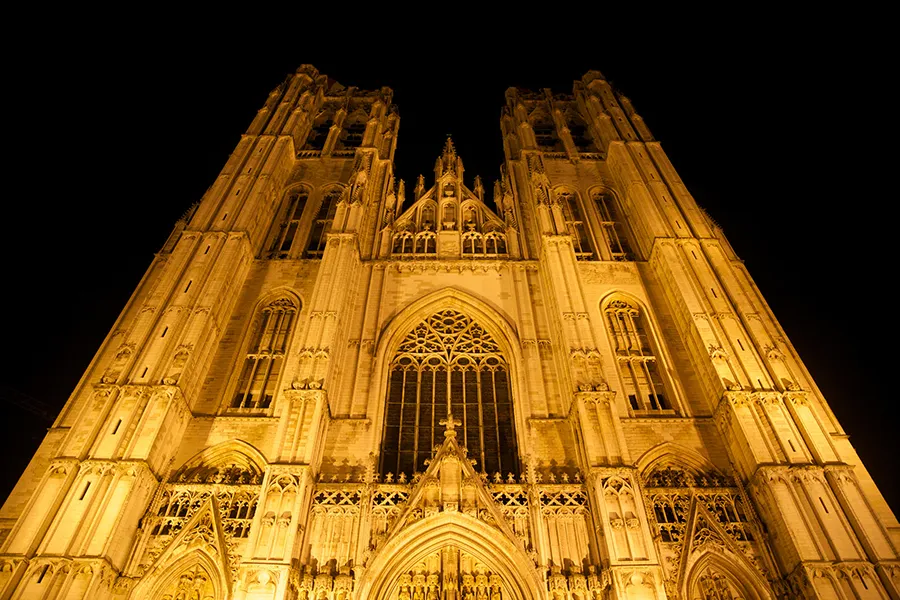
Brussels, Belgium, Oct 31, 2017 / 04:22 pm (CNA/EWTN News).- A group of Catholics who were reciting the rosary were removed Saturday from the Brussels cathedral on the grounds that they were disturbing a service celebrating the 500th anniversary of the Reformation.
The United Protestant Church in Belgium was hosting the event with the Cathedral of St. Michael and St. Gudula to commemorate the 500th anniversary of Martin Luther posting the 95 Theses to the door of Wittenberg Castle – a gesture which led to Luther’s eventual schism from the Catholic Church.
Steven Fuit, president of the UPCB, spoke at the event, saying it was an ecumenical service and noting that “our unity essentially derives from respecting differences.”
“Our individuality and our unity consist not in the passive acceptance of diversity,” Fuit said, according to the Catholic Herald.
“Without the other who is different, who thinks otherwise, who does otherwise, I do not exist, I am nothing. Differences are an inherent part of unity,” he continued.
However, approximately a dozen young Catholics made an appearance during the commemoration and began to recite the rosary with linked arms during the ceremony.
Police ultimately removed the group from the cathedral, as shown on a YouTube video.
The group of Catholics allegedly handed out a leaflet calling the ceremony a “profanation,” according to Media-Presse-Info, a French news website.
“Our Cathedral of St. Michael and St. Gudula is a Catholic building built by our fathers to be a House of God, for the celebration of holy Mass, for the praise of God and the saints,” read the leaflet.
“Indeed, the so-called Reformation was really a revolt: under the pretext of combatting abuses, Luther rebelled against the divine authority of the Catholic Church, denied numerous Truths of the Faith, abolished the Sacrifice of the Mass and the Sacraments, rejected the necessity of good works and the practice of Christian virtues. Finally, he attacked the veneration of the Virgin Mary and the saints, the religious life and monastic vows,” the leaflet continued.
“This terrible revolution was a great tragedy for Christian society and for the salvation of souls. And the Lutheran errors are still heresies today because the Truth is eternal.”
If you value the news and views Catholic World Report provides, please consider donating to support our efforts. Your contribution will help us continue to make CWR available to all readers worldwide for free, without a subscription. Thank you for your generosity!
Click here for more information on donating to CWR. Click here to sign up for our newsletter.


What is there to celebrate about 500 years of heresy?
I’m fairly sure the Protestants involved don’t view it as heresy. Not defending it; just pointing out the obvious.
I’m fairly sure many of the Catholics involved don’t either!
Good for them – more power to them.
A Lutheran Chief of Chaplain Service once told me we Catholics are obsessed with the Law. It seems a hangover from Luther’s insistence that faith alone saves. I responded our laws focus on charity. He in his own way was a charitable person. He responded he thought of becoming Catholic. Despite the inane comment by Steven Fuit, president of the UPCB that “our unity essentially derives from respecting differences” our unity derives from faith in Christ and following His commandments, even if the latter is tacitly admitted by the practice of many Lutherans.
MORTALIUM ANIMOS
ENCYCLICAL OF POPE PIUS XI
ON RELIGIOUS UNITY
TO OUR VENERABLE BRETHREN THE PATRIARCHS, PRIMATES,
ARCHBISHOPS, BISHOPS, AND OTHER LOCAL ORDINARIES
IN PEACE AND COMMUNION WITH THE APOSTOLIC SEE.
ENCYCLICAL OF POPE PIUS XI
ON RELIGIOUS UNITY
6. We were created by God, the Creator of the universe, in order that we might know Him and serve Him; our Author therefore has a perfect right to our service. God might, indeed, have prescribed for man’s government only the natural law, which, in His creation, He imprinted on his soul, and have regulated the progress of that same law by His ordinary providence; but He preferred rather to impose precepts, which we were to obey, and in the course of time, namely from the beginnings of the human race until the coming and preaching of Jesus Christ, He Himself taught man the duties which a rational creature owes to its Creator: “God, who at sundry times and in divers manners, spoke in times past to the fathers by the prophets, last of all, in these days, hath spoken to us by his Son.”[3] From which it follows that there can be no true religion other than that which is founded on the revealed word of God: which revelation, begun from the beginning and continued under the Old Law, Christ Jesus Himself under the New Law perfected. Now, if God has spoken (and it is historically certain that He has truly spoken), all must see that it is man’s duty to believe absolutely God’s revelation and to obey implicitly His commands; that we might rightly do both, for the glory of God and our own salvation, the Only-begotten Son of God founded His Church on earth. Further, We believe that those who call themselves Christians can do no other than believe that a Church, and that Church one, was established by Christ; but if it is further inquired of what nature according to the will of its Author it must be, then all do not agree. A good number of them, for example, deny that the Church of Christ must be visible and apparent, at least to such a degree that it appears as one body of faithful, agreeing in one and the same doctrine under one teaching authority and government; but, on the contrary, they understand a visible Church as nothing else than a Federation, composed of various communities of Christians, even though they adhere to different doctrines, which may even be incompatible one with another. Instead, Christ our Lord instituted His Church as a perfect society, external of its nature and perceptible to the senses, which should carry on in the future the work of the salvation of the human race, under the leadership of one head,[4] with an authority teaching by word of mouth,[5] and by the ministry of the sacraments, the founts of heavenly grace;[6] for which reason He attested by comparison the similarity of the Church to a kingdom,[7] to a house,[8] to a sheepfold,[9] and to a flock.[10] This Church, after being so wonderfully instituted, could not, on the removal by death of its Founder and of the Apostles who were the pioneers in propagating it, be entirely extinguished and cease to be, for to it was given the commandment to lead all men, without distinction of time or place, to eternal salvation: “Going therefore, teach ye all nations.”[11] In the continual carrying out of this task, will any element of strength and efficiency be wanting to the Church, when Christ Himself is perpetually present to it, according to His solemn promise: “Behold I am with you all days, even to the consummation of the world?”[12] It follows then that the Church of Christ not only exists to-day and always, but is also exactly the same as it was in the time of the Apostles, unless we were to say, which God forbid, either that Christ our Lord could not effect His purpose, or that He erred when He asserted that the gates of hell should never prevail against it.[13]
As a 73-year-old Catholic, I find it disrespectful of those young Catholics to disrupt the event. Yes, I know the Protestants were in a very Catholic Cathedral, but it is a very large space, and the recitation of the rosary was done with the intent to preclude the continuation the Protestant celebration. Now one can question why Protestants were celebrating the 5000th anniversary of the Reformation in a Catholic Cathedral, but that doesn’t address the question of why these Catholic youngsters found it necessary to be disruptive to the point that police were called.