
Washington D.C., Jul 7, 2019 / 03:06 am (CNA).- Millennials are notoriously blamed for being killers of previously-thought-necessary industries and activities: Applebees. Napkins. Golf. Mayonnaise. Lunch. And so on.
For the ever-shrinking number of millennials who are practicing Christians, could evangelization be on the chopping block next?
Recent data from the Barna group, which researches the intersection of faith and culture, shows that of millennials practicing their Christian faith, almost half – 47 percent – believe it is at least somewhat wrong to “share one’s personal beliefs with someone of a different faith in hopes that they will one day share the same faith.” This is significantly higher than the number of Gen X-ers (27 percent), and Boomers (19 percent), who said the same.
But while at a glance this statistic may be alarming, given the missionary mandate of the Church, there might be more behind it than just another hit on the millennial kill list.
Elizabeth Klein is an assistant professor of theology at the Augustine Institute in Denver, Colorado. One of the main goals of the institute is to prepare students to respond to the New Evangelization – a term popularized by Pope John Paul II that emphasizes a renewed call to share the Gospel with the world.
Klein said before sounding the alarm about the death of evangelization, the statistic should be read in light of the others also shared by Barna – that 96 percent of millennials believe “part of my faith means being a witness about Jesus,” that 94 percent said that “the best thing that could ever happen to someone is for them to know Jesus,” and that 73 percent said “I am gifted at sharing my faith with other people” – higher than every other generation included in the data.
And in 2013, 65 percent of millennial Christians said they had shared the Gospel with someone in the past year, compared to the national average of about half of Christians in general.
“I thought it was interesting that they didn’t highlight that millennials in fact evangelize more than the older generations do,” Klein said of an article from Christianity Today on the data.
Furthermore, she said, the phrasing of the particular question about evangelization probably also affected the way millennials responded.
“I thought the phrasing of the specific question – it’s about people who already have a religious faith, so I thought that was a big factor,” Klein told CNA.
“I think millennials are more likely to see someone of a different faith as more of an ally maybe than in the past,” she said, “because we are in such a post-Christian, post-religious world that anyone else who is practicing a faith may be more likely to be seen as someone you have a lot in common with, rather than the chief object of evangelization for millennials,” which would probably be atheists or fallen away Catholics, she said.
Vince Sartori is a regional director with the Fellowship of Catholic University Students (FOCUS), which trains students and missionaries on college campuses to form disciples through friendships and Bible studies. Evangelizing in a millennial culture is at the heart of the group’s work.
Sartori, who served as a missionary on two different campuses before becoming a regional director, said he has noticed a hesitancy in millennials on campus to engage in evangelization.
“I think some of it comes down to a misunderstanding of evangelization versus proselytization,” Sartori told CNA.
Proselytization, Sartori said, happens when “the person is preaching or going out to be heard, not listening to someone but rather just trying to get a point across.”
Evangelization, on the other hand, is “about building trust, encountering a person, understanding a person, and introducing them to Jesus and proposing ideas, as opposed to just telling them something.”
Sartori said the way millennials answered this question also reflects the current political climate and a culture that prioritizes people’s comfort over everything else.
“In this culture of ‘if you disagree with me you hate me,’ I would say most millennials would say: ‘I’m not trying to convert anyone,’” Sartori said.
“But I would hope everyone is trying to convert someone, it’s just that there’s a right and true way, and then there’s a way that’s just kind of yelling at people, and that’s obviously not what I’m about and not what anyone would desire. And I think in general millennials are really sensitive to that.”
Klein also said that millennials are reacting to the polarization that characterizes the political and social media world of today.
“Actual authentic dialogue has in fact broken down, and I don’t think that’s a delusion of millennials; things are often so polarized that it is very difficult to have a dialogue which is perceived as open and a back and forth, and not somehow inauthentic or aggressive” she said.
“It’s not that they don’t want to share their faith, but it seems that sharing via dialogue or speaking makes people uneasy, and I don’t think that’s inexplicable, that seems to make sense,” she said.
Part of the training of FOCUS missionaries is teaching them how to evangelize, Sartori said – which includes building friendships and trust with people before proposing that they consider going to church or learning more about Jesus.
“The three habits (taught to missionaries in training) are the things we emphasize that help us to go and do evangelization,” Sartoir said. “The first is divine intimacy (with God), the second is authentic friendship, and the third one is clarity and conviction for what we call spiritual multiplication. So this idea that you’re investing deeply in a few people, and sharing your faith in a way that they can then go and do that with others.”
“You’re listening, you’re building trust, you’re speaking in a way that they’re going to be able to hear you,” Sartori said, “but you’re also hearing where they’re coming from on things.”
Once a friendship is established, Sartori said one of the easiest ways to talk to someone about God is to ask them about the faith tradition they had while they were growing up.
“It’s the basic questions of like – did you ever go to church growing up? Something like that that’s less attacking than, say, ‘How do you feel about abortion?’ or something that’s more politicized or a hot topic,” Sartori said. “You want to do something that’s a softer, more inviting conversation, so you can just understand the person.”
After a conversation about faith has been opened, then it can be time to invite someone to events at a parish or into a Bible study, if the person is open to it.
“While there’s an urgency for someone to accept the Gospel as quickly as possible, we also want to propose it and not impose it, so we’re not going to rush into anything on that,” Sartori said.
Klein said millennials are also most likely to be tuned into the need for authentic witness – that someone must be living a personal life of holiness and friendship with God before they can propose it to someone else.
The article on the Barna research from Christianity Today ended with: “Younger folks are tempted to believe instead, ‘If we just live good enough lives, we can forgo the conversation entirely, and people around us will almost magically come to know Jesus through our good actions and selfless character.’”
“This style of evangelism is becoming more and more prevalent in a culture constantly looking for the fast track and simple fix,’” it said, quoting Hannah Gronowski, the founder and CEO of Christian non-profit Generation Distinct.
But Klein said this kind of attitude is overly dismissive of the importance of personal holiness.
“Witnessing personal holiness – it’s not like that’s easy, its plenty important,” she said, especially with the recent sex abuse scandals that have rocked the Catholic Church.
“I don’t think that millennials are crazy to think that personal holiness is the most important thing right now, especially when dialogue has broken down and there has been a lot of – with the recent scandals – insane hypocrisy where people’s lives are not matching what they’re saying,” she said.
“I think a big part of it is…holistic Catholic formation,” Klein added. “If you’re not prepared to pursue wisdom and pursue personal holiness, you’re not going to have that authentic witness and authentic life to share.”
While that doesn’t remove the necessity of evangelizing with words, Klein said, it does point to why millennial Christians may have answered that particular question the way they did, beyond a trend toward universalism and relativism.
The Catechism of the Catholic Church itself recognizes the disconnect that may exist between a person’s holiness and the preaching of the Gospel: “On her pilgrimage, the Church has also experienced the ‘discrepancy existing between the message she proclaims and the human weakness of those to whom the Gospel has been entrusted.’ Only by taking the ‘way of penance and renewal,’ the ‘narrow way of the cross,’ can the People of God extend Christ’s reign. For ‘just as Christ carried out the work of redemption in poverty and oppression, so the Church is called to follow the same path if she is to communicate the fruits of salvation to men.’” (CCC pp. 853).
“It’s very clear that the Church has a missionary mandate, but I think it nuances that very well and talks about the hypocrisy that has been found,” Klein said. “I think that tension is what millennials are most keyed into, that personal holiness comes first before you can even think about opening your mouth.”
An oft-quoted line, typically attributed to St. Francis of Assisi, speaks of the tension between personal holiness and evangelizing: “Preach the Gospel at all times, and when necessary, use words,” the saying goes.
But if that quote really came from St. Francis of Assisi, Sartori said, it came from a saint who preached the Gospel so prolifically that he was known to preach it “to the birds.”
“He couldn’t stop preaching,” Sartori said, “so of all the people to have said that, St. Francis is one of the greatest examples of preaching (the Gospel).”
So while personal holiness is a must, he said, so is preaching the Gospel with words.
“To preach the Gospel is an integral part of being a Christian,” he said, “and we can’t separate that.”
This article was originally published on CNA Feb. 13, 2019.
 […]
[…]


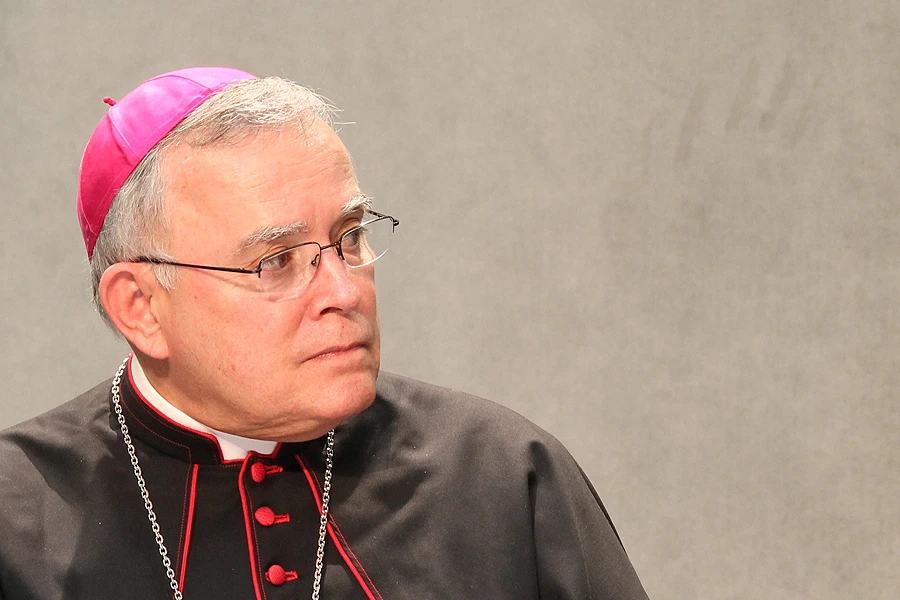

How can one respect a heretic?
Perhaps the same way that Christ respected the Pharisees and priests of his day when He called the whited sepulchers, children of father of lies, congregation of the devil…. (and they weren’t even attempting to justify the that sin of which this whole issue is about)
Re: “the same way that Christ respected the Pharisees . . . ”
It seems to me that perhaps one would need the discernment of Christ to feel secure in making a call like that w/r/t our contemporaries. I think Abp. Chaput makes a good point – – address the ideas, leave the personal vitriol aside (hey, one could even offer the lack of vitriol as a sacrifice).
if it walks like a duck, it probably isn’t a cow.
You might have missed the point of Abp. Chaput’s remarks.
With all due respect to the archbishop, he has demonstrated that he is a culture warrior in his own right in hi attempt to justify and defend Fr. Martin’s obvious undermining of Catholic teachings on homosexuality – where he does not overtly defy it.
I have yet to see any examples of the vitriol which Chaput and Bishop McElroy refer (the latter is himself guilty of the very claim he makes about others). No quotes have been offered.
Both Church Militant – not always my favorite – and Lepanto Institute use language which once was quite the norm for ecclesial leaders when calling out renegades like Fr. Martin, who serves better as an apologist for homosexuality in general and a shill for its normalization in the Church.
Today, the Church lacks shepherds with spine. It is disappointing to see Archbishop Chaput join the Amen chorus in the left corner condemning those who are doing his job. The appropriate behavior for Fr. Martin’s bishop is to silence him, but all he has dene is to order him to not reveal his own sexuality. This act, of course, has outed Fr. Martin completely, when before there was only uncertainty.
If by your self-serving reference to our human difficulties in attaining the discernment of Christ you mean we should eschew tough language, I’m afraid you are contradicted not only by several saints but also by loads of scripture.
Our bishops today are faint of heart and weak-minded. Study the Church Fathers and their saintly contemporaries who blistered both straying clergy and laity alike with the truth, and would turn their wrath upon those like you for your failure to stand for that truth.
The caterwauling we are hearing (and it is a revelation about Chaput) is the reaction of timid bishops to seeing what saintliness in action against those who would pour drops of poison into the waters of the Church.
Quote: “Father Martin is a man of intellect and skill”
One wonders really when he says things like the teaching of the Church not being received hence not binding.
Does that display intellect and skill? Or the devil’s own craftiness.
I love the way faithful Catholics will not avoid the reality of life, and will not back down from a religious fight, no matter the title of the person they are addressing. For myself, I like to maintain the intellectual purity of the argument, so that people arguing with me cannot say, “But you said…” I prefer merely presenting relevant Church documents having the greatest theological authority as my “argument.” That way, the argument is not “mine”, but belongs to the Church’s tradition and the Church’s own authority.
With all due respect, pretending that the enemy’s motives are pure is always the best thing to do. Pretending that Fr. Martin (or Pope Francis) isn’t trying to move the church away from it’s mission might make one feel good about oneself, but doesn’t help.
“The perceived ambiguities in some of Fr. Martin’s views on sexuality have created much of the apprehension and criticism surrounding his book”. There are errors, dangerous errors to the faith that contribute to the loss of souls. Not simply ambiguities in Fr Martin’s book. What is far more deadly to the salvation of all souls is not the “vitriol”. It’s the amelioration of heresy and unwillingness of our prelates to voice the truth.
Exactly. I have great respect for Archbishop Chaput, but I disagree with the position, as stated in the article, he might be taking on the Fr. Martin debacle.
The Church and its ministers must be faithful to the Gospel. We take that solemn oath at ordination. Fr. Martin’s positions and the deceptiveness of his arguments must be called to correction and possible punitive action should he not be properly responsive…that is the duty of the shepherds. The faithful see no evidence of that happening. On the contrary they see his advancement! Failure to address the false teaching clearly leaves the faithful feeling powerless as misdirection and error is not corrected. Psychologically speaking, why would we not expect some amount of vitriol?
Fr. Martin needs correction. Failure on the part of the shepherds to not address the errors is to the detriment of the Church and the Gospel.
Difficult this.
Given his obvious intelligence, what are the options? He really and truly does not support Catholic teaching in his heart, he begrudgingly does so but also works to mute it as much as possible, or his take on the Catholic moral code is so different I find it unrecognizable. None of these options lend themselves to mad respect.
Not to mention Martin’s embrace of spin tactics worthy of political parties versus churchmen.
Especially for those who believe homosexuality, while not a malicious orientation or sin, interesects with matters of grave sin …
Fr. Martin stubbornly providing confusing moral guidance. That is nothing to respect.
Look, people. This ain’t hard. Jesus calls us to love our enemies. It’s that simple directive that makes us different than pagans. Pagans would jump on a heretic and beat him to death. Christians don’t do that sort of thing. Chaput has it right. Everyone deserves his due, and God demands that we respect what is good in each man, even if we disagree with him. Now, we can have some self discipline, and be real Christians, and be respectful of someone like Father James Martin even when he is in the wrong. He has written some books previous to this that have brought people to Christ. Now, he is making huge mistakes now and he is saying some very stupid things. But he can be respectfully taken apart rhetorically, and put in his place, and it can be done in a nice civilized manner. The thing he wants most right now is for putative Christians to descend on him like a pack of dogs, so that he can whine and play the victim. The more respect and civility we show him, the easier it becomes to deal with him. He basically is destroying himself at this point, and the only thing that can save him is stupid moves that enable him to become a gay martyr. He has started panicking, and saying stupid thing after stupid thing. It seems that self destruction is built into him. Every move he has made in this controversy has made things worse for his cause. Don’t help him out by being unnecessarily unkind to the man. Even he can be redeemed, and who knows, in a year or two, he may see the error of his ways and turn around
Samton909, how do you know Martin is being disrespect. No quotes are offered – I suppose they must be so egregious they can’t reproduce them?
I don’t believe that without evidence.
Let’s not conflate disrespect with confrontation, with pushback. There’s nothing mealy-mouthed about this pushback, nor should there be.
To treat the responses he has legitimately brought upon himself as disrespect is a trick as old as the hills. It changes the subject. Please note the ecclesial claim of vitriol and disrespect comes on the heels of a host of cancellations of public appearances by Fr. Martin at Catholic venues.
Wow…LOL a lot of supposition as to motives, intention, etc.
I agree with you and grieve that one like Fr. Martin might be on the road to self-destruction professionally and personally with regard to reputation and, more importantly, salvation. I deeply hope for his repentant return and that of any other misleading teachers.
Basic human respect is a given to all human persons including enemies. At the same time, one cannot respect what is disrespectful. Fr. Martin has earned a certain disrespect due to his failure to teach authentically. No condemnation here, but a clear call to change-conversion.
We are still called upon by the Gospel to correct our brothers and sisters when they are in error. There is a formula for that in the New Testament. I am a purist about definitions, and I have my own definitions. For instance, “love” is to will and, when prudent, to work for the good of the other. “Good” is whatever God says is good. If I see something written by a person, I know that others will read it. If the other person’s writing contains something I think is in error, I must point that out so that others with not be led astray. However, I am subject to possible error, so as I wrote elsewhere, I prefer to use only authoritative Church statements as my argument. Hopefully people who read both the errant writing and my [hopefully] correct argument will recognize the validity of the Church’s teaching, and dissociate that from anyone’s opinion. When we wish to be wise, we should seek God’s will, since His will is perfect wisdom. I still respect the fact that faithful Catholics will support the Church’s consistent teaching, no matter who is presenting possibly contrary opinions.
There’s a YouTube video, referred to on The Catholic Thing. Fr. Martin is given an award by a lgbt activist group. In the Q&A, he is asked about the health risks in homoerotic sex. He literally takes the Obama pass: it’s above my pay grade, I don’t really know about that. I lived in New York in the 80s and 90s, by the end, everyone knew about the risks, they knew what was going on, including the Gay Mens Health Collective. Fr. Martin by his professed ignorance, puts gay men at risk. He also said that he does not preach Catholic sexual morality from the pulpit, only on an individual basis. Does his excellency Archbishop Chaput know these things? Are they not lies and refutation of Catholic moral teachings?
James Martin want respect but he does not show it to those who have been in the trench’s of the gay life style and have come out alive only by the grace of God. Just ask Joseph Sciambra.
Archbishop Chaput—I have been an admirer of yours, but I must say, you disappoint me greatly in this matter. There are some things that should inspire strong reactions and strong, plain talk, and Fr. Martin’s views fit the bill. It is unlikely that he even cares what people say.