

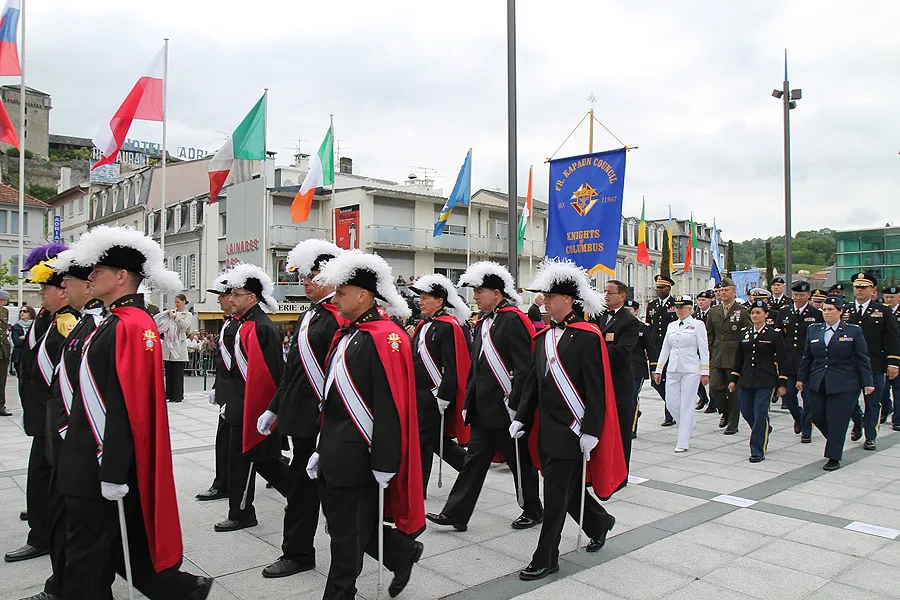
St. Louis, Mo., Aug 3, 2017 / 02:56 pm (CNA/EWTN News).- The classic ceremonial hats and capes of Fourth Degree members of the Knights of Columbus that you may have seen at Mass or at parish events will now be getting a major alteration.
“This fraternal year, we make another historic change. The Board of Directors has decided that the time is right for a modernization of the Fourth Degree uniform,” Supreme Knight of the Knights of Columbus Carl Anderson announced on Tuesday at the Knights’ 135th annual international convention in St. Louis, Mo.
Aaaand the new color guard unis, which are getting some attention on social media… pic.twitter.com/vALB7QVSix
— Matthew Hadro (@matthadro) August 3, 2017
The Knights of Columbus is an international Catholic men’s organization with over 1.9 million members worldwide. The organization promotes four virtues of fraternity, unity, charity, and solidarity among its members.
The Fourth Degree uniform is worn by those who have reached the highest levels of the Knights of Columbus, are at least 18 years of age and have been a Third Degree member in good standing.
Each degree is associated with one of the four virtues of the Knights, with patriotism being associated with the Fourth Degree.
Members of the Fourth Degree serve in honor guards for liturgical processions or in color guards at ceremonial events, hence the distinctive nature of their uniform.
The uniform of the Fourth Degree has changed throughout the history of the Knights, as previous versions included a top hat and a tuxedo with tails. However, it has remained relatively the same since 1940 – a plumed chapeau which can be worn with plumes of different recognized colors, a tuxedo, a cape, and a ceremonial sword.
Now, however, the Knights will be leaving behind the classic uniform for a “modernized” version, a blue blazer with the Fourth Degree emblem and dark gray slacks, a blue Fourth Degree tie, and a beret.
Vice supreme masters processed into Mass on Tuesday at the convention wearing the new uniform. Anderson then officially announced the change while delivering the annual report of the Supreme Knight.
The board of directors for the Knights decided for the change, Anderson said, to “modernize” the dress uniform that is typically worn at ceremonial or solemn events.
“On a limited basis, assemblies may choose to continue using the traditional cape and chapeau for color corps at public events and for honor guards in liturgical processions,” Anderson said on Tuesday.
“However, the preferred dress for the Fourth Degree – including color corps and honor guards – is now the new uniform of jacket and beret.”
If you value the news and views Catholic World Report provides, please consider donating to support our efforts. Your contribution will help us continue to make CWR available to all readers worldwide for free, without a subscription. Thank you for your generosity!
Click here for more information on donating to CWR. Click here to sign up for our newsletter.

The KofC 4th Degree uniform change is ridiculous and tears down a traditional mode of dress which is proper, correct and respectful. No silly berets…no blazers can replace something worm proudly by thousands and thousands of Knights for decades. Worst of all…where is the sword??? This is patently stupid…and I will NOT be wearing the new version…period!
I have been fourth Degree knight for 15years and I am not changing now.I am not army Range if I want to be Range I would have done back in 1950.
I agree with you. I had always loved seeing the Knights in the traditional regalia and now it just looks sloppy.
““However, the preferred dress for the Fourth Degree – including color corps and honor guards – is now the new uniform of jacket and beret.””
Preferred by whom? The same people who think nuns should be schlepping around in street clothes in case someone might think that they were doing something out of the ordinary and special?
I will not be a fourth degree membr much longer
I made no such combative comments, just stated that I may not be a fourth degree
Member much longer
The decision to change the uniform was from the ground up or the top down??
It seem like the latter.
Was there a groundswell of complaints from 4th degree Knights about the old uniform?
Apparently not. So why the change?
Tradition, too much of it represented in the old uniform. And we all know who owns the mindset that has absolutely no use for Tradition. Do we not?
WHY CHANGE. TOTALLY STUPID!!!!!!!!!!!
I LIKE the new uniform! This is 2017, so why are we wearing chapeaus and capes that were the fashion in the 1700s or 1800s? Why not dress in 21st century clothes? The berets are NOT silly. In the military the beret is worn by the most elite forces, not by your average G I Joe. The 4th Deg. is the most elite of the K of C, so the Beret is very appropriate. If we are to look like Elite warriors for the Church, then lets look like soldiers. Tuxedos with nerdy looking bowties are appropriate for a high society Hollywood party, but are very un-military looking. We are knights, not Hollywood playboys. I’m a former Sir Knight who will not rejoin the Degree as long as they are still wearing Tuxedos and wimpy bowties. I’ll wait until this modern uniform is fully adopted and THEN apply to be reinstated. I’ll then wear the new uniform PROUDLY!
Everyone in the US Army now wears berets and most soldiers hate them, most do not know how to form them correctly.
Most of our Knights look silly with the beret because they wear them like Brownie scouts.
You seem to think the beret is more modern than the chapeau and cape. Here’s some information on the history of the beret from wikipedia.
Archaeology and art history indicate that headgear similar to the modern beret has been worn since the Bronze Age across Northern Europe and as far south as ancient Crete and Italy, where it was worn by the Minoans, Etruscans and Romans. Such headgear has been popular among the nobility and artists across Europe throughout modern history.[3]
The Basque style beret was the traditional headgear of Aragonese and Navarrian shepherds from the Ansó and Roncal valleys of the Pyrenees,[5] a mountain range that divides Southern France from northern Spain. The commercial production of Basque-style berets began in the 17th century in the Oloron-Sainte-Marie area of Southern France. Originally a local craft, beret-making became industrialised in the 19th century. The first factory, Beatex-Laulhere, claims production records dating back to 1810. By the 1920s, berets were associated with the working classes in a part of France and Spain and by 1928 more than 20 French factories and some Spanish and Italian factories produced millions of berets.[3]
In Western fashion, men and women have worn the beret since the 1920s as sportswear and later as a fashion statement.
Military berets were first adopted by the French Chasseurs Alpins in 1889. After seeing these during the First World War, British General Hugh Elles proposed the beret for use by the newly formed Royal Tank Regiment, which needed headgear that would stay on while climbing in and out of the small hatches of tanks. They were approved for use by King George V in 1924.[6] The black RTR beret was made famous by Field Marshal Montgomery in the Second World War.[3]
It takes a special person to advance to the 4th Degree, one who is willing to continue the service of the 3rd and be a visible part of the order in the ceremonies, funerals, and parades. Again, time is a major factor. If it is the regalia, then the regalia has not been explained properly. We wear a chapeau to show leadership as heads of families, as leaders in the church as an Admiral leads his fleet. The cape is worn to show that we protect women and children, using the cape as shelter from wind and rain, from poverty and despair. It is an honor to wear the regalia showing that you are a soldier for the church, a soldier against the secular society that is taking away sacred traditions like the sanctity of marriage, the rights of the unborn, and now even the identity of our genders. The regalia sets us apart from other groups such as the legion, the shrine, the kinsman and many more. When they see the regalia, they see the Knights of Columbus. With the new uniform, they will not see this.
Apparantly I am in a very small minority that likes the new uniform. On other websites almost all the comments are negative, some even insulting and bashing the K of C, The Board of Directors, the supreme Council, and even our Supreme Knight Carl Anderson. A few Sir Knights even threaten to resign. Brother Knights, even if we strongly disagree with the decisions of Supreme Council, let us show some respect for our Supreme Knight and Supreme Council. Please, there is no need to be rude or insultive to anyone. Where is our Fraternity? If I had beeen asked to design the uniform I would have designed it differently. But I’m not on the board of directors. and it wasn’t my decision. But let’s stop calling their decisions “stupid”. We need to remain loyal to our leaders and show some respect for them. I’m looking forward to getting back into the 4th Degree and even though I dont like everything about the new uniform, as I said before, I will wear it PROUDLY – as should all Sir Knights! But I will have to wait a while because I cannot afford to pay for a tuxedo and regalia which is being phased out, then pay again for the new design. As for the swords, the Supreme council has said that Ceremonial swords WILL still be used. I presume this includes a Service Baldric to hold the Sword. Let’s give the new uniform a fair trial. I’m willing to bet there was a major outcry among the members long ago when they modernized from top hats and tails, to ordinary tuxedos. But the 4th Degree survived. Now let’s get over these current changes and move on. Vivat Jesus!
You’ve already said that you would not rejoin the 4th degree until they change the uniform, which you describe in disparaging terms. Then you tell us that you are shocked – *shocked* – that a few Knights even threaten to resign over the matter. You don’t seem to be in a position to complain that they may do what you have done.
Your fixation on the 21st century and how the uniform should look modern leads me to wonder if perhaps you would prefer a ceremonial M4 to anything as old-fashioned as a sword.
This seems to have been a top-down, don’t-consult-the-peons, modernism-is-king sort of thing. Hmmm, where have I seen that before? *koff*spiritofVaticanII*koff*
Leslie, you are right. I was being quite a hypocrite to say I would not rejoin the 4th Degree until they adopted the new uniform, and then criticized others for wanting to resign. I was wrong, I stand corrected, and I apologise for those remarks and take them back. The truth is, and yes this IS the truth, on several occasions I HAVE considered rejoining the 4th Degree long before we knew anything about a uniform change. I did not drop out of the degree because of the uniform. I dropped out for financial reasons. (I was broke at the time and couldn’t pay my dues which were almost two years in arrears. The Assembly offered to help me out, but I foolishly declined.) As for the regalia, at one time I actually did own a tuxedo and full regalia – all second hand and offered to me at a reduced cost. These, however, were returned to the Assembly after I dropped out. Yes I did wear these on occasion. I am currently retired and on a low income (Social Security only no other income) Thus it seems prudent to wait and see what happens with the new uniforms. If the Supreme Council goes ahead with this change, why pay double for two uniforms when one is being phased out soon? I’ll just wait and only pay for the new design. On the other hand, If Supreme backs down and rescinds their decision and keeps the old regalia, then I’ll still only have to pay for the one set of “old” regalia. But I take back what I said about not rejoining unless the new uniform is adopted. I really do want to march with the color guard some day, regardless of which regalia is finally mandated. (But I hope it is the new one!) And for the record, I would NOT prefer a ceremonial M4 over a sword. In fact, I strongly wish to keep the sword and do not consider it old fashioned. Vivat Jesus!
If you want “respect” for supreme, then supreme needs to show some respect for us.
I served my country in the armed forces and was proud to serve. My uniforms were PROVIDED by my country. The new fourth degree UNIFORM of the fourth degree is exactly that a UNIFORM, not Regalia with tradition and meaning which is a part of the Fourth Degree. Each piece of my Regalia has a specific meaning. When I must purchase something I must like it. If I don’t like it, I do not buy it simple enough. I do not like the new Uniform and will not wear it just to update. OUR leaders chose it and told us that this is our new uniform. What ever happened to majority rules in our organizations, are we a free society? Were ANY or ALL Assemblies even given an option, or ask for an opinion on this? I think maybe a FEW may have been sold this bill of goods but not the majority. I surveyed all members of my Assembly and not ONE was in favor of the change. I for one was not aware of the change until I was informed in the State Newsletter. I for one WILL NOT buy the new UNIFORM, and will only participate in functions that require the current Regalia. I feel as do a majority of others that this is a travesty for OUR GREAT ORGANIZATION. Let’s still be recognized as Knights of Columbus by our attire, not Special Operation Soldiers. Let our great works of kindness, charity, unity,fraternity, as well as patriotism bring us TOGETHER not DIVIDE. Let us vote by Assemblies, One Sir Knight, One Vote. Lets see DEMOCRACY at work in the Knights of Columbus. WE ARE THE Organization and we should have a voice in what we wear. Vivat Jesus
Where are their Jump Wings and Ranger Tabs? Are they going to be allowed to wear them as well? Those who EARNED the privilege of wearing the beret consider this to be “Stolen Valor.”
I worked on a military base, and I remember when in 2001 the powers that be decided that all soldiers, not just Rangers, should wear black berets. According to Stars & Stripes, their rationale was something to the effect that the Rangers wore black berets and their morale and cohesion was high, and therefore if the rest of the army wore black berets their morale and cohesion would be high.
By that reasoning, I hoped that someone would give me an Olympic gold medal, because people with Olympic gold medals are fit and athletic and healthy, and if they gave me the medal I would then be fit, healthy, and athletic.
What’s with everybody swiping the black beret?