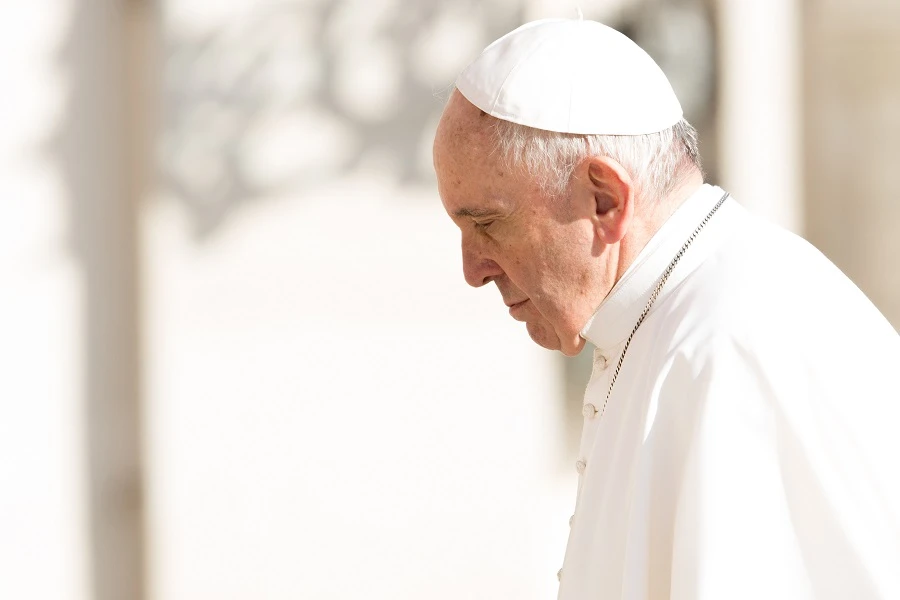
Vatican City, Jul 11, 2018 / 01:15 pm (CNA).- A long-time priority of Pope Francis, curial reform – specifically the overhaul of Vatican finances and communications – has been hanging by a thread for the past few years, and some wonder about the pope’s ability to make any meaningful or lasting changes in the Vatican’s way of doing business.
Observers seem to be underwhelmed at the progress Francis has made on major governance issues, among them financial oversight and sexual abuse policy. Some insiders have noted a palpable sense of confusion about what the pope’s reforms are meant to be, and where exactly they are going.
Since June 2017, the man tasked with leading the Vatican’s financial reform, Australian Cardinal George Pell, has been on leave, and is now preparing to face a historic trial for accusations of sexual abuse in his homeland. Some observers have argued that even when Pell was working at full-strength, the financial oversight structures Francis put into place were so tangled by internal power grabs that pursuing meaningful progress had become a delayed goal.
The pope’s communications overhaul seemed to be in shambles after the man charged with overseeing the process, Msgr. Dario Edoardo Vigano, stepped down amid the fallout of March’s “Lettergate” fiasco.
In recent months Francis has also come under fire for inaction on the topic of clerical sexual abuse, specifically in Chile.
Accused of insulting victims and ignoring their complaints, the pope had a major turnaround on the situation in Chile after receiving fresh evidence against a leading abuser priest in the country and launching an investigation which yielded findings frightening enough to make the pope stop dead in his tracks and speed into reverse.
But one of Pope Francis’ closest aides over the past five years, newly-minted Cardinal Giovanni Angelo Becciu, who is leaving the Secretariat of State for a new position as head of the Vatican’s office for canonizations, said recently that the pope’s reform still lacks an overall vision.
In comments to the press ahead of the June 28 ceremony in which he was given his red biretta, Becciu said that while many steps had been taken, it is still “too early” to give a comprehensive judgment on the Curial reform, since it is not yet finished.
An overall unifying vision is still missing, he said, explaining that “so far we’ve had elements, but not a unified idea.” This vision, he said, will likely be provided in the new apostolic constitution drafted by the pope’s nine cardinal advisors, called “Predicate Evangelium,” or “Preach the Gospel,” which has reportedly been completed and is now awaiting approval from Pope Francis.
A gloomy-seeming outlook for curial reform is often pinned on poor personnel decision-making at the Vatican. But two recent appointments to major posts could mark a turning point for Francis, and provide a much-needed morale boost for Catholics looking for the pope to clean house in Vatican offices.
The first of these is the appointment of a close Francis ally, Archbishop Nunzio Galantino, to take the reigns at the Administration of the Patrimony of the Holy See (APSA), which oversees the Vatican’s real estate holdings and investments.
During pre-conclave meetings in 2013, APSA was a key point in discussions on curial reform, as many cardinals recognized it had been being plagued by corruption and was in serious need of greater oversight.
Until Galantino’s June 26 appointment, APSA was led by Cardinal Domenico Calcagno, who has been accused of corruption and was, at one point, under investigation for charges of embezzlement in a previous diocese.
It took Francis more than five years to take action on APSA, which has been a sore spot for many who were hoping to see the pope crack down on financial issues. In a recent interview with Reuters the pope admitted that “there is no transparency” at APSA.
“We have to move ahead on transparency, and that depends on APSA,” he said in the interview. Many Vatican watchers are hopeful that Galantino will be able to bring in the accountability and oversight the office has typically resisted.
The second important personnel change is the appointment of Italian layman Paolo Ruffini as head of the Vatican’s communications office, making him the first layperson to lead a Vatican department, also called a dicastery.
Though Ruffini’s nomination was highly celebrated among Italians, who are pleased to have one of their own moving to such an important post, the new prefect is also seen as highly competent, bringing with him professional experience in journalism dating back to 1979.
Until his appointment Ruffini worked as the director of TV2000, the network of the Italian Bishops’ Conference, and he brings with him extensive experience in television, radio, and print, making him a choice perceived as a competent, well-rounded pick for the job.
Ruffini is considered to be in line with key priorities of the current pontificate, and his appointment can be read as follow-through on Pope Francis’ commitment to eradicate a clericalist mentality in the curia and to add more laypeople to the mix.
Despite the fact that Msgr. Dario Vigano, who headed the office until the “Lettergate” scandal, is expected to stay in the dicastery in the advisory role the pope gave him, observers are hopeful that at least some of the pope’s stubbornness in decision-making is gone, and that the days of poor personnel choices will be a thing of the past.
And with several decisions made that seem to indicate reform is moving in the right – or at least a better – direction when it seemed to be on the brink of failure, a natural question comes to mind: what changed?
Some believe the turning point was the pope’s reaction to the Chilean abuse crisis. After initially defending the bishop at the center of the debate, calling accusations of cover-up on the part of the bishop “calumny” and claiming that no evidence of the prelate’s guilt had been brought forward, Francis had a major turnaround when news came out that evidence had been presented years prior which he either never got, or potentially ignored.
It was a serious blow to Francis’ credibility in the fight against sex-abuse in the Church, and to his public image. Soon after he sent his top investigator on abuse to Chile to look into the situation, and after receiving a 2,300 page report, the pope issued a letter to Chilean bishops saying he had made “serious errors” in judging the situation due to a lack of “truthful and balanced information.”
Many observers pinned the blame on 84-year-old Chilean Cardinal Javier Francisco Errazuriz, who is a member of the pope’s nine-member Council of Cardinals and who has come under heavy fire from victims for covering up abuse while archbishop of Santiago, and for trying to discredit victims’ testimonies.
In his recent interview with Reuters, Pope Francis said his council of cardinal advisors, called the “C9” and whose mandate will be up in October, would be refreshed with new members.
Though such a decision is natural after term limits end, some observers have pondered whether the Chilean crisis and the accusations against Errazuriz, the absence of Cardinal Pell and separate accusations of financial misdealing on the part of Honduran Cardinal Oscar Maradiaga, also a member of the advisory team, have, to a certain degree, awakened Francis to the need to be more selective with his inner circle.
The answers to these questions, of course, are pure speculation, but if one thing can be said about the pope’s latest round of appointments, it’s that while his track record on reform efforts has not been the best, and while there are still loose ends to tie up, he is at least aware of the problems and he seems intent on making good on his promises, even if that does not happen immediately.
And if the first five years of Pope Francis’ curial reform have largely been seen as ineffective, the appointment of Ruffini and Galantino just might give the flicker of hope needed for Catholics to decide that the jury is still out on the long-term process. However, as with any reform, really only time will tell.
 […]
[…]



“He also said he does not like ‘extremisms, either progressive, or traditionalist ones’ but believes ‘there is a via media’ which is the ‘correct path to take, even if each of us has his own peculiarities, because, thanks be to God, we do not repeat, we are not clones'(Cardinal Ladaria SJ).” Edw Pentin voiced cautious reserve in Pope Francis’ choice. Pentin noted concern of having two Jesuits in the foremost positions of authority in the Church. It’s the “via media” that is most concerning given that he has never expressed any concern whatsoever over AL. Via media is the Pontiff’s putative approach for communion for D&R in AL. What is striking regarding a middle ground narrowly measured approach in AL is far from what has transpired in those Nat Bishops Conf that have adopted AL and gone far beyond giving sanction to reliance on conscience. It seems considering what is said here Cardinal Ladaria SJ will amount to no more than a yes man. An effectual papal puppet. At least to his great credit Cardinal Mueller had the courage to warn the German Bishops. But who would think outlaw Card Reinhold Marx who previously said he would defy Rome in the mold of Martin Luther and follow his own perspectives on moral issues would pay attention to Card Mueller. Now the Pontiff no longer needs to deal with a Gadfly. He’s appointed a Gnat.
“The Vatican announced July 1 that taking Müller’s place will be Jesuit Archbishop Luis Ladaria, who was appointed secretary to the CDF by Benedict XVI in 2008, and is known to be simple, orthodox in his theology, highly intellectual and is described by those who know him as not being a ‘yes man’.”
http://www.catholicworldreport.com/2017/07/02/cardinal-mller-theres-no-problem-between-me-pope-francis/
I hope he is a good Jesuit and not a bad one.
Oh, brother.
I don’t see how Ladaria is anything but a
“Yes” man as Fr. Morello’s excellent comment declares.
At some point, as Christ promised, the Holy Spirit will have to intervene because Pope Francis will actively move to deny Church doctrine.
“The Vatican announced July 1 that taking Müller’s place will be Jesuit Archbishop Luis Ladaria, who was appointed secretary to the CDF by Benedict XVI in 2008, and is known to be simple, orthodox in his theology, highly intellectual and is described by those who know him as not being a ‘yes man’.”
http://www.catholicworldreport.com/2017/07/02/cardinal-mller-theres-no-problem-between-me-pope-francis/
The SJ is about the sexual revolution and their world-wide zeitgeist brand.
With exceptions for the orthodox ones I know I can trust, like Fathers Schall, Fessio and others like them, I begin with total distrust of anyone of SJ.
I wish their decadent order would disappear faster than they already are.
Just what Pope Francis wants – another yes man carrying water for his decadent 1960s “Kasper-Kirk” the new Church of man as god:
Quote Kasper: ” The God who sits enthroned over the world and history as a changeless being is an offense to man.” (Kasper, God in History, 1967).
Total arrogance.
I reject Pope F until the day he answers the dubia by unambiguously affirming FC, and upholding the word of Jesus against his henchman Kasper and his neo-Pharisee demand for divorce.
I thin a correction should be made in the article and instead of saying: “the most important dicastery in the Roman Curia”, it should be “formerly the most important dicastery…”, as it seems clear that the Pontiff doesn’t have much patience with doctrine. Otherwise, why would be refuse to answer the “dubia”? He is gung ho on changing the doctrine surreptitiously by means pastoral practice. Maybe Ladaria, being aJesuit, will be more docile, according to the Ignatian doctrine of “blind obedience”, or at least he will keep his mouth shut on AL. He is certainly not heterodox.
Oh I doubt Father Ladaria would be intimidated by his fellow Jesuit. Look at Father Fessio–he’s not ever been intimated
by his fellow priests, including his fellow Jesuit, the Pope.
Sick and tired of this man who sits in St. Peter’s chair.
He is not my pope until he answers the dubia.
How could one be concerned about the 4th of July celebrations when a whole new scandal is breaking about the sexual abuse of children, wholesale gay parties in the Vatican and how two of the advisors close to the pope are deeply involved in ongoing sexual activities in a place owned by the Vatican. Amazing, we thought the church had entered into a new era obviously nothing ever changes. These priests and even cardinals involved who practice the gay lifestyle in grand style are rife in the Vatican even those who direct the Liturgy are involved and many others. Some from Australia, Pell for one with many cases against him and those from America who have brought new gay life to the Vatican. It has been all over the radio today is Los Angeles, Radio KFI. Tomorrow it will be all over NY news. They were those that pushed the investigations against Cardinal Mahoney. Evidently, the time has come to leave the church as only a nod is given to these unforgivable acts and life goes on starting with the pope and ending with the lowest priest in any diocese. Obviously, there is no cure for these sins. Well, this will never be posted. God help us, evidently, this is just another Jesuits will be Jesuits. The elites? We don’t think so.
Kathy,I believe that God issues the call, but until these molesters and the bishops who shield them face justice,men who want to live a holy life will stay away from the priesthood. Thank God Pope Francis sent Pell back to Australia to face the music and answer to the law for his misdeeds.
Kathy,thank God Pope Francis sent Pell back to Australia to face the music. Men who want to to serve God will stay away from a priesthood where sin is allowed to flourish.
I hope this man is like Father Fessio an not like Bergoglio,I hope he is Orthodox an a Loyal Son of Jesus Christ……