No Picture
News Briefs

Francis: Migrant crises require focus on reality, dialogue, commitment

June 12, 2017 CNA Daily News 0

Vatican City, Jun 13, 2017 / 12:04 am (CNA/EWTN News).- Pope Francis sent a letter last week to the Latin American Parliament as they discuss migration in the region, encouraging governments to protect all who reside in their territory regardless of their origin.

“As members of a large family, we must work to place the ‘person’ at the centre; this is not a mere number or an abstract entity but a brother or sister who needs our help and a friendly hand,” the Pope wrote in his June 7 letter to the Latin American Parliament, which is holding its 33rd General Assembly.

The assembly of representatives from 23 Latin American and Caribbean countries is meeting to discuss migration in the region and international responses.

Francis offered his congratulations to the parliament “on this initiative that aims to help and make life more dignified for those who, having a homeland, regrettably do not find in their countries adequate conditions of security and subsistence” and are forced to flee.

The Pope’s message highlighted three themes: reality, dialogue, and commitment. He explained how each of these can be oriented toward developing effective humanitarian aid for migrant peoples.

Speaking about his first chosen word, “reality,” Francis emphasized knowing the causes of migration.

“This requires not only analysis of this situation from ‘the study desk,’” he said, “but also in contact with people, that is to say with real faces.” He warned against an “aseptic analysis” which “produces sterile measurements,” instead encouraging the parliament to pursue “a relationship with a person in the flesh helps us to perceive the deep scars that he carries with him, caused by the reason, or unreason, of migration.”

Francis expressed hope that the assembly would produce “valid responses for migrants and host countries,” as well as security which is based in reality.

“Dialogue is indispensable in this work,” Francis explained. “One cannot work in isolation; we all need each other.”

He condemned the “throwaway culture,” calling instead for member nations to work for approaches which welcome migrants fairly and efficiently. He emphasized the need for unity in dialogue, saying that attaining “a consensus between the parties is a ‘craft;’ a meticulous, almost imperceptible task but essential for shaping agreements and regulations.”

“Dialogue is essential to foster solidarity with those who have been deprived of their fundamental rights,” Francis said.

Speaking on commitment, the Pope cautioned against spending too much energy “on the detailed analysis and the debate of ideas,” saying instead that a solution must be sought.

“Latin America and the Caribbean have an important international role and the opportunity to become key players in this complex situation,” he said.

He emphasized the need for mid-term as well as long-term planning so that aid can extend beyond emergency responses. This, he said, will allow for migrants’ integration into their new nations and, assistance in the lands they fled.

Francis called special attention to the needs of children in this struggle, recalling their “right to be children,” and once more spoke out against human trafficking, which he described as a “scourge.”

He acknowledged the enormity of the work, saying that “we need men and women of good will who, with their concrete commitment, can respond to this ‘cry.’”

“I urge national governments to assume their responsibilities to all those residing in their territory,” the Pope said, “and I reiterate the commitment of the Catholic Church, through the presence of the local and regional Churches, to responding to this wound.”

In closing, Pope Francis encouraged the assembly in their work on this crisis, and prayed for the intercession of the Holy Virgin, recalling the Holy Family’s flight to Egypt. He asked for the prayers of the assembly, and asked God to bless them.

[…]

No Picture
News Briefs

A new procedure for bishops’ ad limina visits to Rome

June 12, 2017 CNA Daily News 0

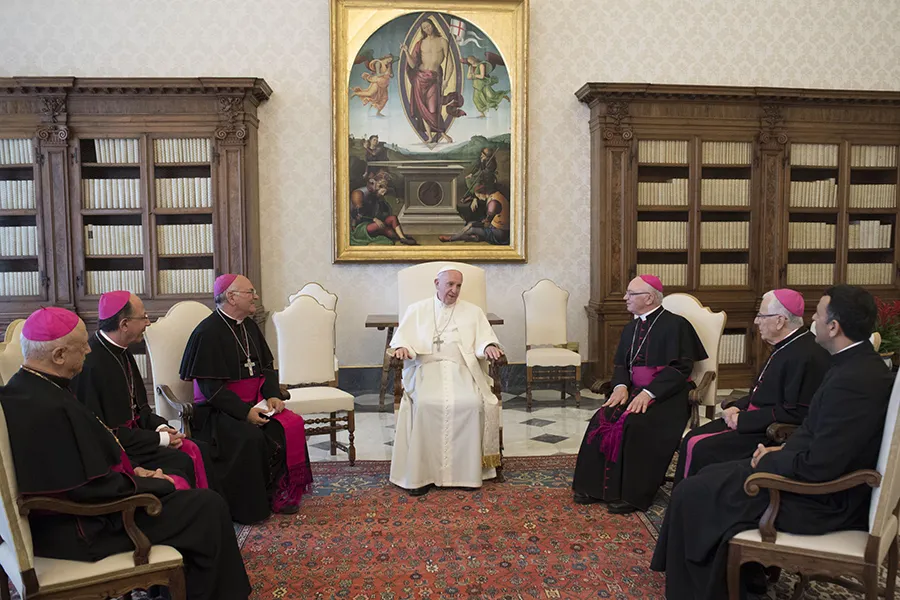
Vatican City, Jun 12, 2017 / 04:03 pm (CNA/EWTN News).- In order to foster collegiality, Pope Francis has added to the usual schedule of bishops’ ad limina visit to Rome: one additional meeting with the heads of the Vatican dicasteries.

The ad limina apostolorum – “to the tomb of the apostles” – visits are the meetings that groups of bishops from each ecclesiastical region in the world have with the Pope every five years. In such occasions they also visit and celebrate Mass at the tombs of St. Peter and St. Paul.
 
Before meeting the Pope, the bishops from a particular country or region visit all the dicasteries Vatican dicasteries and can schedule personal meetings with the head of each dicastery to discuss particular matters.

During such visits, bishops’ conferences prepare exhaustive reports for each dicastery, describing the status of the Church in the country or region.
 
Before Pope Francis, the meeting of the bishops with the Pope included an exchange of speeches: the president of the bishops’ conference delivered a speech to describe the state of the region, and the Pope delivered a speech in his turn which provided pastoral recommendations and priorities.
 
After the exchange of speeches, the Pope held a short conversation with each bishop individually.
 
But since the beginning of his pontificate, Pope Francis chose the format of an open conversation with the whole group of bishops. All of them are allowed to ask questions, and the Pope responds off the cuff.
 
The Pope also prepared a formal speech, a copy of which was provided to each bishop.
 
With time, even the delivery of the papal speech fell into disuse. Now, no official papal text is prepared and therefore the press only knows of the matters discussed during the visit from the bishops who attended it.
 
Pope Francis has made an additional, recent change: the bishops have now a meeting presided over by Pope Francis with many heads of the Vatican dicasteries.

Not all the heads of Vatican dicasteries take part in the meeting, but only those whose dicasteries are in some way related to pastoral care or some of the main issues at stake in the ecclesiastical region visiting Rome.

Bishop Thomas Dowd, auxiliary bishop of Montreal, told CNA that “for the first time with our group, the Pope met twice with the bishops: before in a meeting with several heads of the Vatican dicasteries, and after for the usual exchange of opinions, which lasted about two hours.”

Bishop Dowd described it as a working meeting which included representatives from the Secretariat of State, the Congregation for Clergy, the Pontifical Council for the Promotion of the New Evangelization, and the Dicastery for Laity, Family and Life.

Thanks to provided translation, the Pope, prefect, and bishops of Quebec had “an open exchange of opinions about the Church in the region and its needs. We got advice from the Curia. We gave our input to them, the Curia officials gave their input to us.”

Bishop Dowd added that “the Pope listened to us, and we had coffee together at the end.”

The auxiliary bishop of Montreal recounted: “The Pope basically said: ‘We want to hear from you about what is your situation. Tell us your experience’. The various dicasteries had prepared remarks based on the reports that we sent in advance to the ad limina visit.”

He added that, as the discussion went on, “some of the dicasteries read the texts they prepared, but most of them did not read the texts, but reacted to the experiences raised during the open discussion.”

During the meeting, Pope Francis listened attentively to all the discussions. He spoke at the end, to summarize the discussions and provide an overall reaction.

The bishops of Peru followed next in May, with the same new extra meeting.
 
Archbishop José Antonio Eguren Anselmi of Piura told CNA that the double meeting, first with the heads of the dicasteries and then only with the bishops “gives great attention to the local Churches, since we have the possibility to spend at least four hours with the Pope.”

[…]

No Picture
News Briefs

Immigration arrests stun Detroit’s Chaldean Catholics

June 12, 2017 CNA Daily News 0

Detroit, Mich., Jun 12, 2017 / 03:29 pm (CNA/EWTN News).- Dozens of Chaldean Christians were arrested by federal immigration officials over the weekend in the Detroit metropolitan area, leaving the local Church community with sadness and frustration.

“Yesterday was a very strange and painful day for our community in America,” Bishop Francis Kalabat of the Chaldean Catholic Eparchy of St. Thomas the Apostle of Detroit stated Monday in a Facebook post.

“With the many Chaldeans that were awakened by Immigration Customs Enforcement (ICE) agents and consequently picked up for deportation, there is a lot of confusion and anger,” he added.

Fr. Anthony Kathawa of St. Thomas Chaldean Church in West Bloomfield, Mich., told CNA June 12 that “As a community, we’re all suffering seeing the loss of our loved ones.”

On Sunday, the Detroit Free Press reported that ICE made around 40 arrests of Chaldeans in the Detroit area, according to community leaders.

ICE explained in a statement that Iraq, in negotiations with the U.S., had “agreed to accept” the individuals, who had criminal records.

“As a result of recent negotiations between the U.S. and Iraq, Iraq has recently agreed to accept a number of Iraqi nationals subject to orders of removal,” ICE stated.

A federal judge had also “ordered them removed,” ICE said, noting that their previous criminal offenses included homicide, rape, sexual assault, kidnapping, and “weapons violations.”

A “majority” of those detained are now at the Northeast Ohio Correctional Center in Youngstown, Ohio.

Many of those with criminal records have served their time in prison and have since become good citizens and members of the community, local Church leaders insisted.

“We understand that maybe there was a problem in the past, but there’ve been a lot of people moving forward,” Fr. Kathawa told CNA. “They’ve changed, become better, made families in this great country of opportunity and peace.”

“And now with them leaving, it’s causing chaos within our community, within our families, within our Church,” he added.

“The Church does not oppose justice, all hardened criminals that are a danger to society should be picked up,” Bishop Kalabat stated. “Many who were picked up are not hardened criminals but for the last decades have been great citizens.”

Regarding Sunday’s arrests, the local Church has been in touch with the State Department, members of Congress, and the U.S. Conference of Catholic Bishops on the matter, the bishop added.

Chaldeans are an Iraqi indigenous community and speak Aramaic. The Chaldean Catholic Church is an Eastern Catholic Church which uses the East Syrian rite.

The Chaldean Catholic community in Detroit dates back to the early 20th century, and an apostolic exarchate was established in 1982. There are around 150,000 Chaldeans in the Detroit area, which is the largest Chaldean diaspora community living outside the Middle East, according to the Chaldean Community Foundation.

Around 30,000 refugees were re-settled in Michigan since the Iraq War began in 2003, and more Syrian refugees are expected to be re-settled there in the coming years, the foundation noted.

Martin Manna, president of the locally-based Chaldean Community Foundation, told the Detroit Free Press that deporting the Chaldeans to Iraq “is like a death sentence.”

The U.S. State Department declared in March of 2016 that the Islamic State had committed genocide against Christians and other religious and ethnic minorities in Iraq and Syria.

The fight to dislodge the Islamic State from Iraq is ongoing as parts of Mosul are still under the group’s control. Although the villages of many Christians in northern Iraq have been liberated, many are still not yet able to return to their homes. Many families are still dependent on aid groups for their livelihood.

There have been efforts in Congress to designate groups targeted for genocide, like Christians in Iraq and Syria, as P-2 refugees, which would expedite their resettlement process in the U.S. as refugees.

Contrary to rumors, the local Church had not signed off on any of the deportations, Bishop Kalabat insisted in a Facebook post on Monday.

“It has been rumored that our Church signed documents regarding the deportation issue. To my capacity, as a permanent member of the church synod, I would like to formally state that this is NOT true, and that was no signed document or any type of agreement made with the Iraqi government or anyone else, that would allow the deportation of Chaldeans to Iraq,” he stated. “There was no such thing discussed, signed, or issued.”

The arrests follow a spike in ICE immigration arrests that began with President Donald Trump’s executive order on immigration at the beginning of his presidential term.

In the first 100 days after that order was signed, ICE reported in May that immigration arrests were up 40 percent in comparison with that same time period in 2016.

[…]

No Picture
News Briefs

For Pope Francis, consolation require an open heart

June 12, 2017 CNA Daily News 0

Vatican City, Jun 12, 2017 / 12:14 pm (CNA/EWTN News).- Consolation is never self-reliant, Pope Francis said during Mass on Monday, noting it is only possible to receive the Lord’s encouragement through another.

“No one can console himself, no one – and whoever tries to do it ends up looking into the mirror – staring into the mirror and trying to ‘make oneself up,’” said the Pope during his June 12 Mass at the chapel of the Vatican’s Casa Santa Marta.

“The experience of consolation, which is a spiritual experience, always needs ‘someone else’ in order to be full.”

He reflected on the day’s readings, in which Saint Paul described the need for the Lord’s consolation in his second letter to the Corinthians, and the Beatitudes in the Gospel of Matthew.

He said the “doctors of the law” will not have true consolation because they are the ones who console themselves. “One ‘consoles’ with these closed things that do not let one grow,” he said, “and the air that one breathes is that narcissistic air of self-reference.”

This narcissism never allows for growth or a view of the entire picture, he explained.

Pope Francis said consolation is always from the Lord, and is a two-fold process: receiving a gift and serving others. He said “consolation is a state of transition from the gift received to the service given.”  

Consolation must begin with a recognition of one’s own need, he said, explaining that “only then does the Lord come console us, and give us the mission to console others. It is not easy to have one’s heart open to receive the gift and to serve.”

He said an open heart is a happy one because it relies on the Lord, and he reflected on the receptive spirit described in Beatitudes.

“The poor: the heart is opened with an attitude of poverty, of poverty of spirit; those who know how to cry, the meek ones, the meekness of heart; those hungry for justice who fight for justice; those who are merciful, who have mercy on others; the pure of heart; peace-makers and those who are persecuted for justice, for love of righteousness.”

“Thus is the heart opened and [then] the Lord comes with the gift of consolation and the mission of consoling others,” Francis stated.

The Pope contrasted it to the men with closed hearts, who find themselves sufficient: “those who do not need to cry because they feel they are in the right.” He said these men do not understand meekness, mercy, or forgiveness, and in turn they cannot serve others in the same way.

He asked his audience to reflect on how open their hearts are to be able to ask for consolation and then to pass it on to their neighbors.

Ending with words of encouragement, he said the Lord always aims to console us and “asks us to open the doors of our hearts even only just a little bit.”

[…]