


What the bishop who resisted the Nazis can teach us today
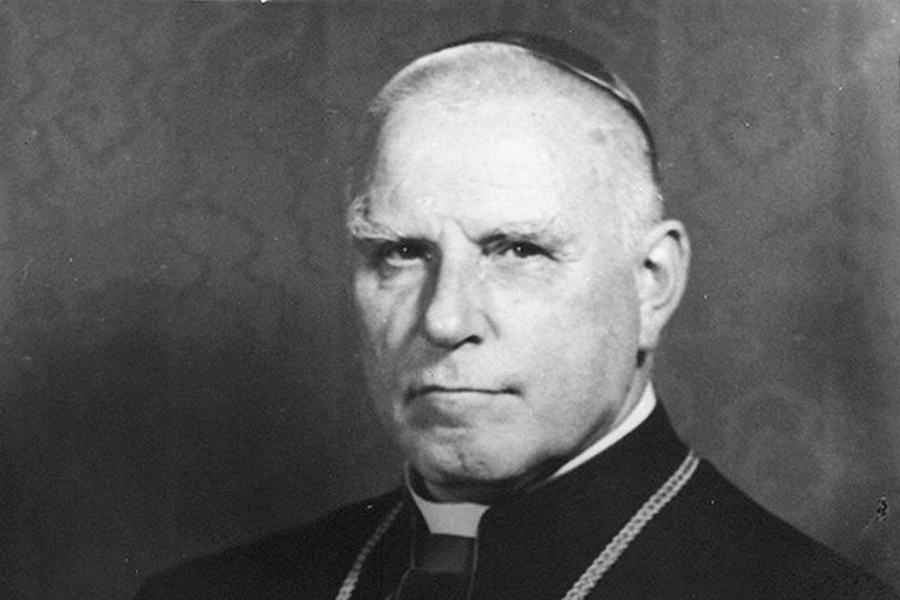
Münster, Germany, Mar 22, 2017 / 07:04 am (CNA/EWTN News).- When Father Clemens August von Galen was consecrated Bishop of Münster in October 1933, he chose for his episcopal motto Nec laudibus, nec timore – neither by praises nor by fear, which summed up his ministry throughout Germany’s Nazi period.
The motto was taken from the liturgy for episcopal consecration, which prays that the new bishop will love humility and truth, and not be overcome by either praise or fear.
Bishop von Galen wrote in his first pastoral letter that “Neither the praises of men nor fear of men shall move us. Rather, our glory will be to promote the praise of God, and our steadfast effort will be to walk always in a holy fear of God.”
During his entire episcopacy the bishop spoke up against the Nazis’ euthanasia program and racial theories, and defended human rights and the cause of justice. He was the most outspoken of Germany’s bishops during that era, and assisted the writing of Pius XI’s 1937 anti-Nazi encyclical Mit brennender Sorge.
He was made a cardinal in February 1946, just one month before his March 22 death, and he was beatified in 2005 by Benedict XVI.
Blessed von Galen’s motto “would be a great motto to have for a bishop,” Fr. Daniel Utrecht of the Toronto Oratory told CNA. Fr. Utrecht is the author of The Lion of Münster: The Bishop Who Roared Against the Nazis.
Fr. Utrecht was drawn to write about Blessed von Galen because he was a model bishop.
“I was telling some people about him during World Youth Day in 2005, and they said, ‘We need bishops like this, why have we never heard of this guy? Someone should write a book about him’,” he related.
The priest recalled reading in German a two volume work of Blessed von Galen’s documents, letters, and sermons written as a bishop. “They became more and more fascinating, and there just wasn’t much in English to read about him. I eventually came to the conclusion that it was up to me to write an English-language biography.”
Blessed von Galen was born into a German noble family in 1878, and was ordained a priest of the Diocese of Münster in 1904. As a priest he wrote on the origins and limits of state power, and the importance of voting as a responsibility for the common good rather than doing so for private interests.
In the later years of the Weimar Republic, Blessed von Galen supported the German Centre Party, which worked to present a Christian voice in defense of Catholic interests and human rights in the public square, and entered into coalition governments with other parties in an effort to balance power.
But the priest was unable to sway many of his acquaintances to support the Centre Party – other Catholics were arguing that the Nazi Party was most compatible with Catholic ideals.
Many bishops had barred Catholics from being members of the National Socialist movement. But when Hitler softened his antireligious stance and stated early in 1933 that Christianity would be prominent in Germany’s rule, the bishops took him at his word and began allowing Catholics to join the movement.
But when Blessed von Galen was made a bishop later that year, he maintained his anti-Nazi beliefs. Within a year he clashed with government officials over the rights of Catholic schools and the Nazis’ racial and anti-Jewish ideology.
He was most outspoken against the Nazi’s involuntary euthanasia program, which under which the disabled, mentally ill, deformed, senile, those with Down syndrome, and the incurably sick were killed. The program began in 1939, and more than 70,000 people were euthanized under it.
Blessed von Galen led Catholic protest against euthanasia. He delivered three sermons in the summer of 1941 which condemned the program, as well as Nazi attacks on the Church, and raised public awareness of what has happening. After the sermons’ delivery he was nicknamed “The Lion of Münster”, and they resulted in a Nazi propaganda minister, Walter Tiessler, recommending that he be executed.
The bishop remained outspoken against Nazi atrocities throughout World War II, and afterwards spoke up against injustices committed by the occupying Allied forces.
“I see plenty of parallels today,” Fr. Utrecht told CNA. “I hope that people reading the book get it for themselves.” Blessed von Galen’s “example of courage and being able to speak out in defense of human life is of interest, very much of interest today, in the fight against abortion and euthanasia … the defense of liberty, religious liberty, the defense of a place for religion in the public square is a very, very big lesson that he has for us.”
In addition to supporting Catholic witness to the value of human life in the face of abortion, euthanasia, assisted suicide, and the dictatorship of relativism, Fr. Utrecht said that the cardinal can speak to Catholics facing political dictatorships as well.
The priest shared how during a recent trip to Germany he met a priest from Africa who is “very keen on making von Galen known to the Africans, because he said ‘In many places we have totalitarian governments and not enough of the bishops speak out’, – so he thought there was a great parallel there.”
Since Cardinal von Galen was beatified 12 years ago, there is a need to develop devotion to him, Fr. Utrecht reflected. “Greater devotion to him is the next step, not just locally, but worldwide.”
“There are plenty of people who do know about him and who are pushing devotion to him, but it needs kind of a new push, so I hope we can get a push, and not only there, but among English- reading people elsewhere.”


