Time for frank talk about the sewage, filth of the sexual revolution
The other day I happened to find out about the recent death of the first person who ever approached me and asked for sex. I am sorry to put it in those ugly words, but […]

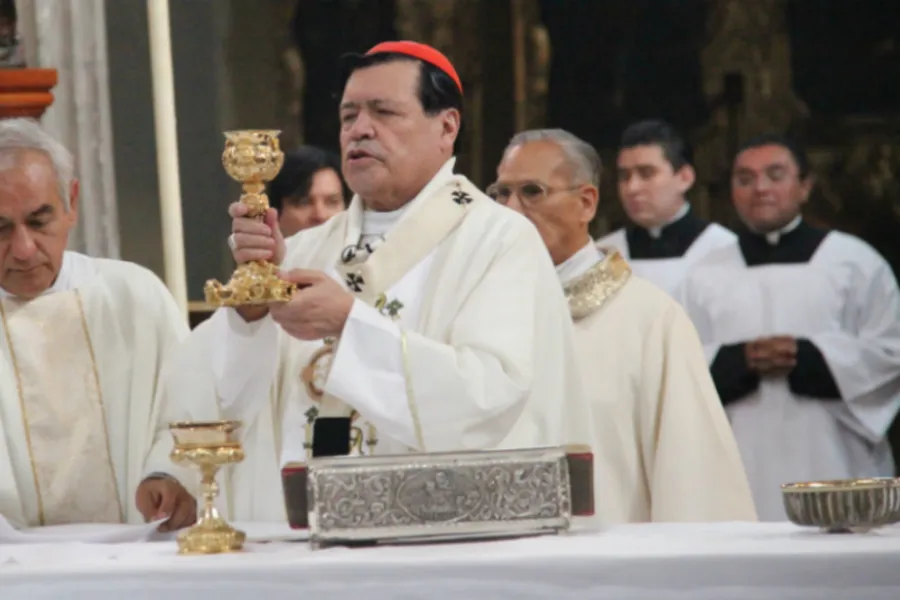
Mexico City, Mexico, Aug 14, 2017 / 02:35 pm (CNA/EWTN News).- The Archdiocese of Mexico has countered claims made by two former priests that Cardinal Norberto Rivera Carrera covered up the actions of pedophile priests, calling the allegations an “orchestrated farce.”
The communications office of the Mexico City archdiocese reported that Cardinal Rivera had spoken to a Public Ministry official July 26, in response to the June 2 complaint filed by Alberto Athié and José Barba.
Athié and Barba filed their complaint with the Attorney General of the Republic’s Office, accusing Cardinal Rivera of the alleged cover-up of 15 pedophile priests. In the 1990s Athié had brought allegations against Fr. Marcial Maciel, founder of the Legion of Christ. Fr. Maciel was later removed from public ministry after it was verified he had committed sexual abuse and fathered several children.
The Archdiocese of Mexico indicated that Athié and Barba based their charges on a Dec. 19, 2016, news brief published in El Universal “in which a meeting was made known that the cardinal had with journalists where the archbishop mentioned that during his administration as head of the Primatial Archdiocese of Mexico he had sanctioned 15 priests – not all for the crime of pederasty, but with other illicit acts classified in canon law.”
The archdiocese said that “the complaint against the Archbishop of Mexico was in the sense that he did not promptly report these cases to the authorities, for which they cavalierly accused him of covering up sexual abusers.”
It indicated that during his July 26 meeting with the Public Ministry agent, “the cardinal showed copies of the complaints filed by the Archdiocese of Mexico since 2010, as laid down by law, against alleged criminal acts within the Church.”
The archdiocese added that Cardinal Rivera “made it clear that from the time that Part 2 of Article 12 of the Law on Religious Associations went into effect Aug. 19, 2010, – which obliged ministers of worship and their representatives to inform the appropriate authority of the probable commission of crimes – he was aware, through some of his episcopal vicars, of the probable commission of six presumably criminal acts.”
According to the archdiocese, the cardinal instructed his episcopal vicars “immediately to notify the appropriate authorities, which was done, as attested by the copies he exhibited, and which demonstrated that he did not commit the crime of cover-up.”
The archdiocese also publicized the dates of the six complaints, along with the authorities to whom they were made, and the officials who made them.
Cardinal Rivera “explained that the other nine cases were prior to the cited law going into effect, and only one had to do with the crime of pederasty, and the accused is being criminally prosecuted with the information that the archdiocese provided to the authorities,” the Mexico City archdiocese stated.
“The other eight cases were for conduct penalized by canon law, such as financial fraud, mistreating an adult, breaking the seal of confession, and others that were made known to Church authorities,” it said.
The Archdiocese of Mexico stated that in response to “the express question of the Public Ministry agent, the Archbishop of Mexico acknowledged as his own the statement referred to in the news brief published by El Universal Dec. 19, 2016; clarifying that, however, since it was an impromptu interview, he failed to specify that not all the mentioned cases had to do with the crime of pederasty – as the former priests Alberto Athié and José Barba maliciously indicated.”
In addition, “he said that regarding the cases made known to the civil authorities, it was solely their responsibility to follow up on them, and of the ones the church authorities knew about, they were concluded with the suspension of priestly ministry, since in those cases the ecclesiastical sentence is given by the Pope and is made known through the Congregation for the Doctrine of the Faith.”

Washington D.C., Aug 14, 2017 / 10:59 am (CNA/EWTN News).- With deadly violence following a rally of white supremacists this past weekend in Charlottesville, Va., bishops throughout the nation denounced racism and racist ideologies.
Cardinal Daniel DiNardo of Galveston-Houston, president of the U.S. Conference of Catholic Bishops, and domestic justice chairman Bishop Frank Dewane of Venice, Fla., issued a statement on Sunday condemning “the evil of racism, white supremacy and neo-nazism.”
They also prayed for peaceful counter-protesters, saying that “our prayer turns today, on the Lord’s Day, to the people of Charlottesville who offered a counter example to the hate marching in the streets.”
“Let us especially remember those who lost their lives. Let us join their witness and stand against every form of oppression,” they said.
This past weekend, a planned “Unite the Right” rally in Charlottesville, Va., to protest the city’s removal of a statue of Confederate General Robert E. Lee drew white supremacists including neo-Nazis and Ku Klux Klan members. A counter-protest, including a diverse coalition of religious leaders and members of the Antifa and Black Lives Matter movements, was formed.
On Saturday, a man drove a car into the counter-protest, injuring 19 and killing one, 32 year-old Heather Heyer of Charlottesville, the AP reported. Attorney General Jeff Sessions said the incident “does meet the definition of domestic terrorism in our statute,” and promised to “protect the right of people, like Heather Heyer, to protest against racism and bigotry.”
Two Virginia State troopers also lost their lives near Charlottesville as they responded to the situation there, when their helicopter crashed in Albemarle County.
Catholic bishops denounced the violence but also explicitly condemned the racist ideology amidst the “Unite the Right” gathering.
Archbishop Charles Chaput of Philadelphia stated on Sunday that “the wave of public anger about white nationalist events in Charlottesville this weekend is well warranted.”
“Racism is a poison of the soul. It’s the ugly, original sin of our country, an illness that has never fully healed. Blending it with the Nazi salute, the relic of a regime that murdered millions, compounds the obscenity,” he said.
Bishop Martin Holley of Memphis called the racist rallies and the violence “appalling.”
“May this shocking incident and display of evil ignite a commitment among all people to end the racism, violence, bigotry and hatred that we have seen too often in our nation and throughout the world,” he said.
Other bishops on Twitter explicitly condemned racism over the weekend as well, in response to the unrest.
“Racism is a grave sin rooted in pride, envy and hatred. It suffocates the soul by means of expelling from it the charity of Christ,” Bishop Daniel Flores of Brownsville, Texas tweeted on Saturday night.
“Pray for an end to the evil of racism. And pray, especially today, for its victims. Pray for justice and mercy in our nation,” Bishop James Conley of Lincoln tweeted on Saturday afternoon.
However, Americans cannot only condemn racism in statements, but must also pray and work for a collective conversion of heart, Archbishop Chaput said.
“If our anger today is just another mental virus displaced tomorrow by the next distraction or outrage we find in the media, nothing will change,” he said.
“Charlottesville matters. It’s a snapshot of our public unraveling into real hatreds brutally expressed; a collapse of restraint and mutual respect now taking place across the country.”
“If we want a different kind of country in the future, we need to start today with a conversion in our own hearts, and an insistence on the same in others,” he said. “That may sound simple. But the history of our nation and its tortured attitudes toward race proves exactly the opposite.”
Cardinal Donald Wuerl of Washington, D.C. also called for “soul searching” in the wake of the unrest.
“We must always identify hate for what it is, but the inevitable pointing of fingers of blame after the fact only entrenches division,” he said on his blog.
“We as a nation must also engage in soul searching about how it is that there is so much social unrest and violence in our communities. After years of seeing the flames of resentment and division fanned by incitement to bitterness and distrust, should we not now be actively seeking reconciliation and a return to civility?” he asked.
“At this time, as Christians, as disciples of Jesus, we must redouble our efforts to bear a witness for peace and the common good,” he said.
President Donald Trump condemned the “egregious display of hatred, bigotry and violence on many sides – on many sides. It’s been going on for a long time in our country.”
Vice President Mike Pence, in a joint press conference on Sunday with Colombia University President Juan Manuel Santos, expressed condolences to the families of Hyer and the two state troopers.
“We have no tolerance for hate and violence, from white supremacists, neo-Nazis, or the KKK. These dangerous fringe groups have no place in American public life and in the American debate, and we condemn them in the strongest possible terms,” he said.
“Our administration is bringing the full resources of the Department of Justice to investigate and prosecute those responsible for the violence that ensued yesterday in Charlottesville. And we will hold them to account, under the law,” he said.

Vatican City, Aug 14, 2017 / 07:20 am (CNA/EWTN News).- The bishops of Australia have indicated that they will resist the Royal Commission’s proposal that priests be legally obligated to disclose details of sexual abuse revealed in the confessional, facing criminal charges if they don’t.
“Confession in the Catholic Church is a spiritual encounter with God through the priest,” Archbishop Denis J Hart of Melbourne said in an Aug. 14 statement.
President of the Australian Bishops Conference, Hart said confession “is a fundamental part of the freedom of religion, and it is recognized in the Law of Australia and many other countries.”
“It must remain so here in Australia,” he said, but stressed that “outside of this all offenses against children must be reported to the authorities, and we are absolutely committed to doing so.”
The statement came the same day Australia’s Royal Commission into Institutional Responses to Child Sexual Abuse, established in 2013, released a sweeping 85 proposed changes to the country’s criminal justice system.
In addition to suggestions tightening the law on sentencing standards in cases of historical sexual abuse, the use of evidence and grooming, the commission recommended that the failure to report sexual abuse, even in religious confessions, be made “a criminal offense.”
“Clergy should not be able to refuse to report because the information was received during confession,” the report said, adding that if persons in institutions are aware of possible child abuse or suspect it, they ought to report it right away.
The commission cited cases brought before them in which perpetrators who had confessed the sexual abuse of children to a priest then “went on to re-offend and seek forgiveness.”
Therefore, “the report recommends there be no exemption, excuse protection or privilege from the offense granted to clergy for failing to report information disclosed in connection with a religious confession.”
In an Aug. 14 statement from the Australian Church’s “Truth, Justice and Healing Council,” established in 2013 as a platform for the Church “to speak as one” on matters involving the Royal Commission, the council voiced opposition to the proposal involving Confession, but suggested that if implemented, the final decision on whether to comply would come down to each priest and his conscience.
In the statement, Francis Sullivan, CEO of the council, said that while the Catholic Church and the council itself “have consistently argued that these reporting provisions should not apply to the confessional, the Royal Commission has now made a different determination based on information and evidence it has heard over the past four years.”
“The whole concept of confession in the Catholic Church is built on repentance, forgiveness and penance,” Sullivan said, adding that “if a child sex-abuser is genuinely seeking forgiveness through the sacrament of confession they will need to be prepared to do what it takes to demonstrate their repentance.”
Part of this, he said, especially in cases of sexual abuse, “would normally require they turn themselves in to the police. In fact, the priest can insist that this is done before dispensing absolution.”
However, since the commission has now made a suggestion counter to the Church’s position, the final decision on whether or not it will become law is up to individual parliaments to form their own view and then make the relevant changes to the law.
“If ultimately there are new laws that oblige the disclosure of information heard in the Confessional, priests, like everybody else, will be expected to obey the law or suffer the consequences,” Sullivan said.
“If they do not, this will be a personal, conscience decision, on the part of the priest that will have to be dealt with by the authorities in accordance with the new law as best they can.”
Other changes proposed by the commission include changes to police responses, such as improvements to investigative techniques when interviewing; provisions for the improvement of “courtroom experience” for victims, making the process less traumatic; the removal of “good character” as a factor in sentencing when that character carried out the abuse; changes requiring sentences to be placed in line with current sentencing standards rather than those at the time of the offense and the extension of grooming offenses to cover when the offender builds trust with a parent or guardian in order access the child.
Of the proposed changes, another that could affect the Catholic Church in real time is the request to change sentencing policies for historical cases of sexual abuse.
The suggestion asks that “all states and territories should introduce legislation so that sentences for child sexual abuse offenses are set in accordance with sentencing standards at the time of the sentencing, instead of at the time of offending.”
However, they said the sentence “must be limited to the maximum sentence available for the offense at the date when the offense was committed.”
“Many survivors of institutional child sexual abuse do not report the offense for years or even decades and applying historical sentencing standards can result in sentences that do not align with the criminality of the offense as currently understood,” they said.
Although it is unknown whether the change will in fact be made or how quickly it could be enforced, the move would directly affect cases such as that of Cardinal George Pell, who is currently facing charges on multiple counts of historical child sexual abuse.
The charges were announced by the police of Victoria, Australia at the end of June. As the Vatican’s Secretariat for the Economy since 2013 and a member of the Council of Cardinals advising Pope Francis, Cardinal Pell is the most senior Vatican official to ever be charged with abuse.
With the permission of Pope Francis, Cardinal Pell has taken leave from his responsibilities in the Vatican in order to return to Australia for the court proceedings.
He has maintained his innocence since rumors of the charges first came out last year. At a brief hearing in Melbourne July 26, the cardinal said he would be pleading “not guilty” to the charges. He is set to appear at a preliminary hearing Oct. 6.
Despite the fact that charges against the cardinal date as far back as the 1960s, the new proposals to historical cases of sexual abuse, if implemented right away, could go into effect in time to determine how Pell is sentenced should he be found guilty.
At the time the charges were announced, Victoria Deputy Commissioner Shane Patton emphasized that at that point, there had been “no change in any procedures whatsoever,” and stressed the importance of remembering that “none of the allegations that have been made against Cardinal Pell have, obviously, been tested in any court yet.”
“Cardinal Pell, like any other defendant, has a right to due process and so therefore it’s important that the process is allowed to run its natural course.”
Glasgow, Scotland, Aug 13, 2017 / 04:11 pm (CNA/EWTN News).- Workers building a three-mile tunnel under the streets of Glasgow, Scotland have a special patron, and a statue of her sits just outside the train that carries them underground each day.
&nb… […]
Life for Life: Maximilian Kolbe is a film with an unique approach to the life and death of St. Maximilian Kolbe, the Franciscan priest who volunteered to die in place of one of the inmates […]

Vatican City, Aug 13, 2017 / 04:41 am (CNA/EWTN News).- On Sunday Pope Francis repeated a message he often has, warning against putting one’s trust in horoscopes and fortune telling rather than Christ, who is the only true security that gets us through times of trial and darkness.
Pointing to how Peter begins to sink when walking toward Jesus on the water in the day’s Gospel reading, Francis noted that the same thing can happen to us when we put our trust in false securities.
“When we do not cling to the Word of the Lord, but consult horoscopes and fortune tellers, we begin to sink,” the Pope said Aug. 13.
The episode, he said, serves as a reminder “that faith in the Lord and in his word does not open a path where everything is calm and easy; it does not take us away from the storms of life.”
Rather, “faith gives us the security of a presence that pushes us to overcome the existential storms, the certainty of a hand that grabs us in order to help us in difficulties, showing the way even when it’s dark.”
“Faith, then, is not an escape from life’s problems, but it supports on the journey and gives it meaning.”
Pope Francis spoke to pilgrims gathered in St. Peter’s Square for his weekly Angelus address, focusing on the day’s Gospel reading from Matthew, in which Jesus walks on water in the midst of a storm, and beckons Peter to come to him. Peter initially begins to walk toward Jesus, but starts to sink out of fear when he sees the waves, and cries out for Jesus to rescue him.
This episode, Francis said, has a lot of symbolism for both individuals, and for the Church as a whole.
The boat can represent the life of each person, but also the life of the Church, he said, explaining that the wind signifies the “difficulties and trials” each will face.
Peter’s cry of “Lord, command me to come to you,” and then his plea “Lord, save me!” represent both our desire feel close to the Lord, and “the fear and anguish which accompany us in the most difficult moments of our lives and our communities, marked by internal fragility and external difficulty,” Francis said.
In the moment when he looked at the wind and the waves and began to fear, Peter wasn’t founded on the Word of God, “which was like an outstretched rope to cling to in front of the hostile and turbulent waters.”
The same thing happens to us when we put our faith in trivial, worldly securities, rather than in the Lord, he said.
Pope Francis said the passage is “a stupendous image” of the reality of the Church throughout the ages: “a ship which, along the crossing, must counter winds and storms which threaten to overwhelm it.”
What saves the ship is not the courage and quality of it’s men, he said, but rather, “the guarantee against a shipwreck is faith in Christ and in his word.”
“On this ship we are safe, despite our miseries and weaknesses, above all when we get on our knees and adore the Lord” as the disciples did, who, after Jesus calmed the storm, prostrated themselves and said “truly you are the Son of God!”
To drive the point home, Francis had the crowd repeat the phrase, listening as they shouted “truly you are the Son of God” three times.
Francis closed his address asking that the Virgin Mary intercede in helping all to “stay firm in the faith in order to resist the storms of life, to stay on the boat of the Church, eschewing the temptation to go on amusing, yet insecure boats of ideologies, fashions and slogans.”
He then led pilgrims in praying the traditional Marian prayer and greeted various groups of youth from around Italy before asking for prayer and giving his blessing.
“Man can be defined as an animal that makes dogmas. As he piles doctrine on doctrine and conclusion on conclusion in the formation of some tremendous scheme of philosophy and religion, he is, in the […]

Rome, Italy, Aug 12, 2017 / 04:02 pm (CNA/EWTN News).- One hundred years ago, at the height of a cultural about-face in Russia, Mary appeared to three shepherd children in Portugal, predicting and encouraging prayer for Russia’s conversion.
Years later, a well-known and beloved Russian Orthodox icon known as Our Lady of Kazan, commonly referred to as “the protection of Russia,” would become tied to the site of the Fatima apparitions, where Mary predicted that “the Holy Father will consecrate Russia to me, and she shall be converted, and a period of peace will be granted to the world.”
Looking back into Russia’s history, it’s clear that that the Virgin Mary has had a very strong cultural influence in the country – from its religion to its art and architecture.
In fact, before the revolutions of 1917 which overthrew the Russian Empire and led to the establishment of the Soviet Union, Russia was colloquially known as the “house of Mary,” since there were more shrines and churches dedicated to Our Lady than in any other country at the time.
According to veteran Vatican analyst Robert Moynihan, who has an extensive knowledge of Russian culture, the majority of Russian icons depict Mary with the child Jesus.
An icon, he explained, “is a sacramental, as it were, which allows the reality of the person depicted to be perceived in prayer and in meditation.”
“(So) in looking at these icons the Russian people are communing with the Virgin Mary, and they have a profound relationship on a spiritual level with Mary.”
And there are unarguably far more varieties of icons depicting the Virgin Mary in Russian iconography than any other figure. Most Russian icons depicting Mary are divided into four broad groups: the Eleusa (The Tenderness), the Odigitria (The Guide), the Oranta (The Sign), and the Akathist (The Hymn).
Many of the world’s most famous icons today are images of Mary found to be miraculous, including the Vladimir, Smolensk, Kazan and Cz?stochowa images.
Aside from Poland’s Cz?stochowa icon, each of these are from or are currently found in Russia.
Our Lady of Kazan is by far one of the most famous images in Russian Orthodoxy, and it has a unique history linking it to the Catholic Church and to the Fatima apparitions.
The icon itself dates back to at least 1569, when it was found in the town of Kazan, located roughly 500 miles east of Moscow. At the time, the area was caught in a conflict between the Volga Tatars and the Tsardom of Russia
According to tradition, one night a little girl had a dream in which Our Lady appeared to her and told her to go to the ruins of a church that had been burnt down, and “there you will find my image.”
The child’s mother refused to let her go out, arguing that it was too dangerous. However, after having the dream for two more consecutive nights in a row, Our Lady said she would become upset if the girl didn’t go.
So the next morning, the child’s mother accompanied her to the church, where they saw a golden light amid the ashes. When they brushed the soot away, they saw that they were holding an image of Mary and the Child Jesus, and that it was glowing.
As they were holding it, a blind man in the area was said to have regained his sight, and the image became known as a miraculous icon. Word of the event spread and eventually reached the tsar in Moscow, who asked that the image be brought to the capital.
“Over the centuries the icon became known as the ‘protection of Russia,’” Moynihan said, explaining that whenever Russia would engage in war, the tsar would call the Patriarch of the Russian Orthodox Church, and the patriarch would then lift the icon in front of the army and pray for Russia’s protection, and although the country suffered great loss, “Russia was never conquered.”
The icon was eventually placed in Moscow’s Cathedral of Our Lady of Kazan, which sat directly across the street from the Kremlin.
However, in 1918, after the Bolsheviks came to power, the icon was taken from the church and sold to an art dealer in Warsaw, and it end up in the possession of an English nobleman who hung the image on the wall of his house in London.
Years later, in 1950, a Russian Orthodox bishop happened to be visiting the house and recognized the image, telling the owner he was in possession of “the protection of Russia.”
After his death, the icon was purchased from the estate by the Blue Army of Fatima – an international organization dedicated to spreading Our Lady of Fatima’s message – in the 1960s, and in the 1970s a chapel was built to house the icon at the Fatima shrine in Portugal.
So the Kazan image ironically ended up in the same place from which Our Lady in 1917 asked the three shepherd children to pray for Russia, asked that it be consecrated to her Immaculate Heart, and predicted that it would be converted.
When St. John Paul II was elected Bishop of Rome in 1978, he had wanted to return the icon to Russia, but it was impossible while the country was under communist rule.
So when the Iron Curtain fell in 1991, within a few days the Polish Pope called the Vatican’s ambassador to Portugal and asked that the Kazan icon be brought to him in Rome, so that he could carry it back to Russia.
Moynihan, who had already developed a strong interest in Russia at that point, began to become curious about the image as plans for a papal trip to Russia fell through.
At one point he asked St. John Paul’s secretary if the story about Our Lady of Kazan was true, and in response was told that it was in fact true, and he was invited to come see the image for himself in his apartment.
“I stood in front of the icon on the mantle piece in the Pope’s study, and I felt a sense of vertigo,” Moynihan said, “because looking at the eyes of the icon, I felt that Mary was both tender and severe, and was both present and distant, and was both in time and out of time.”
However, the Russian Orthodox Church did not want to icon to be returned during a papal visit for fear that it would seem like a triumphant return for the Catholic Church, and not for the Orthodox.
In the end, the icon was handed over in 2004, by Cardinal Walter Kasper, then the president of the Pontifical Council for Promoting Christian Unity, and Cardinal Theodore McCarrick, then the Archbishop of Washington, who traveled to Moscow and placed it in the hands of Patriarch Alexey II.
Moynihan reflected on the icon’s importance for the Russian people.
“It seems to me that there is a profound veneration in Russia for eternal things, for the eternal motherhood of Mary, and that this is still percolating in the dusty soil of the communist ideology,” he said.
Describing it as kind of “holy grace that is attached to the icon of Kazan,” he said this grace “is still working its way through the history of Russia,” and thanks in part to St. John Paul II, “this story is still not finished.”
Readings: • 1 Kngs 19:9A, 11-13A • Psa 85:9, 10, 11-12, 13-14 • Rom 9:1-5 • Mt 14:22-33 There are many temptations and sins that can harm, or even destroy, our communion with God. There are […]
© Catholic World Report