

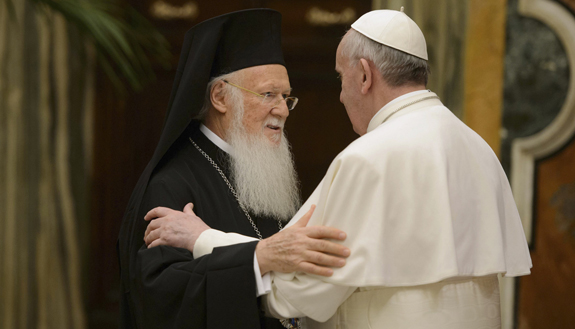

Every January for over a century now, Christians have set aside a special week to pray for unity. This week, my friend the Orthodox priest and historian Oliver Herbel posted an excellent reflection in which he upbraided his fellow Orthodox for, as he powerfully put it, “spitting in the eye of Rome” every time she makes advances towards East-West unity. Father Oliver then went on to note some changes that he and his fellow Orthodox should make to respond better to Rome’s invitations.
Let me return the favor of my gracious friend. Speaking as an Eastern Catholic who tries to help East and West understand each other, let me offer a few reflections on the kind of changes Eastern Catholics and, perforce, Eastern Orthodox, want to see in very practical ways for unity to become a closer and more realistic possibility. However, I do not want to be thought querulous, so let me dwell briefly on areas where I think Roman practice is right and needs to be encouraged:
1) Ecclesial organization: Anyone who knows anything about Orthodoxy in North America knows that one of her besetting struggles is with ecclesial disorganization. Early ecclesiology rather strictly prescribed one bishop to one city to avoid the problems of overlapping and conflicting jurisdictions. Orthodoxy still upholds this as the ideal (as does Rome), but has long struggled with making it a reality in this country. Indeed, the most recent effort to overcome this problem—the so-called episcopal assembly of all Orthodox bishops—seems this month on the verge of collapse, which is sad but not surprising.
Rome, however, has in some ways been better able (though not perfectly so) to avoid these problems and to keep Catholics of all traditions—Eastern and Western—united in certain (imperfect) regional structures. For example, the United States Conference of Catholic Bishops (USCCB) includes Latin and Eastern bishops on full and equal terms and they regularly meet together in organized fashion twice a year, with Eastern Catholics also serving in the other committees of the USCCB. Though the USCCB (and comparable conferences around the world) are not the synods, they could and should be, as I have argued elsewhere, and they are at the very least a commendable start down that road.
2) Canonical updating: Part of the way you keep your home life organized is through periodic purges in which you force yourself to realize that sweater from 1979 no longer fits and that coffee pot from your great Aunt Hilda, who died in 1936, no longer works. The Church is no different. As we recognize that certain old canons do not adequately deal with the conditions and issues of today, we must make a choice: to ignore the canons, to abolish the canons, or to update the canons. Orthodoxy usually chooses the first option while Rome has preferred the latter two. Thus, in 1990, Rome published the Code of Canons of the Eastern Churches, an (imperfect) attempt to bring Eastern canon law into the 20th century and to give it some rational coherence and consistency.
3) Money: Eastern Catholics need to be frank in acknowledging the generosity of Roman institutions in many ways. For decades the Catholic Near Eastern Welfare Association has given generously to Eastern Catholics (and Orthodox!) around the world. Many Eastern communities (including my own mission parish here in Ft. Wayne) are too small to afford their own buildings, and local Roman parishes immediately open their doors and let us use their facilities for worship and fellowship without any cost to us. Other examples could be mentioned. Though we are a tiny drop in the Catholic bucket (a few millions compared to over a billion Latin Catholics in the world), we benefit from belonging to a larger, global institution in very practical ways, including these kinds of “subsidies” in which big, wealthy local churches in, say, the United States or Germany, can help small, impoverished churches in Ukraine or the Middle East and Africa. One regularly sees such subsidies given in the form of scholarships to Eastern Catholic seminarians and priests to be able to pursue advanced degrees in pontifical universities, both in the Eternal City and elsewhere.
4) Intellectual life: This latter point reminds us that the Pontifical Oriental Institute in Rome itself has long been one of the premier centers of Eastern theological scholarship, and not a few of today’s leading bishops and theologians in Orthodoxy (including the current Ecumenical Patriarch) have studied there. Catholic intellectuals (especially the Jesuits, including Robert Taft, Michael Fahey, Brian Daley) have long been recognized as world-class specialists in Eastern theology. Catholic-sponsored scholarly journals (including the one I edit, Logos: A Journal of Eastern Christian Studies) have long focused, either in whole or in part, on Eastern Christian scholarship, making it far more accessible than it would be if it were confined to Orthodox periodicals. And numerous Catholic universities—Loyola Marymount in Los Angeles, Dayton, Notre Dame, Fordham, Saint Paul University (Canada), CUA in Washington, and many others—have in the past (and still today) opened professorial appointments to Orthodox theologians who would be otherwise out of academic work because there are no Orthodox universities anywhere on this continent—nor in most of the rest of the world.
5) Universal focus, universal spokesman: Say what you want about the papacy (and I have in my book, Orthodoxy and the Roman Papacy) but I think no fair-minded observer can deny that the papal office remains a salutary trans-national focus for Catholics around the world, reminding all of us that we are but one part of a vast organization with a presence in huge numbers around the world. In other words, it keeps us from descending into smug little enclaves where, as St. Paul puts it, one part can say to the other, “I have no need of you.” Moreover, though not without risks, the popes are able to command instant, widespread international media attention, making it possible to get the word out immediately on any number of issues. When Pope Francis, for instance, called for a day of fasting for Christians in Syria (most of whom are Orthodox or Eastern Catholic), there were millions around the world who immediately responded. Similar calls to focus on the plight of Syrian Christians, issued by the patriarchs of Antioch and even the Ecumenical Patriarch, never have gained the same level of attention (this is not triumphalism but a simple factual observation of media habits).
I hope, in view of the foregoing litany, that I may be permitted now to note a few areas in which there is room for improvement. Indeed, let me state it as strongly and bluntly as I can: absent significant and unambiguous evidence of change—and not merely vague promissory notes with an unspecified future date—in the following areas, unity with Orthodoxy will not happen.
1) Clerical Celibacy: The whole history of much of Orthodoxy in North America would be inconceivable without the complete fiasco of Latin bishops trying to force priestly celibacy on Eastern Catholics in the early 20th century. When the Latins attempted this with staggering arrogance and insensitivity, tens of thousands of Catholics became Orthodox. Today’s Orthodox (and Eastern Catholics) need it made very clear that while we all honor celibacy highly, in the East the longstanding custom has been that parish priests are usually married while celibate priests are usually monastics. No requirement, therefore, can again be demanded of Eastern Christians whereby all seeking priestly ordination must be celibate. The East should be able to decide about a married priesthood without interference just as the West decides about a celibate priesthood without interference. The Eastern custom, as valid and ancient and “apostolic” as the West’s tradition, must be accepted on equal footing without cavil or qualification. (If the West decides to alter her tradition, it should only be changed after very careful discernment and deliberation as to the major costs—financial and administrative, inter alia—that such a change would bring. It should also be changed not because of some supposed “vocations shortage,” because a married priesthood is no guarantee of lots of priests.)
2) Local election of bishops and patriarchs: Similarly, the right of local churches to elect their own bishops, and especially their patriarchs, must be preserved. The idea that Rome, either by history or custom—or, more absurdly, “divine law”—can and must appoint all the world’s bishops is an innovation so new (emerging juridically only in 1917 with the Pio-Benedictine code of canon law) that the Cambridge historian Eamon Duffy has rightly called it a coup d’Église, unjustified by Vatican I and Vatican II. Not even Gregory VII or Pius IX in their most ultramontane moments would have dared arrogate such power unto themselves.
3) Restoration of liturgical tradition: Many Orthodox (and, again, many Eastern Catholics) are rightly scandalized at the state of the liturgy in Latin parishes today. Though we seem, thankfully, to have moved well beyond the (possibly apocryphal) clown Masses of the high 1960s, still today there is a liturgical culture too often marked by a “domestication of transcendence” (William Placher), by banality and mediocrity instead of mystery and reverence. This is inconceivable to the East where, through centuries of persecution, the liturgy was often the only thing the Church was permitted to do, and so has acquired a pride of place as theologia prima.
4) Discipline of dissenters: The fact that Catholic academics, especially so-called theologians, are permitted to teach for decades in Catholic institutions while openly dissenting from Catholic teaching does not go unnoticed in the East. Heterodoxy needs to be given a simple ultimatum: put up or shut up. The failure of bishops to show much spine here appalls many in the East who are, after all, concerned precisely about, well, orthodoxy.
5) The filioque: Following the statement of Rome in 1995, and the 2003 statement of the North American Orthodox-Catholic dialogue, as well as even more recent statements by leading Orthodox theologians such as Metropolitans Kallistos Ware and John Zizioulas, and the Orthodox historian Edward Siecienski, no serious observer today believes that, theologically, the filioque (the belief, expressed in the Nicene Creed, that the Holy Spirit proceeds “from the Father and the Son [filioque in Latin]) is a church-dividing issue. However, the fact of its continued usage liturgically in the Latin tradition every Sunday does rankle procedurally for many Orthodox. In other words, even if both sides understand and can accept the theological meaning of the other, the fact that the Western church unilaterally altered the creed outside of the procedure of an ecumenical council remains a sore point for the East, made all the more so by the fact that recent popes have said the Greek original remains the authoritative text. If that is so, then why do liturgical translations not use the Greek as their source-text for translation, rather than the Latin with its interpolation? With careful preparation and catechesis the filioque could and should be deleted from common liturgical usage. Yes, it would be a gesture of extraordinary generosity for the Latin Church to remove the filioque from the Creed. But merely to issue a clarification on it would not, I think, be enough for most Orthodox.
6) Papal primacy and jurisdiction: Finally, we come to the major issue widely agreed to be the most important one requiring resolution before unity. I will not get into details here for I have already written an entire book on the topic. I am not being immodest when I say that of the reviews I have seen so far from serious Orthodox observers (i.e., not the illiterate cranks on Amazon who admitted they were never going to read the book but slagged it nonetheless), all of them have said my proposals could offer a way forward.
Certain Orthodox apologists writing this list would add 3, 5, 15, or 30 more items—unleavened bread, priestly beards, altar girls, statues vs. icons, and so on. No sober observer today believes these are remotely serious issues justifying continued division. Other, relatively more serious theological issues—e.g., the modern Marian dogmas, or purgatory—are, properly understood, compatible with Orthodox theology as others (see Sergius Bulgakov, The Burning Bush: On the Orthodox Veneration of the Mother of God; and Emmanuel Lanne, “L’enseignement de l’Église catholique sur le purgatoire,” Irénikon 64) have shown. In the end, if unity is to have a realistic prospect in this century, Rome needs to step up to the plate and prove, by unmistakable actions and not hoary promises, that she means business on these six issues at least. Then the ball will be back in Orthodoxy’s court.
If you value the news and views Catholic World Report provides, please consider donating to support our efforts. Your contribution will help us continue to make CWR available to all readers worldwide for free, without a subscription. Thank you for your generosity!
Click here for more information on donating to CWR. Click here to sign up for our newsletter.
