Full text of Pope Francis’ in-flight press conference from Dublin
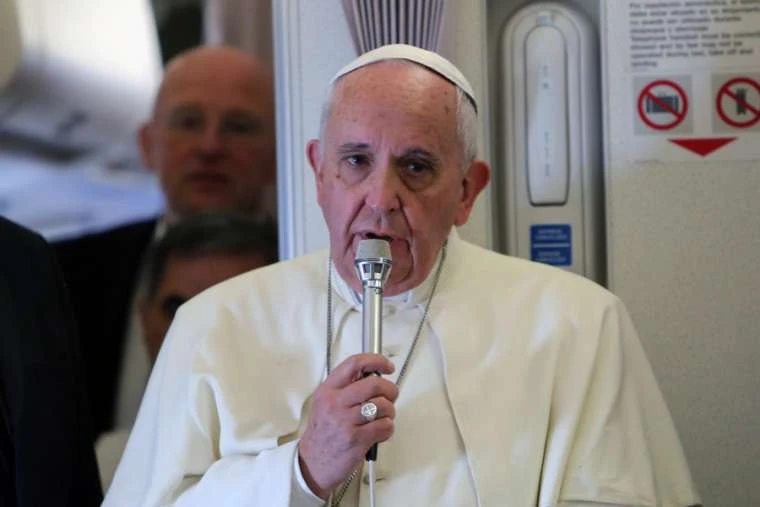
Vatican City, Aug 26, 2018 / 07:05 pm (CNA).- Please read below for CNA’s full transcript of the Pope’s Aug. 26 in-flight press conference from Dublin to Rome:
Greg Burke: Holy Father, thanks for this time you’re dedicating to us after two intense days. Certainly, there were difficult moments. In Ireland, there was the matter of abuses, but also very beautiful moments: the Festival of Families, testimonies from families, the meeting with the young couples and the visit to the Capuchins, but maybe you want to say something else first…
Pope Francis: To say thank you, because if I am tired I think of you who have work, work, work… I thank you so much for your effort and your work. Many thanks.
Greg Burke: The first question, as usual, comes from a journalist of the [host] nation which is Tony Connelly, RTE.
Tony Connelly, RTE: Your Holiness, you spoke on Saturday about the meeting you had with the minister for children. You talked about how moved you were by what she said about the mother and baby homes. What exactly did she tell you? Were you shocked because it was the first time you had heard of these homes?
Pope Francis: The minister first told me something that didn’t have too much to do with mother and children (Editor’s note: mother and baby homes). She told me, and she was brief: “Holy Father, we found mass graves of children, buried children, we’re investigating… and the Church has something to do with this.” But she said it very politely and truly with a lot of respect. I thanked her to the point that this had touched my heart. And, this is why I wanted to repeat it in the speech… and it was not at the airport, I was mistaken, it was at the president’s. At the airport, there was another lady minister and I made the mistake there.
But, she told me, “I’ll send you a memo.” She sent me a memo and I haven’t been able to read it yet. I saw it was a memo, that she sent me a memo. She was very balanced in telling me, “There’s an issue, the investigation has not yet finished.” But, she made me understand that the Church has something to do with this. For me, this was an example of constructive collaboration, but also of, I don’t want to say the word “protest” … of complaint, of complaint for that which at one time maybe the Church was of help to do. That lady had a dignity that touched my heart, and now I have the memo there that I will study when I get home.
Greg Burke: Now, another Irishman, exchanging places, which is Paddy Agnew, who is from the Sunday Independent, a resident in Rome but an Irish journalist.
Paddy Agnew, Sunday Independent: Holy Father, thanks and good evening. Yesterday, Marie Collins, an abuse victim that you know well, said that you are not favorable to a new tribunal for Vatican inquiries on the issue of abuses, new inquiries on the problem of sexual abuse, and in particular on a so-called tribunal of inquiry on bishops, bishop accountability. Why do you think this is not necessary?
Pope Francis: (speaking over the last part of the question) No, no, it is not like this. Marie Collins is a bit fixated on the idea that came up. I esteem Marie Collins so much. At times, we call her to give Vatican conferences. She is fixated on the idea, the idea of the “madre amorevole” (editor’s note: The motu proprio, “As a loving mother”), in which it is said that to judge bishops, that it would be good to have a special tribunal. Then, we saw this wasn’t practical and it also wasn’t convenient for the different cultures of the bishops that had to be judged.
You take the recommendations of “madre amorevole” and you make the “giuria” (Editor’s note: a special commission of bishops) for each bishop, but it’s not the same. This bishop is judged and the Pope makes a “giuria” that is more capable of taking that case. It is a thing that works better and also because not all bishops are able to leave their dioceses. It’s not possible.
In this way, the tribunals, the “giurias” change. And that’s what we’ve done up until now. Rather many bishops have been judged. The latest is that of Guam, the Archbishop of Guam, who appealed. And, I decided – because it’s a very difficult case – to take the privilege that I have of taking on the appeal myself and not sending it to the council of appeal that does its work with all the priests. I took it upon myself. And made a commission of canonists that are helping me and they told me that when I get back, after a maximum of a month, a recommendation will be made so I can make a judgment. It is a complicated case, on one hand, but not difficult because the evidence is clear. I cannot pre-judge, I await the report and then I will judge. I say that the evidence is clear because there is this evidence which led the first tribunal to the condemnation.
This is the latest step. Now, there’s another and we’ll see how it ends. But, of course, I told Marie that the spirit and also the recommendation of “as a loving mother” is being done… a bishop is judged by a tribunal, but it isn’t always the same tribunal, as it is not possible. She did not understand that well. But, when I see her, sometimes she comes to the Vatican, I will explain it more clearly. I love her.
Greg Burke: Now, the Italian group. Holy Father, Stefania Falasca from Avvenire is coming.
Stefania Falasca, Avvenire: Good evening, Father.
Pope Francis: Good evening.
Falasca: You said also today that it is always a challenge to welcome migrants and the foreigner. Well, precisely yesterday a painful matter was resolved, that of the Diciotti ship. Is your hoof behind this solution? What was your involvement?
Pope Francis: The paw of the devil.
Falasca: Yes, then the second question: many in Europe see extortion on the backs of these people. What do you think?
Pope Francis: The welcoming of migrants is something as old as the bible. It’s in Deuteronomy, in the Commandments. God commands welcoming the migrant, the foreigner. It’s so old that it is in the spirit of revelation but also in the spirit of Christianity. It’s a moral principle. I spoke about this. Then, I saw that I needed to bit a bit more explicit because it’s not a welcoming with the “Belle etoile,” no! It should be a reasonable welcoming. That’s why Europe is all in this. And when did I realize how this reasonable welcome must be? When there was the terrorist attack in Zaventem (Editor’s note: the Brussels Airport), that that young men, the guerillas that made the attack on Zaventem were Belgians, but sons of migrants, not integrated, from ghettoes! That is, they were received by the country and left there, and they made a ghetto. They were not integrated. Then I remembered when I went to Sweden, and Franca (Editor’s note: Franca Giansoldati, Vatican correspondent for il Messaggero) in an article mentioned this, of how I explicitly made this though and when I went to Sweden, I knew it, I spoke about integration, as it was, because I knew because during the dictatorship in Argentina, from 1976 to 1983, many, many Argentinians and also many Uruguayans escaped to Sweden and there the government would integrate them immediately. It taught them the language, gave them a job and integrated them. To the point that, this is an interesting anecdote, a Minister who came to bid me farewell at the airport in Lund was the daughter of a Swedish and an African immigrant. This African migrant was so integrated to the extent that his daughter became a minister. Sweden was a model. But in that moment Sweden was beginning to have difficulties, not because it did not have the good will for this, but because it didn’t have the possibility of integration. This was the reason for which Sweden stopped for a bit. (After this step of integration) And then, I spoke during the press conference among you about the virtue of prudence, the virtue of the government. I spoke about the prudence of peoples, about the number or the possibility. A people that can receive but does not have the means to integrate [migrants], it’s better not to receive them. There, there is the issue of prudence. And I believe that this is the real core of the dialogue today in the European Union. We must continue to speak. Solutions will be found.
What happened with the Diciotti? I didn’t put my “paw” there. He who did the work with the minister of the interior was Fr. Aldo (Editor’s note: Fr. Aldo Bonaiuto, member of the Association “Giovanni XXIII”), the good Fr. Aldo that continues the work of Fr. Benzi, who the Italians know well, who work of liberating prostitutes, those that are exploited… The Italian Bishops’ Conference also was part. Cardinal Bassetti was there, but at the telephone, he guided everything by way of one of his two under-secretaries, Fr. Maffeis (Fr. Ivan Maffeis, director of communications) negotiated with the minister. And I believe that he went to Albania. Albania, Ireland took a number. Montenegro, I think not. I’m not sure. The others were picked up by the Conference, I don’t know if under the umbrella of the Vatican or not, I don’t know how it was negotiated there, and they’re going to a better world at Rocca di Papa (Editor’s note: an Italian town near Rome). They will be welcomed there. The number I believe that it is more than 100 and there they will begin to learn the language and to do that work that is done with integrated migrants. I’ve had an experience that was very gratifying for me. When I went to Roma Tre (University), there were students that wanted to ask me questions and I saw a student that “I know this face.” (Nour Essa, see story here, editor note), and it was one that had come with me among the 13 I brought back from Lesbos. And that girl was at the university because Sant’Egidio from the day after at school, to study, had integrated her at a university level. This is the work with migrants. There is an openness of heart for everyone, suffering, then integration as a condition for welcoming and then the prudence of those who govern for doing this. I have seen a clandestinely made film of the things that happen to those who are sent back. They are taken by the traffickers. Painful, the things that they do to the men… the women and the children, out! They sell them. But to the men, they do the most sophisticated torture. There was one there that was capable, a spy, of making that film that I sent to my two under-secretaries for immigration (Editor’s note: Fr. Michael Czerny and Fr. Fabio Baggio, undersecretaries of the Migrants and Refugees Section). For this, to send them back you have to think well. Then, one last thing: there are these migrants that come, but there are also those who are tricked at Fiumicino. They are tricked. “We give you work, they give you documents.” And they end up on the sidewalk enslaved, under threat from traffickers of women. That’s it.
Greg Burke: Thanks, Holiness. Let’s go to the question from the English-speaking group. Anna Matranga from the American television, CBS.
Anna Matranga, CBS: Good evening, Holy Father. I’ll return to the subject of sex abuse about which you’ve already spoken. This morning, very early, a document by Archbishop Carlo Maria Vigano’ came out. In it, he says that in 2013 he had a personal talk with you at the Vatican, and that in that talk, he spoke to you explicitly of the behavior of and the sexual abuse by former-Cardinal McCarrick. I wanted to ask you if this was true. I also wanted to ask something else: the Archbishop also said that Pope Benedict sanctioned McCarrick, that he had forbidden him to live in a seminary, to celebrate Mass in public, he couldn’t travel, he was sanctioned by the Church. May I ask you whether these two things are true?
Pope Francis: I will respond to your question, but I would prefer last first we speak about the trip, and then other topics. I was distracted by Stefania, but I will respond.
I read the statement this morning, and I must tell you sincerely that, I must say this, to you and all those who are interested. Read the statement carefully and make your own judgment. I will not say a single word about this. I believe the statement speaks for itself. And you have the journalistic capacity to draw your own conclusions. It’s an act of faith. When some time passes and you have drawn your conclusions, I may speak. But, I would like your professional maturity to do the work for you. It will be good for you. That’s good. (inaudible)
Matranga: Marie Collins said that after she met you during the victims gathering, that she spoke with you precisely about ex-Cardinal McCarrick. She said you were very tough in your condemnation of McCarrick. I want to ask you, when was the first time that you heard talk about the abuses committed the former cardinal?
Pope Francis: This is part of the statement about McCarrick. Study it and then I will say. Yesterday, I had not read it but I permitted myself to speak clearly with Marie Collins and the group, it was really an hour-and-a-half, something which made me suffer a lot. But, I believe it was necessary to listen to these 8 people and from this meeting came the proposal. I made it, the others accepted and they helped me to do it, to ask forgiveness today in the Mass. But, in concrete things. The last thing. I had never heard about those mothers, they called it the women’s laundry, when an unmarried woman got pregnant she went to the hospital, I don’t know what the school was called, and the sisters said that and then they gave the child away in adoption to people. There were two sons from that time, they tried to find their mothers, if they were alive. And they would tell them that it was a mortal sin to do this, and to the mothers who called for their children also it was a mortal sin. For this reason, today I finished by saying that this is not a mortal sin but it’s the fourth commandment. And the things that I said today some I didn’t know (before). It was painful for me but I also had the consolation of being able to help clear these things up. I await your comment on the document, I would like that. Thanks.
Greg Burke: Thanks, Holy Father. Now, Cecile Chambraud of Le Monde.
Cecile Chambraud, Le Monde: Good evening, Holy Father. I hope you don’t mind if I pose my question in Spanish. I ask you to reply in Italian for all of the colleagues. In your speech in Ireland, you refer to your recent letter to the people of God. In that letter, you call all Catholics to take part in the fight against abuses in the Church. Can you provide details for us what concretely Catholics can do each in their place to fight against these abuses and on this theme, in France, a priest has started a petition for the removal of Cardinal Barbarin accused by victims. Does this initiative appear adequate to you or not?
Pope Francis: If there are suspicions, proofs or half-proofs, I do not see anything bad in making an investigation, but always that is done according to the fundamental juridical principal of “nemo malus nisi probetur” – No one is evil until it is proven. But many times there is the temptation not just to do the investigation but to publish that there is an investigation and why he’s culpable and so some media – not yours, I don’t know yours – to create a climate of culpability. I will tell you something that happened to me in these days that can help with this… because for me it is important how you proceed, how the media can help. Three years ago, more or less, the problem of the so-called “pedophile priests” started in Granada, involving 7, 8 or 10 priests accused of abuse of minors and of having festival or orgies and this kind of thing.
I received the accusation myself, directly, a letter made by a young 23-year old, according to him he was abused, he gave his name and everything, a young man who was working in a prestigious college of Granada, and the letter was perfect. And he asked me what to do to report this. I told him to go to the archbishop of Granada and tell him this, and the archbishop will know what to do. He did, and the archbishop did all that he should do. Then it also went to the civil tribunal and so there were two processes. But then the local media began to speak and speak (about this), and three days later, they wrote “in the parish, three pedophile priests” and so on, and in this way the consciousness was formed that the priests were criminals.
Seven were interrogated and nothing was found. On three, the investigation went ahead and they stayed in jail, for five days, two of them and one, Fr. Romani, the parish priest, was in for 7 days. For almost three years and more, they suffered hate, slaps from the whole town… “criminals!” They couldn’t go outside. They suffered humiliations made by the “giuria” declared to prove the accusations of the boy, that I don’t dare repeat here. After three years, meanwhile, the “giuria” declares the priests innocent, all innocent, but most of all these three, the others were already out of the case and the accuser was then denounced because it was seen that he had a vivid imagination. He was very intelligent and he worked in a Catholic college, he had this prestige and gave the impression of telling the truth.
He was condemned and had to pay the expenses. These men (the priests) were condemned by the local media before justice was done. For this reason, your work is very important, you must accompany the investigation but there must be the presumption of innocence, not with the legal presumption of culpability. There is a difference between the informer who provides information on a case, who isn’t playing for a foreseen condemnation, and the one who investigates, who acts like Sherlock Holmes and presumes that everyone is guilty, When we read the technique of Hercules Poirot, for him everyone was guilty, but this is the work of the investigator. They are two very different positions: but those who inform must start from the presumption of innocence, but saying their admirations, but this is a bit special, but why, to say doubts, but without making condemnations. This case that happened in Granada for me is an example that it will do us all good in our work.
Greg Burke: In the first part, you asked what could the people of God do about the issue…
Pope Francis: When you see something, speak immediately. I will say another thing that’s a little nasty: many times there are parents that cover up the abuse of a priest. Many times. You see it in the condemnation. “No, but…” they don’t believe… They are convinced that it’s not true and the boy or the girl remain like that. I by method receive every week one or two, but it’s not mathematical. And I’ve received a person, a woman, that for 40 years suffered this scourge of silence because her parents didn’t believe: she was abused at 8 years old. Speak! This is important. It’s true that for a mother to see it is better that it wasn’t, seeks that the child maybe is dreaming… speak! And speak with the right people, speak with those who can start a judgment, at least an preliminary investigation. Speak with a judge, with the bishop and if the parish priest is good speak with the parish priest, this is the first thing the people of God can do, this should not be covered up. A psychiatrist told me time ago, but I don’t want that this be an offense for the women, that for sense of maternity, women are more inclined to cover the things of the child than men. But I don’t know if it’s true, but… speak!
Greg Burke: Holy Father, we’re moving… the Spanish group. There’s Javier Romero, of Rome Reports.
Javier Romero, Rome Reports: Holiness, excuse me but I’d like to pose two questions. The first is the that the Prime Minister of Ireland, who was very direct in his speech, is proud of the new model of family different from that which traditionally the Church has proposed up until now: I mean homosexual marriage. And this is perhaps one of the models that generates more battles, and I thought in the case especially of a Catholic family , when there is a person of this family that declares themselves to be homosexual. Holiness, the first question that I’d like to pose you is: what do you think, what would you say to a father whose son says he is homosexual, that he would like to go live with his… this is the first question. And the second that you also in your speech to the Prime Minister spoke about abortion, and we saw how Ireland has changed so much in recent years and that it seems that the Minister was satisfied at these changes. One of these changes was abortion, and we saw that in recent months, in recent years abortion has come out in many countries, Argentina among others, your country. How do you feel when you see this is an issue of which you speak often and that in many countries it’s put in…
Pope Francis: Alright. I’ll begin from the second, but there are two points. Thanks for this. There are two points that are connected to the matter that we’re speaking about, on abortion you know what is thought. The problem of abortion is not religious. We are not against abortion for religion, no! It’s a human problem and it should be studied anthropologically. To study abortion, beginning with the religious fact is to skip over thought. The problem of abortion should be studied anthropologically. There is always the anthropological problem of the ethics of eliminating a human being to resolve a problem. But this is already to enter into the discussion. I just want to underscore this: I will never allow that the discussion on abortion begins on the religious fact. No, it’s an anthropological problem, it’s a human problem. This is my thinking.
Second. There have always been homosexuals, people with homosexual tendencies. Always. Sociologists say, I don’t know if it’s true, that in times of epochal changes, some social, ethical phenomena increase; one of them would be this. This is an opinion of some sociologists. Your question is clear: what would I say to a father who sees that his son or daughter has that tendency? I would say first to pray, pray! Don’t condemn. Dialogue, understand, make space for son and the daughter. Make space so they can express themselves.
Then, at what age does this restlessness of the child express itself? It’s important. One thing is when it shows itself in a child. There are many things to do with psychiatry, to see how things are. Another thing is when it manifests itself after 20 years of age… But I’ll never say that silence is a remedy. To ignore a son or daughter with homosexual tendencies is a lack of paternity and maternity. You are my son, you are my daughter as you are! I’m your father, mother. Let’s talk! And if you, father and mother aren’t up to it, ask for help, but always in dialogue because that son and that daughter have the right to a family and that family of not being chased out of the family. This is a serious challenge, but that makes paternity and maternity. Thank you for the question! Thanks!
Greg Burke: Thanks to you, Holy Father.
Pope Francis: And then I would like to say something for the Irish that are here. I found so much faith in Ireland. So much faith. It’s true, the Irish people have suffered for the scandals. So much. But there is faith in Ireland. It’s strong. And also the Irish people know how to distinguish. And I cite what today I heard from a prelate: the Irish people know how to distinguish well between the truth and half-truths. It is something that they have within. It’s true that it’s in a process of elaboration, of healing from these scandals. It’s true that positions are being opened that seem to distance themselves from any faith. But the Irish people have a deep rooted faith. I want to say it because it’s what I’ve seen, what I’ve heard, of which in these two days I’ve been informed. Thanks for you work. Thanks a lot. And pray for me please.
Greg Burke: Thanks to you. Have a good dinner. Rest well!