No Picture
News Briefs

On St. Joseph’s feast, Italy to pray rosary for protection from coronavirus
March 19, 2020 CNA Daily News 0

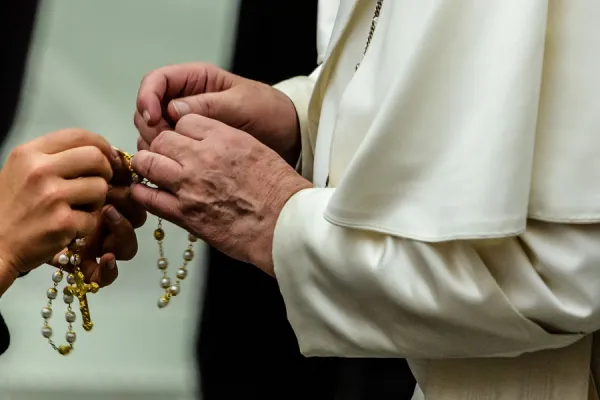
Vatican City, Mar 19, 2020 / 04:45 am (CNA).- On the Solemnity of St. Joseph, the protector of families and the Church, Catholics in Italy will pray the rosary together from their homes for protection from the coronavirus.

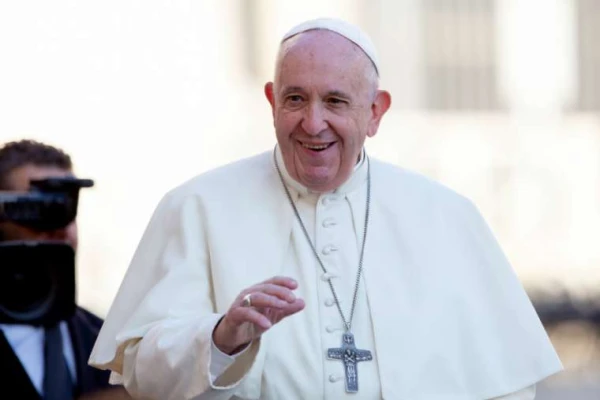
Pope Francis said he will also be praying the rosary from his home at the Vatican.

“Mary, Mother of God, health of the sick, leads us to the luminous and transfigured face of Jesus Christ and to her Heart, to whom we turn with the prayer of the rosary, under the loving gaze of St. Joseph, Custodian of the Holy Family and of our families,” he said March 18.

The Italian bishops have asked people across Italy to pray the rosary together March 19 at 9:00 pm.

A rosary will be live broadcast at that hour on the local Catholic television station and online from Rome’s Basilica of St. Joseph al Trionfale.

The president of the Italian bishops’ conference, Cardinal Gualtiero Bassetti, has also invited families to place a lit candle in the window of their home at that time.

Bassetti said he will be the first “to join in the prayer that will unite us in emphasizing faith, hope and, above all, that love which becomes a red thread from the Valley d’Aosta to Sicily, the red thread of charity, which is much stronger than the red zone.”

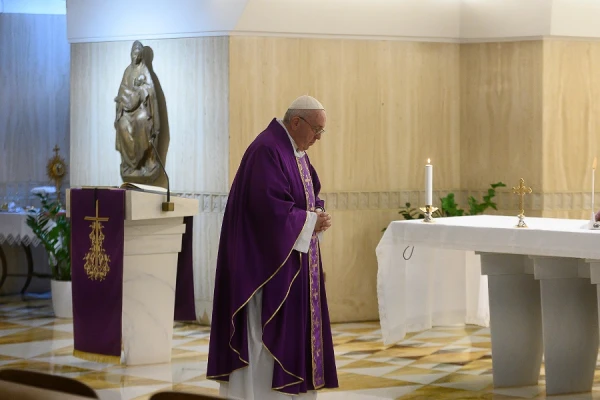
At his morning Mass in the Santa Marta guesthouse March 19, Pope Francis said he was thinking about the Church.

St. Joseph, in the midst of his ordinary life as a carpenter, was able to enter into the mystery of God, he said.

“Our faithful, our bishops, our priests, our consecrated men and women, the popes: are they capable of entering into the mystery?” he asked.

“When the Church loses the ability to enter into the mystery, she loses the ability to worship,” he stated. “The prayer of adoration can only be given when one enters the mystery of God.”

On the feast of St. Joseph, the pope prayed that the Church will be given the grace to live both the concreteness of daily life and the “concreteness” of the mystery.

Without this understanding of the mystery, the Church will just be a “pious association” of rules, lacking in adoration of God, he said.

“To enter into the mystery is not dreaming; to enter into the mystery is precisely this: to worship.”

Francis added that “to enter the mystery is doing today what we will do in the future, when we arrive in the presence of God: worship.”

“May the Lord give the Church this grace,” he prayed.

Pope Francis’ daily Masses are being livestreamed during the coronavirus emergency.

At the end of Mass, the pope invited everyone following along through the internet or TV to make a spiritual communion with him.

“I adore you in the Sacrament of Your love, I wish to receive you in the poor abode which my heart offers you,” he prayed.

“In anticipation of the happiness of sacramental communion, I want to possess you in spirit. Come to me, O my Jesus, that I come to you. May Your love inflame my whole being, for life and death. I believe in you, I hope in you, I love you.”

He then led Eucharistic adoration and gave benediction.

Pope Francis’ March 19 Mass was offered for prisoners during the coronavirus outbreak.

“They suffer so much,” he said, “because of the uncertainty of what will happen inside the prison, and also thinking about their families, how they are, if someone is sick, if something is missing.”

“We are close to prisoners today who suffer so much in this moment of uncertainty and pain,” he said.
 

[…]

No Picture
News Briefs

Pope Francis encourages small acts of love during coronavirus quarantine

March 18, 2020 CNA Daily News 4

Vatican City, Mar 18, 2020 / 04:40 am (CNA).- While many are stuck at home during the coronavirus pandemic, Pope Francis says that there are many small acts of love and kindness one can do for others without leaving the house.

“We must rediscover the concreteness of little things, small gestures of attention we can offer those close to us, our family, our friends. We must understand that in small things lies our treasure,” Pope Francis said in an interview in an Italian newspaper published on March 18.

“For example, a hot meal, a caress, a hug, a phone call… They are familiar gestures of attention to the details of everyday life that make life meaningful and that create communion and communication among us,” the pope said.

Pope Francis said that the quarantine many people are living through right now provides a particular opportunity to grow in personal relationships at home, but this requires disconnecting from technology to spend quality time together.

“In their homes, families often eat together in great silence, but not as a result of listening to each other, rather because the parents watch television while they eat, and children are on their mobile phones,” he said. “Here there is no communication, whereas listening to each other is important because that’s how we can understand the needs, efforts, desires of the other.”

The pope also asked everyone to reach out to those who are alone or who have lost loved ones. “Consolation must not be everyone’s commitment,” he added.

In the interview with Italian journalist Paolo Rodari published in La Repubblica, Pope Francis explained what was on his mind when he made a short walking pilgrimage through the empty streets of Rome on Sunday to pray in front of a Marian icon in the Basilica of St. Mary Major and a crucifix in another church that had been used in prayer processions during the plagues in Rome’s history.

“I asked the Lord to stop the epidemic: ‘Lord, stop it with your hand.’ That’s what I prayed for,” he said.

Nearly 200,000 people have been infected by COVID-19, a respiratory illness that has been linked to the deaths of 7,954 people worldwide as of March 18, according to Johns Hopkins University.

Italy has been the hardest hit country outside of China with over 31,500 documented coronavirus cases, and 2,941 deaths, mostly in the north of the country.

Francis urged people to remember that one’s personal choices and actions have consequences for the lives of others.

The pope cited an article written by Italian journalist, Fabio Fazio, who said that people’s failure to pay their taxes in Italy has hurt the country’s ability to provide for all those who are sick.

“He [Fazio] is right, for example, when he says: ‘It has become evident that those who do not pay taxes do not only commit a felony but also a crime: if there are not enough hospital beds and artificial respirators, it is also their fault’. I was very impressed by this,’” Pope Francis said quoting the journalist.

Pope Francis also said that people can find strength in their families and in the love of the people around them, even if they do not yet have the gift of faith.

“They are all God’s children and are looked upon by Him. Even those who have not yet met God, those who do not have the gift of faith, can find their way through this, in the good things they believe in: they can find strength in love for their children, for their family, for their brothers and sisters,” he said.

“During these difficult days we can find small, concrete gestures expressing closeness and concreteness towards the people closest to us, a caress for our grandparents, a kiss for our children, for the people we love. These are important, decisive gestures. If we live these days like this, they won’t be wasted,” Pope Francis said.

[…]

No Picture
News Briefs

Pope Francis prays for those who have died from coronavirus

March 18, 2020 CNA Daily News 2

Vatican City, Mar 18, 2020 / 04:36 am (CNA).- Pope Francis offered Mass Wednesday for all the people who have died from the coronavirus, including medical staff who have lost their lives after helping the sick.

“Today we pray for the deceased, those who have lost their lives because of the virus,” Pope Francis said before his morning Mass in the chapel of the Santa Marta guesthouse March 18.

“In a special way,” he added, “I would like us to pray for healthcare workers who have died during these days. They gave their life in service to the sick.”

The pope’s daily Mass, which he offers for those affected by coronavirus, is being livestreamed every day during the emergency.

His homily was on the gift of divine law, which God gave to his people “as an attitude of closeness,” he said.

“Our God is close and asks us to be close to each other, not to move away from each other,” he urged.

Francis said during this time of crisis caused by the coronavirus pandemic, Catholics are called to show even greater closeness to each other.

“We cannot, perhaps, get physically closer because of the fear of contagion,” he noted, “but yes, we can awaken in ourselves an attitude of closeness among us: with prayer, with help, [there are] many ways to be close.”

He said people be close to each other “because our God is close, he wanted to accompany us in life.”

“For this reason, we are not isolated people,” he emphasized.

Speaking about divine law, Francis explained that God does not hand down rules like a far-off leader or dictator.

“We know by revelation that it is a fatherly, fatherly closeness that accompanies his people by giving them the gift of the Law,” he said.

He explained that God wrote the laws on the stone with his own hands, and after giving the stone tablets to Moses, he does not go away.

God walks with his people, he said, but in the first few pages of the Bible, people respond with the opposite, by trying to “get away from God.”

“He gets close and we get away,” he stated.

Adam and Eve hide from God because they are ashamed, because they have sinned, the pope explained: “Sin leads us to hide, not wanting closeness.”

The second attitude of running away from God is demonstrated by when Cane killed his brother Abel, saying “I am not my brother’s keeper.”

“We ask the Lord for the grace to be close to each other; do not hide from each other; do not wash your hands, as Cain did, of the problem of others,” the pope urged.

“Neighbors, proximity, nearness,” he said. “‘Indeed, what great nation has the gods so close to him, as the Lord our God is close to us, every time we invoke Him?’”

[…]

No Picture
News Briefs

Do coronavirus closings violate religious liberty? A religious freedom expert weighs in

March 16, 2020 CNA Daily News 1

Vatican City, Mar 16, 2020 / 01:06 pm (CNA).- Few were surprised when the Chinese Communist Party banned church services in the wake of the coronavirus outbreak in Hubei province. But the Italian government decree suspending all public religious ceremonies — leading to the suspension of Masses in the pope’s own diocese — provided more of a jolt.

All four of the vastly different countries with the most documented cases of the Covid-19 coronavirus — China, Italy, Iran, and South Korea — have suspended religious services.

As more government leaders will soon face tough decisions in the face of a spreading pandemic, the president of the Religious Freedom Institute told CNA about important criteria to ensure the protection of a foundational freedom.

“There must be a presumption in favor of full religious freedom for all religious communities in every country, especially in democratic countries. Italy’s decision in this case does not change that presumption, but it does show that in very limited circumstances, temporary limits on the freedom to gather may licitly be applied,” the RFI’s Tom Farr told CNA.

“No right with public effects is absolute, including the precious right of religious freedom,” he added.

Farr was the first director of the U.S. State Department’s Office of International Religious Freedom, and subsequently taught religion and foreign affairs at Georgetown University and the U.S. Foreign Service Institute.

He said that these “limited circumstances” include instances when the extent of deadly infection is exceptionally high.

“Given Italy’s current designation as Level 3 by the U.S. CDC, which indicates the presence of ‘Widespread Community Transmission,’ Italy’s decision seems reasonable, especially in light of the fact that, to use the CDC’s description, ‘There is limited access to adequate medical care in affected areas’ of Italy and this reality understandably contributes to this extraordinary move,” Farr said.

“Absent this level of community transmission, the justification for such extraordinary measures to restrict religious gatherings quickly becomes much more tenuous,” he added.

When Italian government decreed the suspension of all civil and religious ceremonies, including funerals, on March 8, there had been 7,375 documented cases of the coronavirus leading to the deaths of 366 people.

In the days since that decree and a national quarantine, the number of cases in Italy has soared to 27,980 confirmed cases of COVID-19 and 2,470 deaths on March 16.

Along with religious ceremonies, the Italian government also decreed the closure of all schools, universities, museums, movie theaters, concerts, gyms, archaeological sites throughout the country. The following day, the Prime Minister announced a national quarantine.

The religious freedom advocate explained that any government exercising its authority in such an extraordinary fashion should abide by the following criteria to ensure religious freedom:

“Such decrees may not be employed arbitrarily, for example, to target a particular religion or religion in general. They must be public, clear, and transparent. They should be preceded by consultation with the religious communities involved.”

Decrees banning religious freedom also “must be grounded in overwhelming evidence, available to all, that public health would be severely endangered without such a decree. They must be time-limited, with a clear and public expression of when the ban will end,” Farr told CNA.

The Diocese of Rome announced the cancellation of all public Masses shortly after the Italian government decree went into effect. Since then, Church leaders in Rome have debated whether churches in Rome could remain open for private prayer during a national quarantine.

“It is of course the right and the duty of any religious community to challenge in lawful ways any act by government that it considers an illicit restriction of its religious freedom. In some cases a community might find itself in the position of needing to engage in principled, civil disobedience. As I understand it the Catholic Bishops of Italy and the Holy Father have agreed to this decree, from which I infer they believe it prudent and just,” Farr said.

“It would be difficult to imagine such a sweeping decree in the United States, where the Constitution provides to all Americans and all their religious communities the right of free exercise of religion. However, should there be clear and overwhelming evidence that, in particular locations, the public health required a ban on all gatherings, it is not inconceivable,” Farr said.

Numerous state governments have announced prohibitions on gatherings of more than 250 people in recent days.

The Archdiocese of Seattle was the first in the U.S. to cancel public Masses in response to a government directive, and dozens of dioceses have followed suit. Others have granted general dispensations from the obligation to attend Sunday Mass, and some bishops, like Archbishop Alexander Sample of Portland, have encouraged parishes with high Sunday Mass attendance to consider adding more Masses.

Farr said that such banning large gatherings, if not specifically targeting religion, is understood to be within the government’s prerogative at a time of crisis.

“An American bishop bringing suit against a ban, whatever its size, would very likely prevail if the ban were only on religious gatherings. However, he would have trouble prevailing if the ban is on all gatherings, religious or not, and the act is easily justified by a dire threat to public health and welfare,” Farr said.

“Speaking as a Catholic for whom the sacraments are not optional, and are necessary to health and welfare, however, I would hope that the Italian Church, or the Church in any jurisdiction would do everything it could reasonably do to make the sacraments available in ways that would be consistent with just authority,” he added.


[…]

No Picture
News Briefs

Pope Francis reforms Vatican City courts with new law

March 16, 2020 CNA Daily News 0

Vatican City, Mar 16, 2020 / 11:30 am (CNA).- The Holy See announced a new law governing the judicial system of the Vatican City state Monday. The motu proprio provides enhanced safeguards for the independence of judges and prosecutors in Vatican City to better address economic, financial and criminal cases in the sovereign territory.

Law CCCLI was signed by Pope Francis on Friday, March 13. 

“Administering justice,” the pope said in the preamble of the new law, “is not just a necessity of a temporal order.” 

“The cardinal virtue of justice, in fact, illuminates and summarizes the very purpose of the judicial power proper to each State, which is essential above all to cultivate the personal, generous, and responsible commitment of those who are vested with the judicial function,” Francis said.

In the legal text, the pope explained that the law is part of an ongoing process of legal renewal to replace the original 1929 laws of Vatican City, which began with the adoption of a new fundamental law for the city state in 2000.

Francis said the changes are aimed at adapting the Vatican courts to better enforce the law, and to ensure the city state’s compliance with international commitments.

“In the last decades, the Vatican legal system has undergone a season of regulatory reforms in economic, financial and criminal matters, also as a consequence of the adhesion to important international conventions,” the pope wrote, making the changes necessary to keep the wheels of justice turning in the Vatican.

“In continuity with this work of progressive legislative updating and institutional reorganization, I would now like to introduce some changes to the structure of the judiciary, aimed at increasing its efficiency,” he said.

The law provides for new measures to protect the independence of judges and prosecutors in the city state, making explicit that Vatican magistrates are, subject to the law, answerable to the pope directly and to no other office or authority.

Article 2 of the new law states that judges “are hierarchically dependent on the Supreme Pontiff” and “in the exercise of their functions, they are subject only to the law.”

The new norms also codify the ability of prosecutors to deploy the judicial police of the Vatican courts, and grants the law enforcement agency enhanced budgetary independence, explaining that they are not required to account for spending to any other body within the curia.

“The judicial authority has direct use of the judicial police, which it can also use for the notification activities,” the law says. “The judicial bodies enjoy autonomy of expenditure for their operation, on the basis and within the limits of the accounting provisions in force in the State. The relative charges are borne by the Governor’s budget [of the Vatican City state].”

The judicial police, which are a separate section of the Vatican City Gendarmes, are under the direction of the Promoter of Justice, the courts’ chief prosecutor, who is to have two assistants, one of whom “carries out his duties on a full-time basis, without having subordinate employment relationships or carrying out freelance professional activities on an ongoing basis.

Judicial independence is further protected by article 8, which says that judges should be chosen from “tenured or retired university professors, and in any case from well-known jurists who have gained proven experience in judicial or forensic, civil, criminal or administrative matters.”

While recommendations for judicial appointments are still to be made by the Secretary of State, who has overall responsibility for the governance of Vatican City, the article prevents the appointment of curial civil servants to serve as judges, pointing out the necessary conflict of interest.

The pope’s reform, which repeals and replaces the 1987 Law CXIX of St. John Paul II, also underlines the supremacy of canon law in the Vatican’s civil legal system.

The new Law CCLI grounds Vatican City civil law in the Church’s canonical legal system, making the Supreme Tribunal of the Apostolic Signatura, the curia’s highest canonical appeals court, as the final court of cassation for the civil judicial system, charged with hearing appeals related to legal procedure and judicial competence.

Citing 2008 Vatican City state legislation issued by Pope Benedict XVI, which states that “the Vatican legal system recognizes in the canonical order the first normative source and the first criterion of interpretative reference,” Pope Francis said that canonical principles are essential to understanding and applying Vatican City laws.

“This is a founding and precious link that I hope can be increasingly explored by the judicial bodies of this state, in order to express its underlying potential and that the juridical norm puts to the work of the interpreter,” the pope wrote in the legislation’s preamble.

[…]