No Picture
News Briefs

Pope’s historic meeting with Huntington’s patients offered ray of hope

May 19, 2017 CNA Daily News 0

Vatican City, May 19, 2017 / 03:24 pm (CNA/EWTN News).- Pope Francis’ gathering this week with a group of Huntington’s disease patients was a major inspiration for those seeking to increase awareness and research about the condition.

“In the U.S. this is HD Awareness Month, so we’re working on just telling the story of families affected by Huntington’s disease, and this brings it to a whole different platform,” said Louise Vetter, CEO of the Huntington’s Disease Society of America.

“Really, with Pope Francis setting the tone I think it offers so much hope and inspiration.”

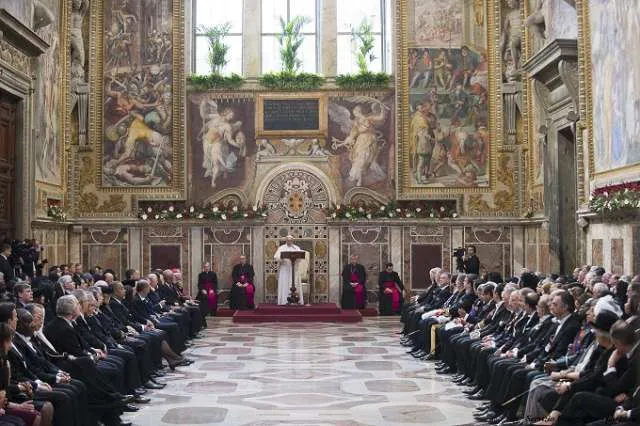
On Thursday, Pope Francis became the first world leader to publically recognize the plight of those suffering from Huntington’s disease, as he welcomed an audience of some 150 people with the condition. The pontiff stayed for nearly an hour after the audience to offer each individual a hug and a greeting.

Huntington’s disease (HD) is an incurable genetic brain disorder characterized by rapid, uncontrollable muscle movement known as chorea. As the disease progresses, it can lead to loss of control over speech and memory, dementia and death. 

The gene which causes Huntington’s was discovered nearly 25 years ago, but there is still no cure and relatively limited treatment options.

This is especially true for people living in South America, where prevalence of the disease is almost 1,000 times higher than in the rest of the world and often combined with extreme poverty. Because the disease affects families generationally, they are often caught in a cycle of need.

In 2013, Ignacio Munoz-Sanjuan, a neuroscientist working to develop treatments to fight the progression of Huntington’s disease, traveled to South America to see first-hand the difficulties faced by communities with high numbers of Huntington’s patients, particularly in Venezuela and Colombia.

While there, he noticed that a lot of the help people needed wasn’t related only to the immense difficulties of the disease, but had even more to do with living in conditions of extreme poverty, such as no food, no water, no clothes, poor housing, and almost no medical support. 

This led to his founding of Factor-H, a humanitarian project specifically to help with non-medical related issues for people in communities with high concentrations of Huntington’s patients.

One of the biggest problems faced there, he told CNA, is that there is no institutional support to provide food or assistance to the communities.

People aren’t able to work because they are often caring day and night for multiple terminally ill family members. And in some communities, “people barely have enough food to eat once a day. They have no sanitation, no running water,” he explained.

Compounding the challenge is the fact that many Huntington’s patients require up to 5,000 calories per day – more than twice the caloric needs of an average healthy adult. Finding adequate nutrition when food is already scare is often impossible.

“In one of the towns in Venezuela, probably the biggest cluster (of Huntington’s patients) in the world, I met a Catholic priest who is there locally and who is trying to do what he can, but there’s nothing institutionalized.”

Munoz-Sanjuan found it very difficult to find ways to help in Venezuela and ran into a lot of roadblocks. It’s hard to send money because of the rate of inflation, he said, and after the border with Colombia was closed he could no longer send food via the neighboring country.

He said that he thinks the more people know about the problem, though, the more they will want to help.

“The problem is concentrated in a few locations and there are not that many people, a few thousand people affected in each one of these towns, so it’s a manageable problem if we get organized. But I think that’s really where the Church can play a big role,” he said.

Because the disease is relatively rare, it is not well-known, and non-governmental organizations generally focus their support elsewhere.

Munoz-Sanjuan also felt “that the scientific community owed something back to those people because they participated in studies for many years that led to the cloning of the gene, but they still don’t have access to the genetic test and really things haven’t changed much for them.”

“I thought that one of the few institutions that could potentially help would be the Catholic Church,” he said.

This gave birth to the idea for the global meeting at the Vatican and the audience with Pope Francis, which took place May 18 with some 1,700 people from 16 different countries.

The meeting with Pope Francis was called “HDdennomore” (pronounced “hidden no more”) and put on in special solidarity with South America. Two families from Venezuela, two from Colombia, and one girl from Argentina – all affected by the disease in different ways – were brought to the Vatican by Factor-H to meet the Pope.  

Present at the audience, in addition to 150 Huntington’s patients, were members of the medical and scientific communities who treat patients with Huntington’s and perform research on how to prevent the disease or slow its progression.

“I know there are some people from Caritas and some cardinals that are really interested in helping, but I think that most Church officials, like many people in institutions, have never really heard of the disease, or the magnitude of the problem in their countries,” Munoz-Sanjuan said.

He hopes this event is the beginning of a conversation and will help shine a light on the disease and on what the conditions are like in many communities. 

For Vetter, the meeting was a big step forward in efforts to combat the “devastating illness.”

“We really have a call to action to raise awareness of Huntington’s disease and the need for community to really be involved caring for these families,” she said.

“We’re thrilled to be part of this global effort and be able to pull off that shame and offer the opportunity for these families to feel validated,” she continued. “To be able to help society offer that reassurance and for the Church to really set that tone – it’s incredible.”
 

[…]

No Picture
News Briefs

Pope Francis: Church teaching helps us avoid harm of ideology

May 19, 2017 CNA Daily News 0

Vatican City, May 19, 2017 / 11:45 am (CNA/EWTN News).- Pope Francis warned that ideologues sow confusion and division in the Church in the name of false clarity, rather than relying on the Pope, the bishops, and Church councils inspired by the Holy Spirit.

“We are human, we are sinners,” he said, adding that there are difficulties even in the Church. Being sinners leads to humility and drawing closer to God who saves us.

Looking to the early Church, Pope Francis made a distinction between those who had “forceful discussions” but “a good spirit,” and those who “sowed confusion.”

“The group of the apostles who want to discuss the problem, and the others who go and create problems,” the Pope distinguished. “They divide, they divide the Church, they say that what the Apostles preached is not what Jesus said, that it is not the truth.”

The Pope’s words came in his homily at Casa Santa Martha May 19, Vatican Radio reports. He reflected on the Council of Jerusalem of 49 A.D., recounted in the Acts of the Apostles, which rejected claims that gentile converts to Christianity would have to be circumcised.

In the early Church, he charged, “there were jealousies, power struggles, a certain deviousness that wanted to profit from and to buy power.”

In the end, the apostles’ discussion came to agreement.

“They had hearts open to what the Holy Spirit said. And after the discussion ‘it seemed good to the Holy Spirit and to us,’” the Pope said.

This is not “a political agreement” but “the inspiration of the Holy Spirit” that led them to reject the “necessities” some would require of Christian converts, like a refusal to eat meat sacrificed to idols and a requirement to abstain from “illegitimate unions.”

The “liberty of the spirit,” however, allowed gentiles to enter the Church without circumcision.

At that first Church Council, Pope Francis said, “the Holy Spirit and they, the Pope with the bishops, all together,” gathered together in order “to clarify the doctrine,” as would be done through the centuries at successive councils so that “what Jesus said in the Gospels, what is the Spirit of the Gospels, would be understood well.”

The Pope encouraged the congregation not to be afraid in the face of “the opinions of the ideologues of doctrine.” He stressed that the Church has “its proper Magisterium, the Magisterium of the Pope, of the bishops, of the councils.” They should follow the path “that comes from the preaching of Jesus, and from the teaching and assistance of the Holy Spirit.” This path is “always open, always free,” because “doctrine unites, the Councils unite the Christian community” but “ideology divides.”   

Pope Francis further warned against divisive elements in the Church.

“But there were always people who without any commission go out to disturb the Christian community with speeches that upset souls: ‘Eh, no, someone who says that is a heretic, you can’t say this, or that; this is the doctrine of the Church,’” he said.

“And they are fanatics of things that are not clear, like those fanatics who go there sowing weeds in order to divide the Christian community.”

He said their “great error” results from when Church doctrine, which comes from the gospel and is inspired by the Holy Spirit, “becomes an ideology.”

[…]

No Picture
News Briefs

Benedict XVI praises Cardinal Sarah as great ‘spiritual teacher’

May 18, 2017 CNA Daily News 0

Vatican City, May 18, 2017 / 04:30 pm (CNA/EWTN News).- In an afterword to a book on silence and prayer recently authored by Cardinal Robert Sarah, Benedict XVI praised the prelate as a spiritual model given the depth of his interior life, saying the liturgy is safe in his hands.

“Cardinal Sarah is a spiritual teacher, who speaks out of the depths of silence with the Lord, out of his interior union with him, and thus really has something to say to each one of us,” Benedict XVI said.

The emeritus Pope added that we ought to be grateful to Pope Francis for his 2014 appointment of Cardinal Sarah as prefect of the Congregation of Divine Worship and the Discipline of the Sacraments.

The liturgy, Benedict said, has a certain type of “specialization” which ultimately “can talk right past the essential thing unless it is grounded in a deep, interior union with the praying Church, which over and over again learns anew from the Lord himself what adoration is.”

“With Cardinal Sarah, a master of silence and of interior prayer, the liturgy is in good hands,” he said.

Benedict’s afterword to Cardinal Sarah’s book marks one of the rare occasions he has spoken publicly or published any sort of document since his retirement in 2013.

Although Cardinal Sarah’s book, The Power of Silence: Against the Dictatorship of Noise, was published last month, future printings will include Benedict’s afterword, which he wrote during the Easter Octave. The full text of the essay was published by First Things May 17.

The book is in interview format, and was conducted by French journalist and author Nicolas Diat, who also collaborated on Sarah’s 2015 interview-book God or Nothing.

In his afterword, Benedict reflected on the topic of silence itself, pointing to the letter of St. Ignatius of Antioch to the Ephesians that reads: “It is better to keep silence and be (a Christian) than to talk and not to be.”

Referring to Christ as a teacher, the text says that “even what he did silently is worthy of the Father. He who has truly made the words of Jesus his own is able also to hear his silence, so that he may be perfect: so that he may act through his speech and be known through his silence.”

Benedict then reflected on what it means to hear Christ’s silence and to know him through it, noting that in the Gospels we learn that Christ spent many nights “alone on the mountain” in prayer and conversation with the Father.

“We know that his speech, his word, comes from silence and could mature only there,” he said. “So it stands to reason that his word can be correctly understood only if we, too, enter into his silence, if we learn to hear it from his silence.”

Although historical context is necessary in order to interpret Christ’s words, that in itself is not enough “really to comprehend the Lord’s message in depth,” Benedict said.

Those who today read the “ever-thicker” commentaries on the Gospels often still end up “disappointed” he said, because they learn “a lot that is useful about those days and a lot of hypotheses that ultimately contribute nothing at all to an understanding of the text.”

“In the end you feel that in all the excess of words, something essential is lacking: entrance into Jesus’s silence, from which his word is born,” he said, adding that “if we cannot enter into this silence, we will always hear the word only on its surface and thus not really understand it.”

Pointing to Cardinal Sarah’s book, Benedict said the prelate “teaches us silence — being silent with Jesus, true inner stillness, and in just this way he helps us to grasp the word of the Lord anew.”

Although the cardinal rarely speaks of himself in the text, Benedict said his answers reveal the depth of his spiritual life.

In response to one of Diat’s questions on whether in his life he has ever felt that words were too “cumbersome” or heavy, Cardinal Sarah responds by saying, “In my prayer and in my interior life, I have always felt the need for a deeper, more complete silence…The days of solitude, silence, and absolute fasting have been a great support. They have been an unprecedented grace.”

This answer, Benedict said, makes visible “the source from which the cardinal lives, which gives his word its inner depth.”

“From this vantage point, he can then see the dangers that continually threaten the spiritual life,” he said, noting that this also goes for priest and bishops.

This threat endangers the Church as well, “in which it is not uncommon for the Word to be replaced by a verbosity that dilutes the greatness of the Word,” Benedict said.

He then pointed to another passage of the book which he said is a good examination of conscience for every bishop: “It can happen that a good, pious priest, once he is raised to the episcopal dignity, quickly falls into mediocrity and a concern for worldly success.”

“Overwhelmed by the weight of the duties that are incumbent on him, worried about his power, his authority, and the material needs of his office, he gradually runs out of steam,” Cardinal Sarah said.

Benedict said that given the depth of Cardinal Sarah’s own spiritual life, he is a “spiritual teacher” who, because of his silent prayer with God, has something to say to everyone.

[…]

No Picture
News Briefs

No research justifies the use of human embryos, Pope Francis says

May 18, 2017 CNA Daily News 0

Vatican City, May 18, 2017 / 10:26 am (CNA/EWTN News).- Pope Francis said that there is no outcome that can justify the use or destruction of embryos for scientific purposes – even for the commendable cause of trying to help those suffering from incurable diseases.

“Some branches of research, in fact, utilize human embryos, inevitably causing their destruction. But we know that no ends, even noble in themselves, such as a predicted utility for science, for other human beings or for society, can justify the destruction of human embryos,” he said May 18.

Pope Francis spoke during a meeting at the Vatican Thursday with people affected by a rare and incurable genetic brain disorder called Huntington’s disease, along with their families and caretakers.

His comments were significant given the massive slate of members from the medical and scientific communities who treat the patients with Huntington’s and perform research on how to prevent the disease or slow its progression. Present were some 1,700 people from 16 different countries. Sponsors for the event included major corporations such as Virgin Airlines.

There are several ethical problems surrounding the research on Huntington’s disease, including the use of embryonic stem cells taken from embryos made through in vitro fertilization.

The Pope noted this fact during the audience, encouraging scientists to pursue scientific advancement only through means that do not contribute to the “throw-away culture” which treats human beings as objects for use.

The is not the first time Francis has spoken out against embryonic stem cell research. In his 2015 environment encyclical Laudato Si, he decried “a tendency” within the field of science “to justify transgressing all boundaries when experimentation is carried out on living human embryos.”

“We forget that the inalienable worth of a human being transcends his or her degree of development,” he said, adding that once technology disregards ethical principles, “it ends up considering any practice whatsoever as licit.”

“When we fail to acknowledge as part of reality the worth of a poor person, a human embryo, a person with disabilities – to offer just a few examples – it becomes difficult to hear the cry of nature itself; everything is connected.”

Once the human being seeks absolute dominion, the foundations of our life “begin to crumble,” the Pope said in Laudato Si, so that instead of cooperating with God, man puts himself in God’s place “and thus ends up provoking a rebellion on the part of nature.”

[…]

No Picture
News Briefs

Pope to ambassadors: Work for peace amid ‘complex’ global conflicts

May 18, 2017 CNA Daily News 0

Vatican City, May 18, 2017 / 05:33 am (CNA/EWTN News).- On Thursday Pope Francis received the credentials of six new ambassadors to the Holy See, telling them to work for the common good and support peace efforts that lessen tensions given the complexity of the global climate.

“The international scene is at present marked by great complexity, nor is it free of dark clouds,” the Pope said May 18. This situation, he added, requires “a greater awareness of the approaches and actions needed to pursue the path of peace and to lessen tensions.”

Francis spoke to ambassadors Ms. Zhanar Aitzhan of Kazakhstan; Ms. Aichetou Mint M’Haiham of Mauritania; Mr. Ramesh Prasad Khanal of Nepal; Mr. Boubacar Boureima of Niger; Mr. Daffa-Alla Elhag Ali Osman of Sudan and Mr. Colin Michael Connelly of Trinidad and Tobago.

He asked them to convey his respect to their respective heads of State, and offered a special greeting to M’Haiham, who is Mauritania’s first ambassador to the Holy See.

In his brief speech, the Pope said there are several factors that aggravate the problems that exist on the global stage, the first of which is “an economic and financial system that, rather than being at the service of people, is set up principally to serve itself and to evade oversight by public authorities.”

These authorities are responsible for the common good, “yet they lack the means necessary to moderate the disproportionate appetites of the few,” he said, noting that there seems to be an increasing impulse toward violence.

In many ways, there is “a greater readiness to have recourse to force,” he said, “not as a last resort but practically as one means among many, ready to be used without a full consideration of its consequences.”

Another factor exacerbating current conflicts is “fundamentalism,” the Pope said, pointing specifically to “the abuse of religion to justify a thirst for power” and the “manipulation of God’s holy name to advance by any means possible one’s own plans to gain power.”

Turning to the task the ambassadors themselves will face, Francis said the response to these “distortions” and the risks they pose to promoting peace must be the creation of “a responsible economic and financial system” that is responsive to the needs of both individuals and their communities.

“Men and women, not money, must once more become the goal of the economy!” he said, urging the diplomats to face differences with “the courageous patience of dialogue and diplomacy, with initiatives of encounter and peace, and not with shows of force and its hasty and ill-advised use.”

Likewise, Pope Francis also stressed the importance of isolating those “who seek to turn a religious affiliation or identity into a motive of hate for all others.”

“Those who befoul the image of God in this way need to be confronted by a concerted commitment to demonstrating that those who honor God’s name save lives, not take them,” he said.

If we move more decisively in the direction of peace, mercy and compassion rather than division, war and indifference, then “the cause of peace and justice – the conditions of a balanced development for all – will make tangible progress,” he said.

Francis then offered his personal greetings to the Catholic population in each of the six countries represented by the ambassadors, and assured the diplomats of the constant support of the Roman Curia in fulfilling their duties.

[…]

No Picture
News Briefs

Medjugorje, the findings of the Ruini report

May 17, 2017 CNA Daily News 0

Vatican City, May 17, 2017 / 10:29 am (Vatican Insider / La Stampa).- Thirteen votes in favor of recognizing the supernatural nature of the first seven appearances in Medjugorje, one vote against and one “suspensive” ballot, which will give… […]

No Picture
News Briefs

Be champions of virtue, Pope Francis tells Coppa Italia finalists

May 16, 2017 CNA Daily News 0

Vatican City, May 16, 2017 / 12:23 pm (CNA/EWTN News).- Two opposing Italian football teams came together on Tuesday to meet in a private audience with Pope Francis, where he encouraged the Coppa Italia finalists to be upstanding role models of virtue, especially to the youth.

“I would like to reflect, briefly, on the importance of sport and consider the fascination it exerts and the impact of professional football on people, especially young people, towards whom you have a responsibility,” Pope Francis told the Italian football teams May 16. The staff, coaches, and players of both teams were present during the papal audience.

“Those who are considered ‘champions’ easily become role models. Therefore, every match is a test of balance, of self-mastery, of respect for the rules.”

“He, who through his behavior, puts all of this into practice, provides a good example for his followers, and this is what I wish for each of you: to be witnesses of loyalty, honesty, harmony and humanity,” the Holy Father continued.

The two Serie A teams, Juventus (from Turin) and Lazio (from Rome), are the finalists in the upcoming Coppa Italia tournament which will take place Wednesday at the Stadio Olimpico in Rome. Juventus is the defending champion of the tournament, and has won the title 11 times, to Lazio’s six.

During their meeting, Pope Francis lamented the occasions of violence that sometimes occur during the football games, saying, “sadly, there are episodes of violence which affect the serenity of matches and the healthy enjoyment for the fans.”

However, the Holy Father encouraged the players to remain good sports and be “promoters of harmony,” even when tensions rise during the game.

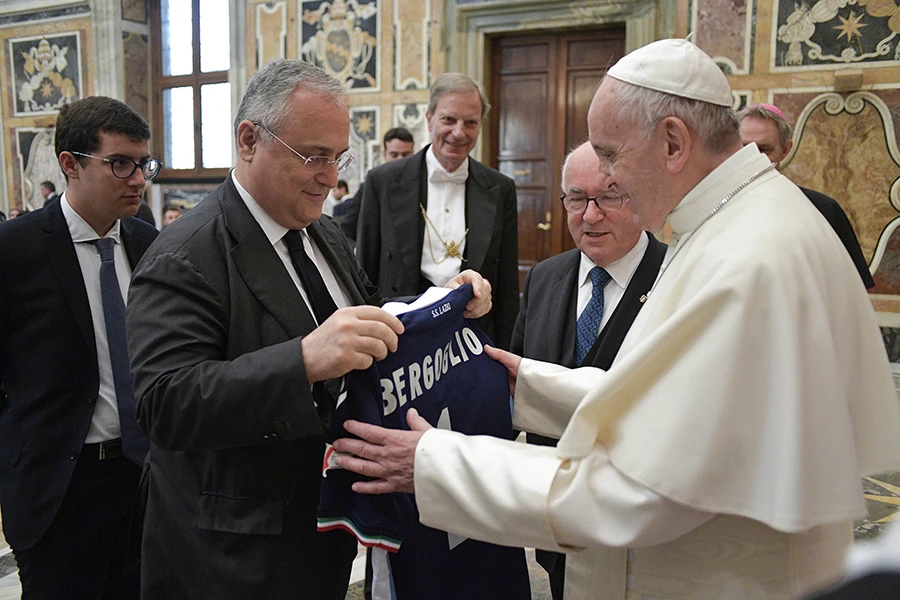
The two teams presented Pope Francis with honorary football jerseys during their audience, along with a replica of the tournament’s trophy, the Coppa Italia. The Holy Father also wished both sides a good game.

“I thank you for your visit with all of my heart,” Pope Francis stated, “and I hope you play out a great match.”

[…]