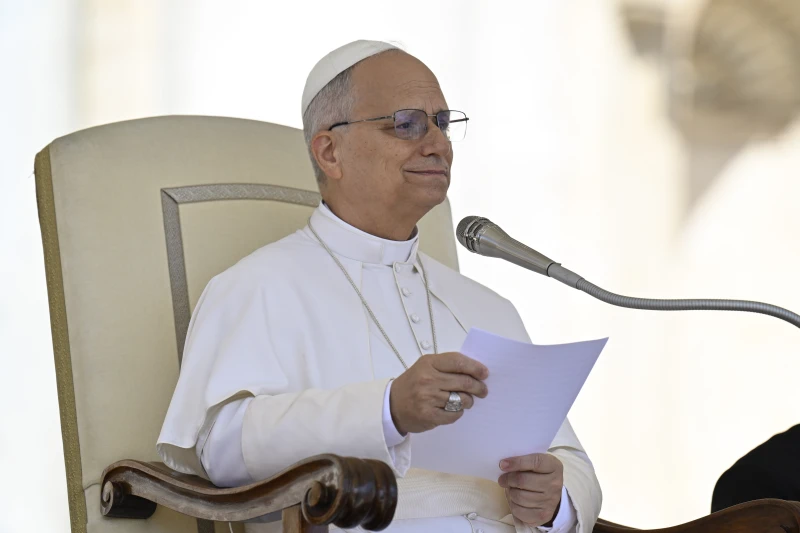
Pope Leo XIV appealed for help for Sudan during his Wednesday general audience in St. Peter’s Square on Sept. 3, 2025. / Credit: Vatican Media.
Vatican City, Sep 3, 2025 / 08:00 am (CNA).
Pope Leo XIV on Wednesday pleaded for international assistance for the North African country of Sudan, which is experiencing violence, famine, natural disasters, and disease.
“I am closer than ever to the Sudanese population, in particular families, children and the displaced,” Leo said at the end of his general audience at the Vatican Sept. 3.
“I pray for all the victims,” the pontiff added. “I make a heartfelt appeal to leaders and to the international community to guarantee humanitarian corridors and implement a coordinated response to stop this humanitarian catastrophe.”
The dramatic situation in Sudan, marked by months of armed clashes, mass displacement, and the threat of cholera, has prompted multiple warnings from humanitarian organizations.
In his appeal, Leo drew attention to the civilians trapped in the city of El Fasher, where they are experiencing famine and violence, and to a deadly landslide in Tarsin, which it is believed killed up to 1,000 people, with others still missing.
“And, as if that were not enough,” the pontiff added, “the spread of cholera is threatening hundreds of thousands of already stricken people.”
“It is time to initiate a serious, sincere and inclusive dialogue between the parties to end the conflict and restore hope, dignity and peace to the people of Sudan,” Leo urged.
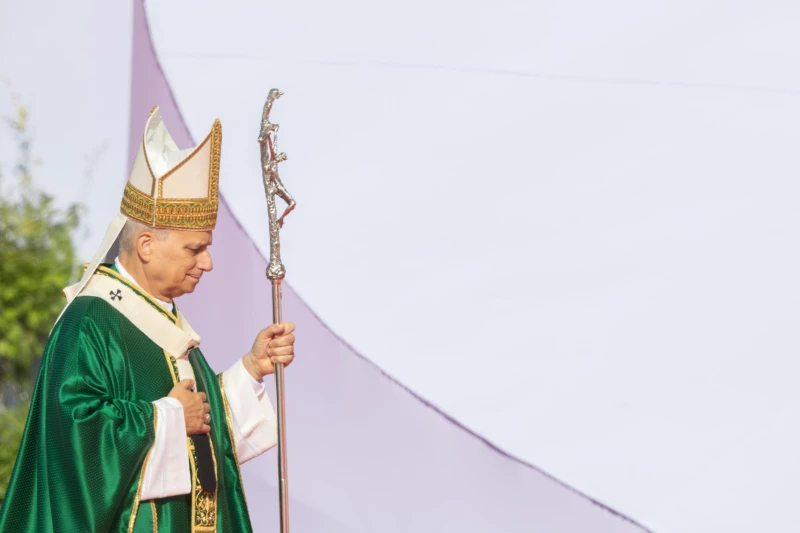
Pope Leo XIV rides in the popemobile before his Wednesday general audience in St. Peter’s Square on Sept. 3, 2025. Credit: Vatican Media.
After three weeks indoors, the pope’s public audience returned to St. Peter’s Square on Wednesday following a dip in Rome’s soaring August temperatures.
‘No-one can save themselves’
In his spiritual message at the audience, Leo reflected on Jesus’ final moments on the cross as narrated in the Gospel of John, where the crucified Christ utters the phrase: “I thirst.”
The pope said the thirst of the Crucified One is not only the physiological need of a tortured body, but above all, the expression of a profound desire for love, relationship, and communion.
His cry, Leo XIV asserted, is that of a God “who is not ashamed to beg for a sip, because in that gesture he tells us that love, in order to be true, must also learn to ask and not only to give.”
The pontiff then stated that “Jesus does not save with a dramatic twist, but by asking for something that he cannot give himself.”
This, according to the Holy Father, opens a door to true hope: “If even the Son of God chose not to be self-sufficient, then our thirst too — for love, for meaning, for justice — is a sign not of failure, but of truth.”
“Jesus’ thirst on the cross is therefore ours too,” he added. “It is the cry of a wounded humanity that seeks living water. And this thirst does not lead us away from God, but rather unites us with him. If we have the courage to acknowledge it, we can discover that even our fragility is a bridge towards heaven.”
Thus, the pope said, on the cross, Jesus teaches us that human beings are not realized “in power, but in trustful openness to others, even when they are hostile and enemies.”
It is precisely through the acceptance of fragility that we achieve salvation, he emphasized, which “is not found in autonomy, but in humbly recognizing one’s own need and in being able to express it freely.”
“None of us can be self-sufficient. No-one can save themselves. Life is ‘fulfilled’ not when we are strong, but when we learn how to receive,” Leo said.
A difficult truth
“We live in a time that rewards self-sufficiency, efficiency, performance,” he said. “And yet the Gospel shows us that the measure of our humanity is not given by what we can achieve, but by our ability to let ourselves be loved and, when necessary, even helped.”
Leo XIV invited the faithful to rediscover the simple joy that is born of fraternity and free gift of self. He emphasized that in everyday gestures, such as “asking without shame” and “offering without ulterior motives,” lies a profound happiness, distinct from that which the world proposes.
“It is a joy that restores us to the original truth of our being: we are creatures made to give and receive love,” the pontiff affirmed.
He encouraged those listening to not be afraid or ashamed to reach out, even when they feel undeserving. “It is right there, in that humble gesture, that salvation hides,” he concluded.
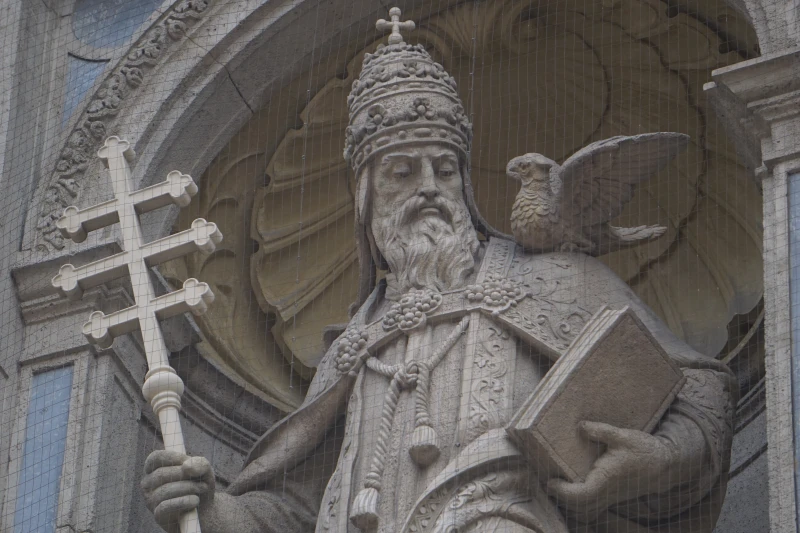
A statue of Pope Gregory I, also known as Saint Gregory the Great, with his famous Catholic iconography of a dove sitting on his shoulder, sits outside of St. Stephen’s Basilica in Budapest, Monday, Dec. 30, 2024 / Credit: Alexander Ruszczynski/Shutterstock
CNA Staff, Sep 3, 2025 / 07:15 am (CNA).
St. Gregory the Great, a central figure of the medieval western Church and one of the most admired popes in history, is commemorated in the Ordinary Form of the Roman Catholic liturgy. He was the first of the bishops of Rome to popularize the now-traditional papal title “servant of the servants of God,” which referred to Christ’s command that those in the highest position of leadership should be “the last of all and the servant of all.”
Born near the middle of the sixth century into a noble Roman family, the future St. Gregory the Great received a classical education in liberal arts and the law. He also had strong religious formation from his devout family, particularly from his mother, Silvia, also a canonized saint.
By around age 30, Gregory had advanced to high political office in Rome, during what was nevertheless a period of marked decline for the city.
Some time after becoming the prefect of the former imperial capital, Gregory chose to leave the civil administration to become a monk during the rise of the Benedictine order. In reality, however, the new monk’s great career in public life was yet to come.
After three years of strict monastic life, he was called personally by the pope to assume the office of a deacon in Rome. From Rome, he was dispatched to Constantinople, to seek aid from the emperor for Rome’s civic troubles, and to aid in resolving the Eastern church’s theological controversies. He returned to Rome in 586, after six years of service as the papal representative to the eastern Church and empire.
Rome faced a series of disasters caused by flooding in 589, followed by the death of Pope Pelagius II the next year. Gregory, then serving as abbot in a monastery, reluctantly accepted his election to replace him as the Bishop of Rome.
Despite this initial reluctance, however, Pope Gregory began working tirelessly to reform and solidify the Roman liturgy, the disciplines of the Church, the military and economic security of Rome, and the Church’s spreading influence in western Europe.
As pope, Gregory brought his political experience in Rome and Constantinople to bear, in the task of preventing the Catholic Church from becoming subservient to any of the various groups struggling for control of the former imperial capital. As the former abbot of a monastery, he strongly supported the Benedictine movement as a bedrock of the western Church. He sent missionaries to England, and is given much of the credit for the nation’s conversion.
Even as he undertook to consolidate papal power and shore up the crumbling Roman west, St. Gregory the Great maintained a humble sense of his mission as a servant and pastor of souls, from the time of his election until his death in 604.
This article was first published on Aug. 19, 2010, and has been updated.
Father James Martin, SJ. / Credit: Flickr by Shawn (CC BY-NC 2.0)
Vatican City, Sep 1, 2025 / 06:00 am (CNA).
Pope Leo XIV met in a private audience with Father James Martin, S.J., at the Vatican on Monday.Martin, who is in Rome to lead a Jubil… […]
Pope Leo XIV is shown here at the Holy Mass for the opening of the general chapter of the Order of Saint Augustine on Sept. 1, 2025 . / Credit: Vatican Media
Vatican City, Sep 1, 2025 / 14:38 pm (CNA).
Pope Leo XIV celebrated the Holy Mass for … […]
Pope Leo XIV celebrated Mass for more than 1 million young pilgrims at the University of Rome Tor Vergata, in Rome’s outskirts, on Aug. 3, 2025. / Credit: Daniel Ibanez/CNA
Vatican City, Sep 1, 2025 / 11:05 am (CNA).
Pope Leo XIV expressed his condolences for the more than 800 dead left by the earthquake that struck eastern Afghanistan on Sunday night, with a magnitude of 6 on the Richter scale, also causing widespread destruction.
According to local authorities, more than 800 people died and 1,500 were injured, especially in the districts of Nurgal, Sawkay, Watapur, Dara Pech, and Chapi Dara.
“Deeply saddened by the significant loss of life caused by the earthquake in eastern Afghanistan, His Holiness Pope Leo XIV offers fervent prayers for the souls of the deceased, the wounded, and those still missing,” reads the telegram sent on behalf of the Pontiff.
The telegram, signed by the Secretary of State, Cardinal Pietro Parolin, states that the Pontiff entrusts “all affected by this disaster to the providence of the Almighty.”
The Pope also expresses “his heartfelt solidarity in particular with those who mourn the loss of loved ones and with the emergency personnel and civil authorities involved in rescue and recovery efforts.”
The main quake, recorded around midnight, was followed by two magnitude 5.2 aftershocks. The U.S. Geological Survey reported that the epicenter was located 27 kilometers east of Nangarhar province, at a depth of eight kilometers, which normally amplifies the destructive power.
Mud and stone houses facilitated the collapse
According to the Afghan news agency Khaama Press, the earthquake destroyed several entire villages because the epicenter was close to the surface and many homes were built with stone and mud.
For now, rescue teams continue working to locate survivors among the rubble, although they say operations are being hampered by landslides that have blocked key roads.
Deputy Information Minister and Taliban spokesman Zabihullah Mujahid wrote on his social media account X that “local officials and residents are involved in the rescue efforts, and all available resources will be used to save lives.”
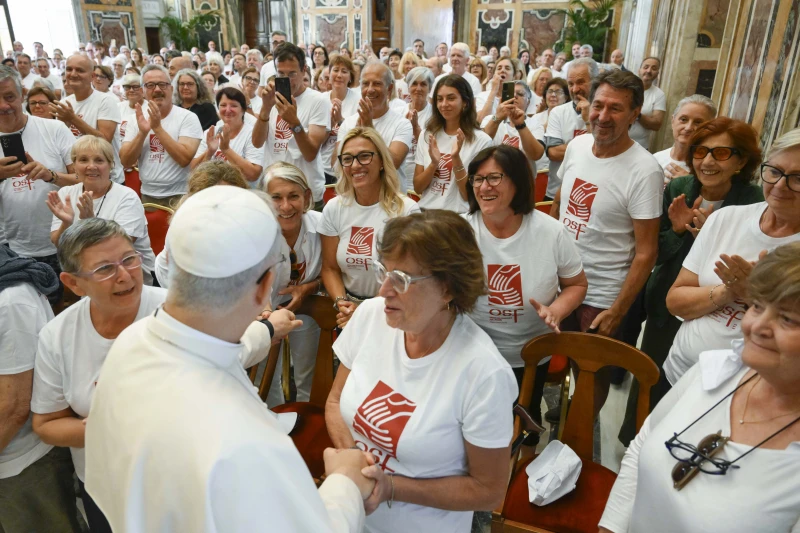
Members of St. Francis’ Work for the Poor, wearing t-shirts with the phrase “a helping hand to man every day,” with the Holy Father in the Vatican’s Clementine Hall. / Credit: Vatican Media
Vatican City, Sep 1, 2025 / 09:47 am (CNA).
Pope Leo XIV on Monday welcomed members of the Opera San Francesco per i Poveri (“St. Francis’ Work for the Poor”) to the Vatican, thanking the society for their witness of charity according to the Franciscan tradition.
“When you see a poor person,” the Holy Father said, recalling the words of St. Francis of Assisi, “you are placed before the mirror of the Lord and his poor Mother.”
“Likewise, in the sick, know how to see the infirmities with which Jesus took on himself,” he added.
Each year, the Opera San Francesco per i Poveri provides a wide variety of services to more than 30,000 people. Their charitable works include managing cafeterias and health clinics, as well as providing job counseling and psychological support for those in need.
Thanking the society for nearly 70 years of service, Pope Leo highlighted the spirit of fraternity and faithfulness that continues to guide its members since its foundation.
“Your institution has been committed to ‘ensuring assistance and hospitality to people in need and […] promoting the comprehensive human development of the person in accordance with Christian tradition, especially Franciscan tradition, the doctrine of the Church and its Magisterium,” Leo said, quoting the society’s statutes.
Several men and women, wearing white shirts with the society’s logo and the phrase “a helping hand to man every day,” had the opportunity to individually greet the Holy Father in the Vatican’s Clementine Hall following his short address.
Describing the Milan-based society’s founder Venerable Fra Cecilio Maria Cortinovis as a “humble doorman” with a generous heart, Pope Leo said the Lord answered his prayers by placing other generous people alongside him in order to better serve the poor.
“Thus began the beautiful adventure of which all of you are witnesses and protagonists today,” he said.
To celebrate the “story of charity” born from the faith of Cortinovis, Pope Leo told the Franciscan society to be faithful to the three “fundamental aspects of charity” outlined in their statues: to assist, to welcome, and to promote.
“Assisting means being present for the needs of others,” he said. “And in this regard, the quantity and variety of services you’ve managed to organize and offer to those who turn to you over the years is impressive.”
“This is accompanied by welcoming, that is, making room for others in our hearts and lives, offering time, listening, support, and prayer,” he added.
Emphasizing the teaching of Pope John Paul II on the dignity and creativity of each person, Pope Leo advised his listeners to help others to discover God and their own vocation in life.
“And so we come to the third point: promoting,” he said. “Here, the selflessness of giving and respect for the dignity of people come into play, so that we care for those we encounter simply for their good, so that they can grow to their full potential and proceed on their own path, without expecting anything in return and without imposing conditions.”
The Holy Father imparted his blessing at the end of the private Monday audience and assured them of his prayerful accompaniment.
“Thank you for what you do and for the witness you give by your journey together!”
Carlo Acutis Catholic High School in Blantyre, Malawi, opened in 2022 with just 90 students and has since grown to accommodate 300, with boarding facilities for girls and a dedicated computer lab. / Credit: Photo courtesy of Carlo Acutis Catholi… […]